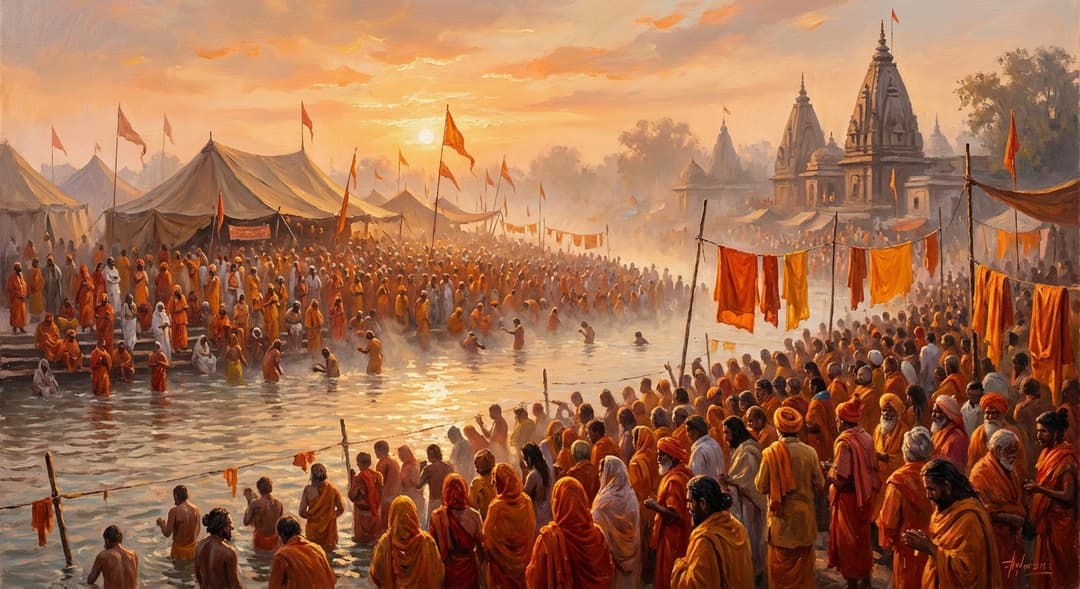
The Kumbh Mela is not just a festival; it is a spiritual phenomenon. Recognized as the largest peaceful gathering of pilgrims in the world, it is held every 12 years in rotation at four sacred sites: Haridwar, Prayagraj (Allahabad), Ujjain, and Nashik.
According to Hindu mythology, the origin of the Kumbh Mela dates back to the Samudra Manthan, or the churning of the ocean of milk by gods (devas) and demons (asuras) to obtain the nectar of immortality (amrita). During a struggle for the pot (kumbh) containing the nectar, four drops fell to earth at these four precise locations.
The central ritual of the Kumbh Mela is the sacred bath, or Shahi Snan. Millions of devotees believe that bathing in the sacred rivers at these auspicious times cleanses them of all sins and liberates them from the cycle of rebirth (moksha).
During the festival, a temporary city rises on the riverbanks, complete with roads, bridges, and tents housing millions of pilgrims, ascetics, and tourists. The atmosphere is electric with chanting, bells, and the smoke of sacred fires, creating a mesmerizing tapestry of faith and devotion.
Key Details
- Frequency Every 12 years at each site (Ardh Kumbh every 6 years)
- Sacred Sites Haridwar, Prayagraj, Ujjain, Nashik
- Origin Samudra Manthan (Churning of the Ocean of Milk)
- 2019 Attendance Estimated 240 million visitors over 49 days
- UNESCO Status Inscribed on the Representative List of Intangible Cultural Heritage (2017)
- Central Ritual Shahi Snan (Royal Bath) in sacred rivers
Timeline
The Churning of the Ocean
According to Hindu mythology, gods and demons churned the cosmic ocean to obtain the nectar of immortality. Four drops fell at Haridwar, Prayagraj, Ujjain, and Nashik.
MilestoneEarliest Historical References
Chinese traveler Xuanzang records a massive religious gathering at Prayag during the reign of Emperor Harsha, believed to be an early form of the Kumbh Mela.
EventAdi Shankaracharya's Influence
The philosopher Adi Shankaracharya is credited with organizing the tradition of gathering ascetics at the Kumbh, strengthening its role as a unifying event in Hinduism.
EventUNESCO Recognition
The Kumbh Mela is inscribed on UNESCO's Representative List of the Intangible Cultural Heritage of Humanity.
MilestoneLargest Gathering in History
The Kumbh Mela at Prayagraj attracts an estimated 240 million visitors over 49 days, making it the largest human gathering ever recorded.
MilestoneSources & Research
Every fact on Temples.org is backed by verified Sources & Research. Each piece of information is rated by source tier and confidence level.
View All Sources (2)
| Field | Source | Tier | Retrieved |
|---|---|---|---|
| UNESCO Intangible Heritage | UNESCO (opens in a new tab) | A | 2026-02-19 |
| Historical Significance | Encyclopaedia Britannica (opens in a new tab) | B | 2026-02-19 |