Visitor Insights
Visiting Tiwanaku
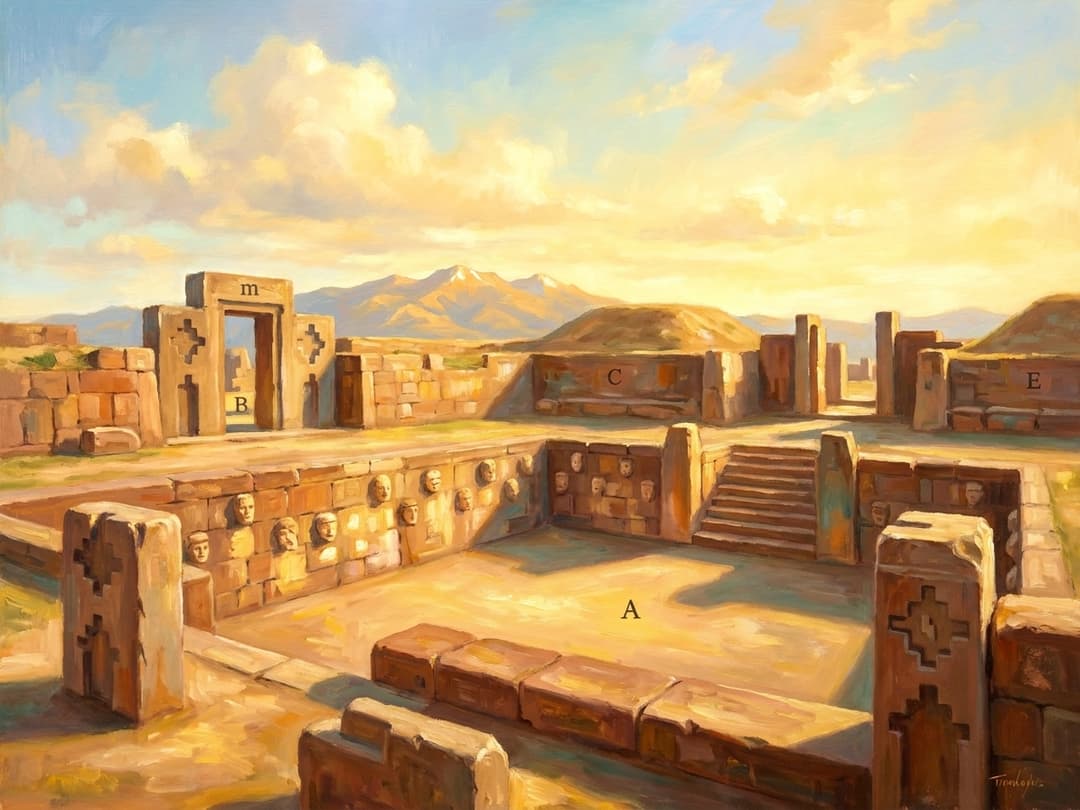
Perched on the windswept Altiplano, Tiwanaku offers a profound encounter with pre-Columbian engineering and sacred landscape design. Visitors explore massive platform enclosures, monolithic portals, and sunken courtyards set against distant Andean peaks. The on-site museums preserve exceptional lithic monuments and delicate ceremonial ceramics.
Highlights
- The iconic Gate of the Sun with its intricate Staff Deity relief carving
- The Semi-Subterranean Sunken Temple ringed by 175 carved stone tenon heads
- Colossal precision-cut andesite blocks and I-shaped bronze cramp sockets at Pumapunku
- The towering red sandstone Bennett Monolith housed in the Lithic Museum
Things to Know
- At nearly 3,900 meters elevation, visitors should acclimatize in La Paz before touring
- High-altitude UV exposure and brisk winds require sunblock, warm layers, and sturdy footwear
- Visitors must remain strictly on designated stone pathways and refrain from touching ancient masonry
Location
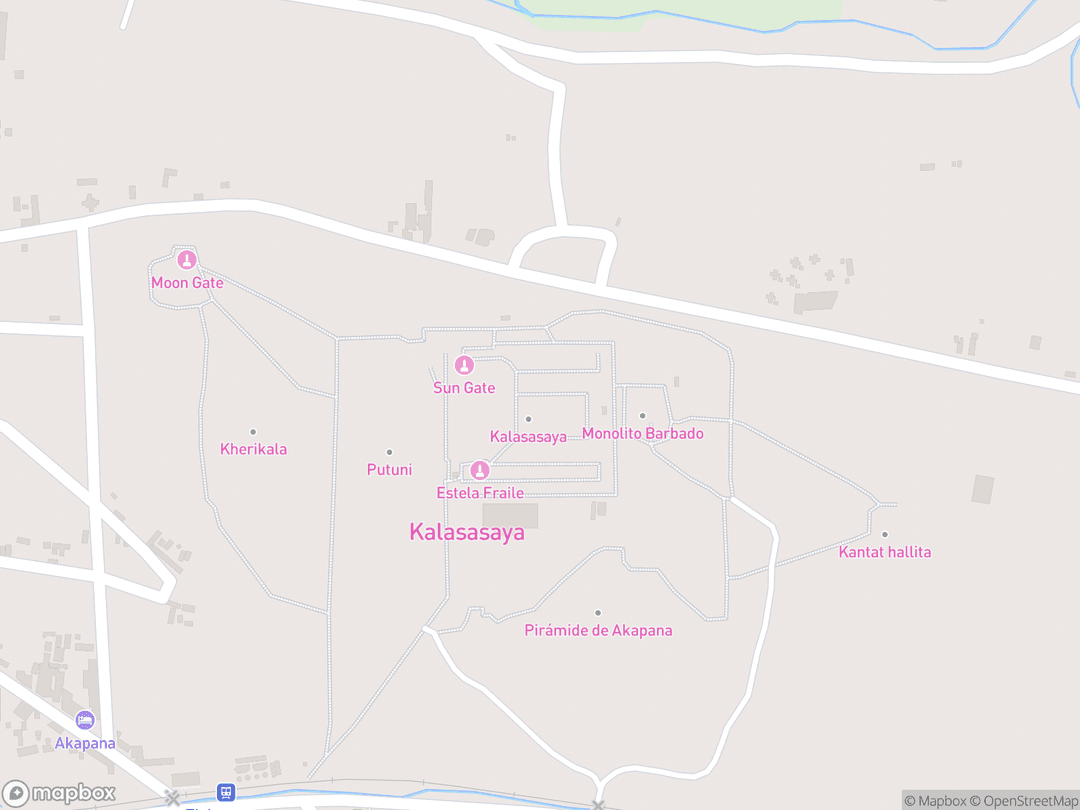
Tiwanaku Municipality, Ingavi Province, Department of La Paz, Bolivia
Hours: Monday through Sunday, 08:30 to 16:30
Getting There: Located approximately 70 kilometers west of La Paz via paved highway; accessible by organized tours or public minibuses departing from near Cementerio General.
Get DirectionsTips for Your Visit
Pacing at High Altitude
Walk deliberately and drink plenty of water or coca tea to mitigate the thin mountain air.
Museum Visits First
Tour the Lithic and Ceramic museums before entering the ruins to contextualize the carvings.
Morning Light
Arrive early to capture dramatic low-angle sunlight across the Kalasasaya pillars and eastern facade.
About
Tiwanaku was the ceremonial capital and cosmological epicenter of a powerful pre-Inca civilization that dominated the southern Lake Titicaca basin for centuries. Flourishing between 500 and 950 CE, its monumental core orchestrated spiritual and civic life across the high Andean plateau.
Conceived as Taypiqala, or the 'Stone in the Center,' the sanctuary bridged three cosmic planes through monumental architecture. Its terraced pyramids, sunken courts, and carved monoliths aligned with celestial bodies and surrounding sacred mountain peaks.
The site is celebrated for its extraordinary stone masonry, where massive sandstone and andesite blocks were fitted with microscopic accuracy. Long after its abandonment following severe megadroughts, Tiwanaku remained a revered cradle of creation for the Inca and indigenous peoples.
Gallery
Symbolic Elements
The temple's exterior features intricate carvings, each rich with spiritual meaning:

The Staff Deity
The supreme cosmic regulator commanding atmospheric forces, rain, and solar cycles from the center of the Gate of the Sun.

Radiant Solar Corona
A dynamic facial halo composed of stepped appendages terminating in puma and condor heads that tracks solar cycles.

Winged Attendants
Kneeling and running celestial messengers flanking the central divinity across three horizontal carved registers.

Chakana Stepped Cross
A geometric Andean symbol reflecting the harmony between the celestial, terrestrial, and subterranean worlds.

The Mallku Condor
The majestic raptor representing the celestial upper world, spiritual transcendence, and state authority.

The Sacred Puma
The apex feline predator symbolizing earthly physical power, sovereignty, and terrestrial vitality.
Carved Tenon Heads
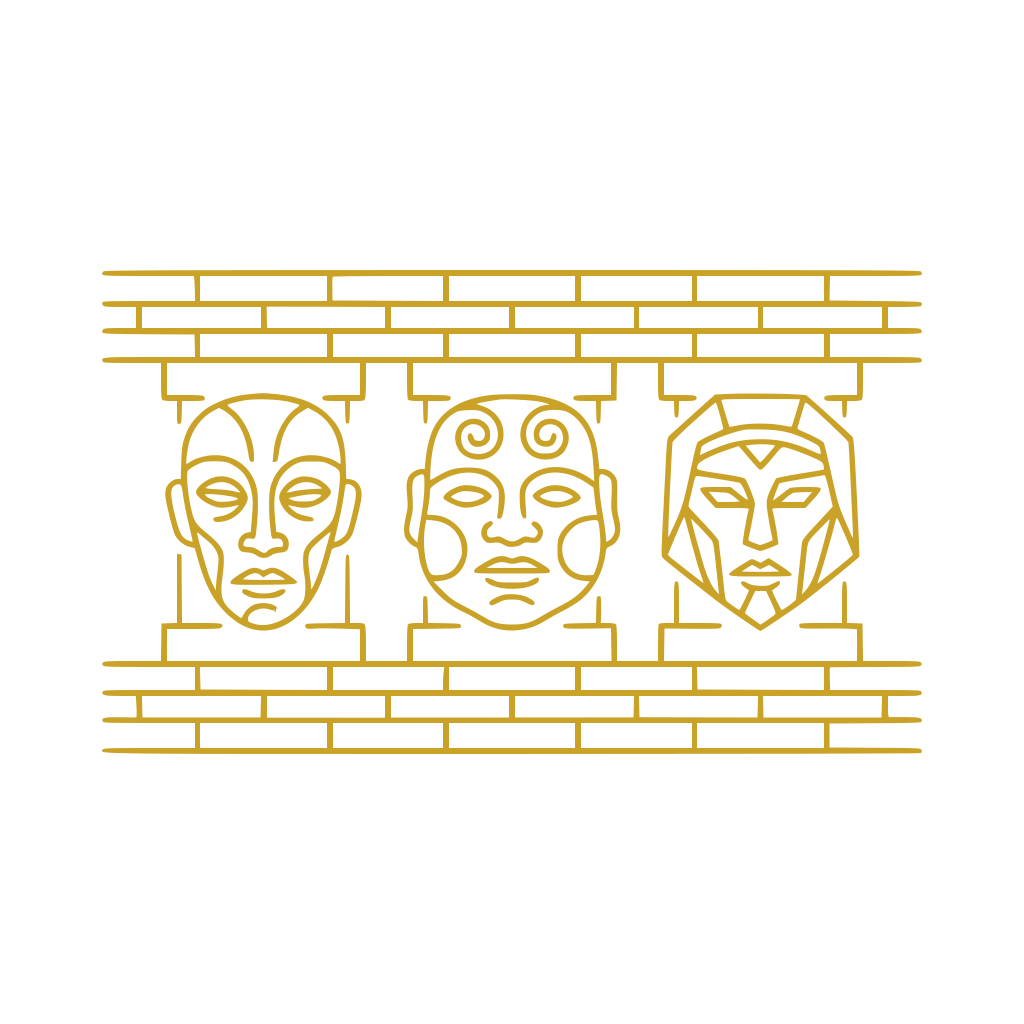
Diverse sculpted stone faces socketed into sunken courtyard walls, representing ancestral spirits and varied ethnic groups.

Tears of Rain
Weeping grooves carved beneath divine eyes that symbolize the vital release of rainfall for agricultural life.
Interesting Facts
Engineers stabilized colossal masonry blocks by pouring molten copper-arsenic bronze into I-shaped cramp channels (Tier B).
The Bennett Monolith spent nearly seventy years in a downtown La Paz traffic plaza before returning to a museum at the site (Tier B).
The Gate of the Sun was originally broken and moved in antiquity, likely relocated from Pumapunku to the Kalasasaya (Tier B).
Extensive raised agricultural canals absorbed solar heat by day and radiated warmth during freezing nights to protect highland crops (Tier B).
Without written language, masons used standardized proportional units and carved miniature stone models as 3D architectural plans (Tier B).
The colonial Catholic church in modern Tiwanaku village was constructed using carved andesite stones scavenged from the ancient temples (Tier B).
Glacial ice-core records demonstrate that an intense multi-decade drought crippled the city's food supply around 1000 CE (Tier B).
Several polished volcanic andesite slabs ring like resonant bells when struck lightly with wooden instruments (Tier C).
Inca mythology asserted that the creator god Viracocha fashioned the sun, moon, and ancestral humanity at Tiwanaku (Tier B).
Common Questions
How old is the Tiwanaku archaeological site?
Village life began around 1500 BCE, but monumental stone temples flourished between 100 BCE and 950 CE.
Why did the Tiwanaku civilization collapse?
A severe prolonged megadrought lowered regional water levels and ruined the canal-based raised-field agricultural system.
How large was the ancient city at its height?
The urban agglomeration covered up to six square kilometers and supported an estimated population of 20,000 to 40,000 people.
What is the Gate of the Sun?
It is a monolithic portal carved from a single volcanic andesite block featuring a central relief of the Staff Deity.
Featured Stories
The Cosmic Alignment of the Solstice Portal
June 21
Every June during the winter solstice, thousands of indigenous worshippers and travelers assemble before dawn in the Kalasasaya courtyard. As the sun crests the eastern horizon, golden light floods directly through the temple's central stone gateway. This celebrated event honors Willkakuti, the Aymara New Year, renewing ancient Andean bonds with solar cycles.
Source: Ministerio de Culturas de Bolivia
The Return of the Colossus
March 2002
In 1932, American archaeologist Wendell Bennett unearthed a towering 20-ton red sandstone monolith from the Sunken Temple. Transported to a busy traffic circle in La Paz, the sacred statue endured decades of vehicular exhaust and weathering. After seventy years, an impassioned cultural campaign repatriated the stela to a modern climate-controlled hall in Tiwanaku.
Source: Lithic Museum of Tiwanaku
The Mystery of the Sunken Assembly
100 BCE
Deep within the Semi-Subterranean Temple, ancient masons socketed 175 distinct stone heads into sandstone revetments. Unlike identical religious iconography, each face displays individual ethnic features, head wraps, or physical traits. Archaeologists believe the courtyard served as an ancestral congress, honoring allied clans and incorporating regional deities into the civic pantheon.
Source: Center for Archaeological Research at Tiwanaku
Timeline
Formative Settlement
Sedentary farming hamlets emerge along the fertile lacustrine plains south of Lake Titicaca.
MilestoneMonumental Emergence
Construction begins on the Semi-Subterranean Temple and early platforms of the Kalasasaya.
EventAgricultural Expansion
Development of extensive raised-field canal systems creates large surpluses that fuel urban growth.
EventImperial Florescence
State-directed building elevates the Akapana pyramid into an effigy of a sacred mountain.
MilestonePumapunku Construction
Architects begin crafting precision-dressed andesite slabs and megalithic terraces at Pumapunku.
EventIconic Carving Era
The Gate of the Sun is sculpted from a single volcanic andesite monolith to codify state iconography.
MilestoneAltiplano Megadrought
Prolonged arid cycles lower Lake Titicaca and destabilize the canal-fed agricultural infrastructure.
EventDesecration and Departure
Monuments are ritually burned or dismantled as central civic authority dissolves.
EventInca Pilgrimage Site
Inca rulers incorporate Tiwanaku into their imperial creation myths as the birthplace of the sun.
MilestoneFirst European Description
Spanish chronicler Pedro Cieza de León records detailed impressions of the monumental ruins.
EventBennett Monolith Excavation
Archaeologist Wendell Bennett discovers the colossal 7.3-meter carved sandstone stela.
MilestoneUNESCO Inscription
Tiwanaku is designated a World Heritage Site in recognition of its outstanding cultural significance.
MilestoneHistory by Decade
1500 BCE–100 BCE — Formative Hamlets
Early agro-pastoral communities established settlements along the lacustrine plains south of Lake Titicaca. Inhabitants herded alpacas and cultivated frost-hardy tubers while utilizing lacustrine reed and fish resources. Modest earthen mounds and early ceremonial platforms anticipated the complex religious centers to come.
100 BCE–500 CE — Monumental Urbanization
Tiwanaku expanded into a dominant regional sanctuary characterized by sunken courtyards and large stone stelae. Master builders perfected raised-field farming across the floodplain, generating agricultural abundance that supported thousands of artisans. Megalithic construction expanded rapidly as the city outpaced rival regional centers.
500 CE–800 CE — The Imperial Golden Age
State authorities orchestrated an unprecedented architectural renaissance, erecting the seven-tiered Akapana pyramid and the megalithic Pumapunku complex. Precision andesite carving flourished alongside bronze clamp joinery and astronomical alignments. Tiwanaku religious influence expanded across western Bolivia, southern Peru, and northern Chile.
800 CE–1000 CE — Urban Apogee and Stress
Dense multi-ethnic residential neighborhoods surrounded the ceremonial precinct, welcoming pilgrims bearing exotic offerings from across the Andes. However, persistent climate shifts began reducing precipitation and lowering regional lake levels. Strains on the canal-fed agricultural infrastructure challenged the ruling elite's authority.
1000 CE–1150 CE — Megadrought and Dispersal
A catastrophic multi-decade megadrought dried the raised fields and collapsed the state's grain storage reserves. Public monuments were ritually decommissioned, elite residential compounds were burned, and the population dispersed into fortified hilltop redoubts. The monumental core ceased functioning as a living metropolis.
1450–Present — Sacred Memory and Science
Inca sovereigns revered the deserted ruins as the cosmological birthplace of humanity and modeled their stonework after its megaliths. Following centuries of colonial stone removal for churches and railways, modern scientific excavations began in the late nineteenth century. International conservation and 3D imaging now safeguard the sanctuary for global heritage.
Architecture & Facilities
Tiwanaku Imperial Megalithic architecture is defined by monumental stepped platform pyramids, sunken courtyards, precision-dressed red sandstone and volcanic andesite ashlar masonry, and sophisticated subterranean hydraulic networks designed to mirror sacred mountain topographies.
Building Materials
Red Sandstone
Quarried ten kilometers south from the Kimsachata range for colossal foundation terraces, pillars, and carved stelae.
Volcanic Gray Andesite
Transported from across Lake Titicaca for fine sculptural reliefs, resonant lintels, and intricate architectural gates.
Ternary Bronze Cramps
Cast in situ using copper, arsenic, and nickel to bind adjoining megalithic blocks against seismic shifts.
Limestone and Tuff
Carved into detailed ancestral tenon heads and decorative structural accents across subterranean courtyard revetments.
Interior Features
Akapana Summit Court
An elevated sunken courtyard that collected rain to feed an internal cascading stone hydraulic drainage network.
Kalasasaya Platform Court
A vast elevated rectangular esplanade featuring astronomical alignments, standing pillars, and prominent monolithic stelae.
Templete Semisubterráneo
An open-air sunken rectangular court excavated into the earth, ringed by walls socketed with 175 ancestral stone heads.
Pumapunku Terrace
A monumental T-shaped platform renowned for prefabricated modular andesite H-blocks and massive floor slabs.
Temple Grounds
The ceremonial precinct spans sixteen hectares surrounded by ancient canal traces, ritual access stairways, and extensive unexcavated urban residential compounds.
Additional Facilities
The complex features modern visitor reception facilities, bilingual interpretive walkways, an on-site lithic sculpture museum, and a ceramic artifact gallery.
Religious Significance
Tiwanaku embodied the cosmological fulcrum of the Andean universe, orchestrating sacred balance between atmospheric sky deities, living human society, and subterranean ancestors.
To serve as Taypiqala—the central cosmic axis mediating water, solar fertility, and ancestral power through monumental stone ritual.
Sacred Ordinances
Willkakuti Solstice Greeting
Ritual gathering at sunrise during the winter solstice to welcome solar energy through the monumental temple portal.
Chicha Libation Rites
Ceremonial pouring of maize beer from decorated kero vessels into stone channels to nourish the earth mother.
Ancestral Veneration
Presenting ritual offerings before carved monolithic stelae representing lineage forebears and divine protectors.
The Tripartite Andean Cosmos
Sacred architecture mirrored the three cosmic planes: the Akapana represented the celestial realm (Hanan Pacha), the Kalasasaya represented earthly humanity (Kay Pacha), and the Sunken Temple reached into the subterranean world of the ancestors (Uku Pacha).
The Staff Deity Cult
Central to Tiwanaku theology was the Staff Deity, an all-powerful front-facing figure wielding thunderbolts and scepters, regulating seasonal rains and agricultural abundance for the high plateau.
Sources & Research
Every fact on Temples.org is backed by verified Sources & Research. Each piece of information is rated by source tier and confidence level.
View All Sources (10)
| Field | Source | Tier | Retrieved |
|---|---|---|---|
| UNESCO World Heritage Inscription & Assessment | UNESCO World Heritage Centre (opens in a new tab) | B | 2026-02-18 |
| About & Historical Background | Wikidata Entity Data (opens in a new tab) | B | 2026-02-18 |
| Architecture & Lithic Technology | Cambridge University Press (opens in a new tab) | B | 2026-02-18 |
| Monumental Chronology & Bayesian Dating | Cambridge University Press (opens in a new tab) | B | 2026-02-18 |
| Archaeological Surveys & Pumapunku Masonry | ResearchGate Scientific Repository (opens in a new tab) | B | 2026-02-18 |
| Highland Hydraulic Engineering & Agriculture | University of California San Diego Archaeological Research (opens in a new tab) | B | 2026-02-18 |
| Iconography & Andean Cosmology | Red de Revistas Científicas de América Latina (opens in a new tab) | B | 2026-02-18 |
| Megalithic Stone Transport & Quarrying | Popular Archaeology (opens in a new tab) | C | 2026-02-18 |
| Visitor Insights & Cultural Management | Ancient Origins Archaeological Archive (opens in a new tab) | C | 2026-02-18 |
| Document Archive & Historical Chronicle | Scribd Archival Documents (opens in a new tab) | C | 2026-02-18 |