Visitor Insights
Visiting Bayon Temple
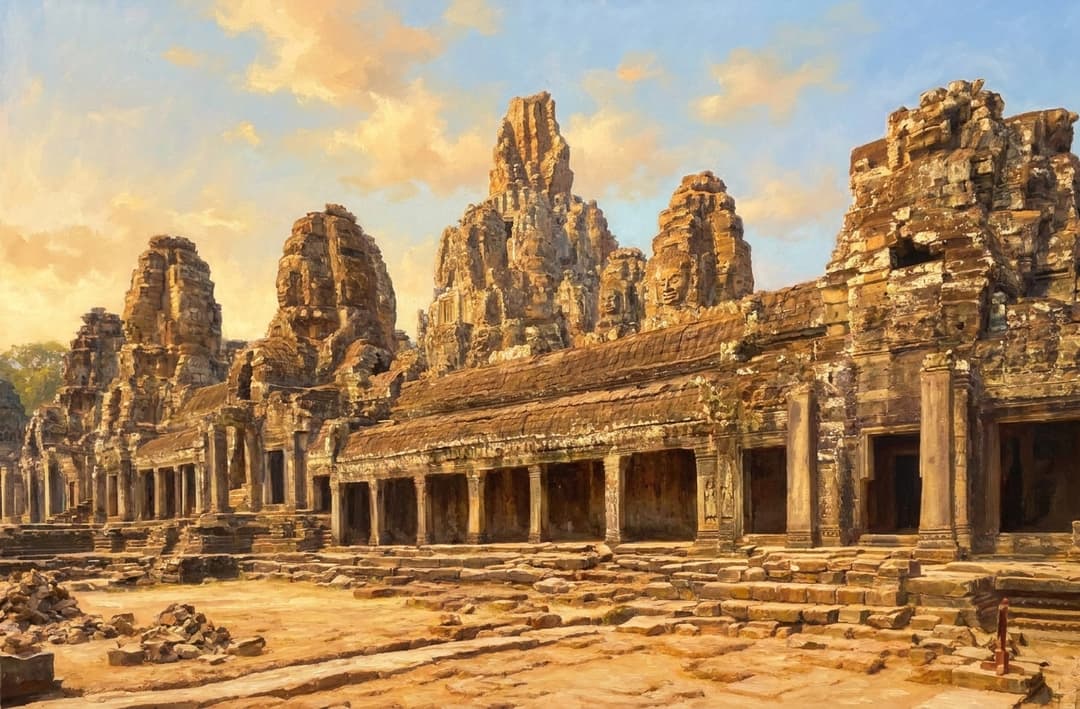
Visiting Bayon offers an unforgettable encounter with towering stone faces in a labyrinth of multi-tiered galleries. The play of early morning or late afternoon light reveals delicate bas-reliefs without the intense tropical midday heat.
Highlights
- Dozens of colossal stone faces gazing serenely in all cardinal directions
- Over 1.2 kilometers of historic bas-relief carvings depicting 12th-century Khmer life
- Active Theravada prayer alcoves where pilgrims light incense and offer marigolds
Things to Know
- Strict dress code requires shoulders and knees to be fully covered at all times
- Uneven stone thresholds, narrow corbelled passages, and steep steps require caution
- Angkor Pass must be purchased in advance before entering the archaeological park
Location
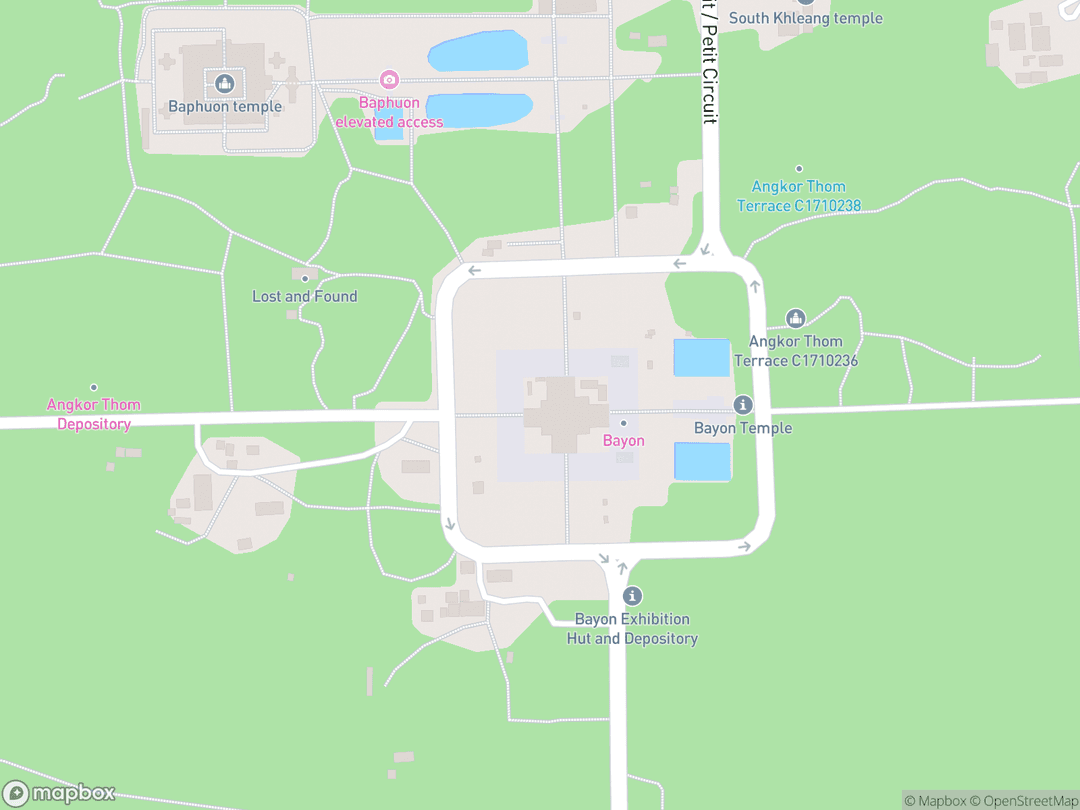
Angkor Thom, Angkor Archaeological Park, Siem Reap Province, Cambodia
Hours: Daily from 7:30 AM to 5:30 PM
Getting There: Located in the heart of Angkor Thom, easily reached by tuk-tuk, private car, or bicycle from Siem Reap.
Get DirectionsTips for Your Visit
Time Your Photography
Arrive at sunrise or late afternoon when low-angled sunlight accentuates the contours of the carved faces.
Examine the Outer Reliefs
Explore the southern outer gallery to witness vivid 12th-century scenes of markets, feasts, and naval battles.
Respect Active Sanctuaries
Maintain silence near local Theravada monks and worshippers offering prayers at internal altars.
About
Founded in the late 12th century by King Jayavarman VII, Bayon Temple stands at the geometric and spiritual center of the fortified royal city of Angkor Thom. Conceived as the official state temple of the Khmer Empire, it signaled a historic religious transition from royal Shaivism to Mahayana Buddhism following periods of intense regional conflict.
Grounded within the shared Dharmic cosmology of Mount Meru as the golden axis mundi, Bayon reimagined imperial authority through the Bodhisattva ideal of universal compassion. Its ascending stepped terraces symbolize the soul's spiritual journey through saṃsāra toward ultimate awakening, blending cosmic order with royal benevolence.
The monument is universally recognized for its towering sandstone spires sculpted with colossal faces bearing the tranquil 'Angkorian smile' of Lokeshvara. Having survived medieval iconoclastic reactions and centuries of jungle encroachment, Bayon continues to function today as an active Theravada Buddhist sanctuary and UNESCO World Heritage treasure.
Gallery
Symbolic Elements
The temple's exterior features intricate carvings, each rich with spiritual meaning:

Mount Meru Pyramid
The stepped stone terraces represent the sacred cosmic mountain at the center of Dharmic cosmology.

Four-Faced Towers
The colossal stone visages embody the four boundless Buddhist virtues of loving-kindness, compassion, joy, and equanimity.
Mucalinda Buddha
The serpent-sheltered Buddha recalls divine natural protection shielding the enlightened mind from worldly turmoil.
Naga Causeway Balustrades
Sculpted devas and asuras gripping the serpent body evoke the cosmic churning of the ocean of milk.
Sacred Lotus Cresting
Carved lotus blooms atop tower pinnacles symbolize spiritual purity rising stainless above mundane waters.
Celestial Apsaras
Hundreds of dancing celestial maidens carved along gallery pillars welcome pilgrims into the heavenly realm.
Corbelled Stone Vaults
Cantilevered stone ceiling blocks create narrow, shadowed corridors evoking ancient meditation caves.

Churned Ocean Waters
Moats and canal connections surrounding the sanctuary represent the primeval waters girding the cosmos.
Interesting Facts
Bayon stands at the exact mathematical center of Angkor Thom, placing the entire royal city under the symbolic gaze of the Bodhisattva. (Tier A)
Unlike most Angkorian monuments, its outer bas-reliefs depict common 12th-century life including markets, feasts, and cockfights. (Tier B)
The shattered 3.6-meter central Buddha statue was recovered from a 14-meter deep well shaft in 1933 and meticulously reconstructed. (Tier A)
The modern name Bayon is an early French phonetic corruption of Prasat Banyan, named for the sacred fig trees once growing on the ruins. (Tier B)
Archaeological excavations reveal the monument was extensively redesigned mid-construction, transforming an open pavilion into a dense vertical maze. (Tier B)
The massive sandstone blocks were dry-laid without any mortar, relying entirely on precision friction joints and gravity. (Tier A)
Approximately 200 serene facial portraits survive across the 37 towers that remain standing today. (Tier B)
Thousands of meditating Buddha carvings were chiseled away during a violent 13th-century Shivaite iconoclastic reaction. (Tier A)
Local Theravada Buddhist monks and regional pilgrims maintain continuous devotional offerings within the temple interior today. (Tier A)
Common Questions
Who built Bayon Temple?
King Jayavarman VII constructed Bayon in the late 12th century as his official Buddhist state temple.
Whose faces are carved on the towers?
The faces depict the Bodhisattva Lokeshvara, sculpted with the idealized features of King Jayavarman VII.
How many face-towers remain standing today?
There are currently 37 standing face-towers preserving approximately 200 distinct carved faces.
What is the dress code for visitors?
Visitors must keep their shoulders and knees fully covered in accordance with the Angkor code of conduct.
Is Bayon still an active religious site?
Yes, local Theravada Buddhist monks and pilgrims regularly maintain active devotional shrines within the corridors.
Featured Stories
The Royal Awakening of Jayavarman VII
1181
Following devastating Cham invasions that sacked the capital, King Jayavarman VII turned toward the Mahayana ideal of universal compassion to rebuild his empire. He conceptualized Bayon as the spiritual anchor of Angkor Thom, ruling as an earthly Bodhisattva dedicated to relieving the physical and spiritual suffering of his subjects. The temple stood as a monument of divine salvation forged from the ashes of warfare.
Source: APSARA National Authority Historical Archives
The Defacement of the Buddha
1243
During the 13th-century reign of King Jayavarman VIII, a fierce Shivaite reaction swept across the Khmer realm to reassert traditional Hindu dominance. Royal artisans methodically chiseled away thousands of seated Buddhas from Bayon's walls and cast the colossal central Mucalinda Buddha into a subterranean well. Despite this systematic purge, the sacred monument survived to be lovingly reoccupied by Theravada monastics.
Source: École française d'Extrême-Orient Records
Resurrecting the Sacred Center
1933
While excavating the debris-filled depths of the central sanctuary pit in 1933, French archaeologists unearthed the shattered sandstone fragments of the original Mucalinda Buddha. Master conservator Henri Marchal directed the painstaking reassembly of the 3.6-meter statue using anastylosis. The restored image was ceremonially consecrated at a nearby royal pavilion, restoring the spiritual heart of the temple.
Source: National Museum of Cambodia Conservator Reports
Timeline
Accession of Jayavarman VII
King Jayavarman VII ascends the Khmer throne and initiates plans for a fortified Buddhist capital at Angkor Thom.
MilestoneFoundations Laid
Engineers begin quarrying sandstone from Phnom Kulen and lay subterranean laterite foundations at the city center.
component.timeline.groundbreakingLower Sanctum Consecration
The primary ground-level chambers are consecrated to Mahayana guardian deities following victory over Champa.
DedicationTower Expansion
Architects alter original plans to raise the central circular terrace and erect dozens of monumental face-towers.
RenovationEnshrinement of Central Buddha
The monumental sandstone statue of Buddha seated upon Mucalinda is consecrated in the central sanctuary.
MilestonePassing of Jayavarman VII
King Jayavarman VII dies, concluding the most expansive stone building campaign in Khmer history.
MilestoneShivaite Iconoclasm
King Jayavarman VIII orders the defacement of Buddhist reliefs and topples the central Buddha statue.
EventTheravada Reoccupation
Theravada Buddhist monks reoccupy inner corridors as the realm adopts the Pali canon.
MilestoneRelocation of the Capital
Following Siamese incursions, the royal court moves south and tropical jungle slowly encroaches on the site.
EventArchaeological Clearance
Jean Commaille begins clearing suffocating tropical vegetation and cataloging fallen sandstone blocks.
RenovationCentral Buddha Recovered
Excavators unearth the shattered pieces of the central Mucalinda Buddha from the sanctuary well and reconstruct it.
MilestoneWorld Heritage Inscription
Bayon and the Angkor Archaeological Park are inscribed on the UNESCO World Heritage List.
MilestoneHistory by Decade
1180s — The Royal Inception
He suffered more from the maladies of his subjects than from his own, for it is the grief of the people that causes the grief of kings.
Following the destructive Cham occupation of the ancient capital, King Jayavarman VII ascended the Khmer throne determined to rebuild the empire. He planned Angkor Thom as an impregnable walled city centered upon a great Buddhist mountain-temple. Massive quantities of sandstone were quarried and transported via canals to begin construction.
1200s — The Forest of Faces
During the first decade of the 13th century, royal architects dramatically expanded Bayon's footprint, transforming it into a vertical forest of face-towers. The central sanctuary was raised upon a circular stone terrace to enshrine the colossal statue of Buddha sheltered by Mucalinda. Dozens of monumental towers were carved with the serene smile of Lokeshvara.
1240s — The Shivaite Purge
With the rise of King Jayavarman VIII, imperial religious policy swung sharply back toward orthodox Shaivism. Over thousands of carved Buddhist relief figures across Bayon's corridors were methodically defaced or modified into Hindu rishis. The monumental central Buddha was smashed and thrown down the temple's central well shaft.
1320s — The Theravada Transition
During the early 14th century, Theravada Buddhism became the primary spiritual tradition across the Khmer realm. Monks gently reoccupied Bayon's sheltered corridors, establishing simple shrines with seated Buddha images inside ancient stone niches. This established a living tradition of Theravada devotion that survives to this day.
1910s — Rediscovery and Clearance
After centuries of dense jungle growth destabilized the dry-laid masonry, the École française d'Extrême-Orient began systematic site clearance. Jean Commaille directed teams of workers to clear strangler figs and categorize the labyrinth of fallen sandstone. These efforts stabilized the monument and opened it to scientific conservation.
1930s — Anastylosis and Reconstruction
Under conservator Henri Marchal, teams applied anastylosis techniques to dismantle, reinforce, and rebuild leaning face-towers. In 1933, excavators cleared the 14-meter central sanctuary shaft, discovering the fragments of the original Mucalinda Buddha. The restored statue was re-consecrated at a nearby shrine south of the royal terrace.
1990s to Present — International Safeguarding
Inscribed on the UNESCO World Heritage List in 1992, Bayon became the focus of major international conservation partnerships. The Japanese Government Team for Safeguarding Angkor and the APSARA National Authority stabilized the complex hydrology beneath the stone foundations. Today, continuous laser scanning and structural monitoring protect the fragile face-towers.
Architecture & Facilities
The Bayon represents the ultimate achievement of late classical Khmer architecture, characterized by its dense verticality, stepped terraces, and enigmatic face-towers. Conceived as a stone microcosm of Mount Meru, the temple fuses Mahayana Buddhist iconography with monumental Dharmic cosmic geometry through intricate bas-reliefs and unmortared ashlar sandstone masonry.
Building Materials
Buff-Grey Sandstone
Fine-grained sandstone quarried at Phnom Kulen forms the visible ashlar masonry, bas-relief galleries, and carved face-towers.
Laterite Substructure
Dense, iron-rich porous laterite blocks provide the heavy subterranean structural foundation supporting the upper terraces.
Iron Dowel Connectors
Internal forged iron pins and mortise-and-tenon joints reinforce critical horizontal stone courses without mortar.
Lime Plaster Accents
Traces of ancient vegetal lime plaster and natural red pigments historically coated selected relief carvings.
Interior Features
Central Sanctuary (Garbhagriha)
A circular stone chamber that originally housed the colossal 3.6-meter statue of Buddha seated upon the serpent Mucalinda.
Inner Mythological Gallery
A labyrinthine corridor lined with bas-reliefs depicting Hindu cosmological epics and modified Buddhist niche figures.
Outer Historical Gallery
A continuous 1.2-kilometer colonnade displaying realistic stone carvings of 12th-century naval battles and civilian markets.
Cruciform Vestibules
Intersecting vaulted stone chambers providing axial access from the cardinal directions into the upper terrace.
Temple Grounds
The temple is centered within the moated 9-square-kilometer grid of Angkor Thom, framed by ancient royal roadways, sandstone causeways flanked by devas and asuras, and cleared grassy parklands.
Additional Facilities
Visitor facilities at the site entrance include modern ticketing checkpoints, eco-friendly transport drop-offs, shaded rest areas, and heritage interpretive boards managed by the APSARA National Authority.
Religious Significance
Bayon stands as a monumental physical embodiment of Mahayana Buddhist soteriology grounded within the universal cosmic order of Dharmic philosophy. By transitioning from the classical Devaraja cult to the Bodhisattva ideal, King Jayavarman VII sanctified the Khmer state as an instrument of universal compassion and spiritual liberation.
To serve as the cosmic axis mundi and imperial mandala of the Khmer Empire, where the sovereign Bodhisattva radiates protective compassion across all realms to liberate sentient beings from saṃsāra.
Sacred Ordinances
Pradakshina (Ritual Circumambulation)
Pilgrims and monastics walk clockwise along the bas-relief galleries, meditating upon scenes of historical struggle and spiritual transcendence.
Metta and Karuna Meditation
Devotees contemplate the four faces of Lokeshvara to cultivate boundless loving-kindness, compassion, sympathetic joy, and equanimity.
Theravada Incense and Floral Offerings
Contemporary practitioners light incense sticks and present yellow marigold garlands at active stone alcove altars.
Buddha Abhiseka (Statue Consecration)
Historical rites invoking the sacred presence of the Buddha and Bodhisattvas into stone images through chant and holy water.
The Sovereign as Bodhisattva
In contrast to earlier Hindu rulers who identified themselves with Shiva or Vishnu, Jayavarman VII governed as a Buddharaja. He saw his imperial mandate as an obligation to relieve human suffering, establishing hospitals and rest houses across his kingdom while Bayon functioned as the spiritual heart of this compassionate empire.
The Cosmic Mandala of Angkor Thom
Bayon is not an isolated sanctuary but the central pivot of a vast cosmic diagram. The city walls of Angkor Thom represent the mountain ranges encircling the universe, the moats symbolize the cosmic ocean, and the axial entry causeways dramatize the churning of the ocean of milk to achieve spiritual immortality.
Sources & Research
Every fact on Temples.org is backed by verified Sources & Research. Each piece of information is rated by source tier and confidence level.
View All Sources (8)
| Field | Source | Tier | Retrieved |
|---|---|---|---|
| About & Historical Background | APSARA National Authority (opens in a new tab) | A | 2026-03-30 |
| Religious Significance & Buddhist Rites | Ministry of Cults and Religions of Cambodia (opens in a new tab) | A | 2026-03-30 |
| Architecture & Structural Conservation | Ministry of Culture and Fine Arts, Cambodia (opens in a new tab) | A | 2026-03-30 |
| Sanctuary Statuary & Historical Relics | National Museum of Cambodia (opens in a new tab) | A | 2026-03-30 |
| World Heritage Status & Preservation | UNESCO World Heritage Centre (opens in a new tab) | B | 2026-03-30 |
| Archaeological Surveys & Inscriptions | École française d'Extrême-Orient (opens in a new tab) | B | 2026-03-30 |
| Hydrology & Foundation Engineering | Japanese Government Team for Safeguarding Angkor (opens in a new tab) | B | 2026-03-30 |
| Visitor Insights & Regulations | Office of the Council of Ministers (opens in a new tab) | A | 2026-03-30 |