Visitor Insights
Visiting Great Mosque of Xi'an
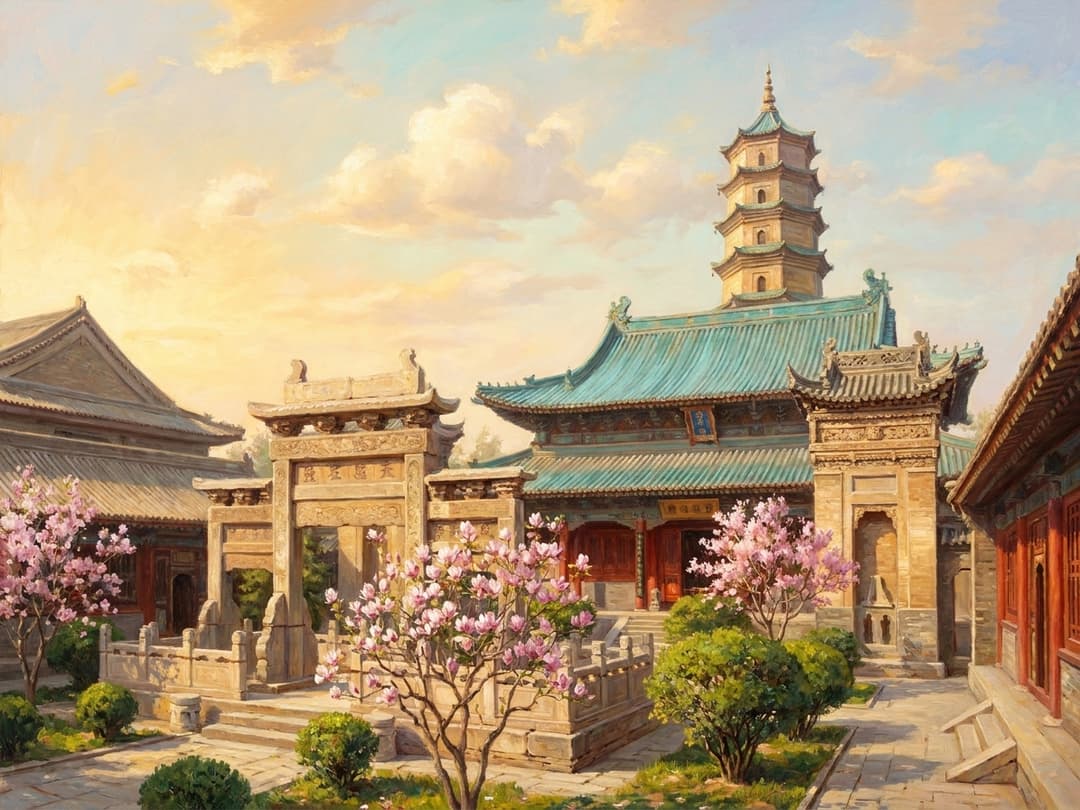
Visitors encounter a tranquil oasis of five verdant courtyards featuring ancient cypresses, stone steles, and sweeping pagoda roofs. While the historic gardens and ornate pavilions are open to all guests, the interior prayer hall remains reserved for Muslim congregants. Modest dress covering shoulders and knees is strictly observed throughout the sacred grounds.
Highlights
- Examining the Heart Tower (Shengxinlou), a two-story wooden pagoda functioning as a minaret
- Phoenix Pavilion (Yifengting), an exquisite tripartite open timber gazebo built in 1764
- Complete Holy Quran carved into six hundred camphorwood wall panels inside the prayer hall
- Historic bilingual stone steles featuring calligraphy by masters Mi Fu and Dong Qichang
Things to Know
- Non-Muslim visitors cannot enter the interior carpeted prayer hall but may view it from outside
- Modest attire covering shoulders and knees is mandatory for all visitors across the complex
- Silence is expected during the five daily prayer services, especially during Friday Jum'ah
- Arrive before ten in the morning to enjoy quiet contemplation before visitor groups arrive
Location
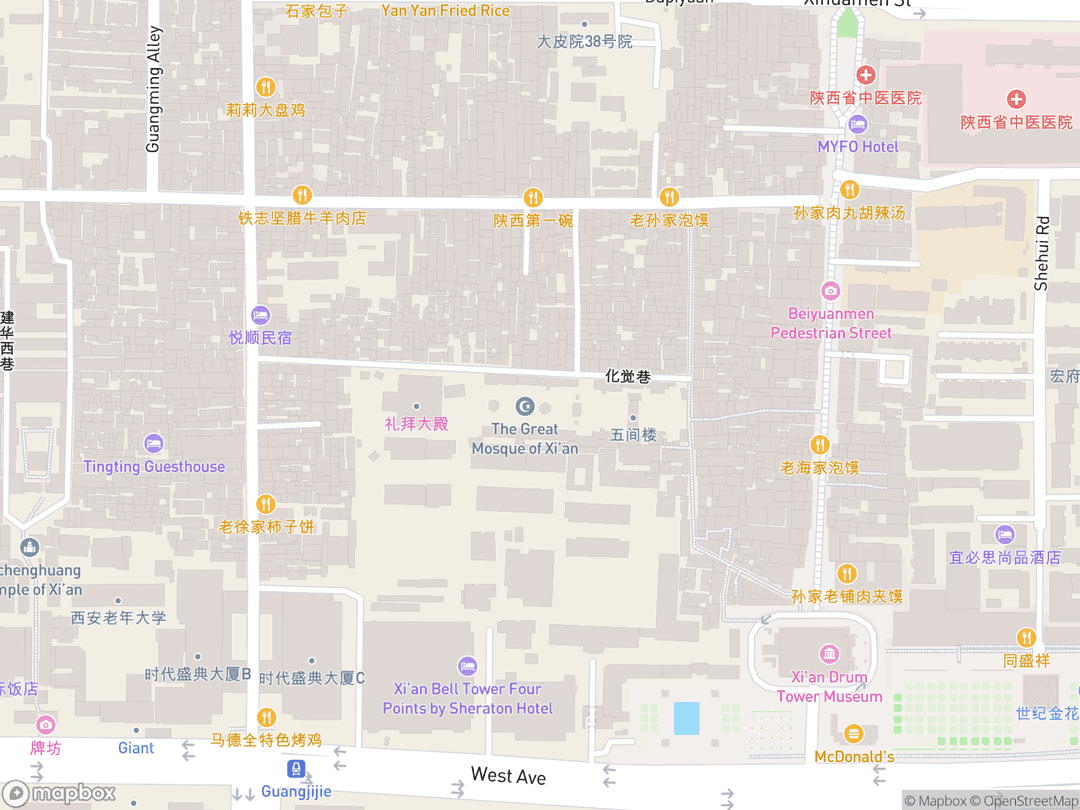
30 Huajue Alley, Lianhu District, Xi'an, Shaanxi, China
Hours: 08:00 - 19:30 daily (Summer); 08:00 - 17:30 daily (Winter)
Getting There: Take Xi'an Metro Line 2 to Zhonglou (Bell Tower) Station and walk five minutes northwest into Huajue Alley.
Get DirectionsTips for Your Visit
Dress Modestly
Ensure shoulders and legs are covered before entering the historic courtyard complex.
Respect Prayer Times
Maintain silence near the prayer hall colonnade during the Friday noon congregation.
Examine the Calligraphy
Look closely at the steles to see the unique fusion of Arabic text and Chinese brushwork.
Explore the Surrounding Quarter
Huajue Alley connects directly to Xi'an's historic Muslim Quarter filled with traditional halal bakeries.
About
The Great Mosque of Xi'an stands as the oldest and most celebrated Islamic sanctuary in China. Founded in 742 during the Tang Dynasty and reconstructed during the Ming and Qing eras, it serves as the spiritual heart of the vibrant Hui Muslim community at the historic terminus of the Silk Road.
Belonging to the Abrahamic monotheistic lineage, the mosque honors the indivisible oneness of Allah while adopting the courtyard layout and bracketed timber framing of classical imperial China. Worshippers assemble here in humble prostration, enacting a spiritual communion rooted in prophetic revelation and profound cultural harmony.
Gallery
Symbolic Elements
The temple's exterior features intricate carvings, each rich with spiritual meaning:

Shengxinlou Pagoda Minaret
An octagonal wooden pagoda serving as a minaret where calling the faithful is united with introspective self-examination.

Phoenix Pavilion
An open timber pavilion with outspread eaves resembling a soaring phoenix to symbolize spiritual elevation.

Sini Calligraphic Script
Arabic sacred script written with traditional Chinese horsehair brushes featuring sweeping rounded strokes.

Lotus and Peony Motifs
Carved vegetal blooms representing purity and spiritual prosperity within strict aniconic guidelines.

Spirit Screen Masonry Wall
A decorative brick barrier that buffers the sacred courtyard from street distraction and noise.
Bilingual Quranic Woodblocks
Hand-carved camphorwood wall plaques displaying Arabic scripture accompanied by parallel Chinese translations.

Moon Platform Terrace
A raised stone platform used for sighting the new crescent moon to determine Islamic lunar months.
Interesting Facts
The entire mosque complex is rotated ninety degrees from classical Chinese tradition to face west toward Mecca rather than south (Tier A).
The interior walls of the prayer hall hold the entire text of the Holy Quran carved across six hundred camphorwood panels (Tier A).
Its minaret is constructed entirely as a two-story octagonal wooden pagoda named the Tower of Introspection (Tier A).
Ming naval explorer Admiral Zheng He sponsored major renovations at the mosque prior to his Indian Ocean expeditions (Tier A).
The mosque preserves historic examples of Sini script, combining Arabic calligraphy with Chinese brush strokes (Tier B).
Ancient stone steles in the courtyards present imperial decrees that harmonize Islamic ethics with Confucian morality (Tier B).
Local residents saved the wooden sanctuary from destruction during the Cultural Revolution by locking it as a grain warehouse (Tier A).
Traditional roof finials replace mythological beasts with abstracted cloud volutes and lotus blooms to maintain strict aniconism (Tier B).
The surrounding Muslim Quarter has maintained continuous culinary, linguistic, and religious traditions for over 1,300 years (Tier B).
Common Questions
Are non-Muslim visitors allowed inside the Great Mosque of Xi'an?
Visitors may explore all courtyards, gardens, and stele pavilions, though the interior prayer hall is reserved for Muslim worship.
Why does the mosque look like a traditional Chinese temple or palace?
It was built by imperial Chinese craftsmen who translated Islamic liturgical requirements into classical wooden courtyard architecture.
Where is the minaret located?
The minaret is the Shengxin Pagoda in the third courtyard, an octagonal wooden tower from which the call to prayer was chanted.
What is the proper dress code for visiting?
Guests must wear modest clothing that covers both shoulders and knees before entering the sanctuary grounds.
How old is the current standing structure?
While first founded in 742 during the Tang Dynasty, the standing timber buildings date from the Ming and Qing reconstructions.
Featured Stories
The Courageous Protection of the Sacred Compound
1966
During the height of ideological turbulence in 1966, local Hui community elders quietly locked the massive wooden gates of the Great Mosque to protect it from roving factions. Sympathetic municipal administrators collaborated by labeling the prayer hall as a state grain storehouse, shielding the ancient wooden Quranic carvings from desecration. Through this quiet act of civic bravery, thirteen centuries of spiritual architecture survived unharmed.
Source: Historical Records of the Xi'an Muslim Quarter
Admiral Zheng He and the Imperial Endowments
1405
Before embarking upon his celebrated treasure voyages across the Indian Ocean, Admiral Zheng He visited the Great Mosque of Xi'an to seek divine blessings. He arranged for imperial endowments to restore the courtyard structures and sponsored gifted Hui translators to join his maritime fleet. His generous benefactions solidified the mosque's standing as an imperial monument recognized across maritime and continental trade routes.
Source: Ming Imperial Heritage Inscriptions
The Quran Carved into Camphorwood
1764
During the extensive Qing dynasty restoration, master woodcarvers undertook the monumental task of inscribing the entire Quran onto hundreds of camphorwood wall panels. Working alongside bilingual Islamic scholars, they painstakingly carved all thirty volumes in both Arabic calligraphy and classical Chinese translation. Today, this breathtaking visual library continues to encircle worshippers as they bow in silent devotion.
Source: Shaanxi Islamic Historical Archive
Timeline
Tang Dynasty Founding
Sanctuary founded during the Tianbao era of Emperor Xuanzong to accommodate Silk Road Muslim merchants.
MilestoneAuxiliary Muslim Settlement
Arab and Persian auxiliary soldiers settle permanently in Chang'an after quelling the An Lushan Rebellion.
EventNorthern Song Calligraphy
Renowned calligrapher Mi Fu creates commemorative inscriptions later preserved on steles within the mosque.
MilestoneYuan Dynasty Administrative Role
Muslim administrators and merchants expand the mosque complex under Mongol governance.
MilestoneMing Dynasty Reconstruction
Emperor Hongwu decrees a comprehensive reconstruction that establishes the current five-courtyard layout.
MilestonePatronage by Admiral Zheng He
Famed navigator Zheng He provides imperial endowments and sponsors repairs before his maritime voyages.
EventDong Qichang Tablets
Ming scholar Dong Qichang inscribes wooden tablets celebrating civic virtue and divine harmony.
MilestonePhoenix Pavilion Dedication
Emperor Qianlong oversees construction of the Phoenix Pavilion and the expansion of the grand prayer hall.
DedicationProtection During Regional Strife
Local civic leaders and community elders successfully shield the historic sanctuary from wartime devastation.
EventProvincial Heritage Listing
Shaanxi Provincial People's Government formally designates the complex as a protected historic relic.
MilestoneProtection During Cultural Revolution
Hui residents and municipal staff lock and safeguard the timber complex to prevent ideological destruction.
EventNational Protected Status
The State Council of China designates the mosque as a Major Historical and Cultural Site.
MilestoneHistory by Decade
740s–760s — Tang Dynasty Cosmopolitan Origins
The divine truth encompasses all under heaven without boundary.
During the height of the Silk Road, Emperor Xuanzong authorized the construction of a sanctuary for foreign merchants in the imperial capital of Chang'an. Arab and Persian traders worshipped peacefully alongside auxiliary troops who settled permanently in the capital. This community laid the enduring foundation for the Hui Muslim heritage in northern China.
1390s–1410s — Ming Imperial Rebuilding & Maritime Ties
Founder of the Ming Dynasty, Emperor Hongwu, decreed the complete architectural transformation of the mosque according to classical timber-frame standards. The sanctuary was rotated along an east-west axis while adopting traditional palace brackets and courtyards. Royal navigator Admiral Zheng He made substantial endowments to the mosque prior to his Indian Ocean expeditions.
1760s–1780s — Qing Dynasty Flourishing
Under the Qianlong Emperor, master carpenters added the ornate Phoenix Pavilion and expanded the grand prayer hall to seat one thousand worshippers. Calligraphers carved the entire Quran across hundreds of camphorwood wall panels. The sanctuary solidified its standing as an architectural marvel harmonizing Islamic monotheism with imperial Chinese aesthetics.
1960s–1980s — Preservation & National Recognition
During the upheaval of the Cultural Revolution, local Hui community members courageously guarded the sanctuary and concealed delicate inscriptions to protect them from harm. Following religious opening reforms in the late 1970s, congregational life resumed fully in the main prayer hall. In 1988, the Chinese State Council formally listed the mosque as a premier national cultural monument.
Architecture & Facilities
The Great Mosque of Xi'an exemplifies Sino-Islamic imperial timber-frame architecture, executing a complete ninety-degree inversion of traditional Chinese spatial planning. Unlike imperial palaces that face south toward cosmic Yang energy, the entire two-hundred-and-fifty-meter compound aligns along an east-west axis, directing worshippers toward the western Qibla of Mecca while employing traditional courtyards, upturned eaves, and bracketed wooden construction.
Building Materials
Glazed Ceramic Roof Tiles
Turquoise and emerald glazed tiles cover the hip-and-gable roofs, symbolizing paradise.
Cinnabar Lacquered Timber
Massive solid cedar and pine structural columns are coated with protective imperial red cinnabar lacquer.
Camphorwood Wall Paneling
Aromatic camphorwood boards are carved with the thirty juz' of the Quran in Arabic and Chinese.
Grey Masonry Brick
Kiln-fired grey bricks form dense boundary spirit screens and paved courtyard pathways.
Interior Features
Grand Prayer Hall (Dadian)
A columned hall capable of seating one thousand worshippers beneath six hundred coffered ceiling panels.
Mihrab Niche
A westward-facing recessed prayer niche embellished with intricate wooden carvings of lotus arabesques.
Ablution Hall (Wudufang)
A specialized bathhouse where worshippers perform ritual purification before congregational prayer.
Scriptorium & Library
Quiet study pavilions housing ancient woodblock Islamic texts and bilingual theological manuscripts.
Temple Grounds
A 1.23-hectare sanctuary arranged into five courtyards bordered by century-old cypresses, ornamental stone steles, floral rockeries, and raised moon viewing terraces.
Additional Facilities
The complex includes administrative offices, an active madrasa, traditional wash facilities, and an open stone terrace for community gatherings.
Religious Significance
As a cornerstone of Islam in East Asia, the Great Mosque of Xi'an expresses the central Abrahamic conviction in one sovereign Creator through communal prayer and moral uprightness.
To serve as a sacred house of prostration, scriptural recitation, ritual purification, and communal fellowship for the Muslim faithful.
Sacred Ordinances
Five Daily Prayers (Salah)
Obligatory congregational prayers performed while facing westward toward the holy Kaaba in Mecca.
Friday Assembly (Jum'ah)
Weekly congregational sermon and communal prayers gathering hundreds of local Hui believers.
Ritual Ablution (Wudu)
Thorough physical and spiritual washing of face, hands, and feet in the ablution pavilion prior to prayer.
Theology of Tawhid in East Asia
The mosque honors the absolute oneness of God (Tawhid) by completely eschewing idols or animal imagery, substituting them with elegant geometric arabesques, Quranic verses, and floral wood carvings.
The Concept of Qingzhen
Chinese Muslims historically described Islam as 'Qingzhenjiao' (the Pure and True Religion), emphasizing purity in worship, dietary integrity, and ethical harmony with broader society.
Sources & Research
Every fact on Temples.org is backed by verified Sources & Research. Each piece of information is rated by source tier and confidence level.
View All Sources (9)
| Field | Source | Tier | Retrieved |
|---|---|---|---|
| About & Historical Background | Archnet Islamic Architecture Community (opens in a new tab) | B | 2026-03-30 |
| Architecture & Facilities | Kuwait University Department of Architecture (opens in a new tab) | A | 2026-03-30 |
| Religious Significance & Ordinances | Marefa Cultural Foundation (opens in a new tab) | A | 2026-03-30 |
| Symbolic Elements & Calligraphy | Wikidata Entity Q820842 (opens in a new tab) | B | 2026-03-30 |
| Timeline & Historical Eras | Smarthistory Art History Center (opens in a new tab) | B | 2026-03-30 |
| Featured Stories & Cultural Resilience | ResearchGate Academic Network (opens in a new tab) | B | 2026-03-30 |
| Visitor Insights & Etiquette | Advantour Silk Road Travel (opens in a new tab) | D | 2026-03-30 |
| Interesting Facts & Heritage | Asia Cultural Travel (opens in a new tab) | D | 2026-03-30 |
| Common Questions & Visitor Information | Trip.com Travel Guide (opens in a new tab) | D | 2026-03-30 |