Visitor Insights
Visiting Old-New Synagogue
Visitors descend into a dimly illuminated medieval hall filled with wrought-iron chandeliers and ancient stonework. The atmosphere retains solemn liturgical reverence as an active Orthodox sanctuary rather than a static museum.
Highlights
- Original 13th-century five-ribbed stone vaults and carved botanical keystones
- The late-Gothic wrought-iron cage surrounding the central elevated Bimah
- The historic red civic banner bearing the early municipal Star of David
- The permanently unoccupied chair of Rabbi Judah Loew ben Bezalel
Things to Know
- Modest attire covering shoulders and knees is strictly enforced for all guests
- Male visitors must wear a kippah, which is provided at the entrance desk
- The sanctuary closes to tourists on Friday afternoons and Saturdays for Shabbat
- Photography is prohibited during religious prayer services and holy days
Location
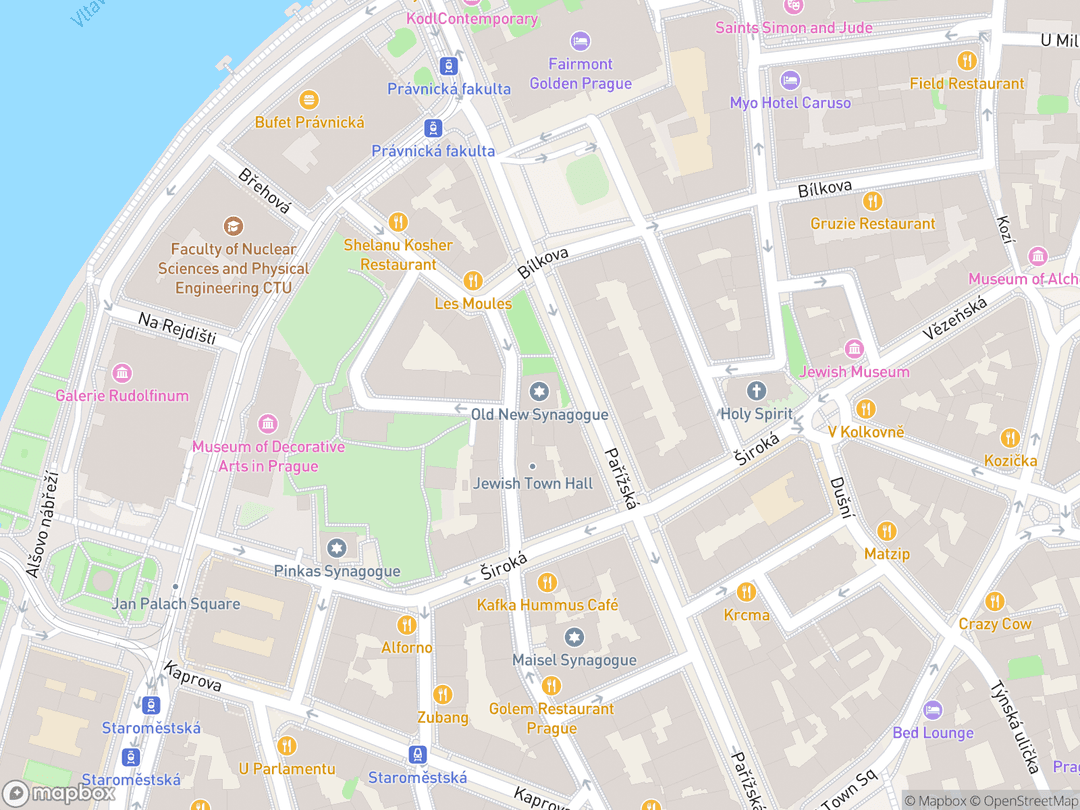
Červená 250/2, Josefov, 110 00 Prague 1, Czech Republic
Hours: Sunday to Thursday 09:00-18:00 (summer) or 09:00-16:30 (winter); Friday closes before Shabbat; closed Saturdays
Getting There: Take Prague Metro Line A to Staroměstská station, then walk three minutes north along Maiselova Street into Josefov.
Get DirectionsTips for Your Visit
Arrive Early for Daylight
Visit before 10:30 on weekdays to experience morning sunlight cutting through the narrow southern lancet windows.
Combined Admission
Tickets are available through the Jewish Museum in Prague ticket counters located on nearby U Starého hřbitova street.
About
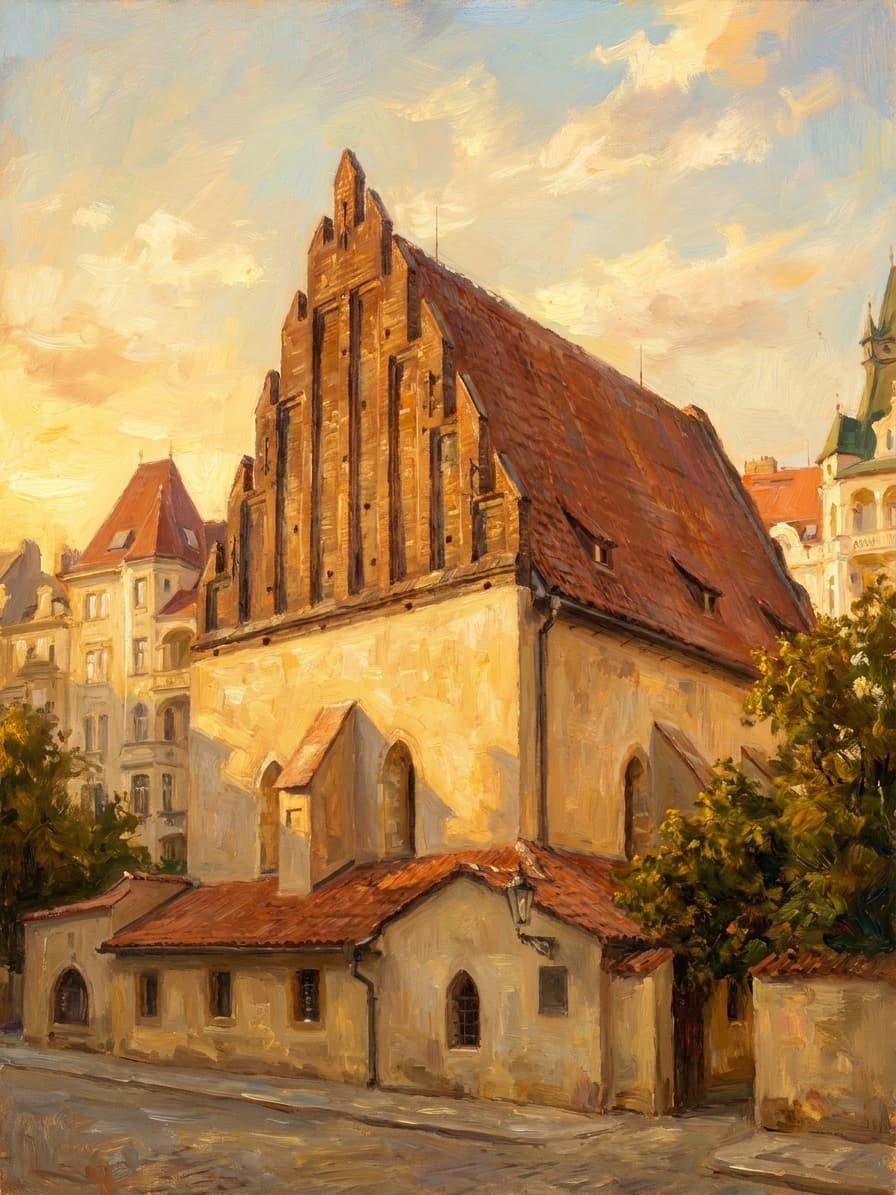
The Old-New Synagogue, completed around 1270 in the historic Josefov district of Prague, is the oldest active synagogue in Central Europe and one of the earliest monumental Gothic buildings in the Czech Republic. Operating continuously for over seven centuries, it embodies the resilient continuity of European Jewry through medieval pogroms, urban clearances, and the Shoah.
Within the sacred architecture of Judaism, the synagogue provides a consecrated space for divine covenant, scriptural proclamation, and liturgical encounter. The Old-New Synagogue expresses the post-Temple Judaic reality of prayer replacing sacrificial service, functioning as a 'miniature sanctuary' (mikdash me'at) oriented eastward toward the Temple Mount in Jerusalem.
Its fortified rubble-stone walls, soaring stepped brick gables, and subterranean floor physically embody Psalm 130: 'Out of the depths I cry to You, O Lord.' Today, the synagogue remains an active Orthodox house of prayer, conducting daily services in uninterrupted fidelity to centuries of rabbinic tradition.
Gallery
Symbolic Elements
The temple's exterior features intricate carvings, each rich with spiritual meaning:

Twelve-Vine Tympanum
A stone relief over the interior portal displays twelve grape clusters representing the Twelve Tribes of Israel.
Twelve Lancet Windows
Slender wall openings channel divine illumination while recalling the twelve portals of the biblical Tabernacle.

Five-Rib Vault Keystones
Carved botanical bosses join five vaulting ribs, deliberately avoiding cross geometry through organic plant motifs.

Prague Jewish Civic Banner
A red swallowtail banner granted by royal privilege displays a golden Star of David enclosing a Swedish-style hat.
Depressed Entry Well
The sunken cantor's station before the Ark lowers the prayer leader to embody humble supplication from the depths.

The Maharal's Seat
A carved wooden desk and chair remain vacant in veneration of the 16th-century mystic and scholar Rabbi Judah Loew.
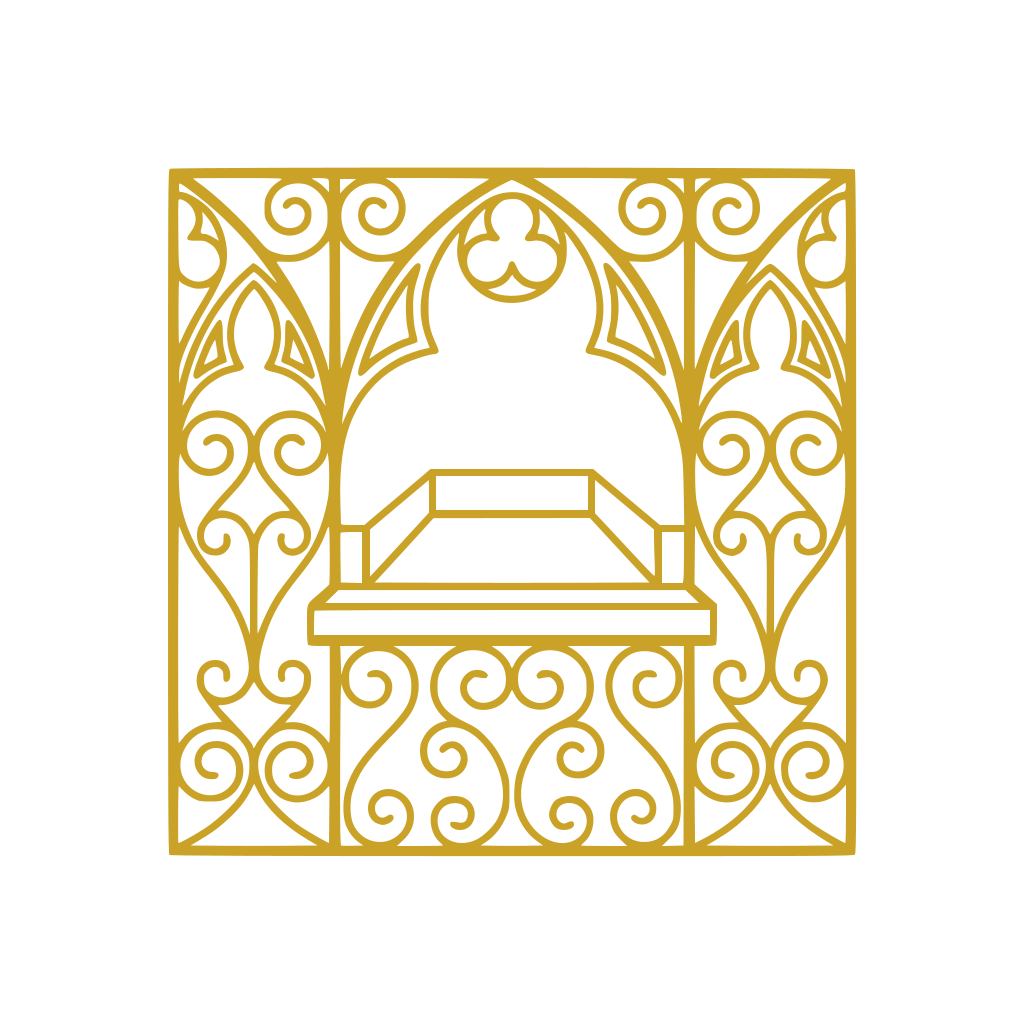
Wrought-Iron Bimah Grille
Late-Gothic ironwork encircles the raised central reading platform to emphasize the primacy of Torah proclamation.

Acrostic Plaster Inscriptions
Hebrew abbreviations painted on the white sanctuary walls serve as scriptural mnemonics to focus worshipper devotion.
Interesting Facts
It is the oldest active synagogue in Central Europe, hosting continuous services since 1270 with brief interruption during Nazi occupation (Tier A).
The name 'Altneuschul' arose in the 16th century when newer synagogues were constructed nearby, transforming the former New Synagogue into the Old-New (Tier B).
According to Jewish tradition, the name derives from 'Al-Tnai' ('on condition'), recounting that angels transported foundation stones from the Temple in Jerusalem to be returned upon the arrival of the Messiah (Tier B).
According to enduring Prague Jewish tradition, Rabbi Judah Loew placed the deactivated Golem in the attic Genizah, prompting the removal of the exterior access stairs (Tier B).
The elevated chair of Rabbi Judah Loew on the eastern wall has remained respectfully unoccupied since his death in 1609 (Tier A).
The interior floor sits nine steps below street level to evoke Psalm 130 and comply with medieval laws limiting synagogue height (Tier A).
A historic red civic banner displayed within the hall features one of the earliest official uses of the Star of David as a Jewish emblem (Tier A).
Bloodstains from the 1389 Easter pogrom were preserved on the interior walls for nearly five centuries as a memorial before the 1883 restoration (Tier B).
Strict biblical adherence to aniconism means all stone reliefs feature grapevines and acanthus leaves rather than human or animal figures (Tier A).
The twin-nave hall utilizes five-ribbed vaulting to distribute roof loads while avoiding the geometry of a Christian cross (Tier B).
Common Questions
Is the Old-New Synagogue an active place of worship or a museum?
It remains an active Orthodox synagogue holding daily minyan prayer services while welcoming cultural visitors outside service times.
Why is the floor of the synagogue lower than the surrounding street?
The sunken floor fulfills Psalm 130 ('Out of the depths') while conforming to medieval laws restricting non-Christian building heights.
Can visitors enter the attic genizah where tradition places the Golem?
No, the attic remains strictly closed to the public and the lower access stairs were removed centuries ago.
What should male visitors wear upon entering the sanctuary?
Men and boys are required to wear a head covering (kippah), which is provided free of charge at the entry desk.
Is the synagogue open to tourists on Saturdays?
No, the synagogue is closed to tourism on Saturdays and Jewish holidays for sacred Sabbath worship.
Featured Stories
The Tragedy and Elegy of 1389
April 18, 1389
During the devastating Easter Sunday pogrom of 1389, hundreds of Prague's Jewish residents sought sanctuary behind the thick stone walls of the synagogue. Royal guards and rioters breached the building, martyring over three hundred men, women, and children within the holy hall. Rabbi Avigdor Kara survived the carnage and authored the heart-rending elegy 'Et Kol Ha-Tela’ah', which is still chanted within the sanctuary every Yom Kippur.
Source: Historical Community Chronicle & Selichot Liturgy
The Maharal and the Legend of the Golem
1590
In the late 16th century, Chief Rabbi Judah Loew ben Bezalel led the Prague congregation with profound mystical and philosophical insight. According to enduring community tradition, the Maharal fashioned a defender from the clay of the Vltava River to protect the community from lethal blood libel accusations. He eventually deactivated the guardian and placed its remains in the synagogue's attic genizah, where access has remained barred to the public for centuries.
Source: Prague Jewish Tradition & Oral History
Survival Through the Holocaust
1941
While hundreds of historic synagogues across Nazi-occupied Bohemia and Moravia were systematically dynamited, the Old-New Synagogue was spared total physical destruction. The occupation regime preserved the building to serve as an architectural centerpiece for a warped central repository of confiscated Jewish cultural artifacts. Following liberation in 1945, surviving members of Prague's decimated Jewish community reconsecrated the hall and resumed daily services.
Source: Post-War Restoration Records
Timeline
Completion of Construction
Cistercian royal stonemasons complete the double-aisled Gothic prayer hall for the Prague Jewish community.
DedicationImperial Banner Privilege
Emperor Charles IV grants Prague Jewry the right to fly an official communal flag within their sanctuary.
MilestoneThe Easter Sunday Pogrom
More than three hundred community members seeking refuge inside the fortified hall are martyred.
EventComposition of Memorial Elegy
Rabbi Avigdor Kara pens the elegy memorializing the 1389 martyrs for annual Yom Kippur recitation.
MilestoneGable Reconstruction
Stepped decorative brick gables are added to the northern and southern rooflines under royal privileges.
RenovationRabbinate of the Maharal
Rabbi Judah Loew ben Bezalel assumes leadership, forever intertwining the synagogue with the Golem tradition.
MilestoneAugmented Red Banner Award
Emperor Ferdinand III awards a red banner honoring the Jewish community's defense of Prague against Swedish troops.
MilestoneExpulsion Decreed by Maria Theresa
The synagogue stands shuttered during the temporary expulsion of Jewish residents from Prague.
EventRestoration by Josef Mocker
Neo-Gothic architect Josef Mocker restores the stone vaulting and cleans medieval wall surfaces.
RenovationExemption from Ghetto Clearance
The sanctuary is designated a protected monument during the municipal redevelopment of Josefov.
MilestoneClosure Under Nazi Occupation
Public worship is forcibly suppressed as the building is commandeered for confiscated cultural property.
EventPost-War Reconsecration
Holocaust survivors reconsecrate the sanctuary and immediately reestablish daily minyan prayers.
MilestoneState Heritage Conservation
Archaeological and masonry conservation stabilizes the medieval limestone fabric and Gothic ribs.
RenovationRestoration of Wall Inscriptions
Conservators restore historic Hebrew acrostic friezes and upgrade environmental climate controls.
RenovationHistory by Decade
1270s–1350s — Royal Patronage and Foundation
Under King Přemysl Otakar II, the Jewish community enlisted skilled Christian masons from royal monastic workshops to build their main sanctuary. Known initially as the New Synagogue, it served as the spiritual and civic anchor of the thriving medieval quarter. In 1357, Holy Roman Emperor Charles IV recognized the community's standing by granting permission to fly an official communal banner within the hall.
1380s–1490s — Persecution, Elegy, and Fortification
In 1389, an Easter Sunday pogrom devastated the community as attackers stormed the sanctuary, martyring hundreds of residents who had sought refuge inside. Rabbi Avigdor Kara memorialized the victims in an elegy that became an enduring fixture of the Yom Kippur liturgy. Later in the 15th century, King Vladislaus II reaffirmed communal charters, prompting the addition of stepped brick gables that fortified the roofline.
1580s–1650s — The Golden Age of Mysticism and Civic Pride
The late 16th century marked an intellectual and spiritual renaissance under Rabbi Judah Loew ben Bezalel, the renowned Maharal of Prague. During this era, newly constructed synagogues transformed the building's name into the Old-New Synagogue. In 1648, Emperor Ferdinand III bestowed an augmented civic banner bearing the Star of David to commemorate the community's valiant defense of the Charles Bridge against Swedish armies.
1740s–1890s — Imperial Turmoil and Modern Preservation
Queen Maria Theresa shuttered the building during the harsh expulsion decree of 1744, though worship resumed after the order was repealed four years later. In 1883, master architect Josef Mocker oversaw a purist Gothic restoration that reinforced the stone vaults and stabilized aging masonry. When municipal planners demolished much of the crowded Josefov ghetto during the 1893 sanitization campaign, the synagogue was strictly spared as a historic treasure.
1940s–1990s — War, Survival, and Rebirth
Nazi forces closed the sanctuary in 1941, intending to preserve the building as part of a twisted museum collection of confiscated Jewish cultural heritage. Following liberation in 1945, surviving remnants of the community reconsecrated the hall and resumed regular prayer. Extensive restoration campaigns in 1967 and 1999 stabilized the subterranean foundations, uncovered early plaster inscriptions, and secured the sanctuary for future generations.
Architecture & Facilities
The Old-New Synagogue is Central Europe's preeminent surviving medieval twin-nave synagogue, built in the High Cistercian-Gothic style characteristic of 13th-century Bohemian royal workshops. Its low-sprung ribbed vaults, thick rubble-stone masonry, and deeply recessed lancet windows reflect early Gothic monastic engineering adapted to halakhic requirements.
Building Materials
Rubble-Stone Masonry
Quarried local sandstone and rubble limestone form thick load-bearing perimeter walls finished in rough lime plaster.
Bohemian Red Brick
Hard-fired medieval clay bricks form the dramatic stepped corbelled gables crowning the northern and southern rooflines.
Bohemian Sandstone
Fine-grained ashlar sandstone is carved into octagonal pillars, vaulting ribs, and naturalistic botanical keystones.
Wrought Iron
Hand-forged ironwork encloses the central elevated Bimah with decorative Gothic tracery and floral finials.
Interior Features
Twin-Nave Prayer Hall
The primary worship space is divided into two parallel naves by two massive octagonal pillars running east to west.
Holy Ark (Aron Kodesh)
Elevated on the eastern wall facing Jerusalem, this stone shrine houses sacred handwritten Torah scrolls behind rich velvet curtains.
The Central Bimah
An elevated octagonal reading platform enclosed by a Gothic iron cage ensures Torah readings resonate through the hall.
Women's Annexes (Ezrat Nashim)
Low vaulted chambers flanking the perimeter feature narrow angled wall slits allowing women to hear services.
Temple Grounds
The building occupies a dense urban plot in Josefov, bordered by stone paving and framed by historic townhouses, without surrounding parkland.
Additional Facilities
An entrance vestibule houses ticket administration, while historic annexes accommodate daily minyan preparation and community meetings.
Religious Significance
As Central Europe's oldest operational synagogue, the Old-New Synagogue represents the enduring heartbeat of Ashkenazi Orthodox Judaism. Rooted in the biblical covenant, the building translates the sanctity of the ancient Jerusalem Temple into the diaspora framework of communal Torah study and daily liturgical prayer.
To serve as a consecrated house of assembly, study, and daily liturgical prayer aligned toward the Holy Temple Mount in Jerusalem.
Sacred Ordinances
Tefillah (Daily Prayer Services)
The regular gathering of an Orthodox quorum (minyan) to recite Shacharit, Mincha, and Maariv services.
Kriat HaTorah (Torah Reading)
The chanting of designated weekly Torah portions from handwritten parchment scrolls elevated upon the central Bimah.
Kabbalat Shabbat
The traditional Friday evening welcoming of the Sabbath bride through liturgical psalms and hymns.
Yom Kippur Memorial Recitation
The annual solemn recitation of Rabbi Avigdor Kara's 1389 elegy commemorating community martyrs.
The Synagogue as Mikdash Me'at
In rabbinic theology following the destruction of the Second Temple, synagogues function as miniature sanctuaries. Divine presence (the Shekhinah) rests upon the congregation as they assemble in holiness, direct their hearts eastward toward Jerusalem, and engage in heartfelt prayer which replaces sacrificial offerings.
Continuity of Ashkenazi Minhag
The Altneuschul maintains distinct liturgical customs established over seven centuries. Unique local melodies, historical prayer variants, and reverent traditions—such as leaving the seat of the Maharal permanently unoccupied—preserve an unbroken living connection to the medieval golden age of Bohemian Jewry.
Sources & Research
Every fact on Temples.org is backed by verified Sources & Research. Each piece of information is rated by source tier and confidence level.
View All Sources (10)
| Field | Source | Tier | Retrieved |
|---|---|---|---|
| About & Historical Background | Jewish Community Heritage Network (opens in a new tab) | A | 2026-03-31 |
| Architecture & Structural Engineering | MDPI Heritage and Architectural Studies (opens in a new tab) | B | 2026-03-31 |
| Medieval History & Royal Privileges | Austrian Academy of Sciences (opens in a new tab) | B | 2026-03-31 |
| Civic Banners & Heraldic Emblems | Heraldry Project Archives (opens in a new tab) | B | 2026-03-31 |
| Theological Context & Liturgical Art | Rev. Prof. Patrick Comerford Architectural Studies (opens in a new tab) | B | 2026-03-31 |
| Historical Folklore & Attic Genizah | Atlas Obscura (opens in a new tab) | C | 2026-03-31 |
| Monument Details & Urban Context | Reveal World Cultural Monuments (opens in a new tab) | C | 2026-03-31 |
| Historical Medals & Memorial Inscriptions | Historic Commemorative Medals (opens in a new tab) | C | 2026-03-31 |
| Visitor Etiquette & Guided Access | Private Prague Guide (opens in a new tab) | D | 2026-03-31 |
| Local Neighborhood Heritage & Lodging | Charles Bridge Travel Guide (opens in a new tab) | D | 2026-03-31 |