Visitor Insights
Visiting Al-Azhar Mosque
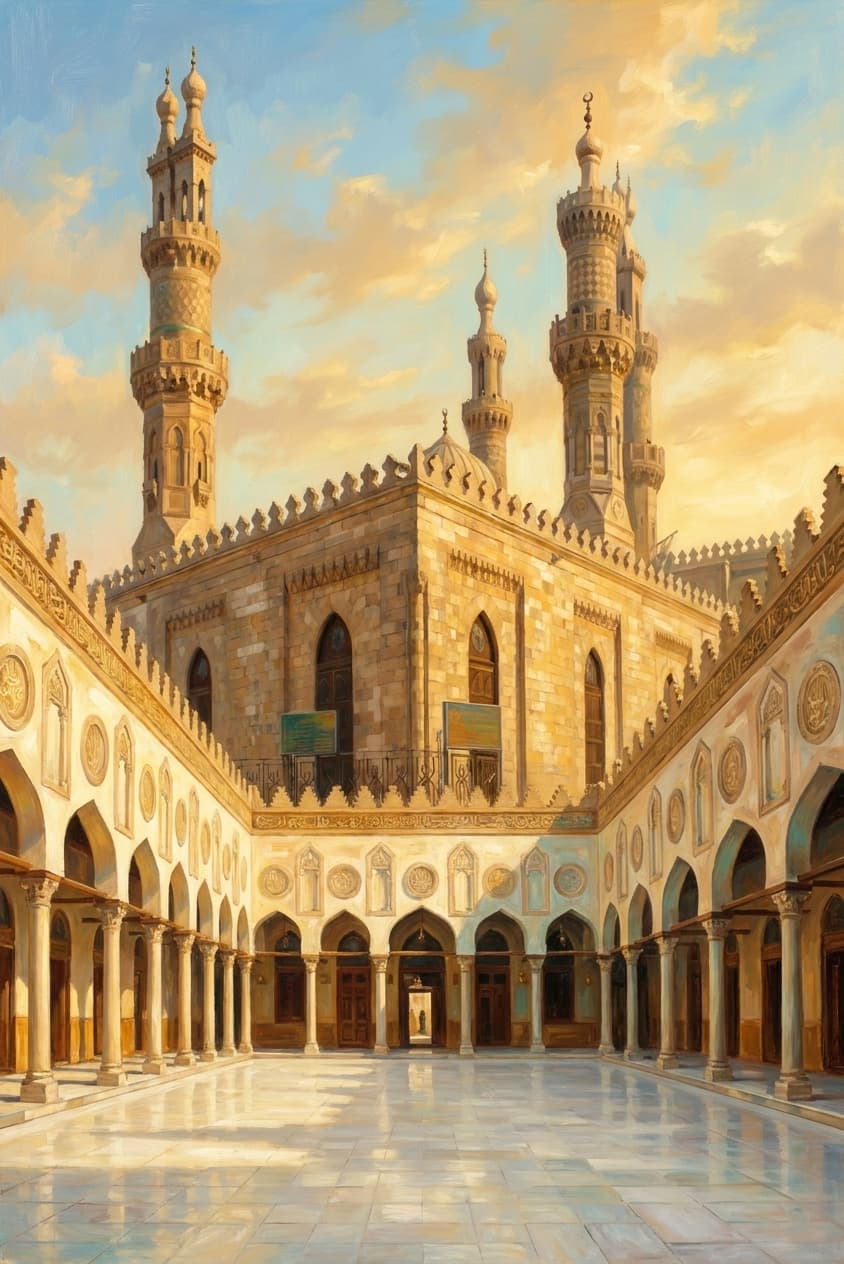
Al-Azhar Mosque welcomes worshippers and visitors daily into one of the Islamic world's greatest living historical landmarks. Visitors experience serene white marble courtyards, active scholarly circles around stone columns, and five distinct historic minarets. Mid-mornings between major prayer calls offer the most peaceful atmosphere for exploring the complex.
Highlights
- Vast central courtyard paved with reflective Carrara marble and bordered by 10th-century keel arches
- Historic madrasa chapels featuring multicolored Mamluk mosaic niches and stone vaulting
- Spectacular double-headed minaret built by Sultan Qansuh al-Ghuri in 1509
- Living scholarly halaqat circles where traditional texts are read beneath hypostyle colonnades
Things to Know
- Modest attire is required, including head coverings for women and full-length clothing for all
- Shoes must be removed and placed in lockers before stepping onto the courtyard marble
- General sightseeing pauses during congregational Friday prayers between 11:30 and 13:30
- Summer midday heat can be intense across the open marble courtyard
Location
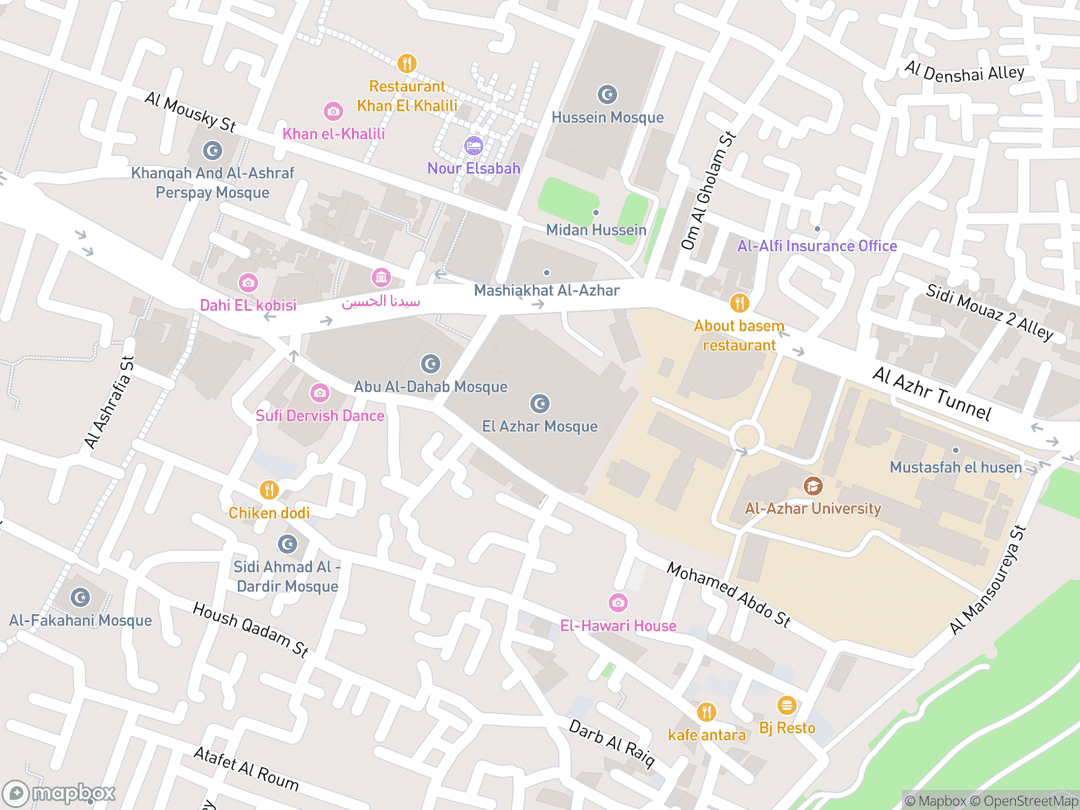
Al-Azhar Street, El-Darb El-Ahmar, Islamic Cairo, Cairo Governorate 11511, Egypt
Hours: Daily from 04:00 to 21:00 (continuous between Fajr and Isha prayers)
Getting There: Located along Al-Azhar Street in Islamic Cairo, reachable by taxi or via Mohamed Naguib Metro Station followed by a short walk through Khan el-Khalili.
Get DirectionsTips for Your Visit
Time Your Arrival
Visit between 09:00 and 11:00 to avoid midday heat and enjoy unhindered views of the open marble arcade.
Explore Corner Madrasas
Take time to examine the Taybarsiyya and Aqbughawiyya madrasas for Cairo's finest Mamluk mosaic mihrabs.
Shoe Storage Etiquette
Use the designated shoe lockers at Bab al-Muzayyinin and keep a few small Egyptian pounds ready for attendants.
Respect Scholarly Circles
Walk quietly around study circles seated along the outer columns to avoid disturbing ongoing theological lessons.
About
Founded in 970 CE by the Fatimid Caliph al-Mu'izz li-Din Allah, Al-Azhar Mosque stands as one of the most venerated monuments of the Abrahamic monotheistic heritage. Conceived alongside the establishment of Cairo itself, this sanctuary has anchored religious thought, spiritual assembly, and scholarly devotion across more than a millennium of dynamic history.
While initially constructed as the central congregational space for Isma'ili governance, Al-Azhar evolved over successive centuries into the premier intellectual heart of global Sunni Islam. Its monumental hypostyle halls and historic colleges have nurtured jurists, theologians, and linguists representing the four classic schools of Islamic law.
Architecturally, the complex presents a layered palimpsest spanning Fatimid, Mamluk, and Ottoman eras. Its marble courtyards, keel-arched arcades, and celebrated skyline of minarets reflect a continuous tradition of royal patronage, communal restoration, and architectural innovation in the center of historic Cairo.
Today, Al-Azhar continues to function both as an active sanctuary for daily congregational prayer and as the symbolic headquarters of Al-Azhar University. Welcoming thousands of daily worshippers and international students, it remains an enduring pillar of spiritual learning, communal charity, and monotheistic worship.
Gallery
Symbolic Elements
The temple's exterior features intricate carvings, each rich with spiritual meaning:

Fatimid Keel Arches
Pointed boat-shaped arches symbolize upward spiritual elevation and divine harmony without excessive physical heaviness.

Double-Pronged Minaret Finial
The bifid stone summit of al-Ghuri's minaret represents the twin foundations of scripture and prophetic tradition.

Stucco Rosettes and Medallions
Radiating geometric arabesques celebrate the oneness of God unfolding into cosmic complexity.

Floriated Kufic Inscriptions
Intertwining vine calligraphy visualizes the living divine word as a source of eternal spiritual nourishment.

The Minbar of Baybars
An inlaid wooden pulpit symbolizing righteous communal leadership and adherence to prophetic guidance.

Step-Down Portal Threshold
Stone entrance steps mark the intentional transition from bustling commercial streets into quiet reverent prayer.

Axial Sanctuary Transept
The elevated central aisle draws the worshipper's gaze directly toward the sacred orientation of the qibla.
Interesting Facts
Founded in 970 CE, Al-Azhar operates as the second-oldest continuous university in the world. (Tier A)
The sanctuary incorporates over 300 ancient Roman, Byzantine, and Coptic columns salvaged across Egypt. (Tier B)
Friday sermons were halted for 95 years under the Ayyubid dynasty before Sultan Baybars restored them. (Tier A)
Sultan al-Ghuri's 1509 minaret is famous for its unique double-bulb twin masonry finial. (Tier B)
The main portal was nicknamed the Gate of the Barbers because students had their hair cut outside it. (Tier B)
Napoleon Bonaparte ordered artillery to bombard the courtyard during the Cairo Revolt of 1798. (Tier B)
Historic students resided in regional riwaq quarters designated by homeland, from Syria to North Africa. (Tier B)
A massive 2018 conservation campaign successfully extracted destructive ground salts from its foundations. (Tier A)
Common Questions
Is Al-Azhar Mosque open to non-Muslim visitors?
Yes, non-Muslim visitors are warmly welcomed outside of congregational prayer times when dressed modestly.
Why is the mosque named Al-Azhar?
The sanctuary was named in honor of Fatima az-Zahra, the daughter of the Prophet Muhammad.
What is the historical significance of the Gate of the Barbers?
Bab al-Muzayyinin received its name because incoming scholars historically had their hair shaved right outside its entrance.
Can visitors attend theological classes inside the mosque?
Visitors may quietly observe the public halaqat lecture circles seated around the sanctuary's hypostyle colonnades.
How old is the educational institution at Al-Azhar?
Formal teaching commenced in 988 CE, making it the world's second-oldest continuously operating higher education center.
Featured Stories
The Inaugural Ramadan Gathering
June 22, 972
On the seventh day of Ramadan in 971 CE, commander Jawhar al-Siqilli gathered thousands of Cairo's newest citizens beneath freshly carved stucco arches for the mosque's inaugural Friday prayer. The reverberating call to prayer signaled both the dawn of a grand imperial capital and the establishment of a sanctuary destined to outlive every medieval dynasty.
Source: Historical chronicles of Al-Azhar Al-Sharif
Baybars and the Restored Voice
January 16, 1266
After nearly a century of mandated silence during which Friday congregational sermons were banned, Mamluk Sultan Baybars oversaw an emotional revival inside Al-Azhar. Installing a masterwork inlaid minbar, he invited scholars and townspeople to witness the emotional return of weekly community worship to the ancient hall.
Source: Mamluk Sultanate architectural archives
Sanctuary Under Siege
October 22, 1798
During the intense Cairo Revolt against French occupation, Al-Azhar became the physical fortress and intellectual sanctuary of community resistance. Although Napoleon Bonaparte directed artillery strikes from the Citadel into the marble sahn, the historic complex endured to remain Egypt's foremost center of moral authority.
Source: Egyptian national historical documentation
Timeline
Groundbreaking Under Jawhar al-Siqilli
Fatimid commander Jawhar al-Siqilli began foundation excavation for the principal mosque of the new capital city.
component.timeline.groundbreakingInaugural Friday Prayer
The sanctuary hosted its first Friday congregational service and sermon during the holy month of Ramadan.
DedicationFormalization of Theological Lectures
Chief Justice Ali ibn al-Numan began regular lectures inside the sanctuary on Islamic jurisprudence.
MilestoneEstablishment of Endowed Faculty
Vizier Ya'qub ibn Killis provided residential stipends for 35 salaried scholars, creating an enduring academic college.
MilestoneFatimid Arcade Reconstruction
Caliph al-Hafiz li-Din Allah constructed the courtyard arcades and adorned them with floriated keel arches.
RenovationSuspension of Friday Sermons
Following the Ayyubid takeover by Salah al-Din, congregational Friday sermons were halted to suppress Fatimid liturgy.
EventRestoration Under Sultan Baybars
Mamluk Sultan Baybars completed major repairs, introduced a new minbar, and reinstituted the weekly Friday khutbah.
RenovationMadrasa al-Taybarsiyya Completed
Emir Taybars erected an adjoining college featuring Cairo's most celebrated marble mosaic prayer niche.
MilestoneErection of Qaytbay Minaret
Sultan Qaytbay rebuilt the western gate minaret with tiered balconies and intricate carved chevron patterns.
MilestoneMinaret of Qansuh al-Ghuri
Sultan al-Ghuri completed the unprecedented double-finial stone minaret over the southwestern gate.
MilestoneGrand Expansion by Abd al-Rahman Katkhuda
Amir Katkhuda doubled the prayer hall, constructed Bab al-Muzayyinin, and added an Ottoman pencil minaret.
RenovationModern Conservation Inauguration
Egyptian authorities completed a historic desalination campaign and extensive restoration across the entire historic fabric.
RenovationHistory by Decade
970s — Fatimid Foundation
Commander Jawhar al-Siqilli broke ground on the congregational mosque on April 4, 970, to anchor the freshly established garrison city of Cairo. Completed in just over two years, the sanctuary held its first Friday service in June 972 and quickly expanded into a center for religious discourse.
1130s — Arcades of al-Hafiz
Caliph al-Hafiz li-Din Allah ordered substantial architectural enrichments across the complex in 1138. Craftsmen added the iconic keel-shaped courtyard arcades, stucco medallions, and a monumental rear transept that established Al-Azhar's enduring architectural silhouette.
1260s — Mamluk Restoration
Following a 95-year suspension of congregational khutbahs under the Ayyubids, Sultan Baybars revitalized the complex in 1266. Wealthy emirs repaired the stone structure, funded generous stipends, and transformed Al-Azhar into Sunni Cairo's leading educational and liturgical headquarters.
1490s–1500s — The Golden Age of Minarets
Late Mamluk sultans transformed the skyline of Islamic Cairo with unprecedented stone towers around the mosque. Sultan Qaytbay erected an intricately carved octagonal minaret in 1495, followed in 1509 by Sultan al-Ghuri's daring double-pronged stone masterpiece.
1750s — Katkhuda's Expansion
Amir Abd al-Rahman Katkhuda directed the largest single expansion in the building's history in 1753. He doubled the footprint of the main prayer hall, added the Bab al-Muzayyinin entrance, and built an elegant Ottoman minaret alongside his personal tomb.
2010s — Groundbreaking Restoration
A comprehensive conservation program culminated on March 6, 2018, addressing centuries of environmental deterioration. Specialists desalted the limestone foundations, renewed the marble courtyards, and stabilized historic woodwork without compromising any original architectural character.
Architecture & Facilities
Al-Azhar Mosque exemplifies a historic architectural synthesis combining Fatimid, Mamluk, and Ottoman styles, structured around a classical hypostyle court that reflects more than a millennium of Islamic civic design.
Building Materials
Mokattam Limestone
Quarried from the cliffs east of Cairo to construct load-bearing walls and monumental gates.
Spolia Marble Columns
Over 300 recycled classical Roman and Byzantine marble pillars supporting the sanctuary aisles.
Carved Stucco Relievo
Fine Fatimid plasterwork carved with floriated Kufic inscriptions and intricate leafy palmettes.
Carrara Marble Pavement
Cool-temperature white marble flags paving the broad central courtyard against harsh Cairo heat.
Interior Features
Original Fatimid Sanctuary
A deep five-aisle hypostyle prayer hall oriented toward the historic carved stucco qibla niche.
Katkhuda Prayer Extension
An elevated four-aisle Ottoman hall added in 1753 that effectively doubled the indoor prayer capacity.
Madrasa al-Taybarsiyya
A 1309 college room celebrated for its polychrome marble mosaic prayer niche.
Madrasa al-Aqbughawiyya
A 1340 vaulted hall featuring ribbed stone arches and stained glass circular windows.
Temple Grounds
A 48-meter by 34-meter central marble court with surrounding porticoes, secondary ablution courts, and student study annexes.
Additional Facilities
Modernized underground ablution rooms, archival manuscript centers, and security administration offices.
Religious Significance
Al-Azhar represents one of the premier sanctuaries of the Abrahamic monotheistic lineage, embodying the shared tradition of covenantal gathering, prayerful prostration, and sacred scriptural study.
To serve as a house of communal prayer oriented toward Mecca and a global center for the dissemination of moderate Islamic theology and law.
Sacred Ordinances
Salat (Congregational Prayer)
Five daily communal prayers uniting worshippers in synchrony and reverence facing the holy qibla.
Jumu'ah (Friday Assembly)
Weekly congregational prayer accompanied by a formal sermon addressing moral guidance and communal welfare.
Halaqat al-Ilm (Study Circles)
Centuries-old teaching circles held around mosque columns to transmit sacred scripture and ethical jurisprudence.
The Pursuit of Knowledge as Divine Service
In Islamic thought, studying sacred texts and legal ethics is considered an act of perpetual worship, a conviction realized through Al-Azhar's centuries of educational mission.
Ecumenical Harmony in Sunni Thought
By officially housing chairs for all four traditional Sunni schools of legal interpretation, the mosque fosters broad intellectual unity within diversity.
Sources & Research
Every fact on Temples.org is backed by verified Sources & Research. Each piece of information is rated by source tier and confidence level.
View All Sources (8)
| Field | Source | Tier | Retrieved |
|---|---|---|---|
| About & Historical Background | Al-Azhar Al-Sharif (opens in a new tab) | A | 2026-03-29 |
| Heritage Status & Historic Cairo | UNESCO World Heritage Centre (opens in a new tab) | B | 2026-03-29 |
| Architecture & Structural History | Museum With No Frontiers (opens in a new tab) | B | 2026-03-29 |
| Theological Academy & Curriculum | Foundation for Science, Technology and Civilisation (opens in a new tab) | B | 2026-03-29 |
| Academic Chronicles & Mamluk Expansions | Brill Academic Publishers (opens in a new tab) | B | 2026-03-29 |
| Urban Design & Architectural Development | Architectural Heritage Studies (opens in a new tab) | B | 2026-03-29 |
| Restoration Records & Conservation | Egypt Planners Heritage Documentation (opens in a new tab) | D | 2026-03-29 |
| Monuments of Cairo Archival Records | Islamic Art and Architecture Press (opens in a new tab) | B | 2026-03-29 |