Visitor Insights
Visiting Mortuary Temple of Hatshepsut
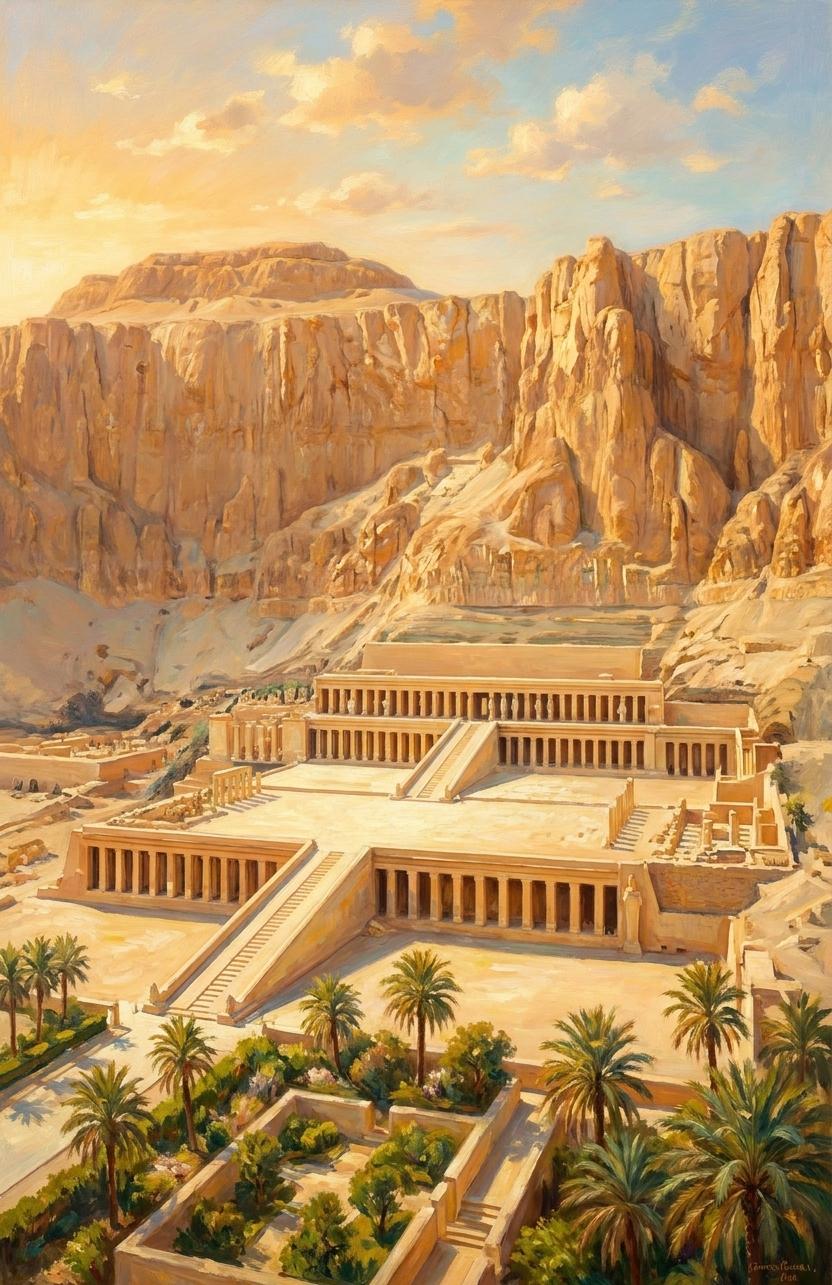
Visiting the Mortuary Temple of Hatshepsut offers a breathtaking encounter with New Kingdom art and cliff-carved architecture. Arriving early in the morning allows visitors to witness golden dawn sunlight illuminating the limestone colonnades without mid-day desert heat.
Highlights
- Vivid polychrome reliefs inside the Chapel of Hathor and Chapel of Anubis.
- The famous Punt Colonnade illustrating the world's earliest recorded botanical mission.
- Rock-hewn Main Sanctuary of Amun-Ra situated on the high upper terrace.
Things to Know
- Shade is scarce across the wide open stone terraces, requiring head protection and water.
- Modest walking distance from the ticket center is aided by low-emission electric shuttles.
- Some inner sanctuaries may have regulated entry to preserve delicate ancient pigments.
Location
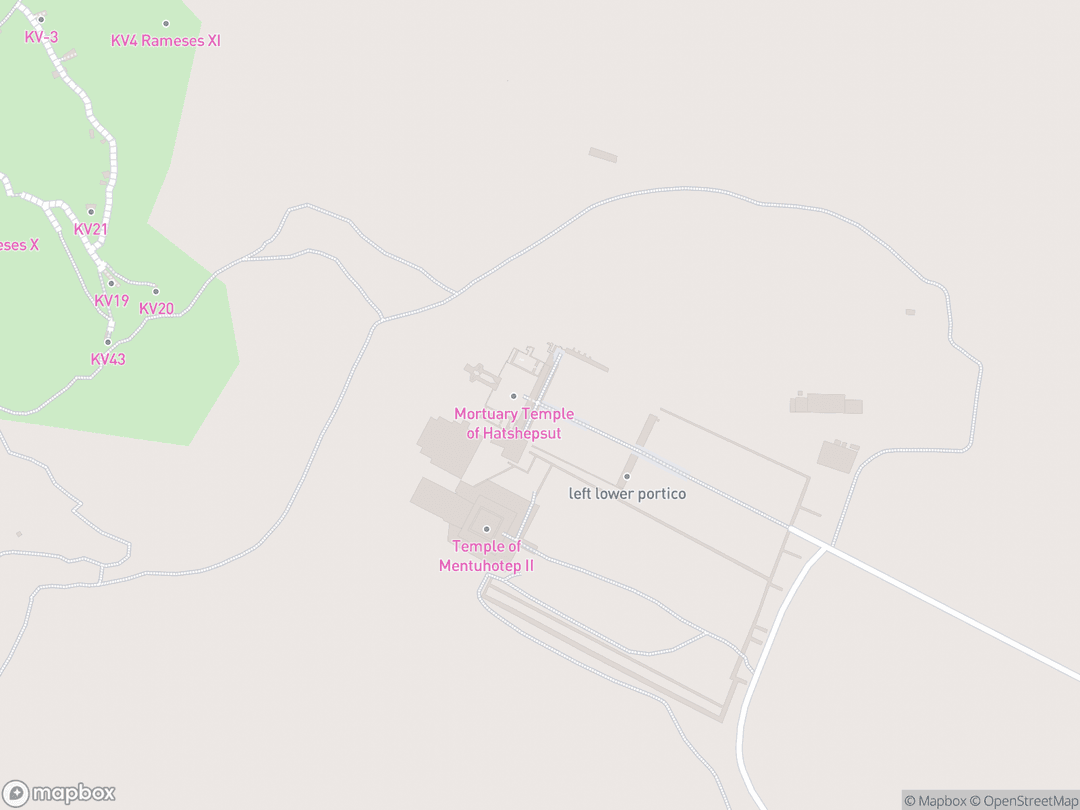
Deir el-Bahari, West Bank of Theban Necropolis, Luxor Governorate, Egypt
Hours: Daily 06:00 to 17:00 (winter) or 06:00 to 18:00 (summer)
Getting There: Located on Luxor's West Bank, accessible via taxi or ferry from Luxor East Bank.
Get DirectionsTips for Your Visit
Arrive at Opening
Enter at 06:00 AM to experience the rising sun lighting the facade while avoiding heavy tourist crowds.
Examine Colonnade Ceilings
Look upward inside the side chapels to view vivid blue ceilings adorned with yellow celestial stars.
Use the Electric Shuttle
Take the quick shuttle cart across the valley floor to conserve energy for the terrace ramps.
About
The Mortuary Temple of Hatshepsut, known anciently as Djeser-Djeseru or 'Holy of Holies,' stands as a supreme achievement of Eighteenth Dynasty New Kingdom architecture. Built into the natural amphitheater of Deir el-Bahari, it served as an eternal cult engine linking heaven and earth.
Consecrated primarily to Amun-Ra while honoring Hathor and Anubis, the complex functioned as a liturgical powerhouse to sustain cosmic harmony (Ma'at). Here, Pharaoh Hatshepsut performed sacred rites, legitimized her divine right of rule, and secured eternal deification alongside her royal ancestors.
Departing from enclosed pyramid complexes of earlier dynasties, the temple features dramatic colonnaded terraces aligned with Karnak across the Nile. Following centuries of reuse, neglect, and quarrying, meticulous multinational archaeological conservation has resurrected its colonnades as an enduring testament to ancient Egyptian sacred geometry.
Gallery
Symbolic Elements
The temple's exterior features intricate carvings, each rich with spiritual meaning:

Proto-Doric Polygonal Columns
Sixteen-sided fluted limestone shafts evoke stylized plant stalks while echoing the vertical cliff lines.

Hathoric Sistrum Capitals
Carved cow-eared faces of goddess Hathor signify cosmic fertility and divine motherly shelter.
Osiride Royal Pillars
Monumental mummiform statue pillars present the sovereign united with Osiris in eternal triumph over mortality.
Divine Solar Barque
Relief carvings of Amun-Ra's sacred Userhat boat illustrate cyclic divine movement across heaven and underworld.
Wadjet Uraeus Serpents
Sculpted cobras coiled on ramp balustrades embody solar fury and celestial guardianship of the pharaoh.
Suckling Cow of Hathor
Wall reliefs depicting the monarch drinking divine milk express royal legitimacy derived directly from the goddess.

Sacred Myrrh Trees of Punt
Relief depictions of fragrant saplings signify ritually purified space and the favor of Amun.
Interesting Facts
The temple's central axis points directly across the Nile toward the Eighth Pylon of Karnak (Tier B).
During the Winter Solstice sunrise, morning light strikes deep into the innermost sanctuary of Amun-Ra (Tier B).
Murals along the middle tier depict thirty-one living myrrh trees transported in baskets from Punt (Tier A).
Architect Senenmut secretly carved small kneeling portraits of himself behind the temple's chapel doors (Tier B).
The tiered architectural concept drew inspiration from Mentuhotep II's earlier adjacent mortuary complex (Tier B).
Smashed statues recovered from nearby quarry pits were painstakingly reassembled by twentieth-century teams (Tier B).
In the Ptolemaic Period, Greeks converted the upper sanctuary into a medical healing center (Tier B).
The modern name Deir el-Bahari honors the 7th-century Christian monastery of Saint Phoibammon (Tier B).
Subterranean bedrock pits on the terraces still retain roots from trees planted over three millennia ago (Tier B).
More than sixty years of Polish-Egyptian anastylosis reconstructed the standing upper colonnades seen today (Tier B).
Common Questions
Why was this temple built at Deir el-Bahari?
Architect Senenmut utilized the natural limestone amphitheater to visually mirror the adjacent Middle Kingdom temple of Mentuhotep II.
Who was Hatshepsut?
She was an Eighteenth Dynasty female pharaoh who ruled Egypt as king for over two decades.
What is the meaning of Djeser-Djeseru?
The phrase translates anciently from Egyptian hieroglyphs as 'Holy of Holies'.
Why were Hatshepsut's statues destroyed?
Later successors ordered a memory erasure to reinforce dynastic legitimacy for Thutmose III's lineage.
Can visitors enter the innermost sanctuary?
Yes, visitors can walk up the central ramps to enter the rock-hewn Sanctuary of Amun-Ra.
Featured Stories
The Royal Architect's Hidden Devotion
1465 BCE
Chief Architect Senenmut designed Djeser-Djeseru with peerless mathematical symmetry into the Theban rock. In a daring act of personal devotion, he had secret portraits of himself carved behind the opened leaves of the inner chapel doors. These covert carvings allowed his soul to eternally witness the holy rites without infringing on royal prerogative.
Source: Polish-Egyptian Archaeological Mission Studies
The Voyage to the Fragrant Land of Punt
1464 BCE
Determined to supply the gods with pure incense, Hatshepsut dispatched five sailing vessels south along the Red Sea to Punt. The expedition returned with gold, ivory, baboons, and living frankincense trees potted in wicker baskets. Artisans immortalized every detail across the southern colonnade, establishing the ancient world's first illustrated botanical expedition.
Source: Theban Necropolis Epigraphic Surveys
Resurrecting Smashed Kings from the Asasif Pits
1923
Decades after Hatshepsut's death, royal work crews systematically demolished her monumental statues and hurled them into nearby ravines. In the 1920s, archaeologist Herbert Winlock excavated thousands of battered limestone and granite fragments from the Asasif quarry dumps. Conservators painstakingly assembled these pieces, restoring the sovereign's likeness after thousands of years in the sand.
Source: Metropolitan Museum of Art Excavation Records
Timeline
Temple Commissioning
Hatshepsut commissions architect Senenmut to initiate terracing works at Deir el-Bahari.
component.timeline.groundbreakingChapels Construction
Work progresses on the Middle Terrace shrines dedicated to Hathor and Anubis.
MilestonePunt Expedition Commemoration
Artisans carve detailed relief murals recording the successful maritime expedition to Punt.
MilestoneUpper Terrace Dedication
The Upper Terrace and rock-cut Sanctuary of Amun-Ra are consecrated prior to the pharaoh's death.
DedicationThutmosid Damnatio Memoriae
State agents systematically chisel away female royal pronouns and dismantle Hatshepsut's statues.
EventAmarna Period Defacement
Agents of Akhenaten excise images and inscriptions of the god Amun across the temple.
EventRamesside Restoration
Pharaoh Ramesses II restores damaged Amun reliefs and repairs terrace masonry.
RenovationPtolemaic Sanatorium
Ptolemaic builders add a granite sanctuary vestibule dedicated to the healer sages Imhotep and Amenhotep.
RenovationCoptic Monastery Established
Christian monks build the monastery of Saint Phoibammon directly atop the upper terrace ruins.
EventExcavations by Naville
The Egypt Exploration Fund begins modern clearances by dismantling the deteriorated monastery.
EventWinlock Sculpture Discoveries
Metropolitan Museum excavators unearth hundreds of smashed statue fragments in the Asasif pits.
MilestonePolish-Egyptian Conservation Launch
The University of Warsaw mission initiates long-term architectural anastylosis across the terraces.
RenovationHistory by Decade
1470s–1450s BCE — Construction of Djeser-Djeseru
I have made for him a temple in the Mountain of the West, exceeding that which was before.
Pharaoh Hatshepsut and royal architect Senenmut transformed the cliffs of Deir el-Bahari into a sacred terraced complex. Laborers cut terraces into the living limestone and carved pristine relief murals honoring Amun-Ra.
1430s–1330s BCE — Successor Damnatio and Amarna Defacement
Thutmose III initiated a systematic purge removing Hatshepsut's royal name and breaking her colossi to solidify his lineage. Later during the Amarna Period, agents of Akhenaten defaced images of Amun throughout the complex.
1280s–1210s BCE — Ramesside Reconstruction
Nineteenth Dynasty monarchs Seti I and Ramesses II dispatched masons to Deir el-Bahari to repair neglected terraces. They recarved vandalized Amun glyphs and erected commemorative restoration markers across the porticoes.
1070s–200s BCE — Elite Necropolis to Ptolemaic Sanatorium
During the Third Intermediate Period, Theban priests converted upper chambers into intrusive family burial crypts. Ptolemaic rulers subsequently renovated the inner sanctuary, transforming the site into a healing center dedicated to Imhotep.
6th–7th Century CE — Monastic Occupation
Coptic Christians constructed the monastery of Saint Phoibammon directly on the ruined upper terrace, naming the locale Deir el-Bahari. Monks whitewashed pharaonic reliefs and erected mudbrick cells across the peristyle court.
1960s–Present — Modern Anastylosis and Conservation
The Polish Centre of Mediterranean Archaeology commenced a systematic conservation program beginning in 1961. Masons and epigraphers reassembled fallen colonnades and restored the Main Sanctuary of Amun-Ra for global visitors.
Architecture & Facilities
The Mortuary Temple of Hatshepsut represents the pinnacle of Eighteenth Dynasty New Kingdom sacred architecture. Designed by Senenmut, the complex abandons enclosed pylon courts in favor of three stepped, horizontal terraces that mirror the vertical striations of the Theban limestone cliffs. Its proto-Doric colonnades demonstrate advanced geometric planning aligned along celestial and liturgical axes across the Nile to Karnak.
Building Materials
Fine White Turah Limestone
Quarried across the Nile to construct delicate low-relief colonnade panels and exterior walls.
Aswan Pink Granite
Used for colossal royal doorways, interior sanctuary thresholds, and freestanding sphinx statues.
Violet Sandstone
Incorporated into foundational architrave blocks adapted from earlier adjacent Middle Kingdom ruins.
Lebanese Cedar
Hewn into monumental ceremonial double doors clad with shining sheets of electrum.
Interior Features
Main Sanctuary of Amun-Ra
Chiseled deep into the living cliff face along the winter solstice sunrise axis to house the sacred barque.
Chapel of Hathor
Rock-cut chamber adorned with sistrum capitals and murals of the divine cow sheltering the sovereign.
Chapel of Anubis
Hypostyle hall featuring twelve sixteen-sided columns and star-painted ceilings honoring the embalmer god.
Solar Cult Court
Open-air upper terrace courtyard centered around a massive elevated limestone altar honoring Ra-Horakhty.
Temple Grounds
The temple grounds are dramatically framed by the semi-circular amphitheater of Deir el-Bahari beneath the natural pyramid peak of El-Qurn. Senenmut engineered subterranean conduits to irrigate lush terrace groves of imported myrrh trees and papyrus, while an avenue of one hundred sphinxes linked the complex to the Nile floodplain.
Additional Facilities
Modern site amenities include an air-conditioned visitor center, shaded pavilions, transit stops, and an electric shuttle system.
Religious Significance
In ancient Egyptian theology, the temple served as a physical axis mundi where divine order was perpetually renewed against cosmic chaos. Dedicated as a 'Mansion of Millions of Years,' Djeser-Djeseru was an active liturgical station designed to sustain the vitality of Amun-Ra, preserve royal ancestors, and uphold cosmic balance (Ma'at).
To serve as the eternal cultic center for Amun-Ra and perpetual divine rebirth theater for Pharaoh Hatshepsut.
Sacred Ordinances
The Beautiful Feast of the Valley
An annual sacred festival where the golden cult statue of Amun crossed the Nile from Karnak to reside overnight in the temple's sanctuary.
Daily Ritual Offerings
Liturgical ceremonies where priests anointed cult statues with incense, pure water, fine linen, and food provisions to nourish divine spirits.
Offering of Ma'at
The primary royal ritual where the pharaoh offered a small figure of truth to the gods, signifying righteous governance and order.
Theogamy and Divine Birth
Murals in the northern colonnade depict the divine conception of Hatshepsut, illustrating Amun-Ra visiting her mother Queen Ahmose. This theology elevated Hatshepsut's kingship beyond mortal inheritance to establish her direct biological daughterhood with the king of the gods.
Hathor and the Theban Necropolis
As Lady of the Western Mountain, Hathor acted as the celestial bridge between the desert realm of the dead and the living valley. Her chapel guaranteed the perpetual rejuvenation of royal and divine spirits through sacred music and motherly protection.
Sources & Research
Every fact on Temples.org is backed by verified Sources & Research. Each piece of information is rated by source tier and confidence level.
View All Sources (8)
| Field | Source | Tier | Retrieved |
|---|---|---|---|
| About & Historical Background | University of Warsaw (opens in a new tab) | B | 2026-03-31 |
| Archaeological Excavations & Restorations | Biblioteka Nauki (opens in a new tab) | B | 2026-03-31 |
| Conservation & Anastylosis | Interdisciplinary Centre for Mathematical and Computational Modelling (opens in a new tab) | B | 2026-03-31 |
| Architectural & Geometrical Analysis | Multidisciplinary Digital Publishing Institute (opens in a new tab) | B | 2026-03-31 |
| Epigraphy & Relief Studies | ResearchGate Network (opens in a new tab) | B | 2026-03-31 |
| Polish Centre of Mediterranean Archaeology Publications | Warsaw University Press (opens in a new tab) | B | 2026-03-31 |
| Terrace Stratigraphy & Geology | Gemarkt Earth Sciences (opens in a new tab) | B | 2026-03-31 |
| World Heritage Documentation | UNESCO World Heritage Centre (opens in a new tab) | B | 2026-03-31 |