Visitor Insights
Visiting Church of Our Lady Mary of Zion
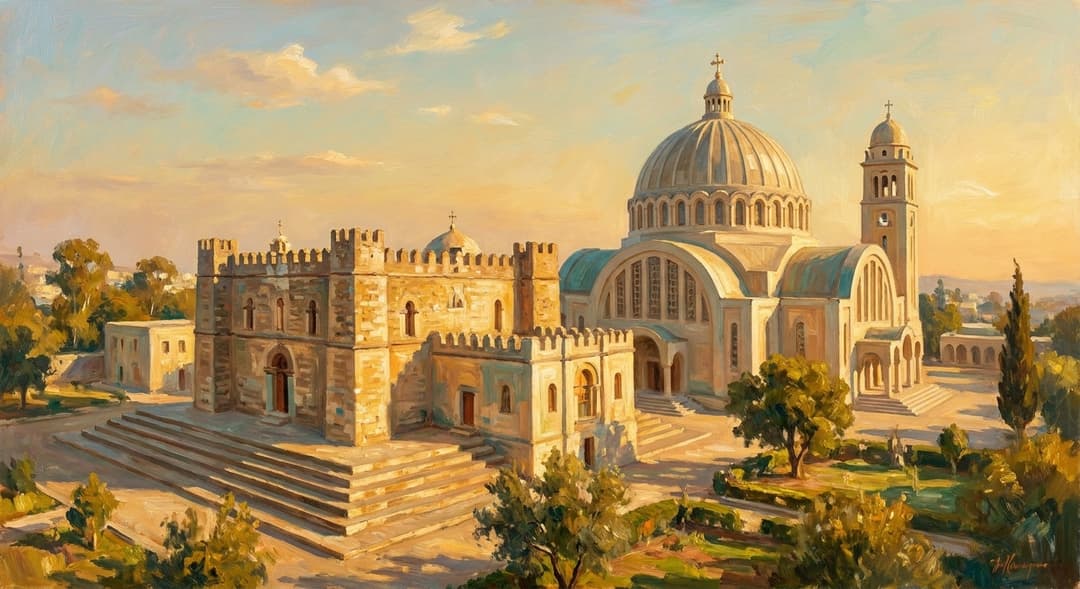
The Church of Our Lady Mary of Zion is an active sacred precinct welcoming pilgrims and international visitors to its historic courtyards. Strict ecclesiastical protocols govern entrance across the various shrines, honoring ancient monastic traditions. Visitors should arrive early in the morning to witness traditional liturgical chants and prayer rites.
Highlights
- Marvel at the 17th-century crenellated Gondarine stonework of the Old Church.
- View the imperial gold coronation crowns inside the protected Treasury Museum.
- Walk alongside the ancient carved stone Thrones of Aksum where monarchs were crowned.
Things to Know
- The 17th-century Old Church interior is accessible strictly to male visitors.
- The Chapel of the Tablet is entirely closed to the public and guarded by a solitary monk.
- Modest white attire and removal of shoes before entering carpeted spaces are strictly required.
Location
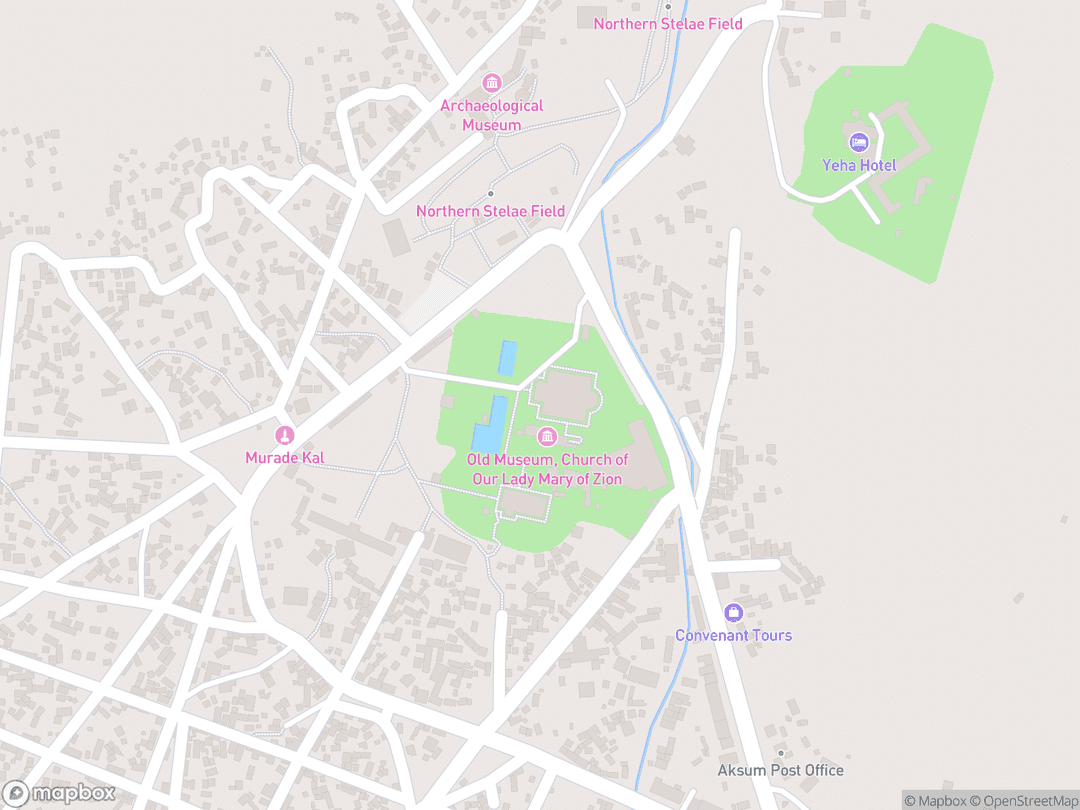
Church of Our Lady Mary of Zion, Aksum, Central Zone, Tigray, Ethiopia
Hours: Daily from 06:00 to 18:00 with early liturgical services starting at 04:00
Getting There: Located in central Aksum opposite the Northern Stelae Field, accessible by domestic flight to Axum Airport and local bajaj taxi.
Get DirectionsTips for Your Visit
Wear Traditional White Attire
Dress in modest white garments or wrap your shoulders in a white cotton netela before entering.
Respect Sacred Boundaries
Pilgrims may venerate the Chapel of the Tablet only from the exterior wrought-iron perimeter fence.
Plan for Major Feast Days
Visit on November 30 for Hidar Tsion or January 19 for Timkat to witness monumental prayer processions.
About
The Church of Our Lady Mary of Zion in Aksum stands as the primordial spiritual mother church of the Ethiopian Orthodox Tewahedo Church. Founded during the 4th century under King Ezana and Saint Frumentius, it represents the earliest known Christian cathedral precinct in sub-Saharan Africa.
According to Ethiopian sacred history in the Kebra Nagast, Emperor Menelik I brought the original Ark of the Covenant from Jerusalem to Aksum. Every consecrated Ethiopian sanctuary houses a tabot replica, deriving its sanctification directly from this foundational throne of Zion.
The sacred precinct encompasses the 17th-century fortress cathedral erected by Emperor Fasilides, the freestanding Chapel of the Tablet, and the expansive 20th-century New Cathedral commissioned by Emperor Haile Selassie I. It remains an active global pilgrimage center and the historic coronation sanctuary of Ethiopian monarchs.
Gallery
Symbolic Elements
The temple's exterior features intricate carvings, each rich with spiritual meaning:

Tabote Seyon
The sacred Ark of the Covenant representing the divine presence and typological archetype of Mary.
Twelve-Pointed Ethiopian Cross
Adorns roof finials and processional staves, symbolizing Christ and the Twelve Apostles uniting both Covenants.
Maryam Tsiyon Iconography
Devotional depictions of the Virgin Mary wearing royal blue with large eyes symbolizing watchful tenderness.

Thrones of Aksum
Carved granite seats representing the enduring covenant between Solomonic state sovereignty and the Church.
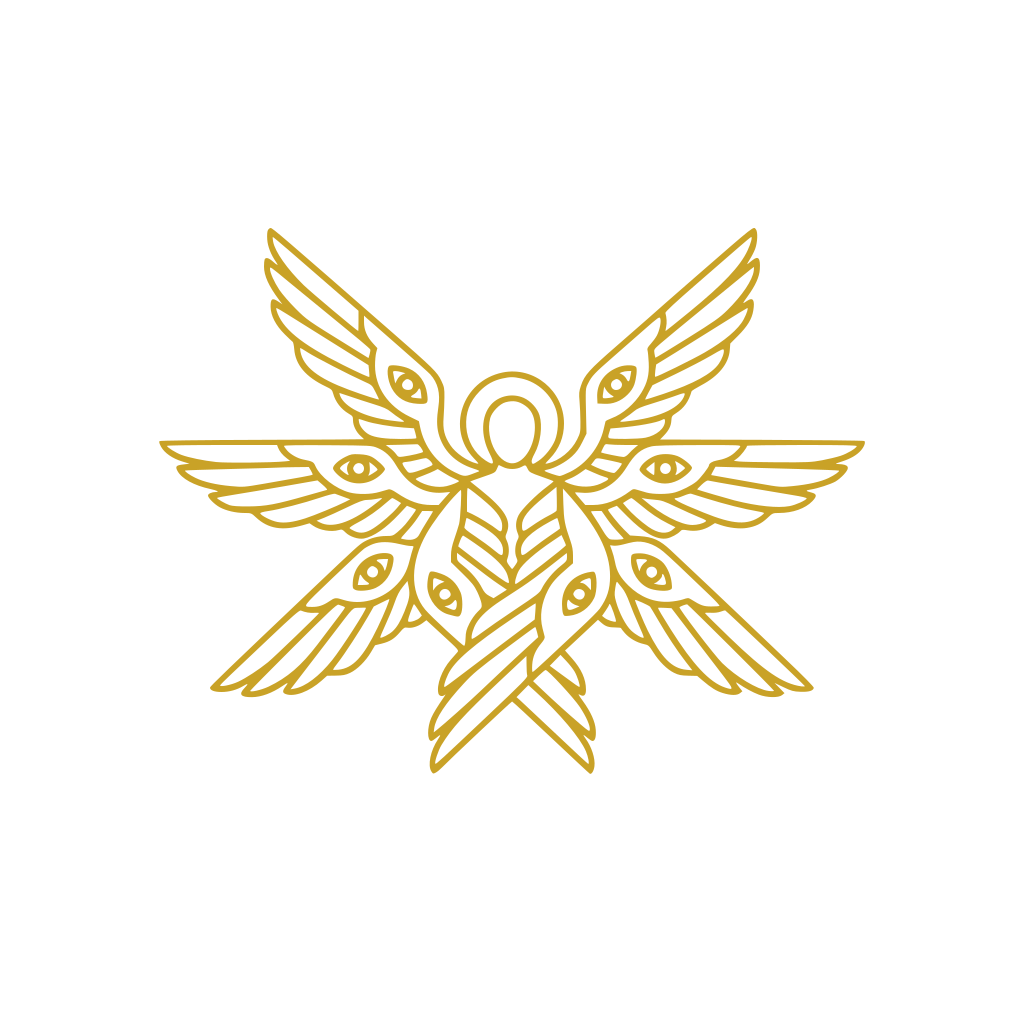
Six-Winged Seraphim
Ceiling murals of multi-eyed celestial cherubim signifying heavenly watchers guarding the altar.
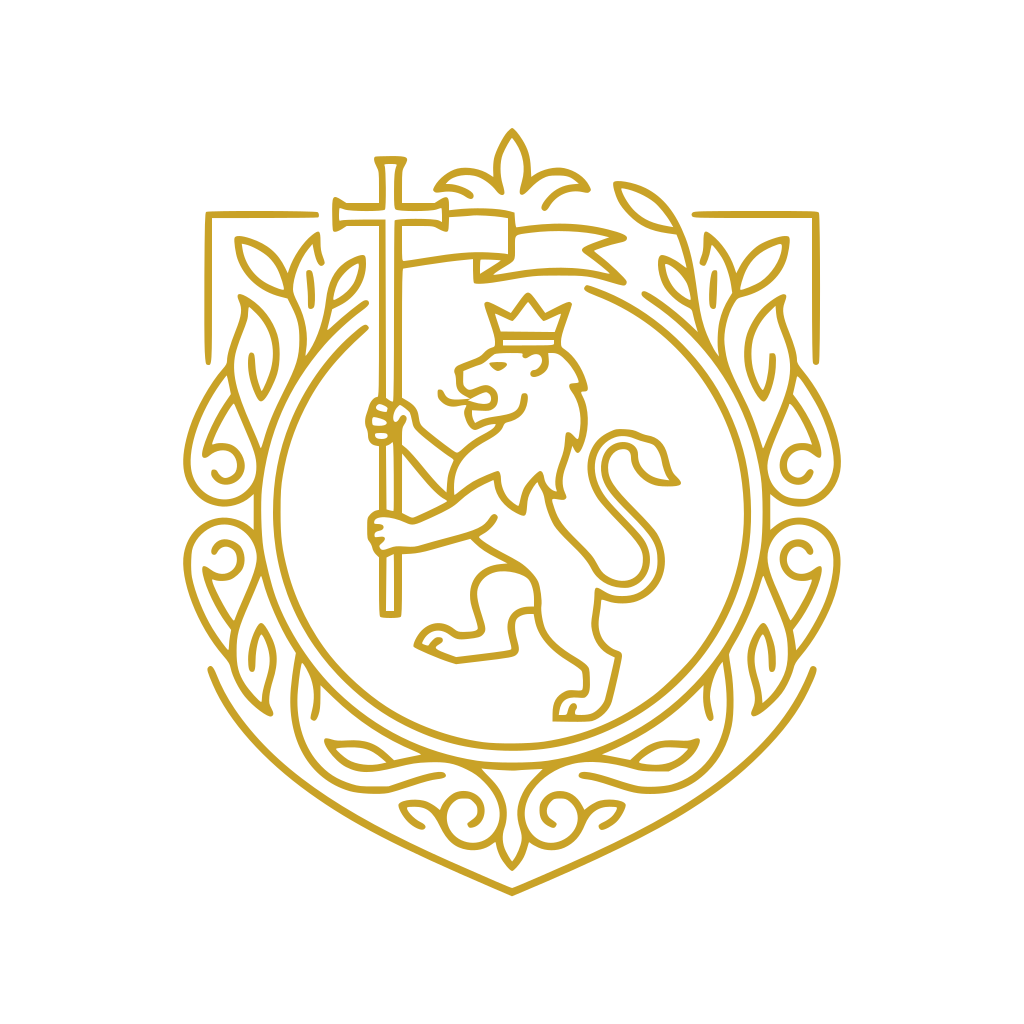
Lion of Judah Crest
Imperial heraldic brass emblem commemorating the Davidic lineage claimed by Ethiopian royalty.

Stepped Aksumite Plinth
Monumental tiered stone foundation demonstrating an unbroken 1,700-year continuity of Christian worship.
Interesting Facts
The designated guardian monk lives as a lifelong hermit and may never leave the chapel compound until death (Tier A).
For nearly a millennium an Ethiopian sovereign could not bear the full imperial title of Atse without coronation here (Tier B).
During her 1965 state visit Queen Elizabeth II respected gender protocols by worshipping only in the New Cathedral (Tier B).
The Treasury Museum protects dozens of solid gold crowns dedicated by abdicating Ethiopian monarchs to the Virgin Mary (Tier A).
The fortified Old Church rests directly upon a twelve-stepped megalithic stone platform built around 340 CE (Tier B).
Monks successfully hid the sacred Ark on volcanic islands in Lake Tana for decades during the 16th-century wars (Tier A).
The original 4th-century basilica was the earliest recorded formal Christian cathedral constructed in sub-Saharan Africa (Tier B).
Monastic accounts tell that the Ark was relocated to its modern chapel because sacred heat cracked older stone walls (Tier C).
Common Questions
Is the Ark of the Covenant really kept at Mary of Zion?
Ethiopian Orthodox Tewahedo tradition holds that the authentic Ark of Moses has been preserved here for millennia.
Can visitors see the Ark of the Covenant?
No, the Ark is never shown to the public and is viewed solely by its lifelong guardian monk.
Why are women not permitted inside the Old Church?
The Old Church follows ancient monastic cloister rules honoring the Virgin Mary as the sole female presence in that sanctuary.
Where do female pilgrims worship in the precinct?
Women participate fully in liturgical services within the spacious 1964 New Cathedral and outer courtyards.
Featured Stories
The Royal Flight to Lake Tana
1535
When military forces under Ahmad Grañ descended upon Aksum to dismantle its historic cathedral, brave priests spirited the Ark away through mountain passes under cover of darkness. They ferried the sacred relic south to the secluded island of Tana Qirqos on Lake Tana, sheltering it safely for decades until the highland sanctuary could be secured once again.
Source: Ethiopian Orthodox Tewahedo Church Historical Archives
The Lifelong Custodian of the Tablet
1965
Upon being chosen by the monastic assembly, the guardian monk of Mary of Zion enters the Chapel of the Tablet under an irrevocable lifetime vow never to set foot outside its courtyard fence. Dedicating every waking hour to perpetual prayer, he alone attends the holy relic and quietly selects his own successor before departing this earthly life.
Source: Diocese of Aksum Custodial Records
A Royal Promise and the New Cathedral
1964
Having witnessed Ethiopia endure foreign occupation during the 1930s, Emperor Haile Selassie I fulfilled a solemn vow of liberation by constructing the expansive New Cathedral of Mary of Zion. Built to welcome both women and men equally, the basilica was formally dedicated in the presence of national and international dignitaries as an enduring monument to faith.
Source: Imperial Ethiopian Ministry of Works Dedicatory Inscriptions
Timeline
Initial Cathedral Consecrated
King Ezana converts to Christianity and commissions a twelve-aisled stone cathedral dedicated to Mary.
component.timeline.groundbreakingVotive Royal Offerings
King Kaleb dedicates imperial votive crowns to the cathedral prior to his military expedition across the Red Sea.
EventDestruction by Queen Gudit
The original 4th-century cathedral is burned during regional upheavals while clergy rescue the sacred Ark.
EventSolomonic Restoration
Reestablished Solomonic rulers restore shrines atop the ancient stepped platform in Aksum.
RenovationSack of Aksum
Forces under Ahmad Grañ demolish the rebuilt complex, prompting priests to shelter the Ark on Lake Tana.
EventGondarine Reconstruction
Emperor Fasilides builds the fortified stone Old Church that stands on the Aksumite podium today.
DedicationImperial Coronation of Yohannes IV
Emperor Yohannes IV receives his imperial crown on the granite coronation thrones of Mary of Zion.
MilestoneConsecration of the New Cathedral
Emperor Haile Selassie I dedicates the monumental New Cathedral, providing full liturgical access for women.
DedicationChapel of the Tablet Built
Empress Menen Asfaw funds the dedicated freestanding sanctuary to permanently house the Ark of the Covenant.
MilestoneUNESCO World Heritage Inscription
The religious precinct and archaeological ruins of Aksum receive formal inscription as a UNESCO World Heritage Site.
MilestoneHistory by Decade
340s — The Foundation of Ezana
Ezana laid the stone foundations of Zion so that the true faith would endure across all generations.
Following King Ezana's conversion to Christianity under Saint Frumentius, royal stonemasons erected a monumental twelve-aisled basilica on a tiered platform. This pioneering structure established Aksum as the sacred metropolitan heart of Christian Ethiopia.
960s — The Crucible of Gudit
During the collapse of the Aksumite kingdom, non-Christian forces led by Queen Gudit burned the ancient 4th-century cathedral to the ground. Monks evacuated the Holy Ark to southern mountain refuges, preserving the relic while Aksum's urban power waned.
1530s — Exile During the Adal War
During the campaigns of Ahmad Grañ, the rebuilt sanctuary suffered severe demolition. Devoted clergy smuggled the Ark across highland ravines to Lake Tana's monastic islands, guarding it in exile until imperial stability returned.
1660s — The Gondarine Fortress Rises
Upon the ancient stones of King Ezana, Fasilides raised a fortress of prayer that no invader could dismantle.
Emperor Fasilides commissioned a full reconstruction, building the defensive crenellated stone cathedral that stands today. He placed the fortified sanctuary directly atop the surviving twelve-stepped Aksumite foundation platform.
1870s — Imperial Coronations Renewed
Emperor Yohannes IV celebrated his grand coronation at Mary of Zion, reviving ancient traditions on the granite thrones. His reign elevated Aksum's national prestige and reinforced its role as the crowning seat of Ethiopian royalty.
1960s — Modernity and Sacred Separation
Emperor Haile Selassie I and Empress Menen Asfaw modernized the precinct by adding the New Cathedral and the Chapel of the Tablet. This landmark expansion granted equal liturgical access to female pilgrims while securing the Ark in its dedicated sanctuary.
Architecture & Facilities
The architectural precinct of Mary of Zion embodies a seventeen-century evolution combining 17th-century Gondarine fortress masonry, ancient Aksumite megalithic foundations, and mid-20th-century Neo-Byzantine basilica design.
Building Materials
Basalt and Granite Ashlar
Megalithic blocks quarried from Tigrayan hills compose the 4th-century foundation plinth and coronation thrones.
Mortared Rubble Stone
Local dressed fieldstone bound by lime mortar forms the defensive exterior walls of the 1665 Old Church.
Reinforced Concrete
Cast concrete piers support the expansive central drum and ribbed hemispherical dome of the New Cathedral.
Indigenous Juniper and Olive
Hand-carved timbers frame the massive interior ceiling trusses, lintels, and sanctuary doors of the Old Church.
Interior Features
Qene Mahlet
The outer western cantors chamber where clergy chant sacred liturgical hymns with drums and prayer staffs.
Qeddeste
The intermediate holy chamber adorned with colorful canvas icons where pilgrims receive Holy Communion.
Maqdas
The square inner sanctuary containing the consecrated altar throne entered solely by ordained clergy.
Central Rotunda
The vast circular auditorium of the New Cathedral crowned by a fresco of the Holy Trinity and Apostles.
Temple Grounds
The landscaped plateau precinct includes broad flagstone walkways, ancient acacia trees, twelve carved granite coronation thrones, and ceremonial stone stairs ascending to the Old Church.
Additional Facilities
A secure on-site Treasury Museum pavilion houses ancient imperial crowns, gold vestments, and illuminated Ge'ez manuscripts beside a modernist freestanding bell tower.
Religious Significance
To the Ethiopian Orthodox Tewahedo Church, Mary of Zion is the living holy of holies where the divine covenant remains tangibly linked with the maternal protection of the Virgin Mary.
The complex serves as the spiritual fountainhead from which all Ethiopian tabotat draw legitimacy and the perpetual resting place of the Ark of the Covenant.
Sacred Ordinances
Qeddase (Divine Liturgy)
The Eucharistic consecration solemnized with traditional hymns, incense, and the veneration of the altar tabot.
Zema (Sacred Chant)
Choral liturgical chants composed by Saint Yared performed using drums, sistra, and rhythmic wooden staffs.
Hidar Tsion Pilgrimage
The annual festival commemorating the arrival of the Ark, celebrated with night vigils and massive choral processions.
The Tabot Tradition
Every consecrated altar across Ethiopia requires an anointed tabot replica, deriving its sacramental grace from the primordial Tabote Seyon preserved at Aksum.
The Royal Solomonic Legacy
For over a thousand years, Ethiopian monarchs validated their divine right to govern by receiving their crown upon the ancient granite thrones of Mary of Zion.
Sources & Research
Every fact on Temples.org is backed by verified Sources & Research. Each piece of information is rated by source tier and confidence level.
View All Sources (8)
| Field | Source | Tier | Retrieved |
|---|---|---|---|
| About & Historical Background | UNESCO World Heritage Centre (opens in a new tab) | B | 2026-02-18 |
| About & Historical Background | Ethiopian Orthodox Tewahedo Church (opens in a new tab) | A | 2026-02-18 |
| Architecture & Relic Tradition | The Metropolitan Museum of Art (opens in a new tab) | B | 2026-02-18 |
| Religious Significance & Liturgy | Ethiopian Orthodox Tewahedo Patriarchate (opens in a new tab) | A | 2026-02-18 |
| Timeline & Royal Heritage | Encyclopaedia Britannica (opens in a new tab) | B | 2026-02-18 |
| Historical Records & Inscriptions | Ethiopian Orthodox Tewahedo Church Faith and Order (opens in a new tab) | A | 2026-02-18 |
| Visitor Insights & Access Rules | Ethiopian Ministry of Tourism (opens in a new tab) | D | 2026-02-18 |
| Chapel Treasury & Architecture | Atlas Obscura (opens in a new tab) | C | 2026-02-18 |