Visitor Insights
Visiting Chartres Cathedral
Chartres Cathedral welcomes pilgrims and tourists daily with free access to its soaring High Gothic nave. Guided tours explore the ancient Romanesque crypt, while the separate northern bell tower ascent affords sweeping vistas across the Beauce plains.
Highlights
- The 12th-century Sancta Camisia relic displayed in the ambulatory treasury.
- Original 13th-century stained glass windows including the iconic Chartres Blue.
- The celebrated nave floor labyrinth available for meditative walking on designated days.
- The ornate 16th-century sculptured choir enclosure screen by Jehan de Beauce.
Things to Know
- Access to the subterranean crypt requires joining an official guided tour.
- The nave labyrinth is uncovered and accessible primarily on Fridays between Lent and November.
- Modest dress and respectful silence are requested during active liturgical services.
Location
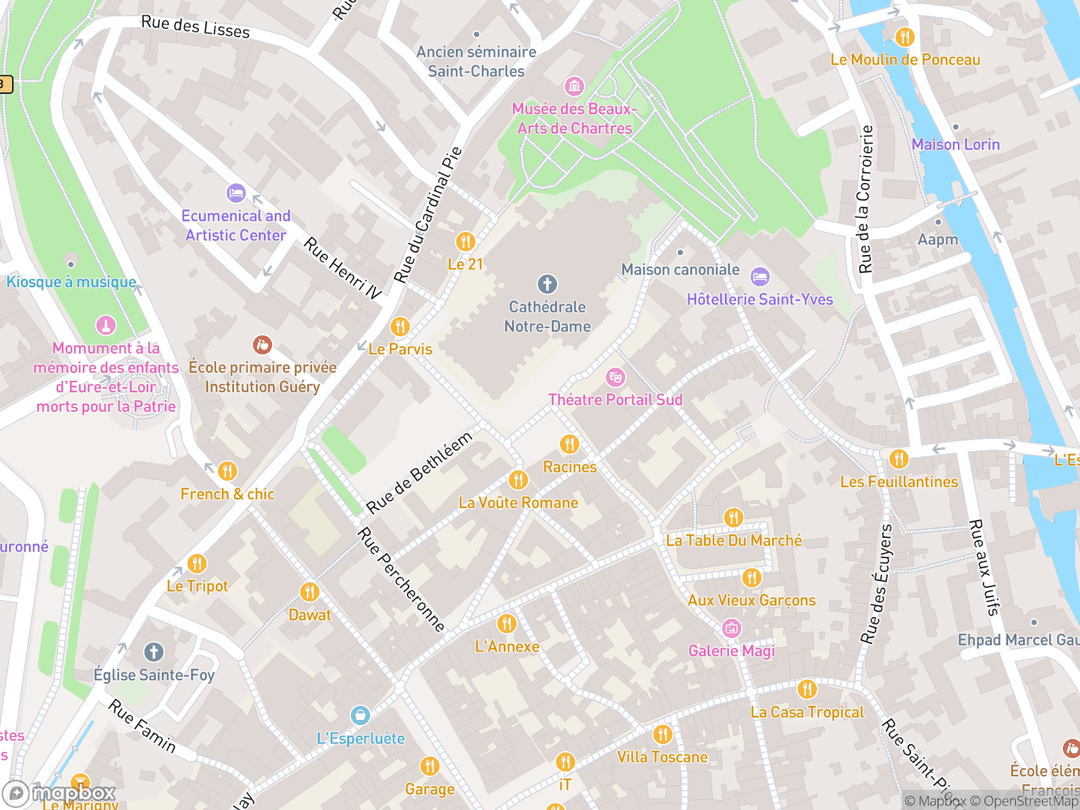
16 Cloître Notre-Dame, 28000 Chartres, France
Hours: Open daily from 8:30 AM to 7:30 PM (closes 7:00 PM November through February).
Getting There: Direct TER regional trains run hourly from Paris-Montparnasse to Gare de Chartres, followed by a 7-minute uphill walk.
Get DirectionsTips for Your Visit
Time Your Stained Glass Viewing
Visit during bright mornings to see eastern choir lancets glow, or late afternoon for the western rose window.
Walk the Stone Labyrinth
Visit on Fridays when nave chairs are cleared, and remember to remove footwear before tracing the contemplative path.
Book Crypt Excursions Early
Join the official cathedral-guided tour in advance to access the extensive 11th-century Romanesque crypt.
About
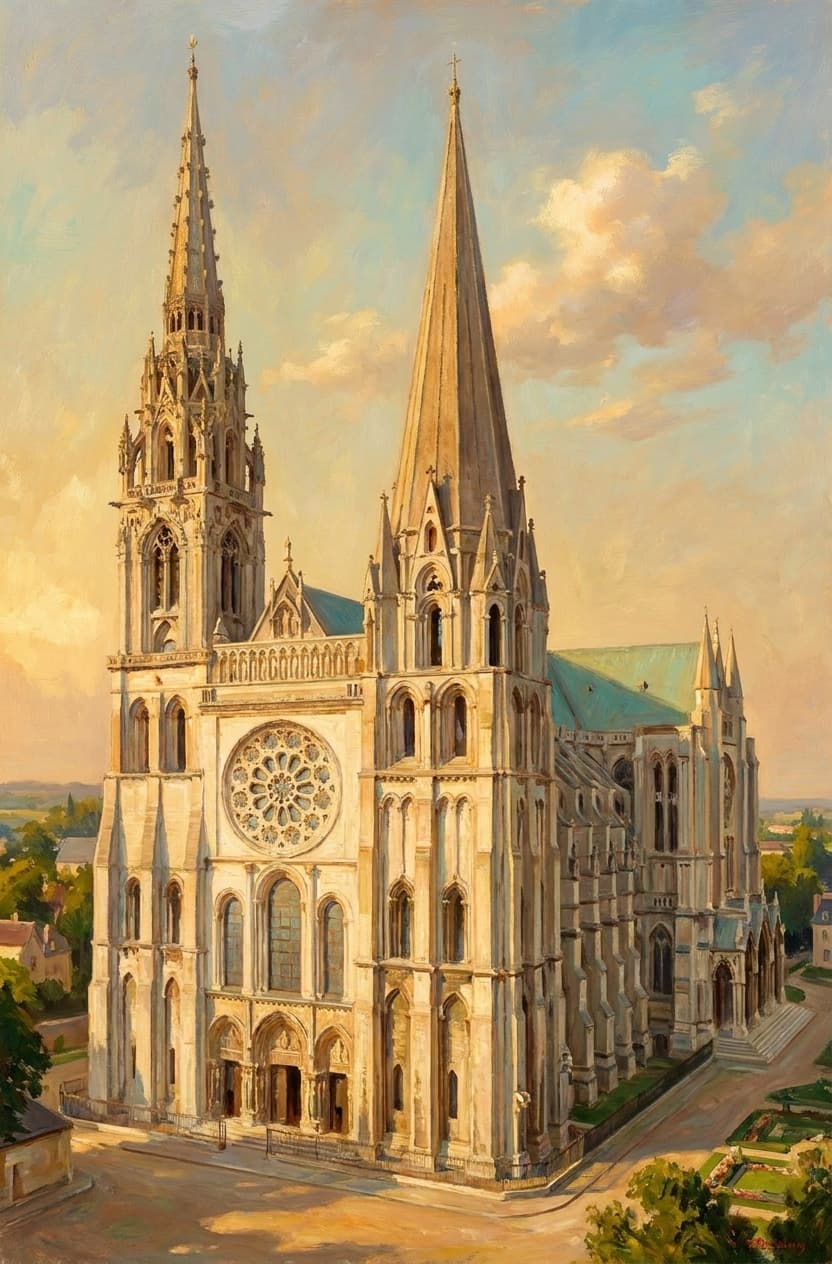
Standing majestically over the Beauce plains, Chartres Cathedral is universally celebrated as the crown jewel of High Gothic architecture. Rebuilt following a devastating fire in 1194, the sanctuary translates Christian metaphysics and heavenly harmony into soaring stone and luminous colored glass.
Long revered as the terrestrial palace of the Virgin Mary, the cathedral houses the Sancta Camisia, the sacred tunic believed to have been worn by Mary during the Nativity of Christ. This revered relic drew thousands of medieval pilgrims seeking maternal intercession beneath her celestial canopy.
Beyond its sacred relics, Chartres exemplifies architectural mastery through its pioneering flying buttresses, four-part rib vaults, and legendary blue stained glass. Today, it remains an active Catholic episcopal cathedral and an enduring monument to human faith and sacred geometry.
Gallery
Symbolic Elements
The temple's exterior features intricate carvings, each rich with spiritual meaning:

The Nave Labyrinth
The 13th-century unicursal floor labyrinth represents the arduous spiritual pilgrimage of the Christian soul toward divine salvation in the heavenly Jerusalem.

The Sancta Camisia
The sacred tunic relic symbolizes the maternal protection of the Virgin Mary and the historic reality of the Incarnation of Jesus Christ.

Chartres Blue Stained Glass
The vibrant cobalt-derived blue glass symbolizes heavenly grace and divine illumination penetrating earthly human reality.

Royal Portal Jamb Statues
Elongated column figures of Old Testament kings and queens symbolize the prophetic foundation supporting the New Covenant of Christ.

The Western Rose Window
The 12-meter circular rose depicts the Last Judgment, symbolizing Christ at the cosmic center of human salvation history.

Asymmetric Twin Spires
The contrast between the 105-meter Romanesque spire and 113-meter Flamboyant Gothic spire symbolizes the historic evolution of medieval architectural devotion.

Guild Donor Panels
Stained glass scenes displaying bakers, vintners, and masons symbolize the sanctification of daily human labor within God's kingdom.

North Porch Ark of the Covenant
Carvings of the Ark of the Covenant on the northern porch symbolize Mary as the living vessel who carried the divine Word.
Interesting Facts
The cathedral preserves over 2,600 square meters of original thirteenth-century stained glass across 176 surviving windows. (Tier A)
The distinctive blue tone of Chartres glass was achieved using rare cobalt oxide imported from Central European mines. (Tier B)
During World War II, curators systematically dismantled every stained glass window and hid them in underground vaults to prevent damage. (Tier A)
American Colonel Welborn Griffith saved the cathedral from Allied artillery bombardment in 1944 by verifying it was free of enemy snipers. (Tier B)
Henri IV was the only king of France crowned at Chartres instead of the traditional coronation site of Reims. (Tier A)
If the western facade were folded flat onto the floor, the center of the western rose window would align precisely with the floor labyrinth. (Tier B)
The 1836 roof fire destroyed the medieval timber attic, prompting engineers to build one of Europe's earliest cast-iron roof frameworks. (Tier B)
The subterranean crypt is the largest Romanesque crypt in France, tracing the foundations laid by Bishop Fulbert in 1020. (Tier A)
Medieval trade guilds including bakers, shoemakers, and vintners funded and appeared depicted within forty-two of the stained glass panels. (Tier B)
Common Questions
Is admission to Chartres Cathedral free?
Access to the main cathedral nave is free to all visitors daily, though tickets are required for the crypt tour and tower climb.
When is the nave labyrinth open to walk?
The labyrinth is uncovered and accessible for walking on Fridays between Lent and November.
Why are the two western spires completely different?
The 105-meter southern spire is plain twelfth-century Romanesque, while the 113-meter northern spire was rebuilt in sixteenth-century Flamboyant Gothic after a lightning strike.
What is the most famous relic housed in Chartres Cathedral?
The cathedral houses the Sancta Camisia, a sacred cloth relic believed to be the tunic worn by the Virgin Mary during the birth of Jesus.
How long does it take to travel from Paris to Chartres?
Direct regional trains from Paris-Montparnasse reach Chartres Station in approximately one hour.
Featured Stories
The Miracle of the Preserved Veil
June 10, 1194
When a catastrophic fire gutted the Romanesque cathedral in 1194, citizens despaired that their most precious relic, the Virgin's tunic, had burned to ashes. Three days later, heroic clerics emerged unhurt from the crypt trapdoor holding the sacred garment completely intact. This dramatic salvation inspired princes, guilds, and peasants to unite and fund the High Gothic masterpiece.
Source: Diocese of Chartres Historical Archives
The Lone American Soldier Who Saved Chartres
August 16, 1944
During the Allied liberation of France, artillery batteries prepared to bombard Chartres Cathedral to eliminate suspected German snipers in the spires. Colonel Welborn Barton Griffith, Jr. refused to destroy the sacred edifice without proof and bravely drove past enemy lines to investigate alone. After searching the silent crypt and climbing the north belfry, he confirmed no Germans were present and canceled the artillery barrage hours before dying in nearby combat.
Source: United States Army Military History Institute
The Unprecedented Coronation of Henri IV
February 27, 1594
Throughout French history, kings were traditionally anointed at Reims Cathedral, but the Wars of Religion left Reims under hostile Catholic League control. Seeking immediate legitimacy, King Henri IV chose Chartres Cathedral as the sacred setting for his royal consecration. Utilizing holy chrism attributed to Saint Martin of Tours, he became the only French monarch crowned within the sanctuary.
Source: French National Heritage Records
Timeline
Gift of the Sacred Tunic
Emperor Charles the Bald presents the relic of the Virgin Mary's veil to the diocese, establishing Chartres as a primary Marian pilgrimage destination.
MilestoneRomanesque Basilica Foundation
Following a catastrophic fire, Bishop Fulbert initiates construction on a massive Romanesque cathedral and extensive subterranean crypt.
component.timeline.groundbreakingConsecration of Fulbert's Cathedral
Bishop Thierry consecrates the completed Romanesque basilica dedicated to Our Lady.
DedicationCarving of the Royal Portal
Master sculptors begin crafting the western facade's Royal Portal, introducing pioneering naturalistic Early Gothic statues.
MilestoneThe Great Fire of Chartres
A cataclysmic blaze incinerates the city and gutting the Romanesque basilica, sparing only the crypt, west facade, and the sacred tunic.
MilestoneHigh Gothic Construction Campaign
Builders introduce pioneering flying buttresses and four-part rib vaults, setting the standard for High Gothic architecture across Europe.
MilestoneSolemn Dedication by Saint Louis
Bishop Pierre de Mincy formally consecrates the High Gothic cathedral in the presence of King Louis IX.
DedicationCompletion of the Flamboyant North Spire
Master mason Jehan de Beauce completes the replacement stone north spire in ornate Flamboyant Gothic style.
RenovationCoronation of King Henri IV
King Henri IV is anointed and crowned King of France in the cathedral during the French Wars of Religion.
EventCathedral Roof Fire
An accidental blaze destroys the ancient oak roof framework, which is later replaced by an innovative cast-iron structure.
RenovationHeroic Defense of Chartres
Colonel Welborn Griffith inspects the belfry under fire, verifying it is empty of German troops and preventing Allied artillery shelling.
EventUNESCO World Heritage Inscription
Chartres Cathedral is inscribed on the UNESCO World Heritage List as a masterpiece of human creative genius.
MilestoneHistory by Decade
870s–1010s — The Carolingian Sanctuary & Marian Gift
In 876, Emperor Charles the Bald gifted the Virgin Mary's sacred tunic to Chartres, transforming the regional church into Europe's premier Marian shrine. The Carolingian sanctuary withstood Norse Viking raids and welcomed thousands of faithful pilgrims seeking miraculous healing. Recurring blazes culminated in the catastrophic fire of 1020 that devastated the early sanctuary.
1020s–1030s — Fulbert's Romanesque Monument
Bishop Fulbert mobilized European nobility to construct a colossal Romanesque basilica, featuring the largest subterranean crypt in France. The extensive double-aisled crypt and fortified foundation established the permanent footprint for all future building campaigns. Consecrated in 1037, this Romanesque fortress stood as a triumphant symbol of eleventh-century spiritual renewal.
1140s–1180s — The Early Gothic Facade & Spire
Following localized fires, builders erected the western towers and the revolutionary Royal Portal between 1145 and 1155. Sculptors abandoned rigid Romanesque conventions to carve graceful, elongated jamb statues expressing profound spiritual humanism. By 1170, the monumental southern stone spire pierced the sky, completing an iconic transitional Early Gothic facade.
1190s–1250s — High Gothic Rebirth & Dedication
When cataclysmic flames gutted the cathedral in 1194, the survival of the Virgin's tunic within the crypt was hailed as a divine call for an incomparable sanctuary. Master builders introduced flying buttresses and eliminated tribune galleries, filling the expansive wall spaces with luminous cobalt glass. In October 1260, King Louis IX attended the solemn consecration of the completed High Gothic masterpiece.
1500s–1590s — Renaissance Flourishing & Royal Anointing
Lightning destroyed the northern wooden bell spire in 1506, prompting master mason Jehan de Beauce to erect an intricate stone Flamboyant Gothic spire. De Beauce also commenced carving the celebrated stone choir enclosure screen depicting the lives of Christ and the Virgin. In 1594, Henri IV chose the cathedral for his coronation, making it the sole venue outside Reims to crown a French monarch.
1830s–1940s — Calamity, Conservation & Wartime Rescue
An 1836 roof fire destroyed the ancient medieval timber framing, leading engineers to construct a pioneering fireproof cast-iron truss framework. In 1939, French curators dismantled and hid all 176 medieval stained glass windows before Nazi forces occupied the city. In August 1944, American Colonel Welborn Griffith personally inspected the vacant bell towers, saving the cathedral from imminent Allied artillery destruction.
Architecture & Facilities
Chartres Cathedral is the quintessential exemplar of High Gothic architecture, representing a transformative evolution from earlier transitional Gothic experiments. Its design integrates four-part quadripartite rib vaulting, the deliberate elimination of internal tribune galleries, and an exterior skeletal system of flying buttresses to maximize wall transparency and direct divine light through colossal clerestories.
Building Materials
Berchères Limestone
Dense, silicious freshwater limestone quarried eight kilometers away, providing exceptional compressive strength for slender vertical piers.
Lutetian Limestone
Fine-grained limestone transported from Parisian quarries, selected specifically for delicate figurative sculptures on portals and lintels.
Cast-Iron Roof Trusses
Pioneering non-combustible nineteenth-century industrial iron roof framework engineered by Émile Martin following the 1836 fire.
Rolled Copper Sheeting
Oxidized green copper plating covering the vast timberless roof attic, shielding the underlying medieval stone vaulting.
Cobalt Pot-Metal Glass
Thick hand-blown colored glass formulated with Central European cobalt oxide that produces the legendary and luminous Chartres Blue hue.
Interior Features
High Nave Vessel
Soaring 36.55-meter quadripartite ribbed vault supported by alternating round and octagonal colonnettes down an expansive 16.4-meter-wide central aisle.
The Nave Labyrinth
Historic eleven-circuit circular unicursal pavement laid in 1205 using dark Tournai limestone and white Berchères stone.
Subterranean Romanesque Crypt
Vast eleventh-century dual-aisled pilgrimage crypt housing the Saint Lubin chapel and the ancient 33-meter Puits des Saints-Forts well.
Choir Enclosure Screen
Monolithic sculptured stone barrier carved by Jehan de Beauce featuring forty elaborate biblical narrative tableaux.
Temple Grounds
The cathedral crowns a prominent limestone ridge above the Eure River, framed by the open cobblestone Parvis Notre-Dame and quiet canonical cloisters. Landscaped terraced gardens drop eastward toward the lower medieval town, offering unobstructed panoramic views of the soaring buttresses and asymmetric spires.
Additional Facilities
The complex includes the fourteenth-century detached Saint-Piat Chapel functioning as a diocesan treasury, alongside visitor reception facilities, bookstore pavilions, and the Centre International du Vitrail located within historical monastic outbuildings.
Religious Significance
Chartres Cathedral was conceived as the earthly court and palace of the Virgin Mary, serving as a primary sanctuary where mortal pilgrims encountered the divine through sacred geometry, holy relics, and transformed light.
To serve as the diocesan seat of the Bishop of Chartres and provide a sacred space for the Eucharistic liturgy, Marian veneration, and communal pilgrimage.
Sacred Ordinances
The Holy Sacrifice of the Mass
The daily Catholic celebration of the Eucharistic mystery uniting the gathered faithful with the sacrifice and resurrection of Jesus Christ.
Marian Pilgrimage & Intercession
Devotional veneration of the Sancta Camisia relic seeking the maternal prayers and protection of the Mother of God.
Sacrament of Reconciliation
Penitential confession of sins traditionally paired with contemplative prayer along the sacred nave labyrinth path.
Liturgy of the Hours
Chanted canonical prayers of psalms and scriptural readings offered throughout the liturgical day by the cathedral chapter.
Theology of Divine Light (Lux Nova)
Influenced by the School of Chartres, master builders designed the cathedral so physical sunlight passing through cobalt and ruby glass transformed into spiritual illumination, reminding believers of the Heavenly Jerusalem described in the Book of Revelation.
The Virgin Mary as the Seat of Wisdom
Chartres specifically venerates Mary as Sedes Sapientiae, the throne carrying incarnate Divine Wisdom, an idea mirrored across the Royal Portal where sacred scripture and the seven liberal arts unite under her maternal patronage.
Sources & Research
Every fact on Temples.org is backed by verified Sources & Research. Each piece of information is rated by source tier and confidence level.
View All Sources (10)
| Field | Source | Tier | Retrieved |
|---|---|---|---|
| About & Historical Background | Cathedral Administration of Chartres (opens in a new tab) | A | 2026-03-31 |
| Religious Significance & Liturgical Life | Diocese of Chartres (opens in a new tab) | A | 2026-03-31 |
| Featured Stories & Relic Documentation | Conférence des évêques de France (opens in a new tab) | A | 2026-03-31 |
| Religious Significance & Marian Theology | The Holy See (opens in a new tab) | A | 2026-03-31 |
| Architecture & Structural Evolution | UNESCO World Heritage Centre (opens in a new tab) | B | 2026-03-31 |
| Timeline & Historical Developments | World History Encyclopedia (opens in a new tab) | B | 2026-03-31 |
| Architecture & Construction Analysis | The Chartres Research Centre (opens in a new tab) | B | 2026-03-31 |
| Symbolic Elements & Iconography | Project Gutenberg (opens in a new tab) | B | 2026-03-31 |
| Visitor Insights & Nave Labyrinth | Sacred Destinations (opens in a new tab) | B | 2026-03-31 |
| History by Decade & Visual Culture | Culture D'Eye (opens in a new tab) | C | 2026-03-31 |