Visitor Insights
Visiting Aachen Cathedral
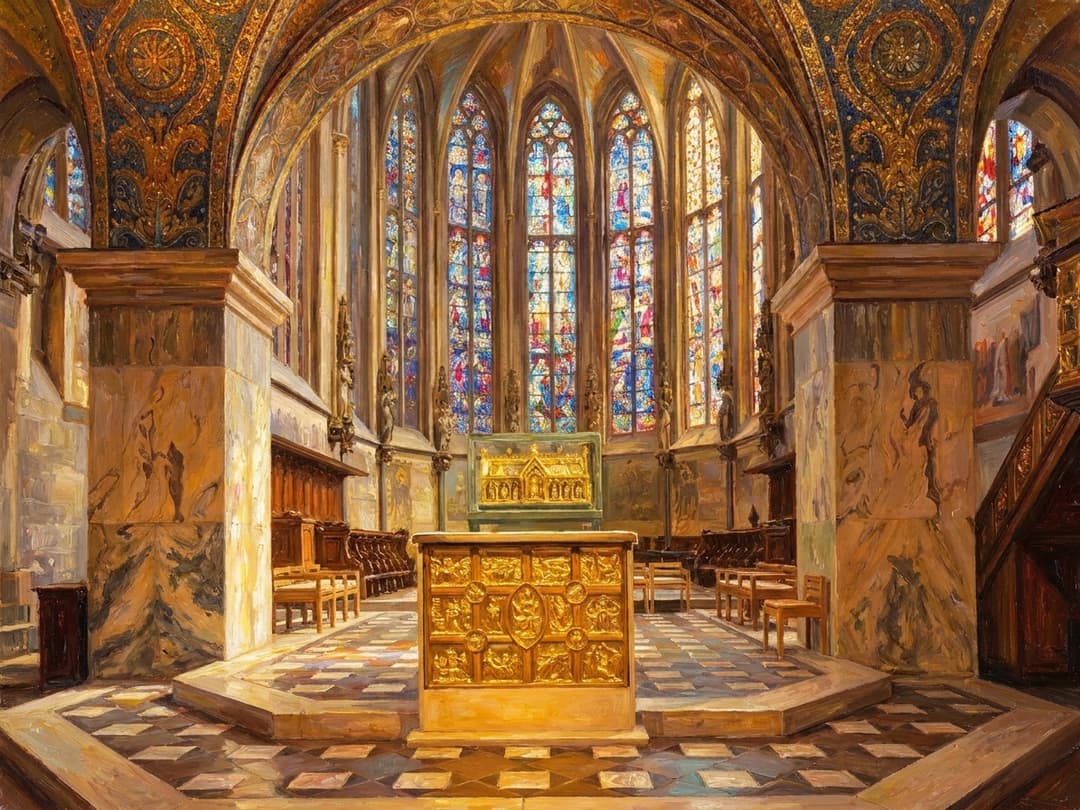
Aachen Cathedral offers a contemplative journey through twelve centuries of sacred architecture and Christian heritage. Visitors experience the soaring light of the Gothic choir and the sublime geometry of the Carolingian Octagon. Guided tours are required to view the upper gallery and Charlemagne's historic marble throne.
Highlights
- Charlemagne's monumental marble throne overlooking the high altar
- The Barbarossa Chandelier depicting the celestial New Jerusalem
- The 25-meter Gothic stained-glass lancet windows of the choir
- The imperial golden Pala d'Oro altar frontal and Mosan shrines
Things to Know
- Access to Charlemagne's throne in the upper gallery is only via guided tour
- Tourist sightseeing is paused during daily liturgical celebrations and masses
- Modest dress and hushed reverence are expected throughout the sanctuary
Location
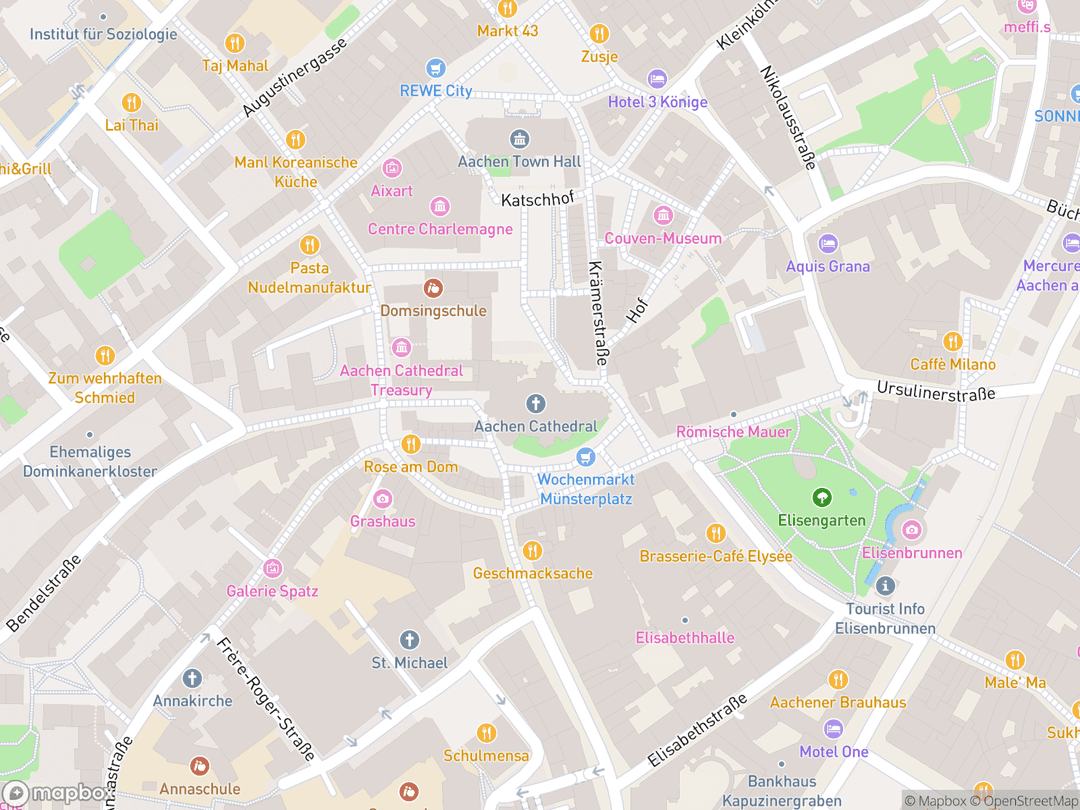
Domhof 1, 52062 Aachen, North Rhine-Westphalia, Germany
Hours: Daily 07:00 to 19:00 (Tourist sightseeing 11:00 to 18:00)
Getting There: Located in pedestrian Aachen Old Town; a 12-minute walk from Aachen Central Station.
Get DirectionsTips for Your Visit
Book Gallery Tours Early
Reserve tickets in advance at the Dom-Information center to access the upper gallery and imperial throne.
Morning Light in the Choir
Visit on weekday mornings to witness vibrant natural light filtering through the soaring Gothic stained glass.
Treasury Visit
Pair your cathedral visit with the adjacent Treasury to inspect the imperial reliquaries and liturgical crowns.
About
Aachen Cathedral stands as an enduring monument of Western Christian civilization and the oldest cathedral structure in Northern Europe. Commissioned by Emperor Charlemagne in the late eighth century as his imperial Palatine Chapel, it bridged Roman architectural majesty with the theological vision of the Heavenly Jerusalem.
Within the broader Abrahamic temple tradition, the cathedral represents a physical axis where heaven and earth converge under divine covenant. Rooted in biblical archetypes of sacred space, the sanctuary was designed to reflect cosmic order, sacred geometry, and the divine call to communal righteousness through Christ.
For over six centuries between 936 and 1531, this sacred precinct served as the coronation church for thirty-one German kings and twelve queens consort. In 1978, its architectural ingenuity and spiritual significance earned it status as the first German site inscribed on the UNESCO World Heritage List.
Gallery
Symbolic Elements
The temple's exterior features intricate carvings, each rich with spiritual meaning:

The Octagon Plan
Eight-sided geometry symbolizes the Eighth Day of creation and the eternal resurrection of Christ.

The Marble Throne
Modelled after King Solomon's biblical judgment seat to signify judicial righteousness under divine law.

The Barbarossa Chandelier
Represents the circular walls and heavenly gates of the New Jerusalem descending from above.

The Bronze Wolf Door
Ancient lion-head bronze doors symbolize threshold protection and classical imperial revival.
Antique Marble Spolia
Columns brought from Rome and Ravenna signify the historical transfer of imperial legitimacy north of the Alps.

The Karlsschrein
A gilded silver reliquary chest honoring Charlemagne as an earthly builder of God's kingdom.
Pala d'Oro Altar
Gold repoussé reliefs showing Christ in Majesty surrounded by scenes of his sacrificial passion.

Ambo of Henry II
Gilded pulpit incorporating classical gems and ivory to show earthly knowledge perfected in the Gospel.
Interesting Facts
Aachen Cathedral was the very first German landmark inscribed on the UNESCO World Heritage List in 1978. (Tier B)
Exactly thirty-one German kings were anointed and crowned upon Charlemagne's marble throne over six centuries. (Tier A)
Charlemagne obtained papal permission to despoil antique Roman ruins in Ravenna and Rome for building materials. (Tier B)
Odo of Metz engineered an early seismic resistance system by embedding continuous iron chains inside the dome walls. (Tier B)
The Gothic choir lancet windows rise twenty-five meters, making them the tallest medieval stained glass in Europe. (Tier B)
Local legend claims the Devil snapped off his thumb in the bronze lion door latch after being outwitted by the townsfolk. (Tier C)
The four great sacred relics are publicly unveiled to pilgrims only once every seven years. (Tier A)
Volunteer masons lived on the cathedral rafters during World War II to extinguish incendiary bombs by hand. (Tier B)
Holy Roman Emperor Otto III was buried in a hidden stone vault directly beneath the center of the Gothic choir floor. (Tier A)
Common Questions
Can regular visitors sit on Charlemagne's marble throne?
No, the fragile Carolingian throne is accessible only via official guided tours and sitting upon it is strictly prohibited.
Why is Aachen Cathedral called the Glass House?
Its Gothic choir features thirteen soaring lancet windows over twenty-five meters high that almost completely replace stone walls.
How often do the Great Relics go on public display?
The four holy relics are displayed publicly during the Aachen Pilgrimage once every seven years.
Is the cathedral still an active place of Catholic worship?
Yes, it serves actively as the seat of the Bishop of Aachen with daily celebration of Holy Mass.
Featured Stories
The Royal Coronation of Otto the Great
936
When Otto I was anointed King of East Francia in 936, he deliberately mounted the ancient marble throne of Charlemagne to claim imperial legitimacy. This historic coronation inaugurated a multi-century tradition making Aachen the mandatory crowning site for thirty-one successive German monarchs. The sacred rite bound the ruler directly to the Christian responsibilities of justice and divine stewardship.
Source: Aachen Cathedral Chapter Archives
The Seven-Year Pilgrimage Tradition
1349
Following the ravages of the Black Death, the cathedral chapter established the formal septennial cycle for displaying the four great holy relics preserved in the golden Marienschrein. Hundreds of thousands of medieval pilgrims converged on Aachen from across Europe, transforming the city into one of Christendom's greatest pilgrimage destinations alongside Rome and Santiago de Compostela. The seven-year tradition continues uninterrupted in modern times as a vibrant testimony of renewal.
Source: Heiligtumsfahrt Historical Records
The Wartime Guardians on the Cathedral Roof
1944
During the devastating aerial bombings of 1944 that leveled most of surrounding Aachen, the ancient Carolingian cathedral was saved by extraordinary personal heroism. Master mason Joseph Buchkremer organized teams of volunteers and students who stationed themselves atop the wooden rafters during intense air raids. Working through smoke and fire, they threw burning incendiary bombs off the roof trusses before the timbers could ignite.
Source: Dombauarchiv Aachen War Records
Timeline
Foundation Timbers Felled
Dendrochronological dating confirms oak pilings were prepared for the foundations of Charlemagne's Palatine Chapel.
component.timeline.groundbreakingCasting of the Bronze Portals
Foundry artisans in Aachen cast the massive bronze Wolf's Door and decorative gallery balustrades.
MilestoneSolemn Consecration
Pope Leo III dedicates the imperial Palatine Chapel to the Virgin Mary and the Savior.
DedicationDeath of Charlemagne
Emperor Charlemagne passes away at age seventy-one and is interred within the chapel vault.
MilestoneCoronation of Otto I
Otto the Great is crowned at Aachen, inaugurating six centuries of imperial German coronation rites.
MilestoneBarbarossa Chandelier Installed
Emperor Frederick Barbarossa and Empress Beatrice donate the massive bronze wheel chandelier.
MilestoneCompletion of the Karlsschrein
King Frederick II finishes the gilded Mosan shrine and ceremonially translates Charlemagne's relics.
MilestoneGothic Choir Consecration
The soaring Glass House choir is dedicated on the six-hundredth anniversary of Charlemagne's death.
DedicationFinal Imperial Coronation
Ferdinand I is crowned King of the Romans, concluding the cathedral's historic era as the royal coronation site.
EventCity Fire and Baroque Dome
A catastrophic city fire destroys the roof, leading to the construction of the baroque lantern cupola.
RenovationWartime Preservation
Roof fire-watchers save the medieval vaults from catastrophic incendiary bomb destruction.
MilestoneUNESCO World Heritage Inscription
Aachen Cathedral becomes the first landmark in Germany inscribed on the UNESCO World Heritage List.
MilestoneHistory by Decade
790s — Carolingian Foundation
He built the most beautiful basilica at Aachen, adorning it with gold and silver, candelabra, and choir screens.
Charlemagne selected the Roman thermal settlement of Aachen to establish his permanent winter palace and administrative capital. Master builder Odo of Metz supervised the erection of the octagonal chapel using advanced stone vaulting techniques. Antique marble columns and capitals were hauled across the Alps from Rome and Ravenna to invest the Frankish kingdom with Roman imperial gravitas.
800s–880s — Imperial Consecration and Raids
Following Charlemagne's imperial coronation in Rome, Pope Leo III traveled north to consecrate the Palatine Chapel in 805. The emperor's death in 814 permanently anchored the church as a sacred imperial mausoleum. In 881, Viking raiders attacked the palace and stabled horses inside the chapel, but the robust stone vaulting resisted destruction.
930s–1020s — The Coronation Church
Otto I selected the cathedral in 936 as the setting for his coronation, establishing Aachen as the mandatory royal coronation church of Germany. Ottonian emperors enriched the interior with spectacular artistic commissions, including the golden Pala d'Oro altar and the Ambo of Henry II. Emperor Otto III opened Charlemagne's tomb in 1000 before being buried himself beneath the choir.
1160s–1230s — Imperial Shrines and Golden Age
Emperor Frederick Barbarossa promoted the veneration of Charlemagne, installing the grand Barbarossa Chandelier to represent the celestial Jerusalem. Frederick II completed the intricate Karlsschrein in 1215 to encase the monarch's bones in gilded silver. Shortly thereafter, the Marienschrein was crafted to house the four great relics of Christ and the Virgin Mary.
1350s–1420s — Building the Gothic Glass House
Overwhelming throngs of international pilgrims prompted the cathedral chapter to lay the cornerstone for a vast Gothic eastern choir in 1355. Consecrated in 1414, this soaring choir featured thirteen lancet windows rising over twenty-five meters high. Known as the Aachen Glass House, its daring structural design minimized stone walls to maximize heavenly light.
1530s–1790s — End of Coronations and Baroque Renewal
The coronation of Ferdinand I in 1531 marked the thirty-first and final royal crowning in Aachen before ceremonies moved to Frankfurt. Catastrophic fire in 1656 damaged the roofs, leading to the construction of the distinctive baroque lantern cupola over the Octagon. In 1794, occupying French Revolutionary troops secularized the chapter and carried antique columns off to Paris.
1800s–1930s — Prussian Restoration and World War
Aachen was elevated to a permanent episcopal see, prompting comprehensive restorations overseen by the Karlsverein after looted columns were repatriated. Neo-Byzantine mosaics were installed across the octagonal dome between 1880 and 1901 to revive the lost medieval decorative scheme. Pope Pius XI definitively re-established the modern Diocese of Aachen in 1930.
1940s–2020s — Reconstruction and World Heritage
Allied bombing raids heavily damaged the Gothic choir glass during World War II, but the core vaults survived through the efforts of volunteer fire brigades. Postwar restoration culminated in Aachen Cathedral becoming Germany's very first UNESCO World Heritage Site in 1978. In 2023, the ancient seven-year pilgrimage resumed, continuing seven centuries of living Catholic tradition.
Architecture & Facilities
Aachen Cathedral represents an exceptional architectural palimpsest merging Carolingian Pre-Romanesque ingenuity with High Gothic soaring verticality. Designed by Odo of Metz, its core centralized octagon mirrors Byzantine imperial basilicas such as San Vitale in Ravenna, utilizing heavy masonry piers and barrel-vaulted tribunes to create the earliest monumental stone vault north of the Alps. The daring fifteenth-century Gothic choir dissolves stone load-bearing walls into radiant fields of stained glass, uniting earthly imperial monumentality with transcendent heavenly light.
Building Materials
Sandstone and Belgian Limestone
Local Devonian gray sandstone and dense Namur limestone provide the structural masonry core.
Classical Marble Spolia
Thirty-two antique Italian marble and porphyry columns hauled from Rome and Ravenna adorn the arcades.
Wrought Iron Tension Rings
Concealed Carolingian forged iron tie-bars encircle the octagonal clerestory to counteract outward vault thrust.
Gilded Copper and Bronze
Imperial Romanesque metalwork forms the massive Barbarossa Chandelier and monumental entrance doors.
Interior Features
The Carolingian Octagon
A centralized two-story dome vault rising over thirty-one meters supported by eight heavy piers.
The High Gothic Choir
A radiant sanctuary surrounded by thirteen towering stained-glass lancets housing the golden shrines.
The Hochmünster Gallery
The elevated second-story stone arcade that preserves the historic coronation throne of Charlemagne.
The Hungarian Chapel
An eighteenth-century baroque side chapel designed by Johann Joseph Couven to serve foreign pilgrims.
Temple Grounds
The cathedral anchors the historic center of Aachen, flanked by the pedestrian Katschhof square, the Gothic City Hall, and landscaped stone courtyards that outline the original palace precinct.
Additional Facilities
The nearby Dom-Information visitor center coordinates guided architectural tours, while the adjacent Aachen Cathedral Treasury showcases medieval liturgical goldwork and imperial relics.
Religious Significance
Aachen Cathedral occupies a singular place in Western Catholic theology and the wider Abrahamic tradition of sacred space, embodying the physical manifestation of the heavenly City of God on earth.
To serve as the mother church of the Diocese of Aachen, a sanctuary for royal consecration under God's grace, and an enduring pilgrimage shrine housing foundational relics of salvation history.
Sacred Ordinances
The Holy Sacrifice of the Mass
Daily Catholic Eucharistic liturgy celebrated at the high altar to renew Christ's redeeming sacrifice.
Imperial Coronation Anointing
Sacramental royal anointing and enthronement signifying that secular authority is subordinate to divine justice.
Relic Veneration (Heiligtumsfahrt)
The septennial public veneration of the four great garments associated with Christ, Mary, and John the Baptist.
The Celestial Jerusalem on Earth
Charlemagne and his ecclesiastical advisors drew directly upon the Book of Revelation to fashion the Palatine Chapel as an architectural icon of the New Jerusalem. The eightfold symmetry of the Carolingian Octagon signifies the Eighth Day—the eternal day of resurrection that transcends earthly creation. Suspended beneath the central dome, the Barbarossa Chandelier with its forty-eight lamps and sixteen symbolic gates renders the celestial city physically tangible to worshipers below.
Incarnational Pilgrimage and Relics
Catholic sacramental theology views sacred relics not as idols, but as tangible witnesses to the mystery of the Incarnation. The four great Aachen relics—the Virgin Mary's cloak, the swaddling clothes of the infant Jesus, the loincloth of the Crucifixion, and the cloth of John the Baptist's martyrdom—anchor the pilgrim's faith in the physical reality of Christ's birth, redemptive passion, and resurrection.
Sources & Research
Every fact on Temples.org is backed by verified Sources & Research. Each piece of information is rated by source tier and confidence level.
View All Sources (7)
| Field | Source | Tier | Retrieved |
|---|---|---|---|
| About & Historical Background | Hohe Domkirche zu Aachen (opens in a new tab) | A | 2026-02-14 |
| World Heritage Documentation | UNESCO World Heritage Centre (opens in a new tab) | B | 2026-02-14 |
| Dendrochronological & Structural Surveys | Multidisciplinary Digital Publishing Institute (opens in a new tab) | B | 2026-02-14 |
| Medieval Architectural Studies | ResearchGate Scientific Repository (opens in a new tab) | B | 2026-02-14 |
| Sacred Art & Reliquary Studies | New World Encyclopedia (opens in a new tab) | B | 2026-02-14 |
| Ottonian Furnishings & Heritage | Sacred Destinations Travel Guide (opens in a new tab) | B | 2026-02-14 |
| Visitor Insights & Regional Tourism | Destination Europe Travel Guides (opens in a new tab) | D | 2026-02-14 |