Visitor Insights
Visiting Tikal Temple I
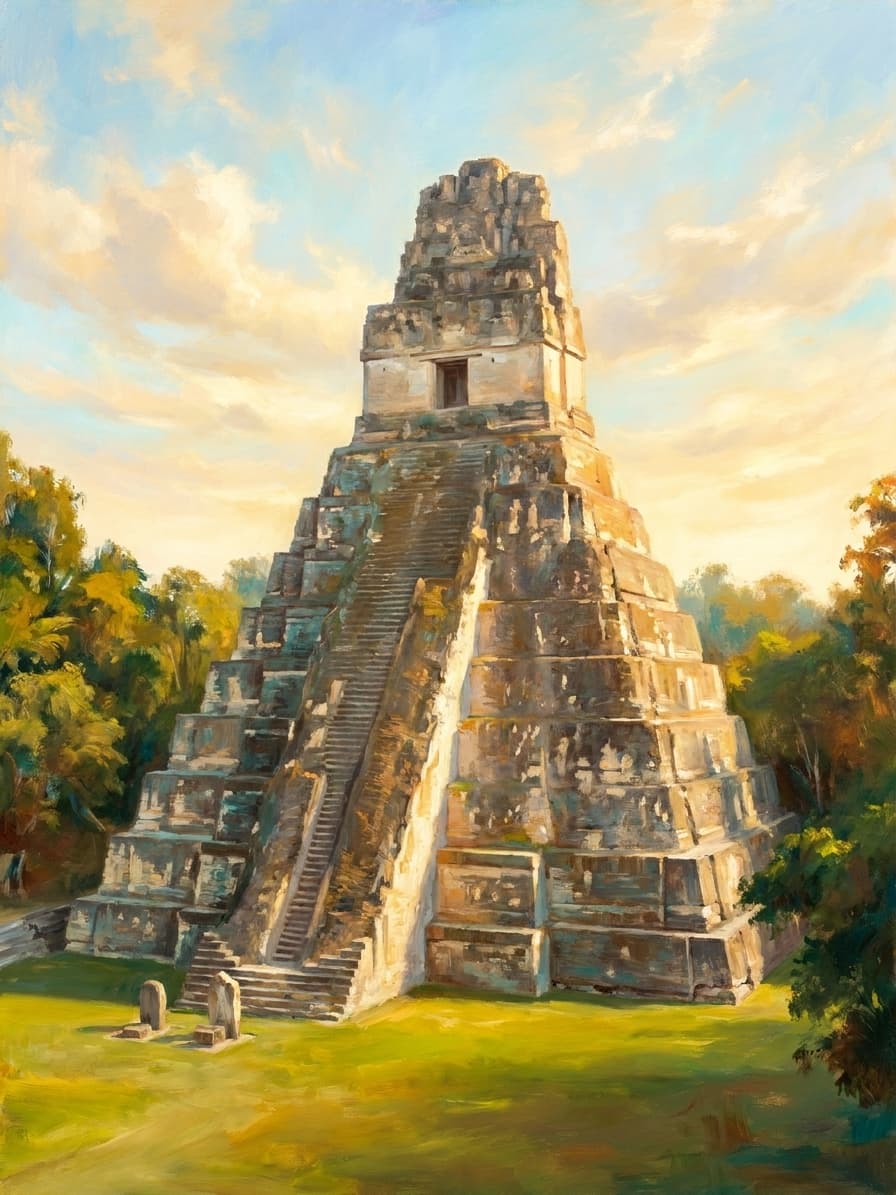
Tikal Temple I presides over the eastern perimeter of the Great Plaza within the dense Maya Biosphere Reserve. Visitors must enter through the national park gate and walk approximately twenty to thirty minutes along ancient jungle causeways to access the central ruins. While direct ascent up Temple I is prohibited to safeguard fragile limestone masonry, visitors can climb the wooden stairway on Temple II opposite for sweeping panoramic vistas.
Highlights
- Marvel at the soaring pierced roof comb towering high above the rainforest canopy.
- Stand in the Great Plaza to hear the handclap echo mimicking the call of the resplendent quetzal.
- Climb neighboring Temple II for direct eye-level views of Temple I across the ceremonial plaza.
- Encounter howler monkeys, coatimundis, and keel-billed toucans around the clearing.
Things to Know
- Climbing Temple I front steps is strictly prohibited for safety and stone conservation.
- High tropical humidity and heat make early morning visits between 6:00 AM and 9:00 AM optimal.
- Sturdy walking shoes, plenty of water, and insect repellent are essential for rainforest trails.
- Special permits are required for pre-dawn sunrise or post-closing sunset access.
Location
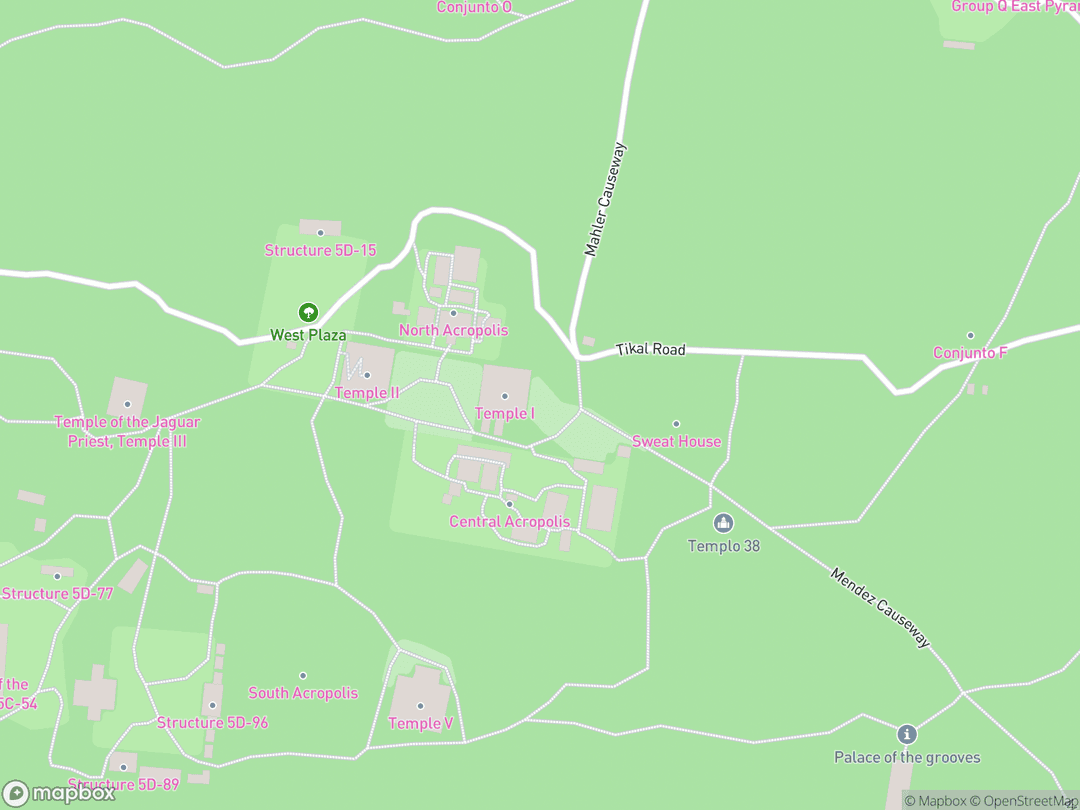
Great Plaza, Tikal National Park, Flores, Petén, Guatemala
Hours: Open daily from 6:00 AM to 5:00 PM; sunrise permits allow entry from 4:00 AM.
Getting There: Located 64 km northeast of Flores in Petén; accessible via private taxis, tourist shuttles, or rental cars along a paved national highway.
Get DirectionsTips for Your Visit
Arrive for Park Opening
Entering at 6:00 AM allows you to experience morning mist lifting off the Great Plaza alongside jungle wildlife.
Climb Temple II for Photos
Use the modern wooden stairwell behind Temple II to photograph the morning sun illuminating Temple I.
Bring Cash for Park Entry
Park admission tickets are often inspected at the entrance gate and should be pre-purchased at authorized bank branches.
About
Tikal Temple I, renowned as the Temple of the Great Jaguar, stands as the crowning architectural achievement of the Classic Maya civilization in the Petén Basin. Commissioned by King Jasaw Chan Kʼawiil I and completed after his death by his son Yikʼin Chan Kʼawiil, the monument dramatically reshaped the ritual landscape of Tikal.
Rising 47 meters above the Great Plaza, the monument is an archetypal expression of the ancient Maya concept of the sacred mountain (witz). Built directly atop the monarch's subterranean bedrock tomb, its nine terraced levels represent the stages of the underworld, establishing a permanent cosmic axis connecting terrestrial kingship to celestial divinity.
Today, Temple I is protected as the centerpiece of Tikal National Park, a UNESCO World Heritage Site recognized for both cultural and natural criteria. While structural conservation bans climbing its steep exterior staircase, the temple endures as an active ceremonial altar for contemporary Maya spiritual traditions.
Gallery
Symbolic Elements
The temple's exterior features intricate carvings, each rich with spiritual meaning:

Nine Terraced Levels
Represents the nine stratified realms of Xibalba through which the deceased ruler journeys to achieve celestial rebirth.

The Great Jaguar
Embodies the nocturnal underworld sun, martial authority, and the supernatural protector spirit of the Mutul dynasty.
Eastern Plaza Orientation
Aligns the monument with the rising sun to affirm cosmic rebirth, dawn, and the eternal reign of the divine sovereign.

The Sacred Mountain (*Witz*)
Conceptualizes the stone pyramid as a living sacred peak housing ancestral spirits and life-giving water springs.
Corbel Vault Sanctuary
Mimics primordial subterranean caves where shamans and kings entered trance states to commune with ancestral deities.

Pierced Masonry Roof Comb
Serves as a colossal vertical billboard elevating stucco royal portraits above the jungle toward the heavens.
Chicozapote Wood Lintels
Utilizes sacred rot-resistant sapodilla hardwood to preserve dynamic royal portraits and historical hieroglyphic inscriptions.
Interesting Facts
Unlike Egyptian pyramids with interior chambers, Temple I was built directly on top of a subterranean bedrock crypt in a single effort (Tier A).
Clapping hands in the Great Plaza produces an acoustic reverberation mimicking the chirp of the sacred resplendent quetzal (Tier B).
The wooden lintels inside the summit sanctuary were carved from sapodilla wood, a timber so dense that it will sink in water (Tier B).
The pyramid was positioned on the east side of the plaza to align with the rising sun, symbolizing divine resurrection (Tier A).
Burial 116 contained nearly four kilograms of jade beads and thirty-seven incised bones depicting gods paddling a celestial canoe (Tier A).
Its summit and neighboring pyramids famously served as the rebel base on Yavin 4 in the 1977 film Star Wars (Tier B).
The nine terraced tiers correspond directly to the nine cosmic levels of Xibalba, the Maya underworld (Tier A).
The monument broke five centuries of tradition by moving royal burials out of the North Acropolis and into the Great Plaza (Tier B).
Common Questions
Can visitors climb to the top of Tikal Temple I?
No, ascending the front stairway is strictly prohibited to preserve the ancient limestone and ensure safety.
Why is the monument called the Temple of the Great Jaguar?
It is named after a carved wooden lintel in the inner sanctuary showing the king seated beneath a protector jaguar.
Is the tomb of the king still inside the temple?
The royal burial remains beneath the plaza floor, while its jade treasures are preserved in national museum collections.
How tall is Tikal Temple I?
The pyramid measures 47 meters (154 feet) from the Great Plaza pavement to the highest point of its roof comb.
Featured Stories
The Triumph of August 5, 695
August 5, 695
After decades of subjugation by the rival Kanul snake dynasty of Calakmul, King Jasaw Chan Kʼawiil I led Tikal's armies in a decisive victory. Capturing Calakmul's patron war god effigies, the king restored Tikal's supreme prestige. The immense spoils from this triumph directly funded the renaissance of the ceremonial core and the construction of Temple I.
Source: Instituto de Antropología e Historia de Guatemala
The Unsealing of Burial 116
1962
While excavating deep beneath the axial center of Temple I, archaeologist Aubrey Trik broke through bedrock into an intact vaulted crypt. Inside lay the skeleton of Jasaw Chan Kʼawiil I surrounded by thousands of jade ornaments and exquisitely carved maritime bones. The find confirmed that the entire forty-seven-meter pyramid had been erected as an enduring memorial over his grave.
Source: University of Pennsylvania Museum Tikal Project
The 13th Bakʼtun Dawn
December 21, 2012
At the close of the 5,125-year cycle of the Maya Long Count calendar, traditional spiritual leaders assembled at the base of Temple I. Fragrant copal incense burned on stone altars as traditional prayers welcomed the new cosmic era. The gathering highlighted the enduring spiritual sanctity of the temple for living Maya communities.
Source: Ministerio de Cultura y Deportes de Guatemala
Timeline
Accession of Jasaw Chan Kʼawiil I
Jasaw Chan Kʼawiil I ascends the Mutul throne, initiating the end of the devastating Tikal Hiatus.
MilestoneTriumph Over Calakmul
Tikal defeats the rival Kanul snake dynasty of Calakmul, inaugurating a golden era of monumental construction.
EventInterment in Burial 116
Jasaw Chan Kʼawiil I passes away and is interred within an elaborate subterranean vault carved into plaza bedrock.
MilestoneCompletion of the Superstructure
Yikʼin Chan Kʼawiil completes the nine-tiered pyramid, corbeled chambers, and towering roof comb over his father's tomb.
DedicationCeremonial Zenith
Temple I functions as the premier ancestral sanctuary for royal bloodletting and state gatherings.
EventClassic Maya Collapse
Monumental building ceases at Tikal amid severe regional droughts, and the forest gradually overtakes the plaza.
MilestoneFirst Official Exploration
Governor Modesto Méndez and Ambrosio Tut lead the first documented government expedition to the ruins of Tikal.
EventMaudslay's Photographic Survey
Alfred Percival Maudslay clears forest vegetation to produce systematic architectural drawings and glass-plate photographs.
RenovationDiscovery of Burial 116
Archaeologist Aubrey Trik tunnels beneath the temple axis and unearths the intact royal tomb of Jasaw Chan Kʼawiil I.
MilestoneWorld Heritage Inscription
UNESCO inscribes Tikal National Park as one of the world's earliest mixed cultural and natural heritage sites.
MilestoneStaircase Closure for Conservation
Guatemalan antiquities authorities close the central stone stairway to visitors to prevent severe erosion.
Renovation13th Bakʼtun Observance
Maya spiritual elders gather in the Great Plaza to celebrate the completion of the 13th Bakʼtun calendar cycle.
EventHistory by Decade
680s–730s — Dynastic Resurgence
Jasaw Chan Kʼawiil I revitalized Tikal after decades of military defeat and stagnant construction. His victory over Calakmul in 695 ushered in renewed wealth, allowing royal architects to plan an ambitious transformation of the Great Plaza. Rather than joining his ancestors in the North Acropolis, the king planned an eastern funerary pyramid.
730s–750s — Construction and Consecration
Following the monarch's death in 734, his successor Yikʼin Chan Kʼawiil oversaw the construction of Temple I above the sealed bedrock crypt. Workers transported thousands of tons of limestone blocks, raising the nine stepped terraces and three-room corbeled summit sanctuary. Carved sapodilla lintels and a brilliantly painted stucco roof comb completed the monument.
750s–890s — Ceremonial Zenith and Silence
Temple I functioned as the central ancestral stage where Tikal's rulers burned incense and conducted state rituals before thousands of assembled citizens. By the late ninth century, severe regional droughts and environmental pressures triggered the Classic Maya collapse. Construction halted, and the surrounding subtropical forest gradually swallowed the plaza.
1840s–1950s — Scientific Exploration
An official Guatemalan expedition in 1848 led by Modesto Méndez brought Tikal's colossal monuments back to national awareness. English explorer Alfred Percival Maudslay cleared encroaching trees in the 1880s to capture pioneering glass-plate photographs. These early expeditions revealed the remarkable preservation of the temple's masonry and wooden lintels.
1950s–Present — Conservation and Living Sacred Site
The University of Pennsylvania and IDAEH conducted extensive excavations between 1955 and 1964, discovering the monarch's tomb in Burial 116. UNESCO designated Tikal a World Heritage Site in 1979, prompting global conservation efforts. Today, Temple I remains protected from climbing wear while continuing to serve as a sacred site for contemporary Maya rituals.
Architecture & Facilities
Tikal Temple I represents the pinnacle of Late Classic Petén Maya monumental architecture, defined by extreme verticality, a narrow stepped base with recessed corners, and an imposing pierced masonry roof comb acting as an artificial sacred mountain.
Building Materials
Crystalline Limestone
Quarried from bedrock depressions adjacent to the Great Plaza that were later repurposed as water-storage reservoirs.
Calcined Lime Stucco
Produced by burning limestone into slaked mortar that originally coated the entire pyramid in vibrant polychrome pigments.
Chicozapote Hardwood
Dense, rot-resistant sapodilla timber utilized for carved interior door lintels and ceiling spans.
Clay-Rubble Interior Fill
Packed marl, limestone rubble, and clay structured within retaining masonry cells to stabilize the massive core.
Interior Features
Outer Vestibule
The primary entry portal facing west across the Great Plaza where ritual incense was offered.
Middle Passage
A narrow corbel-vaulted corridor connecting the exterior doorway to the secluded interior sanctum.
Inner Sanctum
The deepest summit chamber that originally sheltered carved sapodilla wood lintels honoring the enthroned king.
Burial 116 Vault
A vaulted subterranean crypt excavated into bedrock beneath the plaza containing the sovereign's skeleton and jade treasures.
Temple Grounds
The monument defines the eastern perimeter of the Great Plaza, bordered by the North Acropolis, the Central Acropolis, and ancient sacbeob leading through the surrounding tropical forest reserve.
Additional Facilities
Visitor reception facilities include on-site archaeological museums, interpretive pathways, rest areas, and elevated viewing decks on adjacent structures.
Religious Significance
Within the Ancient theological grouping and Classic Maya cosmology, temples were not passive meetinghouses but living architectural mountains (witz) bridging the human cosmos with supernatural realms.
To serve as the permanent ancestral residence, cosmic resurrection axis, and public ceremonial backdrop for the divine sovereign.
Sacred Ordinances
Royal Bloodletting
Kings offered their own blood using stingray spines and obsidian lancets to nourish the gods and maintain the universe.
Copal Incense Burning
Officiants burned tree resin in large censers to open supernatural portals and carry prayers to deified ancestors.
Solar Equinox Observation
Astronomical alignments between Temple I and Temple II regulated sacred agricultural and ceremonial calendar cycles.
Cosmic Tripartite Geography
Temple I mirrored the three planes of Maya reality: its subterranean bedrock crypt anchored the Underworld (Xibalba), its terraced staircase occupied the Middle World of humankind, and its soaring roof comb projected into the celestial Heavens.
Living Ancestral Continuity
Contemporary Maya spiritual guides (Ajqʼijabʼ) continue to travel to the base of Temple I, conducting sacred fire ceremonies with sugar, candles, and copal to honor the ancestral guardians of Petén.
Sources & Research
Every fact on Temples.org is backed by verified Sources & Research. Each piece of information is rated by source tier and confidence level.
View All Sources (8)
| Field | Source | Tier | Retrieved |
|---|---|---|---|
| About & Historical Background | Ministerio de Cultura y Deportes de Guatemala (opens in a new tab) | A | 2026-03-31 |
| Archaeological Excavations & Burial 116 | Penn Museum (opens in a new tab) | B | 2026-03-31 |
| World Heritage Documentation | UNESCO World Heritage Centre (opens in a new tab) | B | 2026-03-31 |
| Classic Maya Epigraphy & History | Mesoweb Resources (opens in a new tab) | B | 2026-03-31 |
| Architectural Surveys & Lintel Studies | The Metropolitan Museum of Art (opens in a new tab) | B | 2026-03-31 |
| Geographical & Historical Overview | Encyclopaedia Britannica (opens in a new tab) | B | 2026-03-31 |
| Visitor Insights & Conservation | Instituto Guatemalteco de Turismo (opens in a new tab) | A | 2026-03-31 |
| Maya Architecture & Iconography | Foundation for the Advancement of Mesoamerican Studies (opens in a new tab) | B | 2026-03-31 |