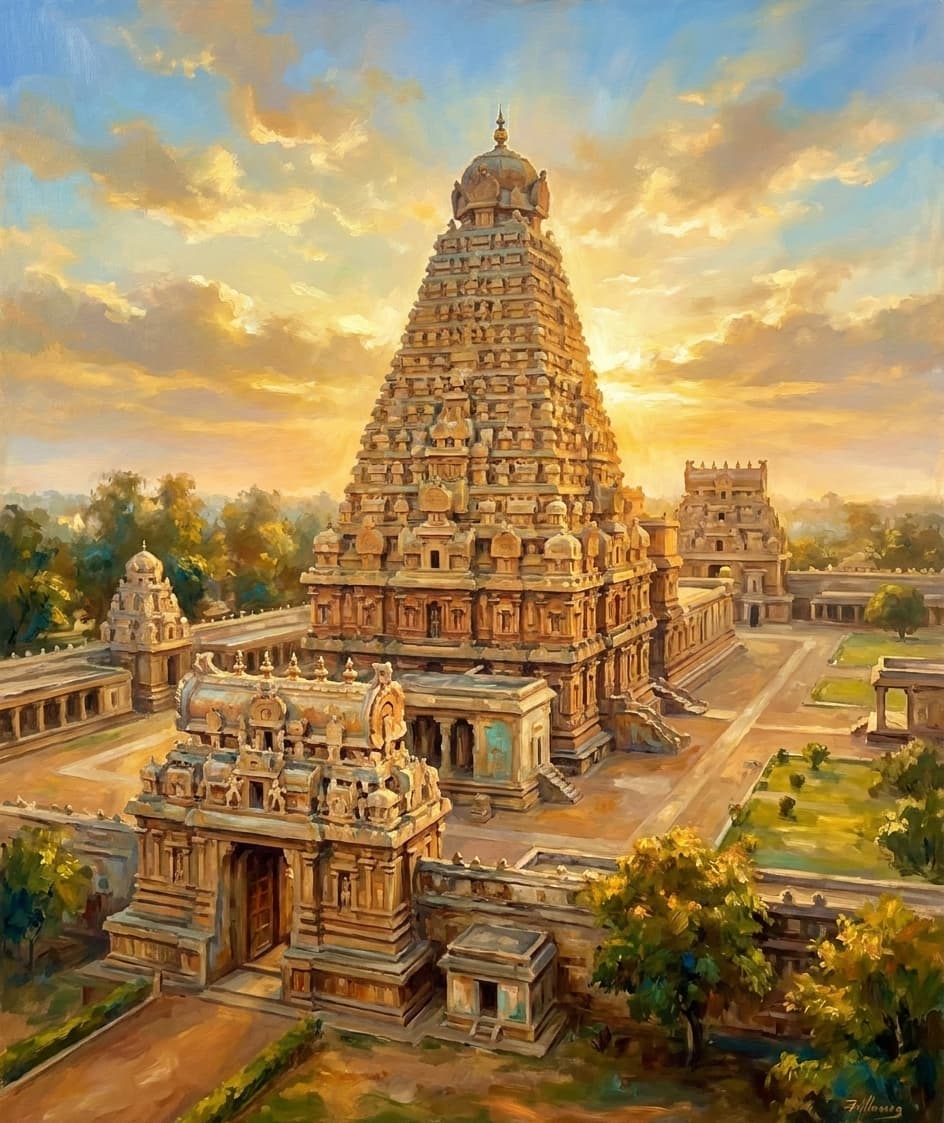
Visitor Insights
Visiting Brihadisvara Temple
Brihadisvara Temple is both an active place of pilgrimage and an archaeological wonder. Devotees gather for traditional daily pujas and pradosham rites, while global travelers admire the precision of its thousand-year-old mortarless granite architecture.
Highlights
- Marveling at the 66-meter pyramidal vimana towering over the central sanctuary
- Examining the massive monolithic Nandi bull carved from a single granite block
- Reading thousand-year-old Chola epigraphs inscribed directly across the granite base
- Viewing the classical Karana dance relief panels in the upper sanctum gallery
Things to Know
- Footwear must be deposited at the outer entrance shoe counters prior to entry
- Strict temple dress code requires covered shoulders and modest attire
- The main garbhagriha closes between 12:30 PM and 4:00 PM for afternoon repose
- Photography is strictly prohibited inside the inner sanctum but permitted in courtyards
Location
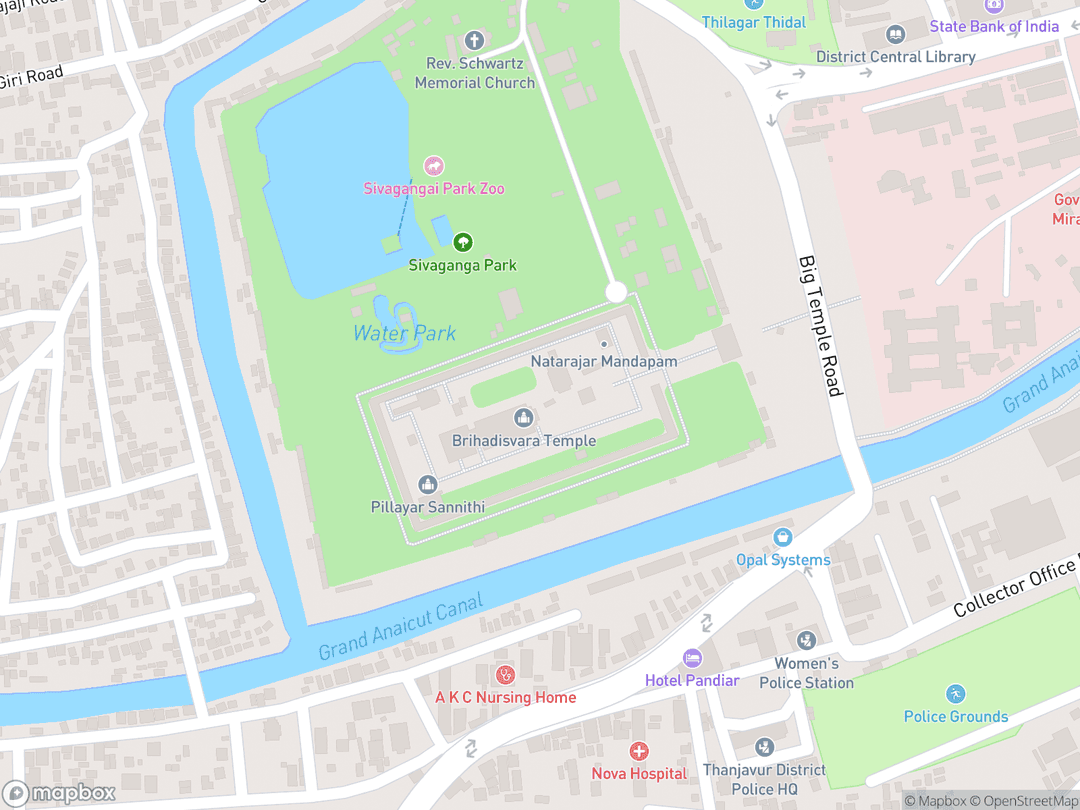
Membalam Road, Balaganapathy Nagar, Thanjavur, Tamil Nadu 613007, India
Hours: Morning: 6:00 AM – 12:30 PM, Evening: 4:00 PM – 9:00 PM daily
Getting There: Located in central Thanjavur, accessible via Thanjavur Junction railway station (1.5 km) and Tiruchirappalli International Airport (58 km).
Get DirectionsTips for Your Visit
Time Your Visit for Sundown
Arrive in the late afternoon to observe ritual evening aarti as courtyard floodlights illuminate the golden granite vimana against the night sky.
Witness Pradosham Rites
Visit during the bimonthly Pradosham observances to view the ceremonial ritual abhishekam bathing of the monumental monolithic Nandi.
Hire an ASI Guide
Engage an Archaeological Survey of India certified guide at the entrance to identify Chola-era inscriptions and concealed fresco corridors.
About
Commissioned around 1003 CE by Emperor Rajaraja Chola I and consecrated in 1010 CE, the Brihadisvara Temple (Rajarajeswaram) stands as the supreme architectural triumph of the Imperial Chola dynasty. Conceived within the Dharmic tradition as a terrestrial manifestation of Mount Meru, the temple embodies the philosophical depth of Shaiva Siddhanta through monumental stone engineering.
Rising above the fertile plains of the Kaveri River basin, the entire structural complex was fashioned from more than 130,000 tonnes of fine-grained granite transported over 50 kilometers. Inverting traditional Dravidian forms, its 66-meter central vimana dwarfs the entrance gateways, crowning the sanctuary with an 80-tonne octagonal stone superstructure and a gilded copper finial.
As the focal point of the UNESCO World Heritage Site 'Great Living Chola Temples', Brihadisvara remains an active sanctuary where ancient Agamic rituals continue uninterrupted. Its plinths preserve thousands of lines of royal Tamil epigraphy, functioning as an indelible historical archive alongside millennium-old fresco murals and classical dance reliefs.
Gallery
Symbolic Elements
The temple's exterior features intricate carvings, each rich with spiritual meaning:

Peruvudaiyar Lingam
The massive monolith Shiva Lingam embodies the boundless, formless absolute reality of Nirguna Brahman.

Dakshina Meru Vimana
The 13-tiered pyramidal sanctuary tower manifests the cosmic golden mountain Mount Meru at the center of the universe.

Monolithic Nandi
The colossal recumbent bull symbolizes steadfast devotion, patient contemplation, and alert focus toward the divine.

Golden Kalasha
The gilded finial acts as a spiritual conduit channeling cosmic energy downward into the sanctum sanctorum.

Ardhanarishvara
The composite half-male half-female form represents the inseparable harmony of consciousness and dynamic creative energy.

Tripurantaka Reliefs
Shiva wielding the cosmic bow symbolizes divine grace severing ego, karma, and worldly illusion to liberate the soul.

Monolithic Dvarapalakas
The fierce threshold guardians warn spiritual seekers to discard mundane ego before stepping into the divine presence.

Padmagarbha Mandala
The geometric courtyard layout mirrors the sacred cosmic lotus grid ordained by ancient Agamic architectural manuals.
Interesting Facts
The temple's granite plinths preserve thousands of lines of royal inscriptions documenting every donation, down to the exact weight of donated jewelry (Tier A).
Brihadisvara is recognized as the world's first major public megastructure constructed entirely out of granite (Tier B).
Despite popular myths that it casts no shadow, the vimana's shadow contracts across its own pyramidal base at solar noon but falls across the courtyard mornings and afternoons (Tier B).
To raise the 80-tonne granite capstone to the summit, engineers built an inclined earthen ramp over four kilometers long from Sarapallam village (Tier B).
The sanctuary's upper gallery houses 81 carved stone reliefs depicting fundamental dance movements from Bharata Muni's ancient Natya Shastra (Tier A).
Over 130,000 tonnes of granite were assembled completely without mortar, using precision interlocking joints that have withstood multiple earthquakes (Tier B).
The colossal courtyard Nandi was sculpted from a single massive granite boulder, measuring six meters long and over three meters tall (Tier A).
Hidden eleventh-century Chola vegetable-dye murals were discovered beneath seventeenth-century Nayaka plaster layers in 1931 (Tier B).
For the temple's millennium celebration in 2010, exactly 1,000 classical dancers performed simultaneously in the stone courtyards (Tier A).
Emperor Rajaraja Chola inscribed the names of 400 temple dancers and their street door numbers permanently onto the temple's granite base (Tier A).
Common Questions
Can non-Hindus enter the Brihadisvara Temple?
Non-Hindus are welcome to explore the outer courtyards and mandapas, though entry into the inner sanctum is reserved for practicing Hindus.
Why is the temple called the Big Temple?
Locals call it Periya Kovil because its 66-meter vimana and massive granite lingam represented the largest architectural undertaking of its era.
Is photography allowed inside Brihadisvara Temple?
Photography is permitted throughout the open-air courtyard and peripheral gardens but strictly prohibited inside the sanctum.
How old is the Brihadisvara Temple?
The temple was consecrated in 1010 CE, making it more than one thousand years old.
Does the vimana shadow really never fall on the ground?
This is a popular folklore myth, as the tower does cast visible shadows on the courtyard paving during morning and late afternoon hours.
Featured Stories
The Imperial Dedication of 1010 CE
1010
In his twenty-fifth regnal year, Emperor Rajaraja Chola I climbed the high wooden scaffolding to personally install the gilded copper finial atop the 66-meter vimana. Refusing sole glory, he ordered the names of all donors, humble dancers, and stonemasons carved alongside his own upon the temple's granite foundation.
Source: Archaeological Survey of India Epigraphic Records
The Hidden Colors of the Chola Frescoes
1931
While examining the dim, narrow corridor encircling the inner sanctum in 1931, Professor S.K. Govindaswami spotted flaking seventeenth-century plaster. Beneath the outer coat lay vibrant, one-thousand-year-old Chola-era natural vegetable paintings depicting Shiva and Emperor Rajaraja with his spiritual guru Karuvur Devar.
Source: Journal of the Annamalai University Archaeological Studies
The Grand Earthen Ramp of Sarapallam
1008
To elevate the gargantuan 80-tonne granite capstone to the summit of the tower without cranes, Chola builders constructed a gradual inclined earthen ramp beginning at the village of Sarapallam four kilometers away. Thousands of laborers, rolling timbers, and war elephants hauled the massive stones skyward section by section.
Source: Archaeological Survey of India Architectural Monographs
Timeline
Temple Construction Commences
Emperor Rajaraja Chola I orders the construction of Rajarajeswaram following imperial mainland and maritime victories.
MilestoneApex Consecration by Rajaraja I
The Emperor crowns the vimana with a gold-plated copper kalasha and records founding endowments upon the stone plinth.
DedicationSuccession of Rajendra Chola I
Rajendra Chola I completes ancillary endowments before establishing the northern capital at Gangaikonda Cholapuram.
EventPandyan Royal Additions
The Second Pandyan Empire takes control of Thanjavur and adds the shrine of Goddess Brihannayaki within the prakara.
EventNayaka Fortifications
The Thanjavur Nayakas construct fortified walls and commission the elaborately sculpted shrine of Lord Subramanya.
RenovationMonolithic Nandi Pavilion
Nayaka governors replace the outer pavilion and install the colossal monolithic granite Nandi facing the sanctum.
MilestoneMaratha Rule Established
The Thanjavur Marathas assume custodianship, repairing courtyards and adding shrines dedicated to Ganesha and Nataraja.
EventRestoration by Serfoji II
Maratha King Serfoji II undertakes extensive restorations, recording Marathi inscriptions across the temple perimeter.
RenovationRediscovery of Chola Frescoes
Scholars discover vibrant eleventh-century Chola murals beneath seventeenth-century Nayaka plaster layers.
MilestoneUNESCO World Heritage Inscription
UNESCO designates Brihadisvara Temple as a World Heritage Site for outstanding architectural achievement.
MilestoneMillennium Celebration
India celebrates the temple's 1,000th anniversary with a gathering of 1,000 classical Bharatanatyam dancers.
EventMaha Kumbhabhishekam
Hundreds of thousands gather as sacred sanctification rites are performed atop the vimana after twenty-three years.
DedicationHistory by Decade
1000s–1040s — Imperial Chola Foundation
Emperor Rajaraja Chola I spearheaded the construction of Rajarajeswaram as the spiritual and political heartbeat of his maritime empire. Following its 1010 CE dedication, his son Rajendra Chola I completed liturgical endowments before moving the imperial seat to Gangaikonda Cholapuram.
1270s–1300s — Pandyan Patronage
With the rise of the Second Pandyan Empire, monarchs respected the sacred integrity of the sanctuary while adding new structures. King Maravarman Sundara Pandyan oversaw the construction of the independent shrine dedicated to the goddess Brihannayaki within the inner courtyard.
1500s–1650s — Nayaka Dynastic Additions
Thanjavur Nayaka rulers fortified the precinct within the Sivaganga Fort moat system to protect the temple treasury. During this vibrant artistic era, governors commissioned the filigreed Subramanya shrine and installed the current colossal monolithic Nandi pavilion.
1670s–1830s — Maratha Revival & Restoration
The Thanjavur Maratha rulers revived full Agamic temple worship and built dedicated shrines for Ganesha and Nataraja. In the early nineteenth century, King Serfoji II undertook monumental renovations, preserving Chola foundations and inscribing royal Marathi records across the complex.
1930s–1980s — Heritage Guardianship
The Archaeological Survey of India assumed custodianship, undertaking delicate preservation of the dry-stone granite joinery and rediscovering hidden Chola murals. In 1987, UNESCO formally inscribed the complex on the World Heritage List for its unmatched structural and artistic value.
2010s–2020s — Millennial Celebrations & Living Worship
In 2010, the temple celebrated its millennium with classical dance festivals and national commemorative coin releases. The year 2020 witnessed the grand Maha Kumbhabhishekam consecration, drawing hundreds of thousands of pilgrims to honor ten centuries of living worship.
Architecture & Facilities
Brihadisvara Temple represents the absolute zenith of mature Dravidian Temple Architecture under the Imperial Cholas. Its groundbreaking master plan inverts traditional temple proportions by subordinating the perimeter gateway gopurams to an immense 66-meter pyramidal vimana rising over the central sanctum. Built entirely of interlocking dry-stone granite masonry, the complex perfectly integrates structural equilibrium, sacred geometry, and iconographic sculpture.
Building Materials
Pink and Gray Granite
Over 130,000 tonnes of fine-grained granite were quarried near Tiruchirappalli and barged downriver to the alluvial delta.
Interlocking Dry-Stone Masonry
Precision-cut tongue-and-groove joints secure the massive blocks purely through gravitational equilibrium without mortar.
Gilded Copper Finial
The eight-foot-tall kalasha crowning the apex was forged of copper and electroplated with gold by Rajaraja Chola I.
Mineral and Vegetable Pigments
Natural herbal binders and mineral dyes were utilized by eleventh-century artisans to execute the vivid sanctum murals.
Interior Features
Garbhagriha
The dark, square inner sanctuary houses the colossal 3.7-meter granite lingam seated upon a massive pedestal.
Sandhara Pradakshina Passage
A two-storey circumambulatory corridor surrounding the sanctum contains the rare eleventh-century Chola frescoes.
Upper Karana Gallery
The upper corridor features 81 carved stone relief panels illustrating the classical dance movements of the Natya Shastra.
Mahamandapa
A monumental hypostyle hall supported by carved pillars that historically accommodated royal assemblies and temple rituals.
Temple Grounds
The vast rectangular courtyard is enclosed by a cloistered perimeter wall lined with pillared colonnades, 108 Shivalingams, and shrines to directional guardians. Manicured lawns maintained by the Archaeological Survey of India flank stone walkways leading past the monolithic Nandi pavilion and secondary shrines.
Additional Facilities
The site provides visitor amenities including shoe-storage counters, clean drinking water dispensaries, informational signboards in multiple languages, and a modern Archaeological Survey of India interpretive museum located adjacent to the outer moat.
Religious Significance
Within Dharmic traditions and Shaiva Siddhanta theology, Brihadisvara Temple is designed as an architectural micro-cosmos (Brahmanda). The pilgrim's physical transit through sequential halls toward the unadorned darkness of the inner sanctum replicates the soul's inward spiritual journey toward enlightenment.
To serve as Dakshina Meru, the southern cosmic axis where humanity communes with the formless divine absolute manifest as Shiva.
Sacred Ordinances
Nitya Puja
Four daily liturgical worship services performed by hereditary priests adhering to ancient Karana and Kamika Agamas.
Pradosham Abhishekam
Elaborate bimonthly ritual bathing of the colossal monolithic Nandi with milk, sandalwood paste, curd, and holy water.
Maha Shivaratri Jagaran
Night-long meditative vigils, Vedic chanting, and classical sacred dance offerings honoring Shiva's cosmic dance.
The Agamic Cosmos in Stone
Every dimension of the sanctuary reflects sacred mathematical ratios ordained in the Vastu Shastras. The movement from outer ornamental brightness to inner silence facilitates the soul's detachment from mundane illusion (Maya) to encounter pure transcendent consciousness.
Shaiva Siddhanta Philosophy
The temple serves as a premier bastion of Shaiva Siddhanta, emphasizing devotion (Bhakti) and ritual action as pathways to dissolve the threefold bonds of ego (Anava), karma, and illusion.
Major Festivals
Maha Shivaratri
February / March
The premier annual festival featuring all-night temple vigils, special pujas, and the Brahan Natyanjali classical dance festival.
Chithirai Brahmotsavam
April / May
An eighteen-day annual chariot celebration where processional deities tour the historic royal avenues of Thanjavur.
Aippasi Annabhishekam
October / November
A harvest thanksgiving ritual where the massive sanctum Lingam is completely enveloped in hundreds of kilograms of cooked rice.
Arudra Darisanam
December / January
A sacred celebration marking the cosmic dance of Lord Nataraja with special pre-dawn abhisekams and processions.
Sources & Research
Every fact on Temples.org is backed by verified Sources & Research. Each piece of information is rated by source tier and confidence level.
View All Sources (8)
| Field | Source | Tier | Retrieved |
|---|---|---|---|
| About & Historical Background | Archaeological Survey of India (opens in a new tab) | A | 2026-02-15 |
| World Heritage Inscription & Conservation | UNESCO World Heritage Centre (opens in a new tab) | B | 2026-02-15 |
| Visitor Insights & Regional Tourism | Tamil Nadu Tourism Development Corporation (opens in a new tab) | A | 2026-02-15 |
| Temple Administration & Ritual Traditions | Hindu Religious and Charitable Endowments Department Tamil Nadu (opens in a new tab) | A | 2026-02-15 |
| Architecture & Structural Engineering | Encyclopaedia Britannica (opens in a new tab) | B | 2026-02-15 |
| Art History & Chola Frescoes | Indira Gandhi National Centre for the Arts (opens in a new tab) | B | 2026-02-15 |
| Epigraphy & Historical Records | Epigraphia Indica, Archaeological Survey of India (opens in a new tab) | A | 2026-02-15 |
| Cultural Heritage & Millennium Festivities | Frontline, The Hindu Group (opens in a new tab) | B | 2026-02-15 |