Visitor Insights
Visiting Khajuraho Temples
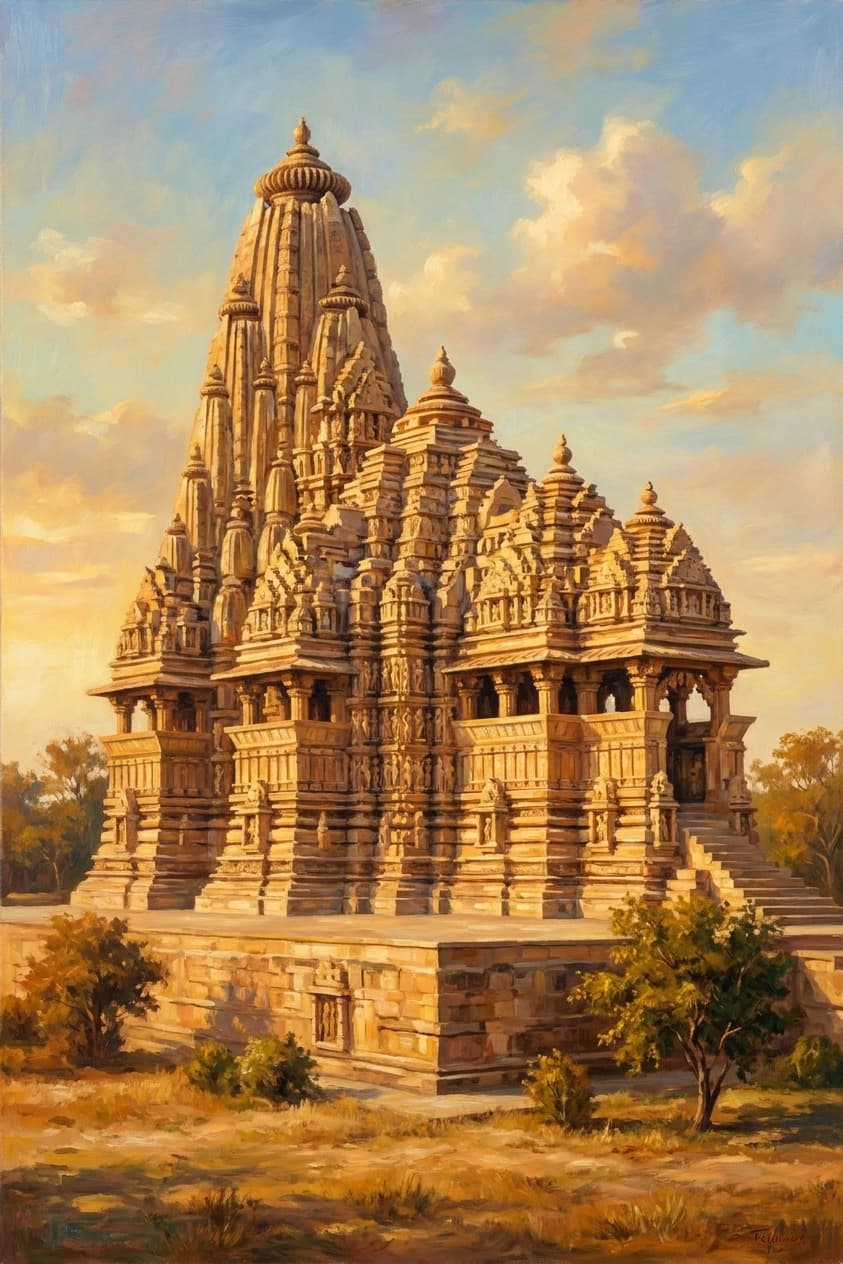
Visiting Khajuraho offers an immersive journey through medieval Dharmic aesthetics and architectural brilliance across peaceful landscaped grounds. The Western Group features the grandest monuments, while the active Matangeshwar Temple continues daily ritual life unbroken since the tenth century.
Highlights
- Marveling at the fractal tower of Kandariya Mahadeva rising over one hundred feet.
- Observing detailed friezes depicting everyday tenth-century Indian life and arts.
- Experiencing the spiritual atmosphere of the living Matangeshwar shrine.
Things to Know
- Visiting during the cool winter months ensures comfortable exploration of open courtyards.
- Modest dress is strictly required for entering the sanctum of Matangeshwar Temple.
Location
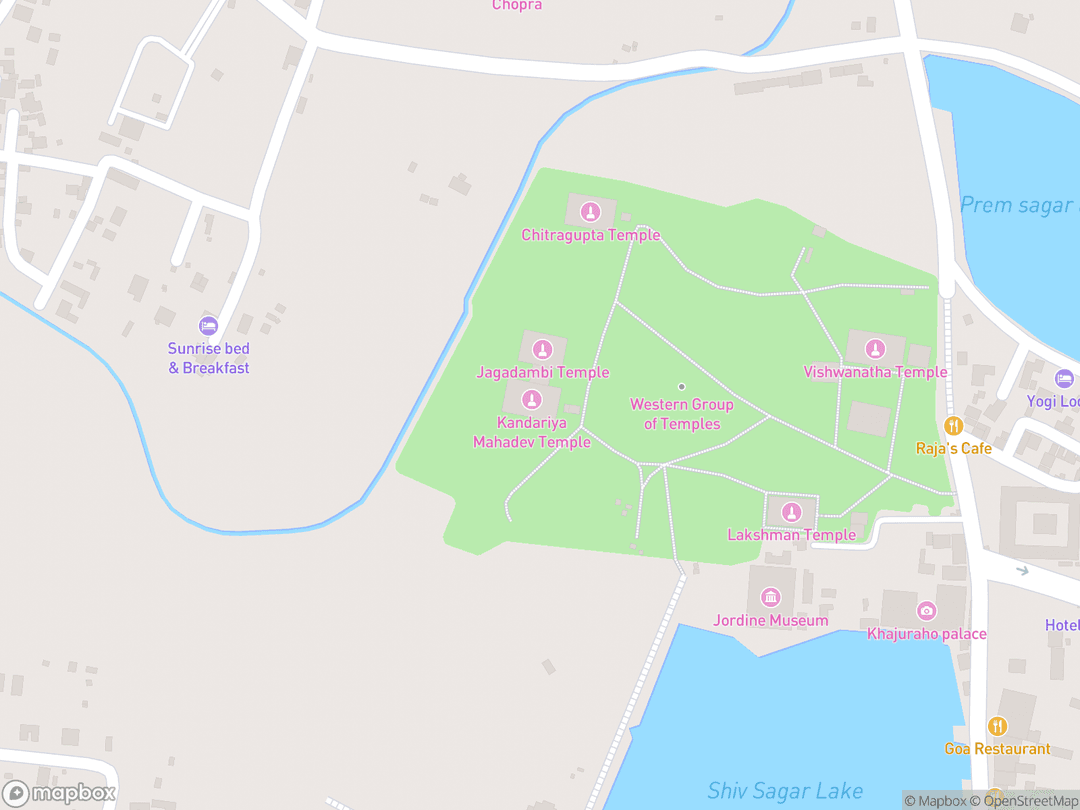
Rajnagar Road, Sevagram, Khajuraho, Chhatarpur District, Madhya Pradesh 471606, India
Hours: Sunrise to sunset daily (Western Group: 06:00 to 18:00)
Getting There: Accessible via Khajuraho Airport (HJR), Khajuraho Railway Station (KURJ), or National Highway 39.
Get DirectionsTips for Your Visit
Optimal Lighting
Photograph the eastern facades at dawn when morning light directly strikes the ornate porches and entry lintels.
Audio Guides
Hire an ASI-certified guide or obtain an official audio guide at the entrance for accurate iconographic explanations.
About
The Khajuraho Group of Monuments represents the high zenith of medieval North Indian temple architecture, flourishing under the sovereign patronage of the Chandela dynasty between the ninth and eleventh centuries. Located in the historic Bundelkhand region of Madhya Pradesh, this celebrated complex initially comprised approximately eighty-five sacred stone sanctuaries, of which twenty-five survive across distinct western, eastern, and southern geographic clusters.
Rooted deeply in classical Dharmic theological traditions, Khajuraho embodies a seamless synthesis of Shaiva, Vaishnava, and Shakta devotional paths, standing in harmonious geographic proximity with venerable Digambara Jain complexes. The temples articulate an organic cosmological vision wherein divine transcendental truth and the multidimensional vitality of worldly creation unite into an integrated spiritual whole.
Architecturally classified within the mature Central Indian Chandela school of the Nagara style, these sandhara temples rise from monumental stone plinths into towering curvilinear spires reminiscent of cosmic peaks. Decorated with hundreds of exquisitely sculpted figures, the monuments celebrate life, duty, devotion, and supreme liberation, establishing Khajuraho as one of humanity's most extraordinary architectural achievements.
Gallery
Symbolic Elements
The temple's exterior features intricate carvings, each rich with spiritual meaning:

Mithuna Junction Carvings
Auspicious couples at wall junctions symbolize the transcendent bliss of soul union and protect the sanctuary.

Surasundari Figures
Graceful celestial maidens adorning facade registers embody the creative feminine energy animating the manifest universe.

Vyala Mythical Beast
Rampant lion-like creatures represent fierce vital energies and inner passions mastered through yogic discipline.

Sekhari Shikhara
Clustered miniature spires ascending toward a central peak evoke sacred Mount Kailasha and the cosmic axis.

Makara Torana
Intricately carved crocodile archways above thresholds symbolize sacred waters and spiritually purify visiting pilgrims.

Amalaka Stone Ring
The ribbed stone disc capping each tower represents the celestial sun and cosmic lotus at the universe's summit.

Kalasha Finial
The crowning copper or stone vase holds the divine nectar of spiritual immortality above the main sanctum.
Interesting Facts
Erotic sculptures constitute only about ten percent of the exterior carvings, with the rest depicting everyday medieval society (Tier A).
The entire monument complex was constructed without mortar, relying on gravitational balance and precise tongue-and-groove joinery (Tier B).
Dense sal and teak forests hid the temples for centuries following the Chandela dynasty's retreat to mountain fortresses (Tier B).
The Matangeshwar Temple contains an eight-foot-tall polished stone Shiva Linga venerated continuously for over a millennium (Tier A).
Both Hindu and Digambara Jain temples were built by the same artisan guilds using identical materials and aesthetic standards (Tier A).
Kandariya Mahadeva features eighty-four miniature spires clustered around its central tower to evoke the Himalayan peaks (Tier B).
British surveyor Captain T.S. Burt hesitated to document the explicit friezes in 1838 due to Victorian sensibilities (Tier B).
Sanctum chambers are aligned mathematically so the first morning rays of solstices strike the primary interior icons (Tier B).
Common Questions
Why were the Khajuraho temples constructed without mortar?
Master builders utilized precise stone cutting, counterweights, and mortise-and-tenon joints that withstand seismic pressures.
Are all surviving temples in Khajuraho dedicated to Shiva?
No, the monuments venerate Shiva, Vishnu, Surya, the Chausath Yoginis, and venerable Jain Tirthankaras.
Does active religious worship still take place here?
Yes, the Matangeshwar Temple has sustained unbroken daily Shaiva worship for more than a thousand years.
What is the meaning of the amorous carvings on temple exteriors?
They reflect kama as one of the four legitimate human aims, symbolizing cosmic creative union and auspicious protection.
Featured Stories
The Sovereign Dedication of Lakshmana Temple
954
In 954 CE, King Yashovarman completed the monumental Lakshmana sanctuary to assert Chandela autonomy from declining imperial overlords. The monarch installed an exquisite three-headed image of Vaikuntha Vishnu obtained through diplomatic alliance, establishing Khajuraho as an independent cultural capital. The lavish dedication ceremony brought together master sculptors and ascetics, inaugurating a century of architectural ambition across the valley.
Source: Archaeological Survey of India Inscription Records
A King's Final Offering at Vishvanatha
1002
King Dhanga reached a venerable age of over a hundred years while overseeing the consecration of the magnificent Vishvanatha temple. Epigraphic records recount how the elderly ruler dedicated pure emerald and stone lingas to Shiva before peacefully abdicating his sovereign duties. His royal retirement demonstrated that state power ultimately yielded to spiritual devotion and preparation for eternal release.
Source: Khajuraho Epigraphical Epistles
Rediscovery through the Bundelkhand Forest
1838
In 1838, British military surveyor Captain T.S. Burt was led through dense jungle thickets by indigenous guides who had preserved knowledge of the ruins. Pushing through tangled teak trees, Burt was stunned to encounter soaring sandstone shikharas rising intact from abandoned terraces. His field journals brought Khajuraho into international scholarship while expressing astonished disbelief at the sculptors' technical precision.
Source: Journal of the Asiatic Society of Bengal
Timeline
Chausath Yogini Temple Construction
The earliest hypaethral granite monument is erected at Shivsagar lake for sixty-four esoteric divinities.
MilestoneGranite to Sandstone Transition
Builders transition from coarse local granite to fine buff sandstone masonry with the Lalguan Mahadeva shrine.
MilestoneDedication of Lakshmana Temple
Chandela monarch Yashovarman dedicates the monumental panchayatana sanctuary enshrining three-headed Vaikuntha Vishnu.
DedicationPatronage of Jain Shrines
King Dhanga extends royal guild patronage to Digambara Jain communities to construct the Parshvanatha temple.
MilestoneDedication of Vishvanatha Temple
King Dhanga consecrates an elaborate Shaiva complex and abdicates his throne in ritual devotion.
DedicationZenith at Kandariya Mahadeva
King Vidyadhara commissions the largest and most complex temple to celebrate victory over invading forces.
MilestoneLate Chandela Building Phase
Construction of the Duladeo and Chitragupta temples introduces stylized angular decorative friezes.
MilestoneStrategic Relocation to Fortresses
Chandela rulers shift patronage to mountain fortresses following defensive military confrontations.
EventAccount of Ibn Battuta
Moroccan traveler Ibn Battuta documents ascetics living among sacred water tanks inside the forest.
EventSurvey by Captain T.S. Burt
British royal engineer Captain T.S. Burt documents the Western Group under guidance of local villagers.
MilestoneUNESCO World Heritage Inscription
The complex is formally recognized as a World Heritage Site for outstanding artistic and architectural value.
MilestoneHistory by Decade
880s–940s — Origins and Tantric Foundations
Early Chandela rulers established their ceremonial capital around Shivsagar lake, initially erecting open-air granite shrines such as the Chausath Yogini. As wealth from regional trade accumulated, royal architects shifted from rough granite to fine buff sandstone, refining early Nagara spatial conventions.
950s–1000s — The Golden Age of Independence
Under King Yashovarman and King Dhanga, Khajuraho flourished as an imperial center of arts and devotion. Grand panchayatana shrines dedicated to Vishnu and Shiva were raised alongside exquisite Jain sanctuaries, showcasing religious ecumenism through shared artisan guilds.
1010s–1070s — Imperial Zenith and Monumental Spired Temples
King Vidyadhara celebrated military victories by commissioning Kandariya Mahadeva, the grandest temple of the complex featuring eighty-four clustered towers. Later rulers completed the Chitragupta and Duladeo temples, introducing more angular and richly decorated sculptural bands.
1080s–1330s — Strategic Withdrawal and Forest Encroachment
Facing geopolitical pressure across central India, the Chandelas relocated their defensive capital to fortresses at Kalanjar and Ajaigarh. While ascetics maintained local rituals around water tanks, the jungle gradually reclaimed the surrounding monuments.
1830s–1980s — Rediscovery and Global Recognition
Captain T.S. Burt's 1838 expedition initiated systematic documentation that culminated in major conservation by the Archaeological Survey of India under Lord Curzon. In 1986, the complex received UNESCO World Heritage status, affirming its global significance.
Architecture & Facilities
The Khajuraho temples embody the mature Chandela school of classical North Indian Nagara architecture, characterized by compact, organic vertical monoliths erected on high terraces. Each temple features an integrated axial plan including porch, hall, vestibule, and sanctum, crowned by rhythmic Sekhari spires that visually emulate sacred mountain ranges.
Building Materials
Panna Sandstone
Fine-grained buff and yellow sandstone quarried from the Ken River basin allowed precise undercutting.
Bundelkhand Granite
Dense local granitic rock formed the heavy foundation terraces and the earliest yogini cells.
Iron Dowels
Forged iron fasteners held dry-stacked stone blocks securely without cementing mortar.
Mortise and Tenon Joints
Interlocking stone sockets and tenons provided dynamic structural equilibrium against seismic shifts.
Interior Features
Ardhamandapa (Entrance Porch)
Elevated vestibule approached by ceremonial stone stairs and framed by makara toranas.
Mahamandapa (Great Hall)
Hypostyle hall with lateral projecting balconies admitting ventilation and soft natural light.
Antarala (Vestibule)
Narrow transitional threshold separating the assembly hall from the inner divine presence.
Garbhagriha (Womb Sanctum)
Windowless, unadorned cubical sanctum housing the central deity to concentrate devotional focus.
Temple Grounds
The surviving twenty-five temples are arranged into Western, Eastern, and Southern groups set amidst manicured lawns and sacred historic water reservoirs maintained by the Archaeological Survey of India.
Additional Facilities
The site features an on-site archaeological museum, modern ticketing concourse, interpretive signage, and an evening open-air amphitheater for cultural performances.
Religious Significance
Within Dharmic philosophy, the Hindu temple represents a physical manifestation of the cosmic being (Vastu Purusha) and a tangible bridge between the temporal realm and absolute divine reality.
To provide a consecrated architectural vehicle for inner spiritual transformation, facilitating worship from worldly multiplicity toward silent non-dual unity.
Sacred Ordinances
Pradakshina (Circumambulation)
Clockwise walking meditation around the high plinth and inner sanctum to internalize divine order.
Darshan (Divine Viewing)
Reciprocal spiritual gaze exchanged between the humble devotee and the consecrated central icon.
Abhisheka (Ritual Lustration)
Ceremonial bathing of the sacred Shiva Linga with water and milk at the living Matangeshwar shrine.
The Four Pursuits of Life (Purusharthas)
Khajuraho visually portrays the four classical Dharmic life goals: Dharma (virtue), Artha (prosperity), Kama (aesthetic love), and Moksha (spiritual liberation).
The Tantric Synthesis of Shiva and Shakti
External figurative carvings reflect the primordial cosmic interplay of consciousness and creative energy, leading the seeker toward inner stillness.
Sources & Research
Every fact on Temples.org is backed by verified Sources & Research. Each piece of information is rated by source tier and confidence level.
View All Sources (9)
| Field | Source | Tier | Retrieved |
|---|---|---|---|
| About & Historical Background | UNESCO World Heritage Centre (opens in a new tab) | B | 2026-03-31 |
| Architectural Documentation | Encyclopaedia Britannica (opens in a new tab) | B | 2026-03-31 |
| Historical Timeline & Epigraphy | Archaeological Survey of India (opens in a new tab) | A | 2026-03-31 |
| Religious Significance & Iconography | Asian Art Museum (opens in a new tab) | B | 2026-03-31 |
| Living Worship Traditions | Maha Shivratri Cultural Association (opens in a new tab) | A | 2026-03-31 |
| Heritage Conservation Profile | Cultural Heritage Online (opens in a new tab) | B | 2026-03-31 |
| Architectural Typology & Structural Analysis | Studio Matrx Architectural Research (opens in a new tab) | B | 2026-03-31 |
| Regional Context & Inscription Research | Model Diplomat Cultural Review (opens in a new tab) | B | 2026-03-31 |
| Academic Research Studies | ResearchGate Scientific Repository (opens in a new tab) | B | 2026-03-31 |