Visitor Insights
Visiting Shore Temple
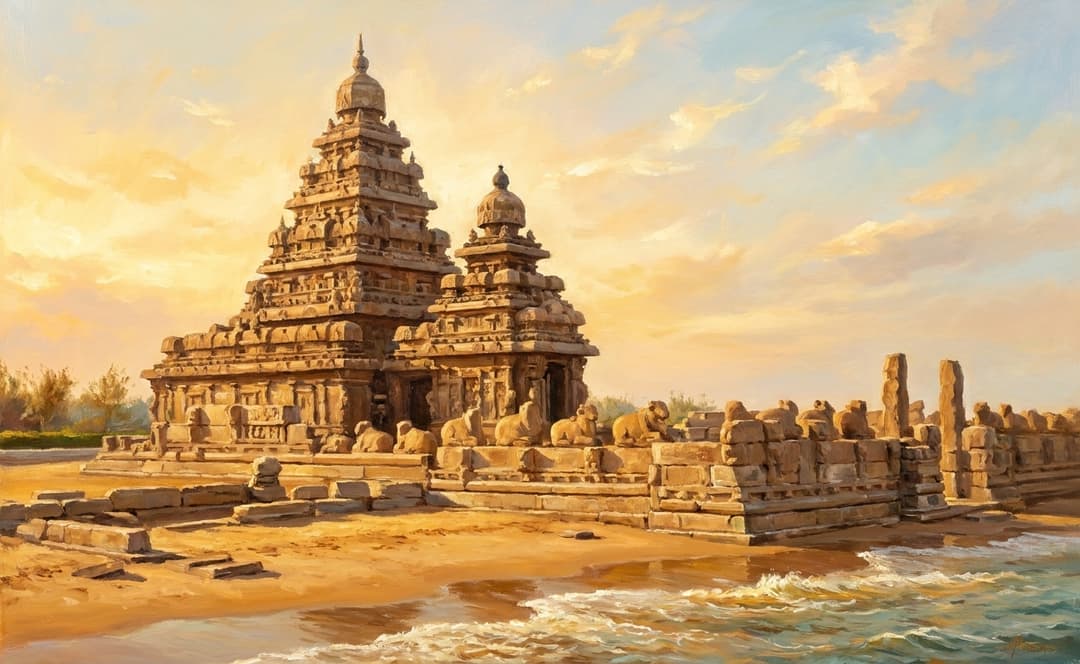
Visiting the Shore Temple offers an evocative encounter with ancient Dravidian stonework bathed in the sea spray of the Bay of Bengal. Arriving at dawn rewards visitors with spectacular views as sunrise illuminates the pyramidal eastern vimana against the ocean horizon. The manicured coastal grounds and sea breezes create a serene atmosphere for exploring early medieval architecture.
Highlights
- Dawn sunrise over the Bay of Bengal framing the five-tiered eastern stone vimana.
- Intricate Somaskanda bas-reliefs carved inside both the eastern and western sanctuaries.
- The ancient rock-hewn carving of Lord Vishnu resting in cosmic sleep between the twin towers.
- Perimeter enclosure walls crowned with dozens of weather-worn monolithic Nandi bulls.
Things to Know
- Coastal winds carry maritime salt spray, so protective covers for sensitive cameras are recommended.
- Footwear must be removed before stepping onto the elevated stone platforms around the sanctums.
- Midday coastal temperatures can be intense; morning or late afternoon visits are most comfortable.
Location
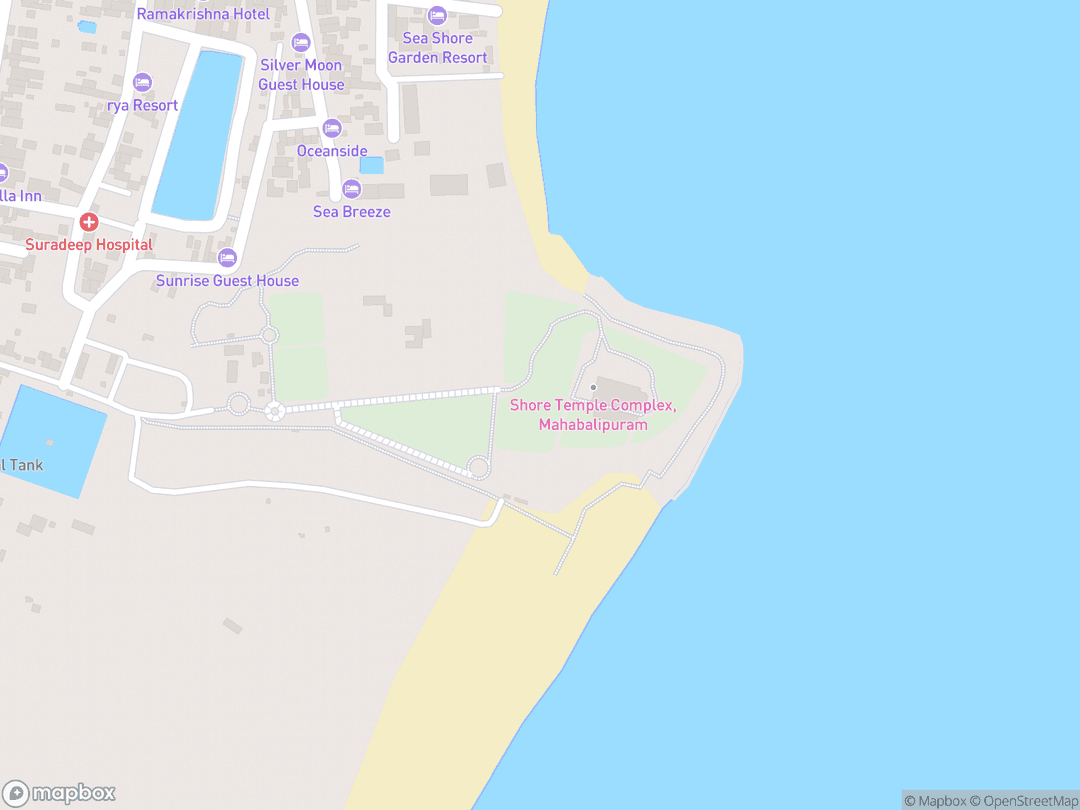
Shore Temple Road, Mamallapuram, Chengalpattu District, Tamil Nadu 603104, India
Hours: 6:00 AM to 6:00 PM daily
Getting There: Located 55 kilometers south of Chennai along the scenic East Coast Road (SH-49), accessible by private taxi or state express bus routes.
Get DirectionsTips for Your Visit
Arrive at Opening
Enter right at 6:00 AM to photograph the temple against the ocean sunrise before midday crowds arrive.
Digital Ticketing
Purchase entry tickets online via the Archaeological Survey of India portal to bypass queue lines at the gate.
Combined Monument Access
Your entry ticket grants same-day admission to the Pancha Rathas and Arjuna's Penance monuments nearby.
Eco-Friendly Buggies
Solar-powered buggies are available at the main parking terminal for senior citizens and mobility-impaired guests.
About
The Shore Temple stands as an eighth-century crowning achievement of Pallava architecture, perched directly upon the rocky shoreline of the Bay of Bengal in Mamallapuram. Built during the reign of King Narasimhavarman II Rajasimha, it represents the pivotal historical transition in South India from rock-cut cave sanctuaries to freestanding structural stone masonry.
Within the overarching Dharmic tradition, the complex embodies a profound syncretic vision by uniting dual Shaiva shrines with a central Vaishnava sanctum upon a single consecrated plinth. Rather than dividing theological streams, the sanctuary harmonizes devotion to Shiva and Vishnu, creating a unified architectural reflection of the cosmic order.
Facing the open ocean, the temple served for centuries as both a sacred destination and a navigational landmark for maritime trade across the Indian Ocean. Its weathered granite vimanas have endured thirteen centuries of salt spray, monsoonal cyclones, and ocean tides, standing today as a timeless testament to ancient Indian spiritual devotion and structural engineering.
Designated a UNESCO World Heritage Site in 1984 as part of the Group of Monuments at Mahabalipuram, the complex continues to inspire scholars and pilgrims worldwide. In 2023, the monument achieved global acclaim by becoming India's first heritage site powered entirely by green solar energy.
Gallery
Symbolic Elements
The temple's exterior features intricate carvings, each rich with spiritual meaning:

Somaskanda Panel
Depicts Shiva and Parvati with infant Skanda, representing cosmic harmony and dynastic continuity.

Fluted Dharalinga
A sixteen-faceted polished basalt emblem capturing dawn light to symbolize the unmanifest Absolute.

Anantasayana Vishnu
Portrays Vishnu resting upon cosmic serpent coils to signify meditative repose and the renewal of creation.

Recumbent Nandi Row
Guarding bulls resting on perimeter copings that embody unwavering devotion and cosmic righteousness.

Durga Lion Cavity
A rampant guardian lion carrying a miniature relief of Durga subduing the demon of spiritual darkness.

Vyala Pilasters
Rearing leonine beasts sculpted along structural walls to represent untamed nature harnessed for sacred defense.

Octagonal Stupika
The rounded stone finial crowning each vimana, channeling celestial energy down into the sanctum core.

Varaha Well
An integrated rock-cut relief of Vishnu's boar incarnation protecting subterranean fresh water channels.
Interesting Facts
European sailors historically referred to Mahabalipuram as the 'Seven Pagodas', believing six sister towers were claimed by the sea. (Tier B)
During the 2004 tsunami, receding ocean waters briefly revealed submerged stone ruins and carved animal reliefs offshore. (Tier A)
The central shrine of reclining Vishnu was carved directly into living bedrock before the stone towers were built around it. (Tier A)
In 2023, the monument became India's very first archaeological site operated entirely by off-grid solar electricity. (Tier A)
Centuries of salty maritime winds have softened the granite reliefs into undulating, impressionistic silhouettes. (Tier B)
Ancient fires maintained atop the eastern vimana once functioned as a coastal lighthouse for incoming merchant ships. (Tier B)
A freestanding stone lion in the southern court contains a miniature carving of Goddess Durga hollowed directly inside its chest. (Tier A)
The complex departs from classical symmetry by deliberately pairing two towers of different heights on a shared terrace. (Tier B)
The heavy granite blocks were fitted together through interlocking joints without using binding cement or iron fasteners. (Tier B)
Common Questions
Is the Shore Temple an active place of daily worship?
No, active liturgical rituals ceased centuries ago and the site is preserved as a protected historic monument.
Why does the Shore Temple have three separate sanctums?
The complex intentionally integrates two Shiva shrines and one central Vishnu shrine upon a single sacred plinth.
How old is the Shore Temple?
The structural granite temple was consecrated around 725 CE, making it more than 1,300 years old.
Did the 2004 tsunami damage the temple?
No, its solid bedrock foundation and protective granite breakwater prevented structural damage during the disaster.
What is the best time of year to visit?
The winter months from November to February offer the most pleasant temperatures and clearest coastal skies.
Featured Stories
The Seven Pagodas and the Receding Sea
December 26, 2004
For centuries, maritime cartographers recounted tales of seven golden spires lining this coast that were swallowed by envious ocean tides. When the catastrophic 2004 tsunami drew the sea back hundreds of meters, astonished residents witnessed ancient submerged granite walls and carved statues briefly exposed on the seafloor. The timeless stone temple stood resilient against the returning surge, confirming centuries of seafaring legend.
Source: Archaeological Survey of India Marine Division
Rajasimha's Leap into Stone
725
Pallava sculptors had spent generations cutting sanctuaries into living rock faces before King Rajasimha dared to assemble freestanding granite blocks against coastal winds. Masons dressed native stone with incredible precision, hauling massive lintels up earthen ramps without mechanical iron cranes. Their architectural triumph proved that structural stonework could endure alongside the ocean for over a millennium.
Source: South Indian Epigraphical Inscriptions
The Sacred Synthesis of Two Traditions
720
During an era when theological rivalries often divided Shaiva and Vaishnava communities across South India, Rajasimha chose unity upon this coastal cliff. Architects integrated a preexisting boulder carving of reclining Vishnu between two soaring towers dedicated to Lord Shiva. This bold design created an enduring monument to reconciliation where both divine visions share one sacred foundation.
Source: Dravidian Architectural Studies
Timeline
Pallava Harbor Expansion
King Narasimhavarman I Mamalla develops the coastal port into a bustling maritime trade center.
MilestoneMonolithic Vishnu Carving
Sculptors carve the reclining Anantasayana Vishnu directly into an existing seaside granite boulder.
MilestoneAscension of Rajasimha
King Narasimhavarman II ascends the throne and pioneers the construction of structural stone temples.
MilestoneShore Temple Consecration
Artisans complete the dressed ashlar granite towers, enclosing walls, and monolithic shrines.
DedicationChola Hegemony
Imperial Cholas assume regional administration while royal building patronage shifts westward.
EventRelocation of Active Liturgy
Regular worship moves inland to Sthalasayana Perumal Temple due to relentless coastal sea spray.
EventAntiquarian Documentation
British surveyor Colin Mackenzie prepares architectural drawings and maps of the coastal ruins.
MilestoneSystematic Desiltation
Early archaeological excavations clear deep sandbanks engulfing the stepped plinth and outer courtyards.
RenovationGranite Breakwater Construction
Engineers erect an offshore stone groyne wall to shield the fragile monument from marine erosion.
RenovationWorld Heritage Inscription
UNESCO inscribes the complex as a World Heritage Site within the Monuments at Mahabalipuram.
MilestoneIndian Ocean Tsunami
Receding tsunami waters briefly expose submerged offshore masonry while the temple stands undamaged.
EventGreen Energy Milestone
The site becomes India's first green energy archaeological monument powered by off-grid solar arrays.
MilestoneHistory by Decade
630s–680s — The Monolithic Era
Under King Narasimhavarman I Mamalla, the port settlement grew into an international trade hub connecting South India to Southeast Asia and Rome. Early sculptors worked exclusively with living granite outcrops, carving open-air rock shelters and creating the initial coastal shrine of reclining Vishnu.
700s–730s — Structural Masterwork
King Rajasimha shifted Pallava building practices from excavation to structural stone assembly. Quarrying crystalline granite, masons erected the twin pyramidal towers and enclosure walls to protect the older rock-hewn Vishnu sanctum from the advancing sea.
850s–1300s — Dynastic Transition
Following the decline of the Pallava dynasty, the Chola Empire assumed regional control and made endowments to coastal shrines. Although major architectural projects moved inland to Thanjavur, the Shore Temple remained a vital navigational marker for trans-oceanic merchants.
1350s–1500s — Liturgical Relocation
Continuous marine encroachment and corrosive salt spray gradually took a toll on daily temple rituals. Under Vijayanagara rule, active liturgical services were transferred inland to the newly built Sthalasayana Perumal Temple, leaving the Shore Temple as an admired sacred landmark.
1790s–1880s — Antiquarian Clearance
British surveyor Colin Mackenzie and Victorian antiquarians excavated the complex from deep dunes of coastal sand. Early photographs revealed ocean waves breaking against the temple's southern foundations, prompting systematic conservation efforts by the newly founded Archaeological Survey of India.
1970s–Present — Conservation & Green Energy
The Archaeological Survey of India constructed an offshore granite groyne wall in the 1970s, which successfully shielded the temple during the 2004 tsunami. In 2023, the monument achieved global acclaim as India's first green energy archaeological site powered completely by solar infrastructure.
Architecture & Facilities
The Shore Temple represents the seminal masterpiece of early Dravidian structural stone architecture, marking South India's historic transition from subtractive rock-cut shrines to additive granite masonry. Constructed with dressed ashlar blocks set in precise horizontal courses, its soaring vimanas feature stepped pyramidal storeys ornamented with pilasters, miniature barrel-vaulted roof pavilions, and crowning octagonal domes.
Building Materials
Crystalline Granite
Dense igneous rock quarried inland and dressed into rectangular ashlar blocks for structural stability.
Leptynite Gneiss
Local metamorphic stone utilized across perimeter foundations to resist continuous saltwater erosion.
Polished Black Basalt
Fine-grained volcanic stone carved into the faceted Dharalinga housed inside the primary eastern sanctum.
Lime Mortar
Thin binding layer of crushed seashells and slaked lime used to seal joint lines between masonry courses.
Interior Features
Kshatriyasimhesvara Sanctum
The primary east-facing cell housing the sixteen-sided fluted Dharalinga and Somaskanda relief panel.
Narapatisimha Pallava Vishnugriha
A flat-roofed central shrine preserving the rock-hewn figure of Lord Vishnu in cosmic slumber.
Rajasimhesvara Sanctum
The west-facing cell crowned by a three-tiered tower and adorned with an ornate Somaskanda relief.
Inner Pradakshina Pathway
A narrow circumambulatory stone corridor circumscribing the sanctum to facilitate meditative devotion.
Temple Grounds
The temple complex rests upon an elevated stone platform bordered by a protective granite groyne breakwater, casuarina shelterbelts, manicured lawns, and ancient stepped water tanks.
Additional Facilities
Visitor amenities include an off-grid solar-powered information pavilion, RO drinking water kiosks, clean restrooms, and zero-emission electric shuttles connecting to the parking terminal.
Religious Significance
In Dharmic cosmology, a Hindu temple represents the Prasada—a physical manifestation of cosmic order where the human soul realizes communion with the Absolute.
To serve as a sacred coastal sanctuary uniting Shaiva and Vaishnava devotion while providing maritime protection to seafaring travelers.
Sacred Ordinances
Pradakshina (Circumambulation)
Ritual clockwise walking around the sanctum to align individual consciousness with cosmic harmony.
Darshan (Sacred Viewing)
Direct visual communion with the consecrated deities to receive divine spiritual blessings.
Deepam (Light Offering)
The ceremonial lighting of oil lamps atop the tower to dispel darkness both spiritually and across the sea.
Shaiva and Vaishnava Synthesis
The Shore Temple stands as an extraordinary Dharmic testament to sectarian reconciliation, deliberately placing Shiva and Vishnu on a single consecrated platform.
Cosmic Ocean and Yoga Nidra
Positioning the sleeping Vishnu directly beside the Bay of Bengal symbolically merges the physical ocean with the primordial waters of cosmic renewal.
Sources & Research
Every fact on Temples.org is backed by verified Sources & Research. Each piece of information is rated by source tier and confidence level.
View All Sources (8)
| Field | Source | Tier | Retrieved |
|---|---|---|---|
| About & Historical Background | Smarthistory (opens in a new tab) | B | 2026-03-31 |
| Architecture & Structural Engineering | Encyclopaedia Britannica (opens in a new tab) | B | 2026-03-31 |
| Religious Significance & Iconography | Tamil Arts Academy (opens in a new tab) | B | 2026-03-31 |
| Timeline & Royal Patronage | Studio Matrx (opens in a new tab) | C | 2026-03-31 |
| Visitor Insights & Conservation | Plutus IAS Research (opens in a new tab) | C | 2026-03-31 |
| Maritime History & Archaeology | Madras Documentaries (opens in a new tab) | C | 2026-03-31 |
| Grounds & Outer Courts | The Aarch News (opens in a new tab) | C | 2026-03-31 |
| Symbolic Elements & Art | Model Diplomat Cultural Gazette (opens in a new tab) | D | 2026-03-31 |