Visitor Insights
Visiting Somnath Temple
Somnath Temple provides an immersive coastal pilgrimage experience that seamlessly integrates ancient oceanfront rituals with modern visitor management. The sanctum remains active continuously from early morning through late evening, offering evocative views of the crashing Arabian Sea waves against the temple ramparts.
Highlights
- Witnessing the resplendent Sandhya Aarti accompanied by ringing brass bells and oceanic waves.
- Examining the ancient astronomical inscription upon the oceanfront Bana Stambha arrow pillar.
- Attending the nightly Jay Somnath light and sound show projected against the sandstone shikhara.
- Visiting the historic subterranean sanctum commissioned by Queen Ahilyabai Holkar in 1783.
Things to Know
- Strict security mandates require all mobile phones, cameras, smartwatches, and leather goods to be deposited in exterior lockers.
- Modest traditional attire covering shoulders and knees is strictly enforced for all visitors.
- Footwear must be deposited at designated free stalls before passing through the security gates.
- Pilgrim crowds peak dramatically during Maha Shivratri and the sacred month of Shravana.
Location
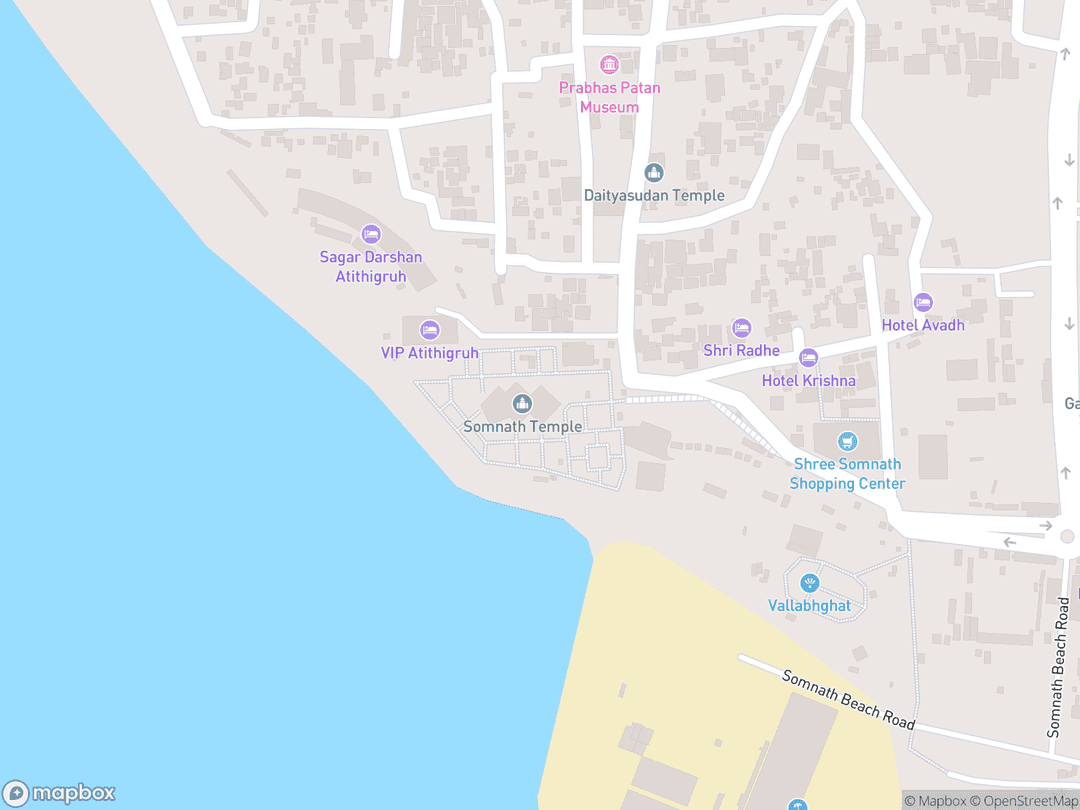
Prabhas Patan, Veraval, Gir Somnath District, Gujarat 362268, India
Hours: Open daily from 6:00 AM to 10:00 PM without afternoon closure.
Getting There: Located in Prabhas Patan, accessible via Veraval Junction Railway Station (7 km), Diu Airport (85 km), and national highway NH-51.
Get DirectionsTips for Your Visit
Arrive Early for Morning Aarti
Enter the queue before 6:30 AM to secure a direct view of the sanctum during the 7:00 AM morning worship ceremony.
Utilize Free Locker Facilities
Deposit electronics and valuables at the official trust-managed counter outside the main entrance prior to queuing.
Evening Sound and Light Show
Purchase tickets inside the courtyard after dusk for the 8:00 PM bilingual multimedia historical narration.
Walk the Coastal Promenade
Spend time along the fortified sea-facing walkway behind the temple to observe the unbroken maritime horizon toward the south.
About
Somnath Temple, revered in Dharmic traditions as the foremost of the twelve sacred Jyotirlingas, stands where the mythological Saraswati, Hiran, and Kapila rivers merge with the Arabian Sea at Prabhas Patan. Across multiple millennia, this sacred site has served as a primary tirtha, representing a consecrated crossing point between temporal existence and transcendent liberation.
According to Puranic scripture, Soma, the Moon God, was cursed to lose his celestial brilliance and performed intense penance to Lord Shiva at this seashore. Shiva manifested as Someshvara, transmuting the debilitating decree into the eternal lunar rhythm of waxing and waning, establishing the sanctuary as an enduring center of cosmic healing and cyclic rejuvenation.
Throughout a thousand years of political upheaval, the coastal shrine was repeatedly desecrated and rebuilt, emerging as an enduring metaphor for cultural resilience. Following Indian independence in 1947, Deputy Prime Minister Sardar Vallabhbhai Patel initiated its grand restoration, funded entirely through public contributions rather than state revenues.
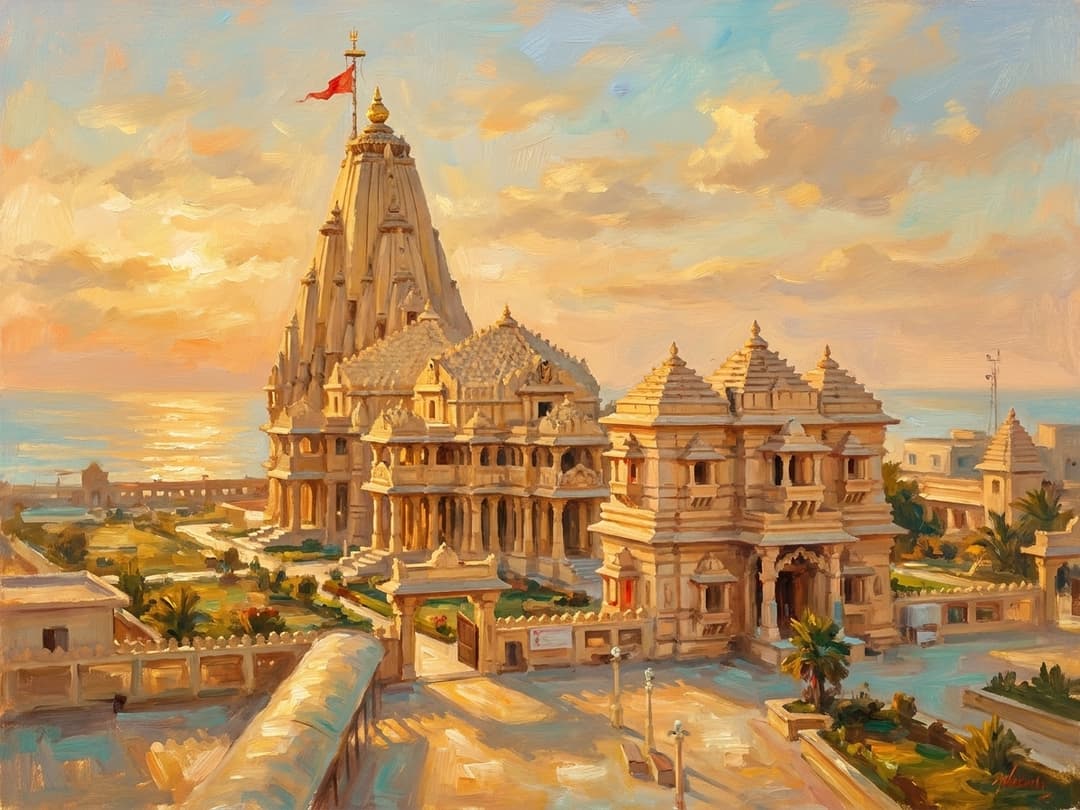
Completed in 1995 according to classical Solanki temple architecture by the Sompura guild of master builders, the present honey-toned sandstone edifice soars above the ocean surf. The active pilgrimage complex welcomes millions of devotees who gather daily to witness ancient Vedic rituals and the dramatic evening sunset over the waters.
Gallery
Symbolic Elements
The temple's exterior features intricate carvings, each rich with spiritual meaning:

Somanatha Jyotirlinga
The aniconic black stone pillar in the inner sanctum manifests Shiva as infinite formless cosmic light.

Bana Stambha
An ancient sea-wall arrow pillar denoting an unimpeded maritime path straight from the temple to the South Pole.

Nandi Bull
A polished stone sculpture of Shiva's vahana gazing into the sanctum, exemplifying steadfast devotion and controlled senses.

Ten-Tonne Kalash
The colossal gilded stone finial crowning the spire symbolizes spiritual culmination and cosmic abundance.

Dhwaja Danda
A thirty-seven-foot flag mast supporting the saffron flag that announces the active presence of divine grace.

Triveni Sangam
The sacred tripartite river confluence into the sea represents the purification of bodily energetic pathways.

Nataraja Relief
Intricately carved stone imagery depicting Shiva orchestrating the five cosmic cycles of creation and dissolution.

Ahilyabai Crypt
The preserved historic subterranean chamber honors devotional tenacity and the preservation of sacred rites.
Interesting Facts
The Bana Stambha pillar marks an oceanic meridian where no land obstructs a direct course south to Antarctica (Tier A).
Historian K.M. Munshi termed Somnath the 'Shrine Eternal' because it rose repeatedly from six devastating destructions (Tier C).
Mahatma Gandhi mandated that the post-1947 reconstruction be financed through voluntary public donations rather than public tax funds (Tier A).
Master architect Prabhashankar Sompura belonged to the ancient ancestral guild that constructed Western India's medieval stone shrines (Tier B).
For nearly two centuries, continuous daily worship occurred inside Queen Ahilyabai's secret underground chamber nearby (Tier A).
Holy soils and consecrated waters from hundreds of Indian rivers and global embassies were poured into the foundation in 1951 (Tier A).
The massive gilded stone kalash finial anchoring the apex of the spire weighs an astonishing ten tonnes (Tier A).
The temple precinct sits near Dehotsarga Tirtha, the sacred ground where Lord Krishna concluded his earthly incarnation (Tier A).
Common Questions
What does the name Somnath mean?
The name signifies 'Lord of the Moon', referencing Shiva curing Soma of his wasting affliction.
Are non-Hindu visitors allowed to enter the temple?
Non-Hindu visitors may enter the complex after completing a simple entry registration at the temple office.
What is the significance of the Bana Stambha pillar?
The sea-wall pillar indicates that an unobstructed line of ocean extends from Somnath directly to Antarctica.
Can visitors take photographs inside the inner sanctum?
Photography and personal electronic devices are strictly prohibited throughout the inner sanctum and courtyards.
When are the daily aarti ceremonies held?
Aarti takes place three times daily at 7:00 AM, 12:00 PM, and 7:00 PM.
Featured Stories
Sardar Patel's Shoreline Vow
November 13, 1947
Standing amid the ocean breeze and weathered ruins of Prabhas Patan following the integration of Junagadh, Sardar Vallabhbhai Patel dipped his hands into the Arabian Sea and declared that Somnath would rise again. Endorsed by Mahatma Gandhi on the condition of using public donations, this decisive moment catalyzed modern India's largest spiritual restoration project. The resulting monument stands as a shared triumph of community devotion over historical adversity.
Source: Shree Somnath Trust Official Archive
The Sacrifice of Hamirji Gohil
1403
When the armies of the Gujarat Sultanate descended upon Prabhas Patan, the young Rajput prince Hamirji Gohil refused to abandon the sacred precinct. Joining forces with the tribal chieftain Vegda Bhil, a small detachment mounted an unyielding rear-guard defense directly before the sanctuary gates. Memorial cenotaphs honoring both fallen warriors stand beside the entrance today, commemorating their selfless dedication to safeguarding sacred ground.
Source: Saurashtra Historical Gazette
Ahilyabai's Hidden Underground Sanctum
1783
Faced with persistent imperial edicts prohibiting public worship, the visionary Maratha Queen Ahilyabai Holkar devised an ingenious subterranean design to ensure rituals continued uninterrupted. She secretly constructed an underground sanctum two hundred meters inland, concealing the lingam beneath street level away from coastal raiders. For one hundred and sixty-eight years, priests conducted unbroken worship in this hidden retreat until the oceanfront temple was reborn.
Source: Historical Records of the Holkar State
Timeline
Vedic and Puranic Sacred Site
The maritime shrine at Prabhas Patan is documented in the Mahabharata and Puranas as an ancient pilgrimage ford.
MilestoneEarly Solanki Stone Shrines
Early Chaulukya rulers construct layered stone sanctuaries over ancient red sandstone and brick foundations.
MilestoneGhaznavid Raid
Mahmud of Ghazni sacks the wealthy coastal sanctuary and loots its historic treasury.
EventRestoration by Bhima I
King Bhima I of Gujarat joins regional rulers to construct a monumental new stone temple on the plinth.
RenovationKumarapala Royal Reconstruction
Emperor Kumarapala replaces aging masonry with a grand granite and sandstone multi-tiered complex.
RenovationDelhi Sultanate Campaign
Commanders under Sultan Alauddin Khalji invade Saurashtra and damage the imperial sanctuary.
EventReconstruction by Mahipala I
Chudasama King Mahipala I restores the oceanfront complex and commissions an elaborate new lingam.
RenovationSacrificial Defense of the Gates
Rajput chieftain Hamirji Gohil and warrior Vegda Bhil perish while defending the temple entrance.
EventAhilyabai Subterranean Shrine
Queen Ahilyabai Holkar of Indore builds a covert underground sanctum nearby to preserve uninterrupted daily rituals.
MilestoneThe Rebirth Vow
Sardar Vallabhbhai Patel addresses an oceanfront assembly and pledges the complete reconstruction of Somnath.
MilestonePran-Pratishtha Consecration
President Dr. Rajendra Prasad installs the sacred Jyotirlinga during a national spiritual ceremony.
DedicationDedication of the Completed Spire
President Dr. Shankar Dayal Sharma dedicates the finished Kailash Mahameru Prasad complex.
DedicationHistory by Decade
Antiquity–10th Century — The Ancient Maritime Ford
Prabhas Patan flourished for centuries as a vital trade port and sacred tirtha referenced in the Mahabharata. Archaeological excavations beneath the existing plinth reveal multiple successive foundations made of baked brick and red sandstone, reflecting patronage by Maitraka and Vallabhi dynasties.
1020s–1160s — Sacks and Solanki Golden Age
Following the devastating 1026 raid by Mahmud of Ghazni, King Bhima I immediately rebuilt the sanctuary in stone. Emperor Kumarapala substantially enlarged the oceanfront mandir in 1169, utilizing pure granite and sandstone to establish an imperial center of Maru-Gurjara art.
1290s–1400s — Sultanate Raids and Warrior Defiance
The expansion of the Delhi and Gujarat Sultanates brought repeated incursions, notably the 1299 assault under Alauddin Khalji's generals. Local chieftains like Hamirji Gohil repeatedly sacrificed their lives defending the shrine gates, prompting recurrent reconstructions by regional Chudasama rulers.
1660s–1780s — Imperial Prohibitions and Ahilyabai's Crypt
Mughal farmans issued under Aurangzeb halted visible public rituals along the coastal shoreline. In response, Queen Ahilyabai Holkar of Indore established an underground stone sanctum in 1783, ensuring that uninterrupted daily pujas continued shielded from hostile eyes.
1940s–1950s — National Rebirth and Consecration
Following Sardar Patel's 1947 declaration, the Shree Somnath Trust was established to oversee an authentic archaeological reconstruction. On May 11, 1951, President Dr. Rajendra Prasad presided over the Pran-Pratishtha ceremony, consecrating the Jyotirlinga before hundreds of thousands of pilgrims.
1990s–Present — Completion and Modern Corridors
The completed Kailash Mahameru Prasad shikhara and halls were formally dedicated to the nation on December 1, 1995. Contemporary development has added illuminated coastal walkways, enhanced security facilities, and integrated the nearby Triveni Sangam pilgrimage corridors.
Architecture & Facilities
The Somnath Temple represents the definitive modern masterpiece of classical Chaulukya or Solanki architecture, specifically codified in western Indian canonical shilpa-shastras as the Maru-Gurjara tradition and shaped into the soaring Kailash Mahameru Prasad configuration.
Building Materials
Porbandar Sandstone
Fine-grained, salt-resistant regional sandstone meticulously interlocked with dry-masonry mortise and tenon joints.
Dhrangadhra Stone
Durable cream-hued sandstone carved to form the multi-tiered exterior friezes and pillar capitals.
Polished Black Granite
Dense igneous rock utilized for the central Jyotirlinga and sanctum flooring.
Silver Plating
Embossed ceremonial silver sheathing cladding the inner thresholds, holy doors, and sanctum canopy.
Interior Features
Garbha Griha
The square stone inner sanctum housing the radiant Jyotirlinga on a silver yoni-pitha.
Gudha Mandapa
A closed assembly hall with high corbelled ceilings promoting quiet reflection.
Rang Mandapa
A spacious open pavilion supported by octagonal fluted pillars with delicate floral carvings.
Antarala Vestibule
A narrow stone threshold transitioning pilgrims between the grand halls and the inner sanctum.
Temple Grounds
The temple precinct features broad oceanfront stone terraces, fortified seawalls resisting tidal erosion, manicured lawns, and wide circumambulatory paths overlooking the Arabian Sea.
Additional Facilities
Visitor facilities include the Atithi Bhavan pilgrim guest houses, automated baggage and mobile lockers, a dedicated light-and-sound show amphitheater, and accessible ramps for elderly devotees.
Religious Significance
Within the broader Dharmic theological worldview, a temple serves as a tirtha—a metaphysical bridge allowing humanity to cross from the ocean of worldly delusion to divine liberation. Somnath occupies a preeminent position in this sacred geography as the Prathama Jyotirlinga.
To provide an consecrated focal point for realizing the unmanifest, infinite consciousness of Paramshiva through prayer, meditation, and aniconic worship.
Sacred Ordinances
Pran-Pratishtha
The consecration ritual infusing divine vitality and presence permanently into the sanctum's stone icon.
Abhisheka
The ceremonial bathing of the Jyotirlinga with holy water, milk, honey, and sacred bilva leaves.
Sandhya Aarti
The twilight offering of multi-tiered flaming brass lamps accompanied by Vedic hymns and oceanic bells.
Maha Shivratri Rites
All-night vigils, sacred chanting, and specialized pujas celebrating the celestial marriage of Shiva and Parvati.
The Radiance of the Jyotirlinga
Unlike sculpted anthropomorphic figures, the Jyotirlinga is an aniconic manifestation of Shiva as a cosmic pillar of light without beginning or end. It reminds the practitioner that the Supreme Reality transcends material form, appearing within creation to bestow spiritual illumination.
Dharmic Unity and Cyclic Preservation
In common with Buddhist, Jain, and wider Hindu philosophies, Somnath reflects the eternal truth that material structures undergo cyclic decay while spiritual consciousness remains imperishable. The repeated rising of the temple embodies this foundational Dharmic resilience.
Sacred Geography of Prabhas Kshetra
The proximity of the Saraswati river outflow and Lord Krishna's Dehotsarga Tirtha connects Somnath with multiple epic traditions. It remains a focal point where diverse theological streams within Indian spirituality converge in mutual reverence.
Sources & Research
Every fact on Temples.org is backed by verified Sources & Research. Each piece of information is rated by source tier and confidence level.
View All Sources (6)
| Field | Source | Tier | Retrieved |
|---|---|---|---|
| About & Historical Background | Shree Somnath Trust (opens in a new tab) | A | 2026-03-31 |
| Visitor Insights & Practical Information | District Administration Gir Somnath (opens in a new tab) | A | 2026-03-31 |
| Architectural Tradition & Sompura Guild | Sompura Salat Guild (opens in a new tab) | B | 2026-03-31 |
| Medieval History & Resistance | Swarajya Magazine (opens in a new tab) | C | 2026-03-31 |
| Independent India Rebuilding Initiative | ThePrint (opens in a new tab) | C | 2026-03-31 |
| Transit & Regional Access | AbhiBus (opens in a new tab) | D | 2026-03-31 |