Visitor Insights
Visiting Borobudur Temple
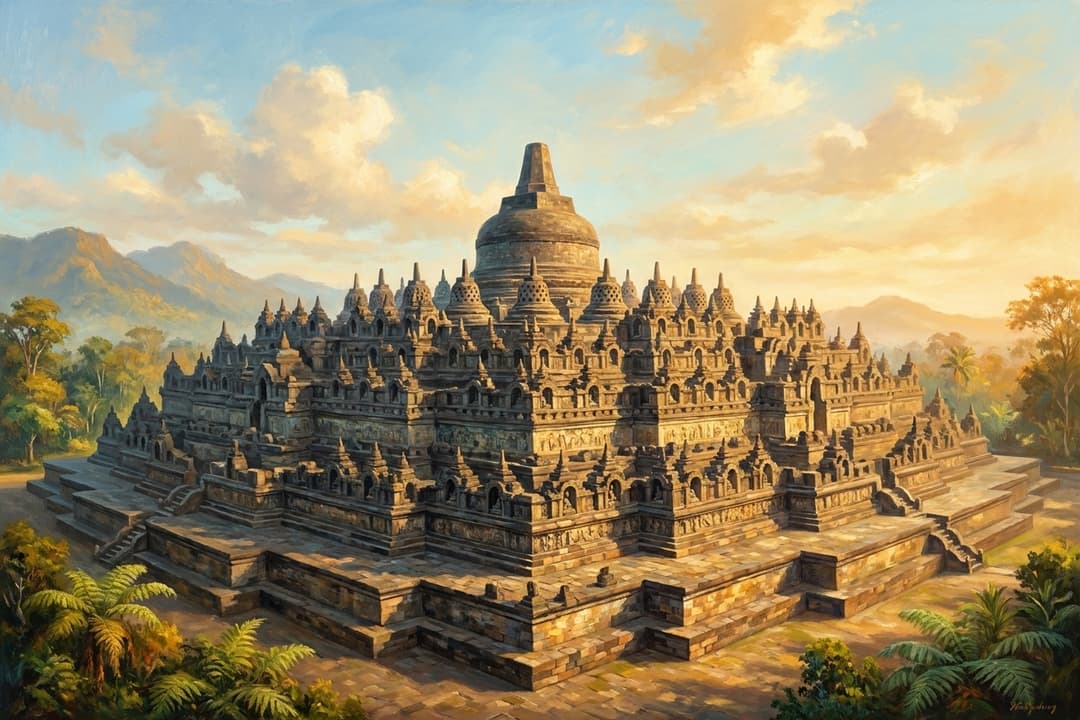
Ascending Borobudur is an immersive spiritual ascent designed to lead the traveler from mundane worldly distractions into tranquil contemplation. Visitors wind clockwise through deep volcanic stone galleries lined with sacred narratives before stepping onto radiant circular terraces with sweeping volcanic vistas.
Highlights
- Ascending the three circular open-air terraces to view 72 perforated stupas against Mount Merapi
- Studying the world's most extensive continuous collection of Buddhist stone relief carvings along the lower galleries
- Viewing the unencased southeastern corner revealing the ancient hidden carvings of the Karmavibhangga
- Participating in peaceful clockwise circumambulation along stone corridors carved with celestial bodhisattvas
Things to Know
- Structural access to the upper stone terraces is strictly capped and requires reserved timed admission passes
- All visitors ascending the monument structure must wear provided traditional woven Upanat sandals to safeguard the stone
- The stone monument structure is closed every Monday to allow routine structural conservation and maintenance
- Shoulders and knees must remain covered; traditional batik wraps are provided at the entrance gates
Location
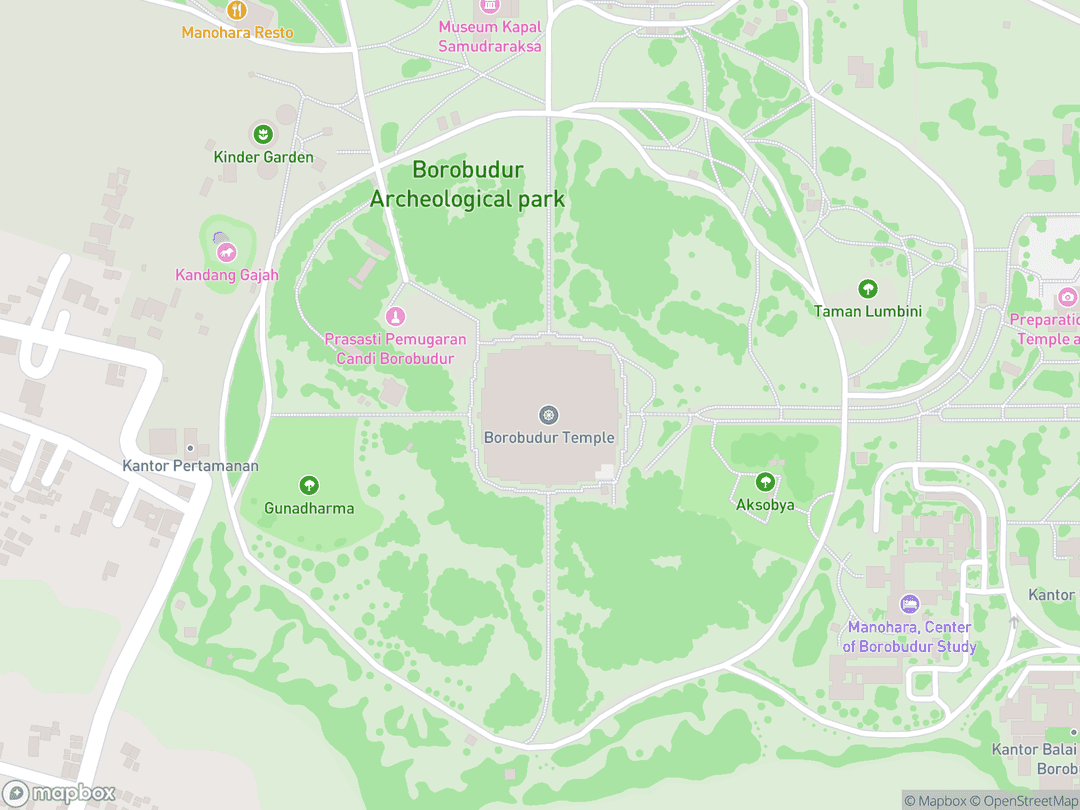
Jl. Badrawati, Kawasan Candi Borobudur, Borobudur, Kec. Borobudur, Kabupaten Magelang, Jawa Tengah 56553, Indonesia
Hours: Park grounds open daily from 06:30 to 17:30 WIB; monument structure access runs Tuesday through Sunday from 08:30 to 16:30 WIB
Getting There: Located approximately 40 kilometers northwest of Yogyakarta, accessible via a 75-minute drive via private hire car or regular Damri shuttle buses from Jombor Terminal
Get DirectionsTips for Your Visit
Arrive at Morning Opening
Enter the grounds right at 06:30 to experience cool mountain breezes, softer morning lighting, and minimal crowd volume.
Book Structural Passes Online
Reserve your temple ascent ticket weeks in advance through the official park portal to guarantee access to the upper terraces.
Observe Clockwise Flow
Follow the sacred pradaksina tradition by circumambulating clockwise with the stone relief walls consistently on your right side.
Protect the Porous Stone
Never lean upon stone balustrades or reach inside perforated stupas to touch the fragile ancient Buddha sculptures.
About
Borobudur stands as the world's grandest Buddhist monument, rising majestically over the lush Kedu Plain of Central Java against a backdrop of smoking volcanoes. Built during the 8th and 9th centuries under the patronage of the Sailendra Dynasty, the colossal dry-stone sanctuary embodies the architectural zenith of classical Javanese stonecraft. It integrates ancient Austronesian stepped terrace traditions with Indian Mahayana and Vajrayana cosmological blueprints.
Within the broader Dharmic theological grouping, Borobudur functions as an architectural cosmogram representing Mount Meru, the sacred axis at the core of all cosmic existence. Rather than offering an enclosed inner sanctum, the open-air monument is designed as a three-dimensional mandala and meditative yantra. Pilgrims physically participate in a progressive journey of circumambulation, gradually shedding worldly entanglement while ascending toward spiritual liberation.
The structure maps the Buddhist cosmos across the Three Realms of Existence (Trailokya). The encased base embodies Kāmadhātu (the realm of earthly passions), five square galleries reflect Rūpadhātu (the realm of pure form and dharma narratives), and three unadorned circular terraces represent Arūpadhātu (the formless realm of ultimate emptiness and Nirvana).
Following centuries of abandonment beneath volcanic ash and tropical forest canopy, Borobudur was systematically uncovered in the 19th century and fully restored through a historic UNESCO engineering initiative. Today, it remains an internationally venerated place of pilgrimage, serving as the sacred focal point for the annual Vesak full moon procession and a universal symbol of spiritual awakening.
Gallery
Symbolic Elements
The temple's exterior features intricate carvings, each rich with spiritual meaning:

The Mandala Footprint
The monument transitions from a terrestrial square base into celestial concentric circles, charting a complete meditative cosmogram.
Latticed Bell-Stupas
Seventy-two perforated stone stupas partially reveal seated Buddhas within, symbolizing the paradoxical union of visible form and formlessness.
The Hidden Foot
The buried base holds 160 bas-reliefs illustrating karmic retribution, symbolizing the obscured desires binding humanity to cyclic existence.

Kala-Makara Portals
Monumental demon heads perched above gateway arches swallow spiritual impurities as pilgrims cross into higher meditative realms.
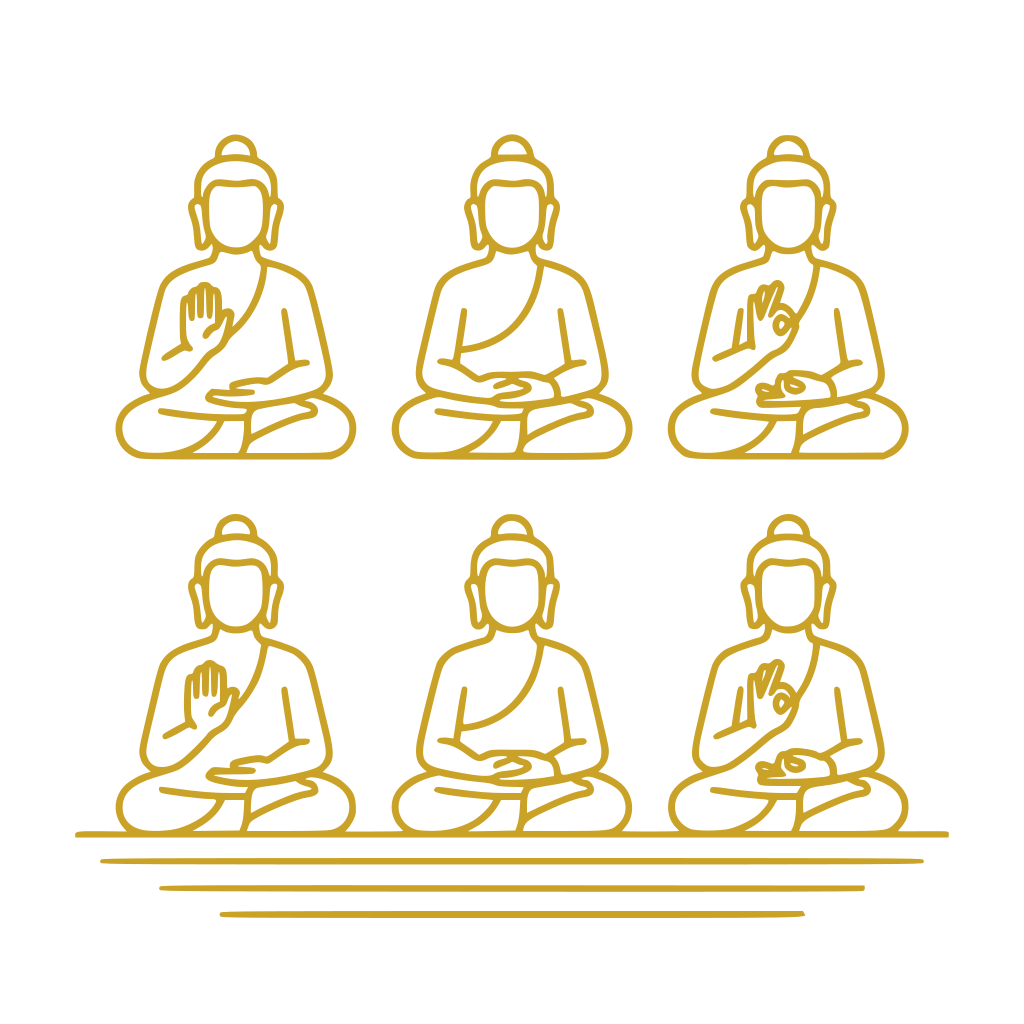
The Six Mudras
Buddha statues seated along the terraces display cardinal hand gestures representing fearlessness, meditation, and dharma teaching.

The Borobudur Ship
Carved double-outrigger maritime vessels symbolize the Buddha's teachings as a sacred ship ferrying seekers across the sea of suffering.

Crowning Central Stupa
The pinnacle's solid stone stupa contains no decorative reliefs, embodying the silent and transcendent state of supreme Nirvana.

Jaladwara Waterspouts
Sculpted sea-monster gargoyles channel rainwater off gallery floors while symbolically purifying the temple terraces.
Interesting Facts
The lowest tier features 160 carved karmic relief panels that were deliberately buried under 12,000 cubic meters of stone casing in antiquity to stabilize the hillside. (Tier A)
The entire monument is assembled without mortar, relying exclusively on gravity, dovetail joints, and mortise-and-tenon stone interlocks. (Tier A)
Javanese folklore holds that the master architect Gunadharma lies sleeping nearby, his profile traced in the ridge of the Menoreh mountains. (Tier B)
Geological sediment cores confirm the temple once sat beside a vast prehistoric lake, evoking a sacred lotus floating on water. (Tier B)
A mysterious unfinished Buddha statue was discovered inside the sealed central stupa during 19th-century excavations. (Tier B)
If unraveled horizontally, the narrative stone carvings along the gallery walls would form a continuous path over three kilometers long. (Tier A)
A detailed 8th-century carving of an Indonesian double-outrigger vessel inspired a successful modern 11,000-mile ocean voyage to West Africa. (Tier B)
Over two hundred of the original Buddha statues lost their heads to historical looters, tremors, and colonial diplomatic gifts. (Tier B)
Following the 2010 eruption of Mount Merapi, international conservators spent six months dry-brushing acidic volcanic ash from every block. (Tier B)
The sacred east-west ritual axis connects Borobudur in a straight three-kilometer line directly with Candi Pawon and Candi Mendut. (Tier A)
Common Questions
Is Borobudur an active Buddhist temple or an archaeological site?
It serves as both an active UNESCO World Heritage site and the primary pilgrimage destination for Southeast Asian Buddhist Vesak rituals.
Why are visitors required to wear special Upanat sandals?
These traditional woven pandanus-reed slippers prevent visitor footsteps from wearing down and eroding the fragile volcanic stone floors.
Why are so many Buddha statues missing their heads?
Historical looting by colonial treasure hunters, volcanic tremors, and 19th-century royal gifts resulted in the decapitation of many statues.
What is inside the crowning central stupa?
The central stupa is completely sealed and hollow, housing an intentionally unfinished stone Buddha that symbolizes the unconditioned nature of Nirvana.
How long does a typical visit to Borobudur take?
Most visitors spend between two and three hours exploring the temple terraces and walking through the surrounding archaeological park grounds.
Featured Stories
The Jungle Rediscovery of 1814
1814
While governing Java during the British interregnum, Sir Thomas Stamford Raffles heard local legends of a colossal buried stone mountain near Muntilan. He dispatched Dutch engineer Hermanus Cornelius, who supervised two hundred laborers hacking through volcanic soil and dense jungle vines for forty-five days. Their efforts pulled back centuries of tropical entombment, reawakening one of humanity's greatest architectural treasures to the modern world.
Source: Taman Wisata Candi Borobudur Historical Archives
The 11,000-Mile Voyage of the Stone Ship
2003
Perplexed by an 8th-century relief carving depicting an ocean-going double-outrigger vessel, maritime historians wondered whether such wooden ships actually navigated ancient global trade routes. Craftsmen in the Kangean Islands built the Samudra Raksa using only traditional hand tools and 8th-century techniques depicted on Borobudur's walls. The completed vessel successfully navigated 11,000 miles across the Indian Ocean to Ghana, validating the seafaring prowess carved into Javanese stone.
Source: Borobudur Maritime Heritage Project
The Colossal UNESCO Safeguarding Campaign
1973
By the mid-20th century, internal water infiltration was destabilizing the natural earth mound inside Borobudur, threatening a catastrophic structural collapse. In response, UNESCO launched a historic international effort that systematically dismantled over one million volcanic stone blocks. Specialists cataloged each stone, installed subterranean drainage conduits over reinforced concrete foundations, and perfectly reconstructed the cosmic monument for future generations.
Source: UNESCO International Safeguarding Campaign Records
Timeline
Sanctuary Groundbreaking
Sailendra Dynasty builders level a natural bedrock hill on the Kedu Plain to begin construction of a grand stepped stupa.
component.timeline.groundbreakingMandala Redesign & Encasement
Architects expand the complex into a concentric mandala and encase the lower relief panels to prevent hillside subsidence.
MilestoneConsecration of the Sanctuary
The Karangtengah inscription records royal dedication of monumental Buddhist sanctuaries by King Samaratungga.
DedicationEastward Dynastic Relocation
The Mataram royal court moves to East Java following volcanic disasters, inaugurating centuries of tropical neglect.
MilestoneVolcanic Entombment
A violent eruption of Mount Merapi covers the terraces in volcanic debris as dense jungle overgrows the superstructure.
EventModern European Rediscovery
Sir Thomas Stamford Raffles tasks surveyor Hermanus Cornelius with clearing vegetation from the hidden stone terraces.
MilestoneDiscovery of the Hidden Foot
Jan Willem Yzerman unearths the buried base, revealing the complete cycle of 160 Karmavibhangga stone relief panels.
MilestoneVan Erp Restoration
Theodoor van Erp conducts the first systematic restoration, rebuilding collapsed circular stupas and stabilizing the upper platforms.
RenovationUNESCO Engineering Overhaul
UNESCO launches a ten-year restoration that catalogs, cleans, and reassembles over one million stones over modern drainage slabs.
RenovationStupa Restoration
Indonesian stone specialists repair nine circular stupas damaged by domestic extremist bombings.
RenovationWorld Heritage Inscription
Borobudur Temple Compounds is officially inscribed on the UNESCO World Heritage List under cultural criteria.
MilestoneMerapi Ashfall Remediation
Heritage authorities execute a massive non-chemical cleaning program to remove acidic ash following Mount Merapi's eruption.
RenovationHistory by Decade
770s–840s — Imperial Sailendra Creation
The monument was conceived as a mountain of accumulated virtues guiding the pilgrim across the ten stages of the Bodhisattva path.
Under the Buddhist kings of the Sailendra Dynasty, thousands of artisans gathered volcanic andesite stone from nearby riverbeds to shape a sacred mountain on the Kedu Plain. Construction progressed across multiple phases, shifting from an initial stepped pyramid into an intricate three-dimensional cosmogram. To counteract foundational settling, the lowest relief-carved level was encased with an enormous stone buttress before royal consecration in 824 CE.
10th–18th Century — Volcanic Slumber in the Forest
When political power shifted to East Java in the 10th century, Borobudur slipped from active state ritual into centuries of quiet isolation. Heavy ash clouds from Mount Merapi periodically showered the terraces, burying the lower galleries while tropical vegetation took root across the stones. Local villagers preserved the site in sacred oral memory as a mystical mount of ancient kings, known reverently in palm-leaf manuscripts as Redi Borobudur.
1814–1911 — Rediscovery and Colonial Conservation
Following British administrator Thomas Stamford Raffles' excavation orders in 1814, European antiquarians systematically surveyed and photographed the massive site. Engineer Jan Willem Yzerman exposed the hidden foot in 1885, prompting complete photographic documentation of its karmic bas-reliefs before reburial. Between 1907 and 1911, Theodoor van Erp directed the first major restoration, reassembling collapsed circular terraces and restoring fallen stupas.
1970s–Present — Global Safeguarding and Living Worship
Between 1973 and 1983, a massive UNESCO project dismantled and stabilized the entire monument over modern drainage foundations, leading to World Heritage inscription in 1991. Despite challenges from terrorist bombings in 1985 and acidic ashfall from Mount Merapi in 2010, international and Indonesian conservators preserved its structural integrity. Today, Borobudur flourishes as both Indonesia's premier cultural destination and the epic center of Southeast Asian Vesak celebrations.
Architecture & Facilities
Borobudur represents the pinnacle of Classical Central Javanese Buddhist architecture, synthesizing Indian Buddhist stupa and mandala design with indigenous prehistoric Austronesian step-pyramid traditions into an open-air stone mountain.
Building Materials
Volcanic Andesite
Dense dark-gray igneous rock quarried directly from nearby riverbeds of the Elo and Progo valleys.
Dry-Stone Interlocking Joinery
Precision-cut mortise-and-tenon and dovetail joints locking adjoining stone blocks without the use of lime mortar.
Carved Bas-Relief Panels
Over two thousand narrative and decorative panels carved directly into volcanic gallery stone balustrades.
Reinforced Concrete Foundation Slabs
Engineered hidden foundation beds installed during the UNESCO restoration to ensure earthquake resilience.
Interior Features
The Hidden Foot Gallery
A subterranean perimeter encasement preserving 160 dramatic panels illustrating the karmic workings of desire.
The First Gallery Corridor
A narrow open-air stone hallway enclosed by high balustrades depicting the historic life story of Gautama Buddha.
The Upper Narrative Galleries
Stacked rectangular stone corridors presenting the spiritual quest of Sudhana in the Gandavyuha Sutra.
The Circular Stupa Platforms
Three open-air concentric stone rings carrying 72 perforated stupas framing panoramic views of Central Java.
Temple Grounds
The temple grounds encompass extensive landscaped botanical lawns designed with pedestrian stone walkways, shady banyan trees, and archaeological interpretive parks. The complex is strictly aligned along a straight three-kilometer ceremonial pilgrimage axis running westward from Candi Mendut and Candi Pawon to Borobudur's grand eastern entrance staircase.
Additional Facilities
Comprehensive visitor reception pavilion, the Karmawibhangga Archaeological Museum, the Samudra Raksa Maritime Museum, and electric shuttle transit routes.
Religious Significance
Within the Dharmic world, Borobudur stands as a three-dimensional manifestation of the cosmos, translating core Mahayana and Vajrayana teachings into a physical path of spiritual ascent.
To serve as a meditative instrument and cosmological map guiding the pilgrim from worldly delusion to supreme enlightenment.
Sacred Ordinances
Pradaksina (Circumambulation)
Walking clockwise through the ascending galleries while maintaining meditative focus on the sacred dharma carvings.
Dharmasravana (Sutra Study)
Contemplating the carved bas-reliefs illustrating the Jataka tales, the Lalitavistara, and the Gandavyuha scriptures.
Samadhi (Meditative Absorption)
Sitting in quiet mindfulness upon the circular terraces amidst the serene presence of the Dhyani Buddhas.
Waisak Lantern Offering
Releasing thousands of glowing paper lanterns during the full moon of Vesak to honor the Buddha's birth, awakening, and parinirvana.
The Three Realms of Existence
The monument physicalizes Buddhist cosmology by dividing space into Kamadhatu (the base of desire), Rupadhatu (the five square galleries of form), and Arupadhatu (the three circular terraces of formlessness).
The Bodhisattva's Ascent
The vertical path through Borobudur's stone galleries systematically mirrors the ten spiritual grounds (Dasabhumika) traversed by a Bodhisattva on the journey to unconditioned Buddhahood.
Sources & Research
Every fact on Temples.org is backed by verified Sources & Research. Each piece of information is rated by source tier and confidence level.