Visitor Insights
Visiting Prambanan
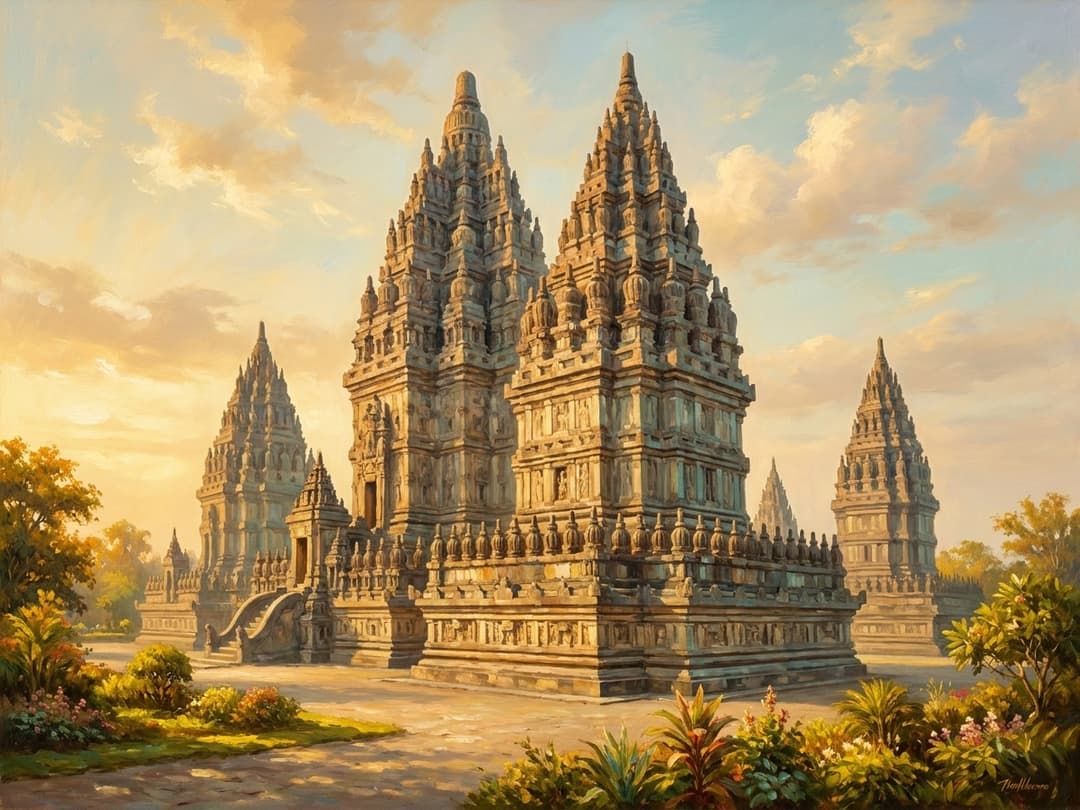
Visiting Prambanan offers an immersive journey into the sacred grandeur of 9th-century Hindu Java. The soaring spires of the inner sanctuary create an awe-inspiring vista across the manicured green lawns of the archaeological park. The experience is best complemented by attending the evening Ramayana Ballet staged with the illuminated shrines as a majestic backdrop.
Highlights
- Soaring 47-meter central Shiva shrine containing the deified likeness of King Rakai Pikatan.
- Continuous bas-relief narrative of the Ramayana carved along the balustrades of the Shiva and Brahma temples.
- Intact sanctuary of Nandi the sacred bull alongside celestial deities Surya and Chandra.
- Dramatic sunset silhouettes casting long shadows across the restored concentric rows of ancillary shrines.
Things to Know
- Shoulders and knees must be respectfully covered; complimentary batik sarongs are provided at the entrance.
- Tropical heat intensifies rapidly by mid-day across the open stone courtyards.
- Steep, narrow volcanic stone staircases inside the sanctum chambers require steady footing.
- Joint admission tickets can be purchased combining entry with Borobudur or Ratu Boko Palace.
Location
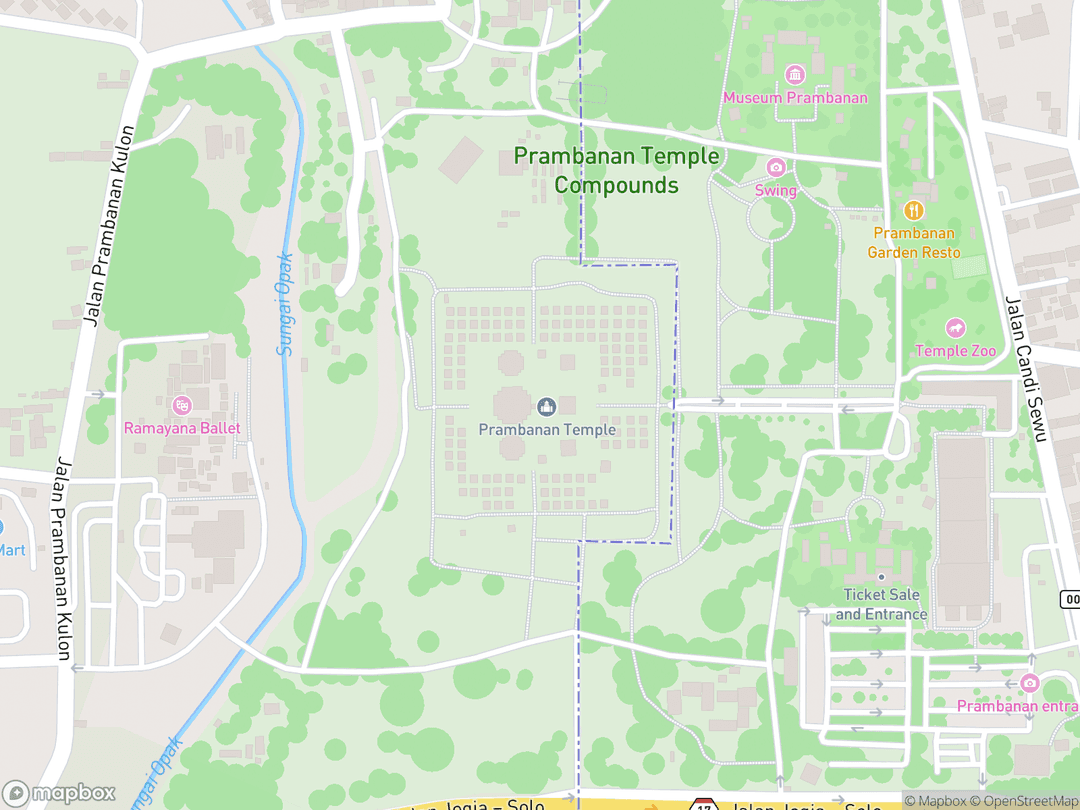
Jl. Raya Solo - Yogyakarta No.16, Kranggan, Bokoharjo, Kec. Prambanan, Kabupaten Sleman, Daerah Istimewa Yogyakarta 55571, Indonesia
Hours: Open daily from 06:30 to 17:00 (ticketing closes at 16:30).
Getting There: Located 17 km northeast of downtown Yogyakarta along Jalan Raya Solo; accessible via Trans Jogja Bus Line 1A or the commuter rail to Prambanan Station.
Get DirectionsTips for Your Visit
Arrive at Opening
Enter right at 06:30 to experience cool morning temperatures, soft directional light for photography, and serene solitude before tour groups arrive.
Follow the Pradaksina Walkway
Walk clockwise around the inner balustrades of the Shiva and Brahma shrines to read the continuous bas-relief panels of the Ramayana epic in chronological order.
Book the Evening Ballet
Reserve tickets in advance for the open-air Ramayana Ballet, performed on dry-season evenings against the dramatically floodlit temple spires.
About
Candi Prambanan, historically consecrated as Candi Shivagrha ('The House of Shiva'), is the largest and most magnificent Hindu temple compound in Indonesia. Consecrated on November 12, 856 CE by King Dyah Lokapala under the patronage of King Rakai Pikatan of the Medang Kingdom, this towering sanctuary marked the flourishing pinnacle of the Hindu Sanjaya Dynasty in Central Java.
Constructed as a monumental expression of Dharmic cosmology, the complex centers on the veneration of Shiva Mahadeva alongside the deities Brahma and Vishnu. Its architecture mirrors Mount Meru, the sacred cosmic axis in Hindu theology, creating an earthly mandala where human existence converges with the transcendent divine through sacred geometry.
Following political shifts and catastrophic volcanic eruptions from nearby Mount Merapi in the 10th century, the sanctuary fell into centuries of silent slumber amidst the tropical plains. Rediscovered during the colonial era and meticulously restored using scientific anastylosis throughout the 20th century, the complex was inscribed as a UNESCO World Heritage Site in 1991.
Today, Prambanan stands as both an awe-inspiring archaeological monument and a revitalized sanctuary of living Hindu worship. It hosts the grand national Tawur Agung Kesanga ceremonies prior to Nyepi, alongside ancient Vedic Abhiseka rituals that affirm its enduring spiritual significance across the Dharmic world.
Gallery
Symbolic Elements
The temple's exterior features intricate carvings, each rich with spiritual meaning:

Kalpataru (Prambanan Motif)
The divine wishing tree flanked by celestial bird-human Kinnaras represents cosmic abundance and spiritual fruitfulness.

Kala-Makara Archways
Fierce Kala monster heads connected to aquatic Makaras purify entering pilgrims by symbolically devouring worldly impurities.
Shiva Mahadeva Icon
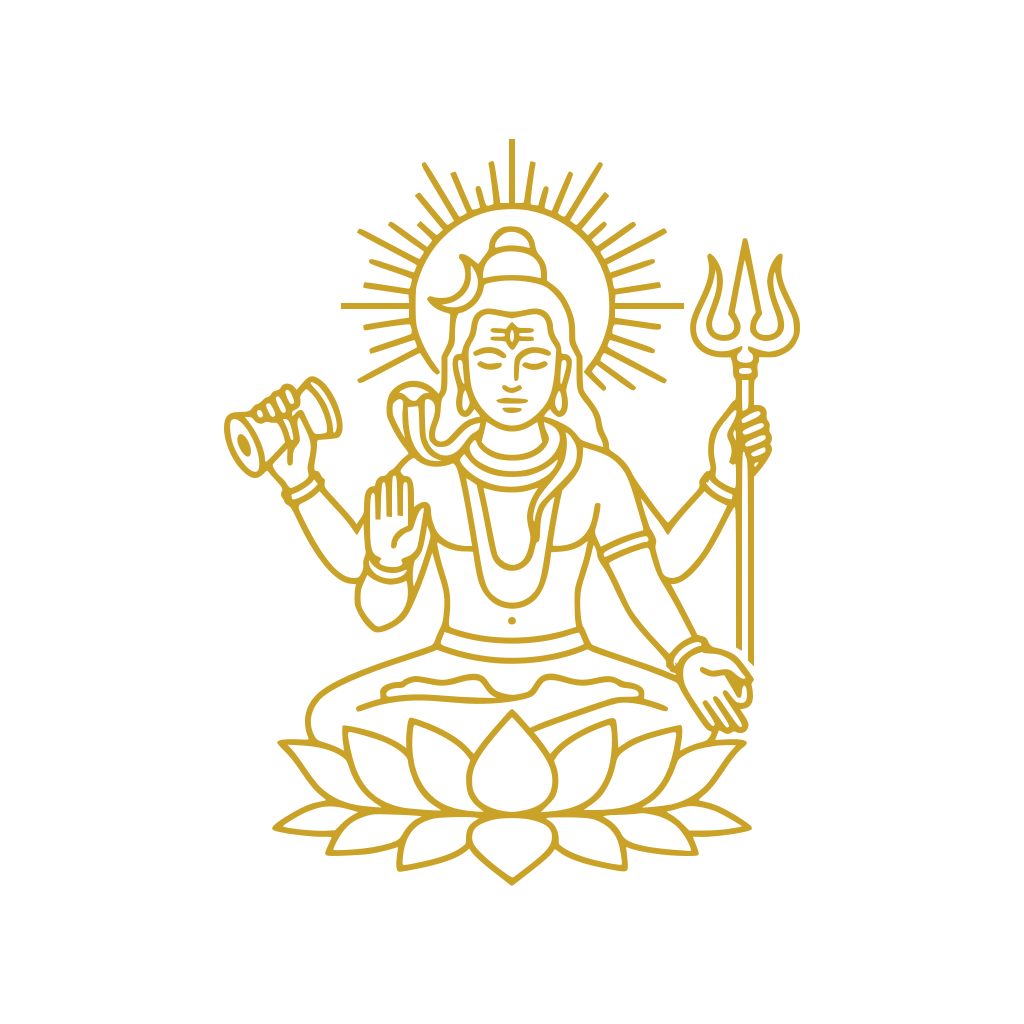
The four-armed supreme deity represents transcendent cosmic unity and the apotheosis of King Rakai Pikatan.

Batara Guru (Sage Agastya)
Depicted as a bearded hermit with a water vessel, Agastya symbolizes the transmission of divine Vedic wisdom.

Ganesha
The elephant-headed son of Shiva embodies supreme intellect, divine scholarship, and the removal of obstacles.
Durga Mahisasuramardini
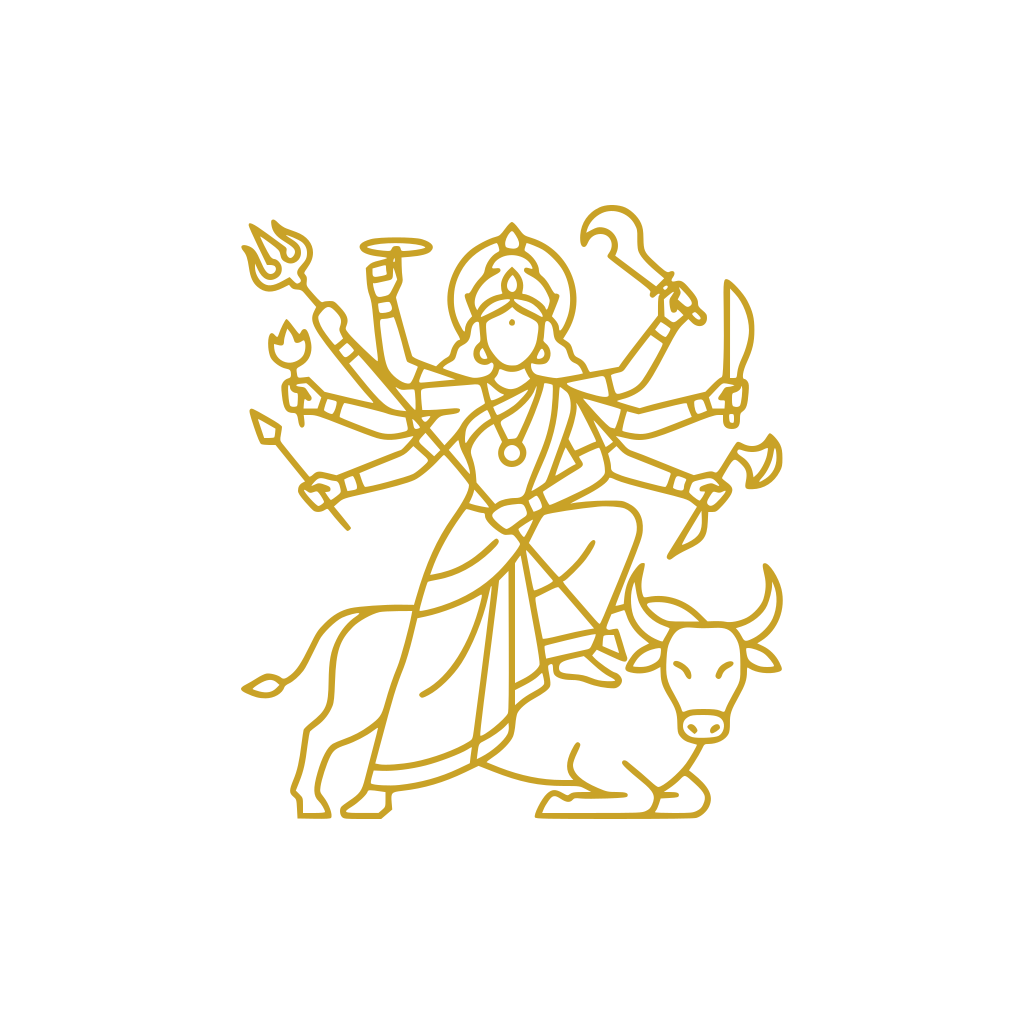
The eight-armed goddess vanquishing the cosmic buffalo demon symbolizes the eternal triumph of righteousness over chaos.

Nandi the Sacred Bull
Shiva's faithful vehicle represents unswerving devotion, steadfastness, and pure spiritual surrender.

Mount Meru Pinnacles
Stepped jewel ratna pinnacles crowning the multi-tiered roofs reflect the ascending golden peaks of Mount Meru.
Interesting Facts
Ancient builders diverted the Opak River along the western wall to drain the land before building the temples (Tier A).
The famed local statue of Princess Rara Jonggrang is actually the eight-armed Hindu warrior goddess Durga (Tier A).
Shiva Mahadeva stands upon a double-lotus pedestal carved identically to Mahayana Buddhist art at nearby Borobudur (Tier B).
Dutch restorers used anastylosis to rebuild only structures where at least seventy-five percent of original stones remained (Tier B).
The mortarless dry-stone interlocking joints protected the temple cores during the violent 2006 earthquake (Tier B).
Formal Hindu worship ceased for over one thousand years until the ancient Abhiseka ceremony was revived in 2019 (Tier A).
The central shrine faces east so equinox sunrise rays pass through the portal to illuminate the inner Shiva icon (Tier B).
The inner balustrade features the oldest continuous carved narrative cycle of the Ramayana in the world (Tier B).
Common Questions
Is Prambanan an active temple or an archaeological ruin?
It serves as both an operating Hindu sanctuary for major pilgrimages and national rituals and an active archaeological park.
Why is the temple also called Candi Loro Jonggrang?
Local folklore attributed the Durga statue in the north chamber to the petrified mythical princess Rara Jonggrang.
What is the dress code for visiting Prambanan?
Visitors must wear clothing that covers their shoulders and knees, and traditional batik sarongs are provided at the entry gates.
How long does a thorough visit take?
A standard visit requires two to three hours to explore the central platform and examine the detailed narrative balustrades.
Featured Stories
The Sovereign River Diversion
November 12, 856
Before erecting the massive stone platform, royal master-builders executed an extraordinary hydraulic feat by rerouting the roaring Opak River into an artificial canal. Recorded in the Shivagrha Inscription, this public engineering miracle drained the waterlogged plain to create an immovable foundation for 240 temples. The resulting sanctuary manifested divine order carved directly out of the wild Javanese earth.
Source: Shivagrha Stone Inscription (BPCB DIY)
The Rebirth of the Central Spire
December 23, 1953
After centuries of neglect following the 1584 earthquake, the central Shiva shrine had collapsed into a shapeless mound of shattered andesite blocks. Guided by rigorous anastylosis protocols, archaeologists spent decades cataloging and reassembling over twenty thousand fallen stones by hand. On a triumphant December morning, President Sukarno dedicated the restored spire as an everlasting monument to Indonesian civilizational brilliance.
Source: National Archaeological Archives of Indonesia
The Awakening of Ancient Prayers
November 12, 2019
Exactly 1,163 years to the day after its founding dedication, Vedic chants echoed through Prambanan's corridors during the sacred Abhiseka ceremony. White-clad Hindu priests consecrated the central sanctum with holy waters collected from sacred springs across the archipelago. The historic ceremony transformed the ancient stone complex from a colonial relic into a vibrant living sanctuary of prayer.
Source: Parisada Hindu Dharma Indonesia
Timeline
Foundational Construction
King Rakai Pikatan initiates construction of the royal state temple complex to consolidate the Sanjaya Dynasty's cultural renaissance.
component.timeline.groundbreakingConsecration of Shivagrha
King Dyah Lokapala issues the historic Shivagrha Inscription marking the formal consecration of the temple and diversion of the Opak River.
DedicationCarving of Epic Reliefs
King Balitung sponsors royal sculptors to complete the narrative Ramayana and Krishnayana friezes along the inner balustrades.
MilestoneCourt Migration to East Java
King Mpu Sindok relocates the Medang capital eastward following catastrophic volcanic eruptions from Mount Merapi, leading to gradual abandonment.
MilestoneVolcanic Inundation
A violent eruption of Mount Merapi blankets the Prambanan plain in lahars and volcanic silt, destabilizing peripheral masonry.
EventGreat Central Java Earthquake
A major seismic event fells the corbelled spires and vaulted chambers, reducing the complex to massive mounds of scattered stone blocks.
EventEuropean Documentation
Cornelis Antonie Lons visits the ruins on behalf of the Dutch East India Company and drafts the earliest surviving Western account.
MilestoneArchaeological Excavation
Jan Willem IJzerman clears dense jungle overgrowth and volcanic debris from the central platform, exposing buried bas-reliefs.
RenovationInauguration of Anastylosis
The Dutch Archaeological Service institutes scientific anastylosis, establishing strict standards to rebuild only with authentic stone elements.
RenovationShiva Temple Inauguration
President Sukarno presides over the official completion of the central 47-meter Shiva shrine reconstruction as a symbol of national heritage.
DedicationWorld Heritage Inscription
UNESCO officially inscribes the Prambanan Temple Compounds on the World Heritage List under cultural criteria i and iv.
MilestoneSeismic Recovery & Stabilization
A 6.3-magnitude earthquake causes structural displacement, prompting an international micro-grouting and seismic reinforcement campaign.
RenovationSacred Abhiseka Revival
Indonesian Hindu priests perform the sacred Abhiseka ceremony for the first time in 1,163 years, reviving Prambanan as a living sanctuary.
EventHistory by Decade
850s–890s — Royal Genesis & Consecration
Under the patronage of King Rakai Pikatan and his successor King Dyah Lokapala, the Sanjaya Dynasty mobilized thousands of stonecutters to build the royal state temple. The compound was inaugurated in 856 CE following the successful diversion of the Opak River bed. King Balitung further expanded the sanctuary by commissioning the narrative Ramayana and Krishnayana relief friezes.
920s–1000s — Volcanic Abandonment
Following devastating eruptions of Mount Merapi and regional political upheaval, King Mpu Sindok relocated the royal capital to East Java in 928 CE. Deprived of imperial patronage and maintenance, the monument fell into disuse. A massive volcanic event in 1006 CE buried outer terraces beneath lahars and volcanic silt.
1580s–1730s — Seismic Collapse & Folklore
A violent earthquake in 1584 collapsed the corbelled stone vaults, reducing the towering spires to overgrown rubble mounds. Local villagers came to revere the ruins as an enchanted realm, weaving the tragic romance of Princess Rara Jonggrang around the mysterious stone images. Dutch explorer Cornelis Antonie Lons recorded the first European account of the fallen stones in 1733.
1880s–1950s — Scientific Anastylosis
Systematic jungle clearance began in 1885 under archaeologist Jan Willem IJzerman, revealing buried platform structures. In 1918, the Dutch Archaeological Service instituted strict scientific anastylosis, using original blocks wherever feasible. Reconstruction culminated on December 23, 1953, when President Sukarno dedicated the fully restored 47-meter Shiva shrine.
1990s–2000s — World Heritage & Seismic Resilience
UNESCO inscribed Prambanan on the World Heritage List in 1991 following the successful reconstruction of the Brahma and Vishnu sanctuaries. On May 27, 2006, a 6.3-magnitude earthquake damaged several spires and caused structural fractures. An intensive international restoration program stabilized the monuments with advanced micro-grouting techniques.
2010s–2020s — Spiritual Renewal
The Ministry of Culture achieved major progress reconstructing concentric rows of ancillary perwara temples to recreate the ancient spatial plan. On November 12, 2019, the performance of the sacred Abhiseka ritual legally restored Prambanan as an active place of Hindu worship. Today it hosts thousands of pilgrims annually for the national Tawur Agung Kesanga ceremonies.
Architecture & Facilities
Prambanan represents the absolute zenith of classical Hindu-Javanese temple architecture, synthesizing ancient Indian Vastu Shastra principles with indigenous Javanese aesthetic verticality. Modeled after the sacred cosmic mountain Mount Meru, the compound embodies the Padmavinyasa mandala grid, rising through stepped volcanic stone tiers crowned by ornate jewel ratna pinnacles.
Building Materials
Volcanic Andesite Stone
Quarried from the cooled lahars of nearby riverbeds, dense andesite blocks provide immense compressive strength.
Dry-Stone Tongue-and-Groove Joinery
Interlocking stone sockets and tenons provide flexible seismic stability without the use of binding mortar.
Bas-Relief Tuffaceous Masonry
Finely carved volcanic stone panels along the balustrades depict intricate mythological narratives.
Corbelled Vault Keystones
Inward-stepping horizontal stone courses meet at inverted pyramid keystones to enclose the interior sanctums.
Interior Features
Garbhagriha of Shiva Mahadeva
The primary eastern sanctum houses a three-meter statue of four-armed Shiva standing upon a carved double-lotus pedestal.
Southern Chamber of Agastya
The southern sanctum enshrines the bearded sage Agastya Batara Guru, holding a prayer rosary and water vessel.
Western Chamber of Ganesha
The western sanctuary contains a seated Ganesha dipping his trunk into a nectar-filled skull cup.
Northern Chamber of Durga
The northern sanctum encloses an eight-armed image of Durga Mahisasuramardini slaying the celestial buffalo demon.
Temple Grounds
The complex spans three concentric quadrangular zones representing the Dharmic tripartite cosmos: Bhurloka (the mortal outer realm), Bhuvarloka (the middle court originally containing 224 ancillary perwara shrines), and Swarloka (the elevated celestial terrace holding the 16 principal temples). Landscaped stone pathways, expansive green lawns, and open-air performance theaters surround the archaeological perimeter.
Additional Facilities
An open-air amphitheater, the indoor Trimurti Theater for the Ramayana Ballet, an archaeological site museum, gift shops, and pilgrim rest pavilions.
Religious Significance
In classical Javanese Hinduism, Prambanan is conceived as a physical manifestation of Mount Meru, anchoring the cosmic axis upon the earth. The temple's spatial progression from the outer mortal grounds to the inner celestial platform reflects the soul's liberation from worldly illusion toward union with the transcendent divine.
To serve as the supreme royal sanctuary honoring the Trimurti and venerating Shiva Mahadeva as the ultimate cosmic source.
Sacred Ordinances
Abhiseka Consecration
Sacred lustration rites performed with holy spring waters to sanctify the temple sanctums and awaken divine energy.
Pradaksina Circumambulation
Devotional clockwise circumambulation of the shrines along elevated balustrades while meditating upon the Ramayana reliefs.
Tawur Agung Kesanga
National purification and sacrificial rites held on the eve of Nyepi to cleanse the cosmos of negative forces.
Puja and Darshan
Devotional prayers, incense offerings, and sacred viewing of the deity statues within the inner garbhagriha chambers.
The Trimurti Synthesis
Prambanan integrates the triad of Brahma the creator, Vishnu the preserver, and Shiva the dissolver into a unified theological whole. While Shiva occupies the central position of supreme reality, his divine companions face their respective celestial mounts, illustrating the fundamental balance of cosmic governance.
The Devaraja Ideal
Classical Southeast Asian kingship linked temporal sovereignty directly to divine dharma. The towering central image of Shiva Mahadeva was sculpted to capture the likeness of King Rakai Pikatan, immortalizing the righteous monarch as an eternal emanation of the supreme godhead.
Sources & Research
Every fact on Temples.org is backed by verified Sources & Research. Each piece of information is rated by source tier and confidence level.
View All Sources (8)
| Field | Source | Tier | Retrieved |
|---|---|---|---|
| About & Historical Background | Directorate General of Culture, Ministry of Education and Culture of Indonesia (opens in a new tab) | A | 2026-02-18 |
| Religious Significance & Sacred Ceremonies | Directorate General of Hindu Community Guidance, Ministry of Religious Affairs (opens in a new tab) | A | 2026-02-18 |
| Visitor Insights & Conservation | PT Taman Wisata Candi Borobudur, Prambanan dan Ratu Boko (opens in a new tab) | A | 2026-02-18 |
| History By Decade & Epigraphy | Parisada Hindu Dharma Indonesia (PHDI) (opens in a new tab) | A | 2026-02-18 |
| Architecture & Structural Layout | UNESCO World Heritage Centre (opens in a new tab) | B | 2026-02-18 |
| Timeline & Archaeological Restoration | ResearchGate Archaeological Review (opens in a new tab) | B | 2026-02-18 |
| Interesting Facts & Iconography | Facts and Details Cultural Reference (opens in a new tab) | C | 2026-02-18 |
| Visitor Insights & Practical Travel | Insights on India World Heritage Studies (opens in a new tab) | C | 2026-02-18 |