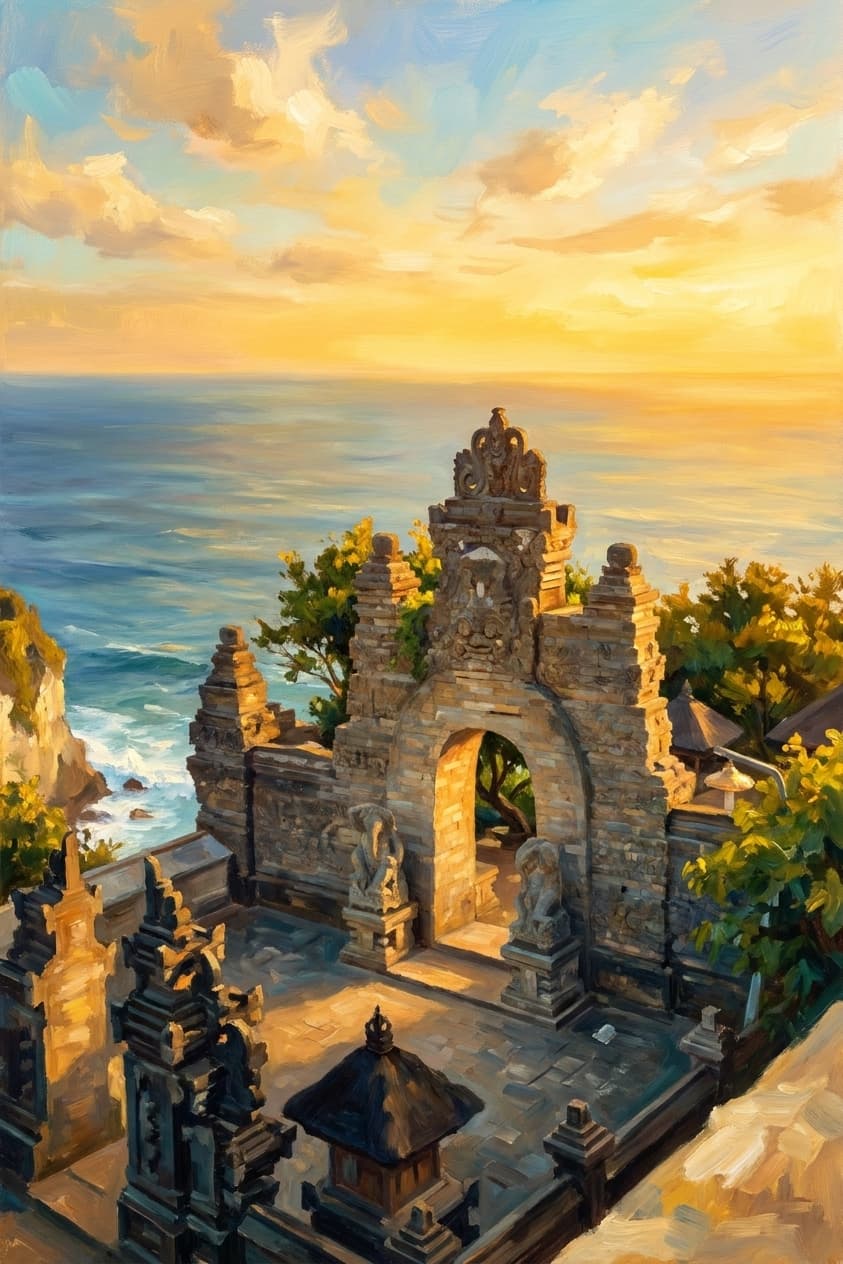
Visitor Insights
Visiting Pura Luhur Uluwatu
Pura Luhur Uluwatu offers dramatic cliffside ocean vistas, historic dry-stone shrines, and vibrant ceremonial life. Visitors navigate paved pathways along sheer limestone walls while observing ancient open-air sanctuaries and resident macaques.
Highlights
- Spectacular 70-meter limestone precipice dropping directly into the Indian Ocean
- Ancient black coral gate featuring sculpted Garuda wings at the inner sanctum
- Daily sunset Kecak and Fire Dance performances in the clifftop amphitheater
- Lush dry-forest coastal preserve inhabited by sacred macaque monkeys
Things to Know
- Modest attire is required; all visitors must wear a sarong and temple sash
- Entry into the inner courtyard is strictly reserved for Hindu worshipers
- Resident long-tailed macaques frequently snatch loose items such as glasses and phones
- Steep stone staircases along the cliffs require sturdy footwear and steady balance
Location
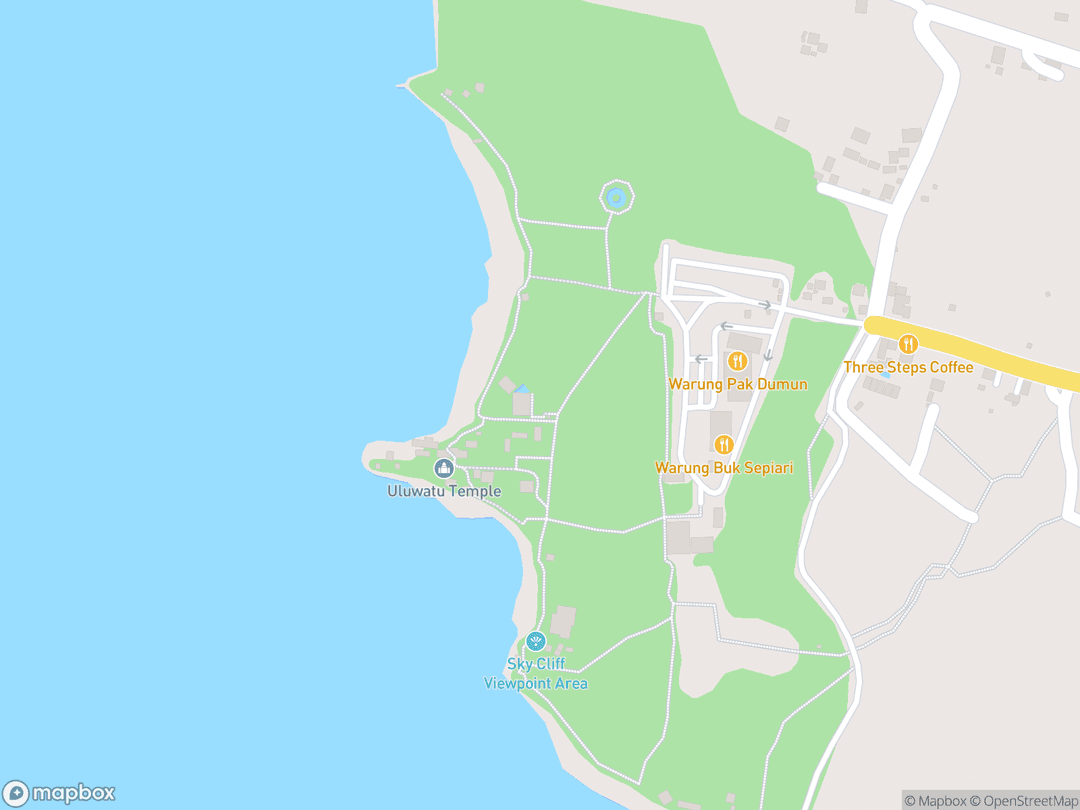
Jalan Raya Uluwatu, Desa Pecatu, Kecamatan Kuta Selatan, Kabupaten Badung, Bali 80361, Indonesia
Hours: 07:00 to 19:00 WITA daily for visitors; 24 hours for Hindu worshipers
Getting There: Located in Pecatu on the southern Bukit Peninsula, approximately 45 minutes by car or scooter from Ngurah Rai International Airport.
Get DirectionsTips for Your Visit
Arrive for Morning Solitude
Visit between 07:00 and 09:00 to experience quiet spiritual contemplation and avoid large tour groups.
Secure Valuables Against Monkeys
Conceal sunglasses, hats, jewelry, and loose electronics inside zipped bags before entering the forest perimeter.
Purchase Dance Tickets Early
The sunset Kecak dance sells out quickly, so reserve seats at the on-site kiosk upon early afternoon arrival.
About
Within the Dharmic worldview, sacred geography mirrors the dynamic order of the cosmos. Pura Luhur Uluwatu embodies this sacred balance through Agama Hindu Dharma, the unique Balinese synthesis of Vedic Shaivism, Tantric philosophy, and indigenous ancestor reverence.
Perched 70 meters above the roaring Indian Ocean on the southwestern tip of the Bukit Peninsula, Uluwatu is one of Bali's six supreme sanctuaries of the cosmos. As a directional pillar, it anchors the realm of Bhatara Rudra, shielding the island from malevolent oceanic energies.
Founded in the eleventh century by the revered sage Mpu Kuturan and expanded in the sixteenth century by Dang Hyang Nirartha, the sanctuary remains an active pilgrimage epicenter where terrestrial boundaries dissolve into celestial transcendence.
Gallery
Symbolic Elements
The temple's exterior features intricate carvings, each rich with spiritual meaning:

Candi Bentar
The split stone gateway symbolizes the cosmic Mount Meru divided in two, purging worldly duality from arriving pilgrims.

Winged Paduraksa Portal
This rare arched doorway features sculpted stone wings representing Garuda carrying the devotee toward celestial transcendence.

Bhoma Lintels
The fierce face of Bhoma rests over threshold lintels to repel malevolent spirits and neutralize impure intentions.

Padmasana Lotus Throne
An open stone high seat carved atop cosmic serpents, honoring the supreme formless reality of Ida Sang Hyang Widhi Wasa.
Bhatara Gana Statuary
Stone carvings of Ganesha stand at boundary thresholds to remove obstacles for pilgrims walking hazardous cliff paths.

Naga Basuki Balustrades
Sculpted stone serpents lining perimeter walkways symbolize cosmic balance, water fertility, and stability against the sea.

Sugar Palm Meru Roof
The tiered roof thatched with black sugar palm fiber represents the divine layers of the sacred cosmic mountain.
Interesting Facts
Balinese tradition states that sage Dang Hyang Nirartha attained bodily moksha on this cliff without leaving physical remains (Tier A).
Resident macaques practice intentional token bartering, trading high-value stolen items with rangers for preferred fruit rewards (Tier B).
The primary shrine towers are built using dense, blackened fossilized coral and marine limestone to resist salt-air corrosion (Tier A).
Uluwatu is the only coastal sea temple that simultaneously functions as one of Bali's nine directional cosmic pillars (Tier A).
A 1999 lightning strike burned the wooden Meru roof entirely, yet left the sacred stone foundation completely untouched (Tier B).
The cliff's lower marine caves serve as the primary entry channel for professional surfers navigating the world-famous Uluwatu reef break (Tier D).
Local folklore recounts that the black limestone cliff foundation is the petrified boat hull of lake goddess Dewi Danu (Tier C).
Tens of thousands of white-robed devotees climb the arid peninsula every 210 days to present towering agricultural offerings (Tier A).
Common Questions
Can non-Hindu visitors enter the inner sanctuary?
No, the innermost courtyard is reserved exclusively for worshipers engaged in prayer and ceremonial rituals.
What should visitors do if a monkey steals an item?
Seek help immediately from local temple rangers, who can safely barter fruit to retrieve stolen belongings.
Is the temple accessible during major Balinese holidays?
Yes, though tourist zones may experience heavy ceremonial congestion during the bi-annual Odalan festival.
Why is the temple situated on a high cliff edge?
The elevated promontory physically and symbolically defends the island against negative oceanic energies while facing the sacred horizon.
Featured Stories
The Transcendence of Dang Hyang Nirartha
1550
In the sixteenth century, the venerable sage Dang Hyang Nirartha journeyed to the windswept precipice of Uluwatu for his final earthly meditation. Chronicled in the sacred text Dwijendra Tattwa, the master achieved moksha, dissolving his physical form into radiant spiritual light. Devotees subsequently bestowed the honorific title Luhur, recognizing the cliff as a gateway of transcendent divine origin.
Source: Dwijendra Tattwa Palm-Leaf Chronicle
The Miracle of the Consecrated Stone
1999
During a ferocious maritime storm in late 1999, a bolt of lightning struck the peak of the sacred Meru tower, setting its ancient palm thatch ablaze. Priests watched in awe as the fire consumed the flammable organic roof but spared the sacred coral base without a single fracture. The community celebrated the miraculous event as divine purification, immediately rebuilding the roof through traditional consecration rituals.
Source: Temple Guardian Records
The Royal Pilgrimage of Mengwi
1680
During the height of the Mengwi Kingdom, royal retinues undertook arduous annual treks across the barren limestone scrubland to worship at Uluwatu. The monarchs believed that paying homage to Bhatara Rudra on this remote precipice guaranteed military protection and cosmic agricultural fertility for their realm. The royal patronage solidified Uluwatu as one of the island's most revered ancestral sanctuaries.
Source: Babad Mengwi Chronicles
Timeline
Initial Sanctification by Mpu Kuturan
The Javanese sage Mpu Kuturan establishes a coastal shrine to anchor the island's southwestern spiritual perimeter.
MilestoneArrival of Dang Hyang Nirartha
Shaivite reformer Dang Hyang Nirartha expands the temple complex and introduces the open-seat Padmasana altar.
RenovationAttainment of Moksha
Dang Hyang Nirartha achieves ultimate spiritual liberation on the cliff edge, disappearing bodily into divine light.
MilestoneCustodianship of Puri Mengwi
The Royal House of Mengwi assumes protective patronage over the temple, establishing dedicated royal pilgrimage rites.
EventColonial Era Preservation
Following regional conflicts, the isolated clifftop sanctuary remains an untouchable spiritual redoubt for local priests.
EventCompletion of Modern Access Roads
Paved vehicular roadways reach the Bukit Peninsula, transitioning the remote sanctuary into an accessible national landmark.
EventLightning Strike and Renewal
A lightning strike ignites the sacred palm-thatch roof of the primary Meru shrine, prompting immediate traditional reconstruction.
RenovationMarine Cliff Reinforcement Project
Regional engineers initiate advanced marine revetment works to arrest wave erosion at the base of the ocean promontory.
MilestoneComprehensive Heritage Zoning
Provincial authorities establish enhanced preservation corridors protecting the coastal dry forest and sacred cliff perimeter.
MilestoneHistory by Decade
11th Century — The Mpu Kuturan Foundation
During the reign of King Udayana Warmadewa, the Javanese sage Mpu Kuturan established Uluwatu as a vital coastal outpost. The sanctuary was dedicated to balancing cosmic forces and protecting the island's residents from malevolent sea spirits.
16th Century — The Nirartha Reformation
Dang Hyang Nirartha significantly expanded the complex, introducing modern Balinese theological concepts such as the Padmasana altar. His eventual bodily transcendence on the cliff established the site as an immortal sanctuary of spiritual liberation.
17th to 19th Century — Royal Custodianship
The Royal Dynasty of Mengwi assumed primary custodianship, maintaining the remote stone structures through generational patronage. Royal princes made regular pilgrimages along the arid limestone peninsula to reaffirm royal authority and island-wide cosmic harmony.
1900s to 1940s — Preservation Through Seclusion
Following European colonial expansion in Bali, the shrine remained largely untouched due to its forbidding terrain and isolated geographical position. Local priests and forest guardians preserved its sacred rituals without external interference.
1980s to 1990s — Infrastructure and Rebuilding
The completion of paved roads in the early 1980s integrated Uluwatu into national cultural networks. Following a dramatic lightning strike in 1999, the community successfully rallied to restore the central Meru shrine according to classical ritual mandates.
2010s to Present — Modern Preservation
Advanced civil engineering works were implemented along the cliff base to prevent marine wave erosion from compromising the limestone promontory. Structured zoning protocols now preserve the quiet sanctity of inner worship while accommodating global cultural pilgrims.
Architecture & Facilities
Pura Luhur Uluwatu exemplifies classical Balinese temple architecture adapted to extreme marine cliff topography. Organized according to the Tri Mandala cosmological spatial model, the complex transitions from outer protective coastal scrub forest to sacred open-air stone courtyards overlooking the Indian Ocean.
Building Materials
Black Marine Coral
Dense, weather-resistant dark fossilized coral stone forms the primary walls and altars to withstand corrosive ocean spray.
Bukit Limestone
Locally quarried white calcareous limestone provides sturdy foundations and extensive stepped cliffside retaining walls.
Sugar Palm Fiber (Ijuk)
Tightly bound black fibers from the Arenga pinnata palm create durable, water-resistant thatched shrine roofs.
Teak and Merbau Timber
Durable tropical hardwoods form the load-bearing pillars of open-air ceremonial pavilions across the middle courtyard.
Interior Features
Utama Mandala
The elevated open-air inner sanctum houses sacred altars positioned directly against the ocean horizon.
Padmasana of Rudra
An elaborately carved stone lotus throne dedicated to the supreme deity manifested as Lord of the Southwest.
Central Meru Pagoda
A compact wooden and stone tiered tower honoring both Bhatara Rudra and the spiritual ascendance of Dang Hyang Nirartha.
Madya Mandala Gathering Court
The middle courtyard features open pavilions where gamelan musicians perform and ritual offerings are assembled.
Temple Grounds
The temple grounds comprise paved, winding limestone pathways following the undulating cliff edge, bounded by stone balustrades and protected by dense coastal dry-forest vegetation.
Additional Facilities
Facilities outside the sacred boundary include a terraced open-air cultural amphitheater for sunset performances, visitor ticket offices, and shaded parking areas.
Religious Significance
In Balinese Hinduism, Pura Luhur Uluwatu is venerated as a foundational cosmic anchor within the Dewata Nawa Sanga mandala. It guards the southwestern quadrant against destructive oceanic forces while honoring the transformative energy of Bhatara Rudra.
To maintain cosmic balance, protect the island from negative maritime entities, and provide an open portal for devotees seeking spiritual purification and divine grace.
Sacred Ordinances
Muspa (Devotional Prayer)
Devotees present floral offerings and receive holy water (tirtha) and consecrated rice (bija) from presiding pedanda priests.
Odalan Anniversary Rite
A bi-annual purification festival held every 210 days, during which deities are invited down to inhabit decorated temple shrines.
Melasti Marine Cleansing
Sacred temple heirlooms and effigies are brought down to the ocean edge for ritual bathing and spiritual revitalization.
The Guardianship of Rudra
As the fierce manifestation of Shiva presiding over dissolution and atmospheric power, Bhatara Rudra neutralizes disruptive forces, transforming chaos into spiritual rejuvenation.
The Legacy of Moksha
The site holds singular theological importance as the physical point of transcendence for Dang Hyang Nirartha, proving the Dharmic reality of spiritual liberation through disciplined meditation.
Sources & Research
Every fact on Temples.org is backed by verified Sources & Research. Each piece of information is rated by source tier and confidence level.
View All Sources (9)
| Field | Source | Tier | Retrieved |
|---|---|---|---|
| About & Historical Background | Uluwatu Temple Heritage Authority (opens in a new tab) | A | 2026-02-18 |
| Religious Significance & Philosophy | NOW! Bali Cultural Documentation (opens in a new tab) | A | 2026-02-18 |
| Palm-Leaf Manuscripts & Ancient Inscriptions | Balinese Palm-Leaf Manuscript Archive (opens in a new tab) | A | 2026-02-18 |
| Architecture & Structural Layout | Bali Tourism Board & Cultural Heritage Documentation (opens in a new tab) | A | 2026-02-18 |
| Timeline & Restoration | Anywhere Heritage and Travel Guide (opens in a new tab) | C | 2026-02-18 |
| Visitor Insights & Access | Take Me There Indonesia (opens in a new tab) | C | 2026-02-18 |
| Symbolic Elements & Iconography | Cosmo Bali Tours and Cultural Resources (opens in a new tab) | D | 2026-02-18 |
| Cultural Ceremonies & Performance | Kura-Kura Heritage Travel Services (opens in a new tab) | D | 2026-02-18 |
| Visitor Regulations & Etiquette | Bali Destination Planning Guide (opens in a new tab) | D | 2026-02-18 |