Visitor Insights
Visiting Holy Shrine of Imam Reza
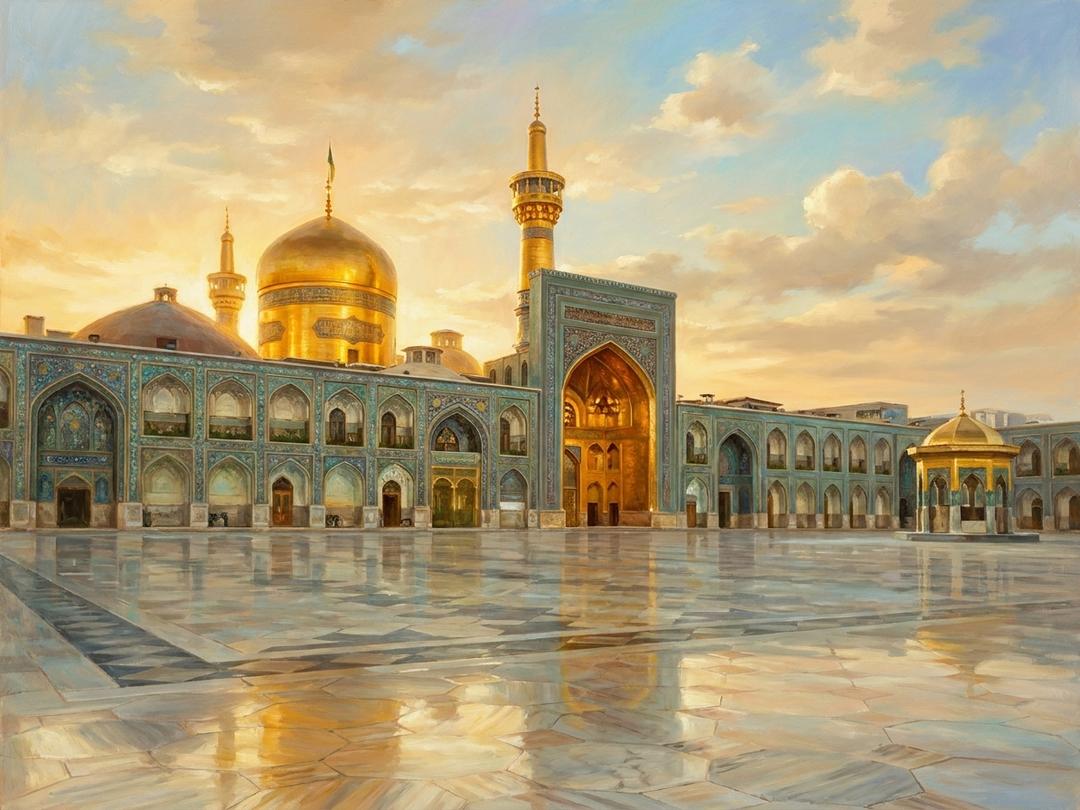
The Imam Reza Shrine is an active global pilgrimage sanctuary operating continuously day and night. Visitors experience radiant courtyards, stunning mirror mosaics, and profound spiritual devotion. Modest Islamic dress and shoe removal before stepping onto carpeted riwaqs are strictly observed across all precincts.
Highlights
- Vast marble courtyards framed by towering minarets and soaring tile iwans
- The shimmering Golden Dome rising majestically above the central tomb chamber
- The historic Saqakhaneh drinking fountain anchored by a monolithic marble basin
- Intricate Persian mirror mosaics refracting chandelier light into an infinite lattice
Things to Know
- Women must wear a full-length chador, provided freely at all exterior entrance gates
- The innermost tomb chamber is reserved for Muslim pilgrims engaged in prayer
- Complimentary shoe-check facilities must be utilized prior to entering carpeted halls
- Late night between 2:00 AM and 5:00 AM offers the most tranquil visiting atmosphere
Location
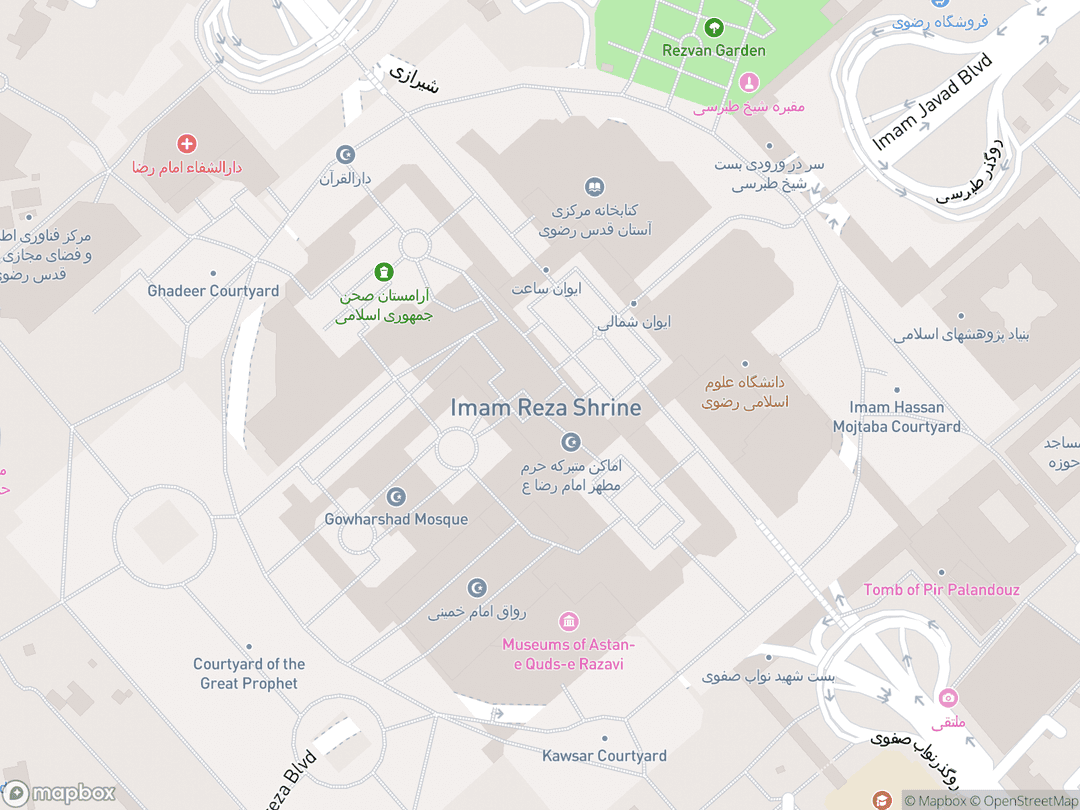
Haram-e Motahhar Complex, Shohada Square, Mashhad, Razavi Khorasan Province, Iran
Hours: Open 24 hours daily, 365 days a year
Getting There: Located in central Mashhad accessible via city metro lines, airport shuttles, and major urban thoroughfares.
Get DirectionsTips for Your Visit
Chador Borrowing
Women can collect clean chadors without charge at specialized visitor kiosks situated at every main gate.
Luggage and Electronics
Large baggage and professional cameras must be deposited at free secure custody desks before checkpoint security.
International Guide Service
Non-Muslim guests can request multi-lingual cultural guides through the International Pilgrim Affairs Office.
Blessed Meals
Foreign passport holders may register at the pilgrim services desk for invitations to the Hazrati banquet kitchen.
About
The Holy Shrine of Imam Reza in Mashhad stands as the spiritual heart of Twelver Shia Islam in Iran and ranks among the most monumental architectural complexes in the Islamic world. Commenced in 818 CE following the martyrdom and burial of Ali ibn Musa al-Rida, the eighth Shia Imam, the sanctuary has expanded organically across twelve centuries into a sprawling sacred city.
Within the broader Abrahamic family, sacred architecture provides an earthly portal connecting temporal life to Divine transcendence. The Razavi shrine embodies the classic Islamic concept of the 'Haram'—an inviolable sanctuary of spiritual refuge, monotheistic prayer, and moral contemplation rooted in absolute devotion to God (Tawhid).
Pilgrims arrive from every continent to perform Ziyarah (pious visitation), seeking spiritual intercession (Shafa'ah), ethical renewal, and emotional consolation. Administered by the ancient charitable foundation Astan Quds Razavi, the complex harmonizes transcendent Persian artistry with an enduring mission of hospitality, education, and social charity.
Gallery
Symbolic Elements
The temple's exterior features intricate carvings, each rich with spiritual meaning:

The Golden Dome
A double-shelled gilded dome that acts as a geographic beacon symbolizing the uncreated Divine Light.
The Fifth Zarih
A chased silver and gold latticed enclosure protecting the crypt while offering an interface for supplication.

The Window of Steel
A gilded bronze and steel lattice allowing pilgrims in the open courtyard direct sightlines to the crypt.

The Saqakhaneh Pavilion
An octagonal gilded water pavilion providing free drinks in remembrance of the martyrs of Karbala.

The Naqareh Khaneh Balcony
An elevated brick gallery where ceremonial kettle drums and horns herald daily sunrise and sunset prayer times.
Baysunghur Calligraphic Portal
Monumental Thuluth script framing Goharshad Mosque asserting the supremacy of Divine Revelation over human royalty.

Stalactite Mirror Mosaics
Faceted micro-mirrors set in plaster vaults illustrating the multiplicity of creation dissolving into Divine Unity.
Interesting Facts
The sanctuary complex spans over one million square meters, making it the largest religious complex by area in the world. (Tier A)
Abbasid Caliph Harun al-Rashid of One Thousand and One Nights fame is buried beneath the exact same primary dome as Imam Reza. (Tier B)
The Fifth Zarih weighs twelve metric tons of silver and gold, built with mortarless interlocking joints without a single screw. (Tier A)
Ceremonial kettle drums and long horn trumpets have sounded from the high balconies twice daily for nearly five hundred years. (Tier B)
In 1601, Shah Abbas the Great walked barefoot across one thousand kilometers of desert to demonstrate royal humility at the shrine. (Tier B)
The giant drinking basin inside the Saqakhaneh was sculpted from a single solid block of marble brought from Herat. (Tier B)
The Central Library preserves more than 80,000 ancient manuscripts, including parchment Qurans attributed to early Imams. (Tier A)
Non-Muslims historically approached the Window of Steel to seek personal blessings, establishing an enduring interfaith tradition. (Tier B)
Common Questions
May non-Muslim visitors enter the Imam Reza Shrine?
Non-Muslims are warmly welcomed to explore the grand exterior courtyards and world-class museums with complimentary guides.
What dress code is required to enter the sanctuary?
Women must wear an opaque full-length chador provided at the gates, while men must wear pants and shirts covering shoulders.
Is the shrine open at night?
The sanctuary grounds, courtyards, and primary halls remain open continuously twenty-four hours every day of the year.
What is the best time of day to experience the shrine?
The tranquil pre-dawn hours between 2:00 AM and 5:00 AM provide quiet contemplation before dawn prayer crowds gather.
Featured Stories
The Imperial Pilgrimage of Shah Abbas
1601
Demonstrating public humility before the eighth Imam, Safavid monarch Shah Abbas the Great walked entirely on foot from Isfahan to Mashhad across one thousand kilometers of rugged desert. Entering the holy precinct barefoot, the monarch supervised the gilding of the primary dome and swept the carpets alongside common dervishes. This dramatic royal trek cemented the shrine's position as the paramount spiritual sanctuary of the Safavid Empire.
Source: Encyclopaedia Iranica
The Crafting of the Fifth Zarih
2001
Master miniaturist Mahmoud Farshchian dedicated five continuous years to engineering the fifth protective crypt enclosure, balancing twelve metric tons of chased silver, solid gold, and aged Burmese walnut. Crafted strictly using traditional wood joinery without modern structural nails, the enclosure incorporates graceful floral vines and relief verses from the Quran. Its installation unified centuries of classical Persian decorative crafts into a singular devotional masterwork.
Source: Astan Quds Razavi Heritage Records
The Unbroken Music of the Naqareh Khaneh
1550
For nearly five centuries, guild musicians have climbed the high brick towers above the Revolution Courtyard twice daily to sound antique brass horns and kettle drums at sunrise and sunset. This stirring sonic ritual signals the approach of obligatory prayer times while according royal honors to the Prophet's grandson. The melodic fanfare echoes across Mashhad every day of the year, silenced only during the solemn mourning months of Muharram and Safar.
Source: Astan Quds Cultural Archives
Timeline
Burial of Harun al-Rashid
Abbasid Caliph Harun al-Rashid dies in Khorasan and is interred inside the garden palace of Sanabad.
MilestoneMartyrdom and Founding
Imam Ali ibn Musa al-Rida is buried beside the caliph, transforming the site into Mashhad al-Rida.
DedicationGhaznavid Rebuilding
Sultan Mahmud of Ghazni reconstructs and fortifies the sanctuary with a reinforced brick dome.
RenovationSeljuk Embellishment
Sultan Sanjar repairs the complex and commissions glazed turquoise tilework and its first minaret.
RenovationIlkhanid Royal Patronage
Sultan Oljaytu converts to Shia Islam and orders elaborate stucco arabesques and lustrous tiles.
RenovationGoharshad Mosque Dedication
Queen Goharshad commissions architect Qavam al-Din Shirazi to construct the southern congregational mosque.
MilestoneSafavid State Patronage
Shah Ismail I proclaims Twelver Shia Islam the imperial faith, initiating extensive royal shrine endowment.
EventShah Abbas Imperial Pilgrimage
Shah Abbas walks barefoot across Iran to Mashhad and orders the gilding of the outer dome.
MilestoneAfsharid Golden Portal
Nader Shah Afshar crowns Mashhad his capital and gilds the monumental northern courtyard iwan.
RenovationImperial Russian Shelling
Tsarist artillery shells the outer dome while suppressing constitutional reformists sheltered in the courtyard.
EventAshura Bombing
A terrorist bomb detonates inside the crowded shrine hall on Ashura, prompting extensive security modernization.
EventInstallation of the Fifth Zarih
The 12-ton gold and silver burial enclosure designed by master Mahmoud Farshchian is ceremonially installed.
RenovationHistory by Decade
9th Century — The Garden of Sanabad
Whoever visits me in my solitude far from home, I shall come to their aid on the Day of Resurrection.
Following the sudden death of Caliph Harun al-Rashid in 809 CE, the suburban Khorasan garden estate of Sanabad became an imperial tomb site. Nine years later, Imam Ali ibn Musa al-Rida was poisoned and interred beneath the same brick cupola. The tranquil burial garden swiftly evolved into a sacred destination of quiet pilgrimage, gradually adopting the name Mashhad al-Rida.
12th Century — Seljuk Reconstruction
Sultan Sanjar and his court grandees lavishly restored the mausoleum following destructive raids across Khorasan by roaming Oghuz tribes. Skilled artisans erected the sanctuary's first soaring minaret and dressed the inner brick chamber in cobalt and turquoise luster tiles. This era established the geometric four-iwan architectural framework that governed all subsequent imperial expansions.
15th Century — The Timurid Renaissance
Under Queen Goharshad and her husband Shahrukh Mirza, the shrine precinct underwent an extraordinary artistic golden age. Court master Qavam al-Din Shirazi erected the monumental Goharshad Mosque, famed for its sweeping vaulted portals and Prince Baysunghur's pristine calligraphy. Simultaneously, grand halls were established to host perpetual Quranic chanting day and night.
17th Century — Safavid Splendor
The elevation of Shia Islam to Iran's imperial religion prompted massive Safavid funding, masterminded by court polymath Sheikh Baha'i. The outer shell of the primary dome was enveloped in over seven thousand gleaming gilded copper plates. Sprawling outer courtyards were paved in smooth stone to receive thousands of caravan travelers walking the Silk Road.
18th Century — The Afsharid Capital
Conqueror Nader Shah Afshar designated Mashhad the political capital of his empire, funneling military spoils directly into royal shrine enrichments. He gilded the grand northern courtyard portal, erected a matching southern minaret, and installed a monolithic water basin captured from Herat. The shrine solidified its civic and economic dominion over eastern Persia.
20th Century to Present — Modern Megastructure
Following the 1979 Islamic Revolution, Astan Quds Razavi executed an unprecedented urban expansion plan around the historical core. Modern engineers cleared surrounding urban sprawl to build massive multi-level prayer plazas, subterranean riwaqs, libraries, and hospitals. Today the complex constitutes the largest religious architectural facility on earth.
Architecture & Facilities
The complex embodies the absolute apex of Classical Persian-Islamic architecture, integrating monumental four-iwan courtyards, soaring stalactite-vaulted porticoes, double-shelled bulbous domes, and shimmering micro-faceted mirror mosaics developed across twelve centuries of continuous imperial patronage.
Building Materials
Iranian Green and White Onyx
Quarried in Yazd and Kerman to pave the interior crypt and dadoes.
Gilded Copper Plates
More than seven thousand gold-sheathed metal sheets clad the outer dome.
Luster and Mosaic Tilework
Intricate cobalt, saffron, and turquoise ceramic tesserae form calligraphic friezes.
Burled Burmese Walnut
Aged dense hardwood forms the internal mortise-and-tenon armature of the crypt enclosure.
Interior Features
The Raudah (Burial Chamber)
The sanctified core hall housing the golden Zarih beneath a glittering mirror-work canopy.
Dar al-Huffaz
A 15th-century hall dedicated continuously to blind scholars reciting the Holy Quran.
Dar al-Siyadah
One of the oldest vaulted halls historically reserved for lineal descendants of the Prophet.
Dar al-Hojjah
A vast underground marble hall featuring Venetian glass and brilliant mirror stalactites.
Temple Grounds
The sanctuary grounds encompass eight grand open-air marble courtyards spanning over 330,000 square meters. Broad walkways, central ablution pools, sun-tracking solar clocks, and shaded perimeter riwaqs channel immense flows of worshippers smoothly across the holy precinct.
Additional Facilities
The complex incorporates the Central Library holding 80,000 rare Islamic manuscripts, the Carpet Museum, Quranic galleries, a specialized emergency hospital, and vast charitable banquet kitchens.
Religious Significance
In monotheistic Islamic theology, sacred shrines do not deify mortal human beings, but stand as thresholds where believers gather to worship the One True God (Allah). The Imam Reza Shrine draws its profound sanctity from the Prophet Muhammad's lineage, commemorating his eighth generational heir who exemplified supreme moral virtue, scholarly wisdom, and peaceful fortitude.
To serve as a consecrated center of divine worship, spiritual refuge, moral teaching, and generous charity toward all humankind.
Sacred Ordinances
Ziyarah (Pious Visitation)
A prayerful pilgrimage of greeting and contemplation honoring the spiritual witness of the Prophet's household.
Salat (Congregational Prayer)
The universal Islamic pillar of five daily prayers conducted in unison across vast open courtyards.
Shafa'ah (Supplication for Intercession)
Humbly entreating holy exemplars to join their prayers before the throne of God for spiritual mercy and healing.
Waqf (Perpetual Charity)
The Islamic endowment principle funding free hospital care, food distribution, and higher scholarship.
The Sanctuary of Universal Refuge
Known throughout Persian history as the ultimate refuge (bast), the sanctuary complex provided inviolable legal and physical sanctuary to common citizens, political dissidents, and foreign travelers facing persecution, underscoring the Islamic ethical mandate of protecting the vulnerable.
Sources & Research
Every fact on Temples.org is backed by verified Sources & Research. Each piece of information is rated by source tier and confidence level.
View All Sources (8)
| Field | Source | Tier | Retrieved |
|---|---|---|---|
| About & Historical Background | Astan Quds Razavi Official News Portal (opens in a new tab) | A | 2026-03-30 |
| Sanctuary Expansion & Subterranean Halls | Astan Quds Razavi International Affairs Portal (opens in a new tab) | A | 2026-03-30 |
| Historical Inscriptions & Calligraphy | Central Library and Documentation Center of Astan Quds (opens in a new tab) | A | 2026-03-30 |
| Visitor Operations & Pilgrim Care | Ministry of Cultural Heritage, Tourism and Handicrafts of Iran (opens in a new tab) | A | 2026-03-30 |
| Architecture & Structural Engineering | Encyclopaedia Iranica (opens in a new tab) | B | 2026-03-30 |
| Timeline & Key Milestones | UNESCO World Heritage Centre (opens in a new tab) | B | 2026-03-30 |
| Religious Significance & Rites | The Oxford Dictionary of Islam (opens in a new tab) | B | 2026-03-30 |
| Symbolic Elements & Sacred Art | Tehran Times Cultural Heritage Desk (opens in a new tab) | C | 2026-03-30 |