Visitor Insights
Visiting Shrine of the Báb
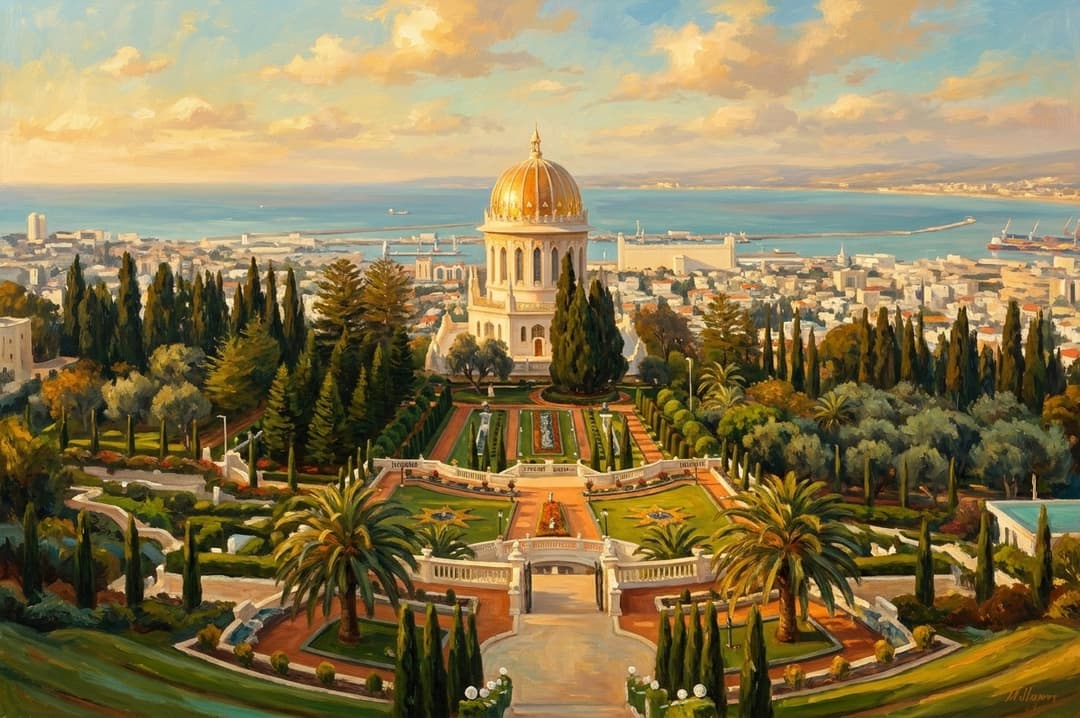
The Shrine of the Báb is a sanctuary of profound contemplation, welcoming thousands of international pilgrims and world travelers every week. Visitors encounter immaculately landscaped garden paths, sweeping vistas of the Mediterranean Sea, and an interior chamber enveloped in sacred reverent quietude.
Highlights
- Gazing upward at the 12,000 gold-glazed porcelain tiles shimmering under the Mediterranean sun.
- Walking the tranquil paths through nineteen precision-sculpted terraced gardens spanning Mount Carmel.
- Experiencing the contemplative atmosphere inside the quiet threshold of the inner shrine chamber.
- Viewing the direct optical alignment stretching north across Haifa Bay toward ancient Acre.
Things to Know
- Modest dress is required: shoulders and knees must remain covered at all times on the holy precinct.
- Shoes must be removed or covered with protective felt slippers prior to entering the shrine interior.
- Photography and cell phone use are strictly prohibited within the interior prayer chambers.
- Interior meditation access is limited to morning hours, whereas outer garden viewpoints remain accessible longer.
Location
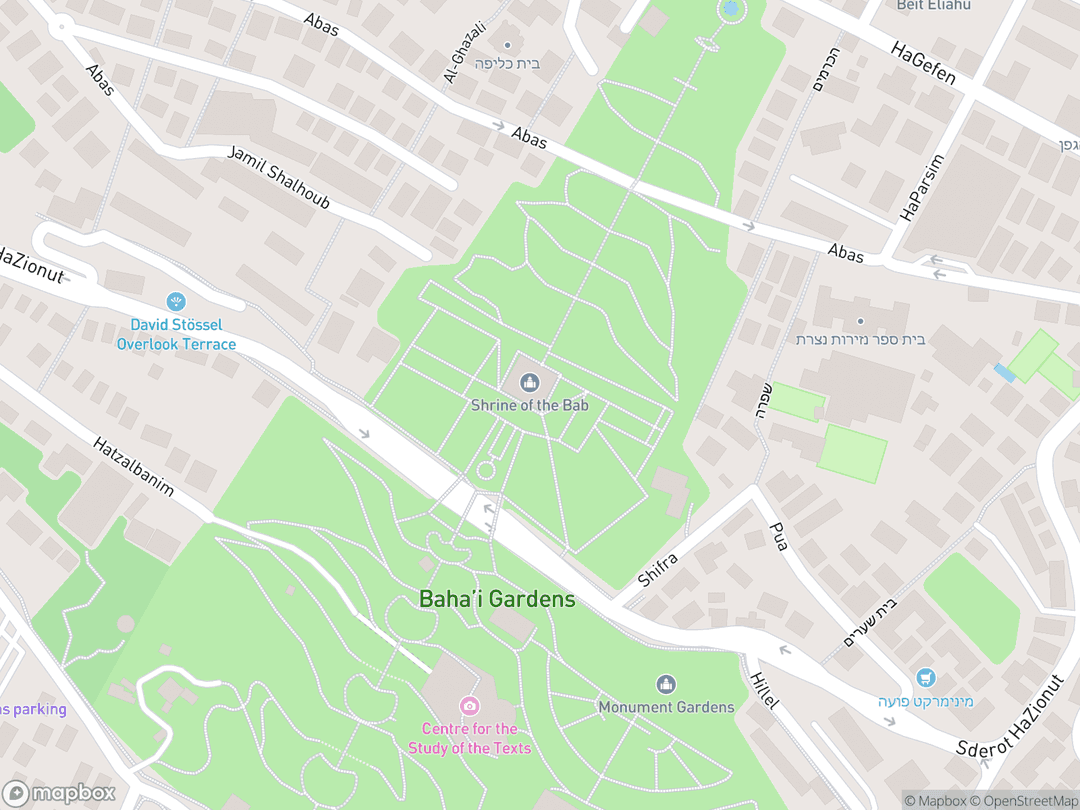
80 Hatzionut Avenue, Mount Carmel, Haifa, Israel
Hours: Interior shrine open daily 9:00 AM to 12:00 PM; surrounding terrace gardens open 9:00 AM to 5:00 PM.
Getting There: Accessible by public buses and the Carmelit underground funicular to Golomb or Yefe Nof stations, with primary visitor reception located at 80 Hatzionut Avenue.
Get DirectionsTips for Your Visit
Arrive Early for Interior Entry
The interior prayer room closes promptly at noon, so plan your morning arrival to allow unhurried meditation.
Wear Comfortable Walking Shoes
Navigating the extensive stone stairways and gravel pathways across the terraces involves substantial walking.
Book Free Garden Walking Tours
Official Baháʼí guided walking tours descend from the Yefe Nof summit and provide deep historical context.
Maintain Quiet Demeanor
Maintain a hushed voice across the inner terraces to preserve the sacred atmosphere for worshipers.
About
The Shrine of the Báb crowns the northern slope of Mount Carmel in Haifa, serving as the resting place of Siyyid ʻAlí-Muḥammad, the Prophet-Herald of the Baháʼí Faith known as the Báb. Elevated within the sacred geography of Abrahamic prophecy, Mount Carmel has been venerated for millennia as the sanctuary of the Prophet Elijah and the mountain extolled by Isaiah. Baháʼís view this holy site as the literal fulfillment of biblical prophecy regarding the establishment of the Mountain of the Lord in the latter days.
In 1891, Baháʼu'lláh personally pointed out the exact spot on Mount Carmel where the martyred remains of the Báb were to be entombed. Over half a century after the Báb's public execution in Tabriz, ʻAbdu'l-Bahá constructed the initial stone mausoleum and interred the sacred relics in 1909. Between 1948 and 1953, Shoghi Effendi oversaw the construction of a majestic classical superstructure designed by Canadian architect William Sutherland Maxwell.
Crowned with a brilliant gilded dome of 12,000 gold-glazed ceramic tiles, the monument is embraced by nineteen monumental garden terraces descending the mountainside. The Shrine stands second only to the Shrine of Baháʼu'lláh as the holiest pilgrimage destination for millions of Baháʼís across the globe. In 2008, UNESCO inscribed the Shrine and its surrounding gardens onto the World Heritage List in recognition of their exceptional spiritual and artistic value.
Gallery
Symbolic Elements
The temple's exterior features intricate carvings, each rich with spiritual meaning:

Gilded Dome
The gold cupola symbolizes the celestial realm, divine incorruptibility, and the dawn of a new revelation.

Eight-Sided Octagon
The octagonal tier marks the architectural transition from the earthly square foundation to the circular heaven.

Eighteen Drum Windows
Eighteen lancet windows symbolize the Letters of the Living, the first eighteen disciples who recognized the Báb.

Nine-Room Floor Plan
The nine-vaulted layout embodies the numerical value of Bahá, signifying spiritual perfection and unity.

Rose Baveno Granite Columns
The dawn-pink Italian granite columns symbolize steadfastness and the unyielding strength of divine faith.

Nineteen Monumental Terraces
The nineteen garden tiers represent the Báb and His eighteen disciples forming a sacred complete unity.
The Maxwell Door
The southern portal honors architect William Sutherland Maxwell for his sacrificial devotion and artistry.
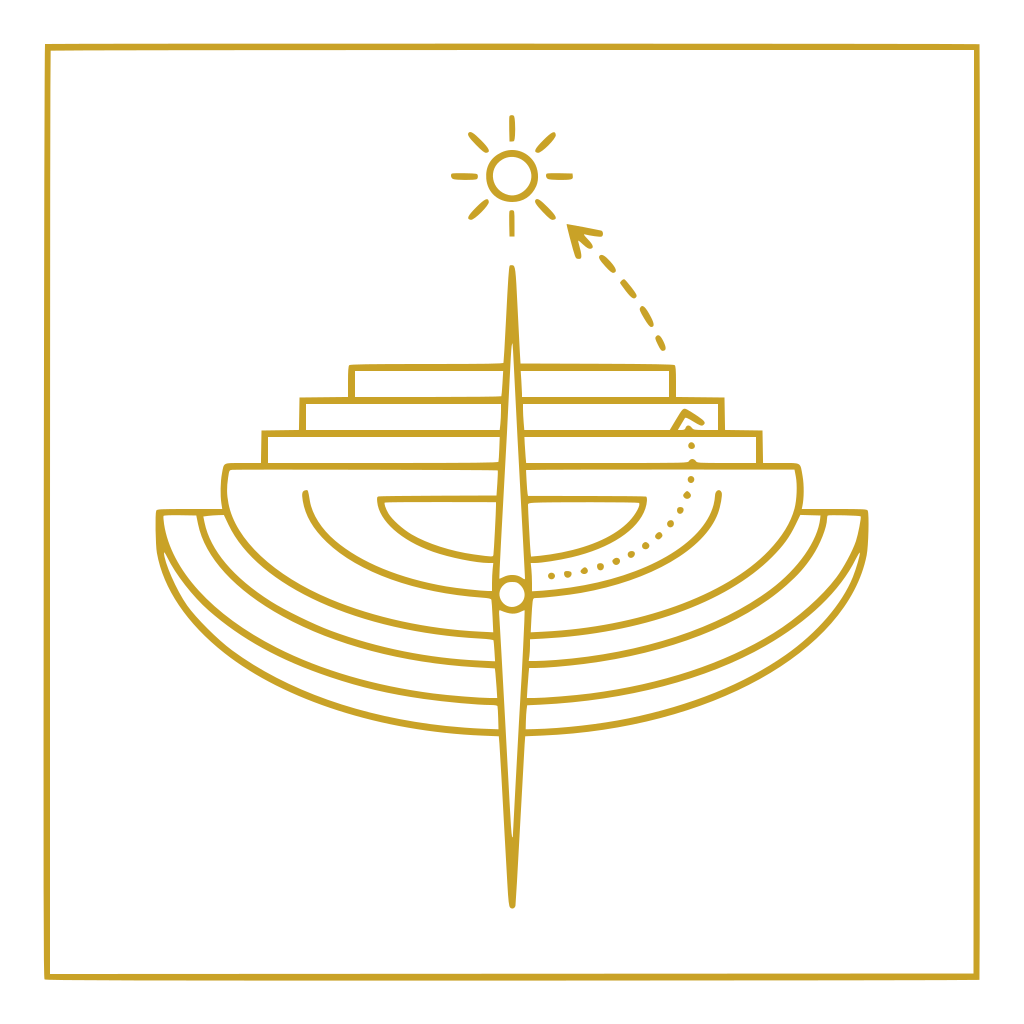
Qiblih Alignment
The terrace axis aligns across Haifa Bay toward Acre, directing the spiritual focus toward Baháʼu'lláh's resting place.
Interesting Facts
The Báb's remains were hidden in grain mills and silk factories for nearly 50 years before reaching Haifa. (Tier A)
Over 2,000 tons of Italian marble and granite were shipped into Haifa during the 1948 war without damage. (Tier B)
The 12,000 ceramic dome tiles are fused with authentic 24-karat gold leaf beneath an impermeable glaze. (Tier A)
Superstructure architect William Sutherland Maxwell was a renowned designer of major Canadian civic landmarks. (Tier B)
Construction was financed entirely by voluntary Baháʼí donations, declining all outside or state funds. (Tier A)
The remains of ʻAbdu'l-Bahá were reverently sheltered within the northern vault of the Shrine for over a century. (Tier A)
The central axis of the nineteen terraces points directly across Haifa Bay toward the Shrine of Baháʼu'lláh. (Tier A)
German Templers carved 'The Lord is near' above doorways in the colony directly aligned with the Shrine. (Tier B)
The gardens operate on an eco-friendly pest management program that avoids synthetic chemical pesticides. (Tier B)
An independent reinforced concrete ring beam cushions the superstructure to shield the inner vault from earthquakes. (Tier B)
Common Questions
Who is entombed inside the Shrine of the Báb?
The Shrine holds the sacred remains of the Báb, the Herald-Prophet of the Baháʼí Faith, alongside His disciple Anís.
Can non-Baháʼí visitors enter the Shrine?
Yes, people of all faiths and backgrounds are warmly welcomed into the Shrine for silent prayer and contemplation.
Why is the dome covered in gold?
The gold-glazed tiles symbolize heavenly light, spiritual sovereignty, and the dawn of a new global religious era.
How many garden terraces surround the Shrine?
There are nineteen terraces in total, with nine ascending from the city, nine descending from the crest, and the Shrine centered.
What is the relationship between Mount Carmel and Abrahamic prophecy?
Mount Carmel has been venerated as Elijah's sanctuary and is honored by Baháʼís as the fulfilled Mountain of the Lord.
Featured Stories
The Secret Half-Century Journey of the Báb's Remains
1850
Following the Báb's execution in Tabriz in 1850, devoted followers rescued His sacred remains and concealed them across Persia for decades. Traveling through silk warehouses and mountain hideouts, the relics crossed Ottoman borders safely in 1899 to reach Mount Carmel.
Source: Baháʼí International Community Archives
ʻAbdu'l-Bahá's Tears at the Naw-Rúz Interment
March 21, 1909
On Naw-Rúz in 1909, after overcoming decades of Ottoman surveillance and political harassment, ʻAbdu'l-Bahá placed the casket inside the vault. Setting down his lantern, he openly wept with relief and immense gratitude that the Báb had finally achieved eternal rest on Carmel.
Source: The Promulgation of Universal Peace
Quarrying Marble Amid Post-War Hardship
1949
During the severe material shortages of post-war Europe and the 1948 Arab–Israeli War, Shoghi Effendi commissioned Ugo Giachery to quarry granite in Italy. Defying logistical odds, over two thousand tons of flawless stone sailed across the Mediterranean without a single cracked pillar.
Source: Shoghi Effendi: The Visionary Builder
Timeline
Declaration of the Báb
Siyyid ʻAlí-Muḥammad announces His prophetic mission in Shiraz, inaugurating the Bábí dispensation.
MilestoneMartyrdom in Tabriz
The Báb is executed by firing squad in Persia, beginning five decades of secret transit for His remains.
EventSite Designated on Carmel
Baháʼu'lláh points out the exact burial location on Mount Carmel to His eldest son, ʻAbdu'l-Bahá.
MilestoneFoundation Stone Laid
ʻAbdu'l-Bahá initiates construction of the six-room local limestone mausoleum amidst political resistance.
component.timeline.groundbreakingInterment of Sacred Remains
ʻAbdu'l-Bahá places the Báb's remains in the alabaster sarcophagus inside the vault on Naw-Rúz.
DedicationPassing of ʻAbdu'l-Bahá
ʻAbdu'l-Bahá passes away and is temporarily interred in one of the northern chambers of the Shrine.
EventNine-Room Expansion
Shoghi Effendi adds three eastern chambers, completing a harmonious nine-room symmetrical plan.
RenovationSuperstructure Model Unveiled
A scale plaster model of William Sutherland Maxwell's golden-domed design is unveiled in Haifa.
MilestoneSuperstructure Completed
The golden dome and Italian marble arcade are finished, earning the title 'The Queen of Carmel'.
DedicationInauguration of the 19 Terraces
The completed monumental terraced gardens designed by Fariborz Sahba are consecrated before global delegates.
DedicationUNESCO World Heritage Designation
UNESCO inscribes the Shrine of the Báb and its gardens onto the World Heritage List.
MilestoneRestoration and Seismic Retrofit
A comprehensive structural restoration completes the re-gilding of all 12,000 dome tiles.
RenovationHistory by Decade
1850s–1880s — Martyrdom and Sacred Concealment
Following the Báb's execution by firing squad in Tabriz, His followers retrieved the sacred remains under Baháʼu'lláh's guidance. The relics were secretly moved between Iranian safe houses, grain depots, and remote shrines for nearly fifty years to evade desecration.
1890s–1900s — Securing the Carmel Foothold
Baháʼu'lláh pointed out the resting place on Mount Carmel in 1891, directing ʻAbdu'l-Bahá to secure the land. Despite intense opposition from Ottoman officials, ʻAbdu'l-Bahá completed a fortress-like stone mausoleum and laid the Báb to rest on Naw-Rúz in 1909.
1910s–1930s — Expansion and Turmoil
The shrine was safeguarded through World War I, after which ʻAbdu'l-Bahá passed away in 1921 and was entombed in an adjacent room. In 1929, Shoghi Effendi added three eastern chambers to produce a symmetrical nine-room layout.
1940s–1950s — The Golden Superstructure
Canadian architect William Sutherland Maxwell was commissioned to encase the original stone structure in a monumental arcade and golden dome. Completed in October 1953, the $750,000 project brought Italian granite and Florentine gold tiles to Mount Carmel.
1980s–2000s — Cultivating the Monumental Terraces
Architect Fariborz Sahba directed the creation of nineteen terraced gardens climbing the mountain slope. Inaugurated in May 2001, the terraces transformed the Shrine into an internationally celebrated focal point for peace and interfaith harmony.
2010s–Present — Conservation and Heritage Preservation
Between 2008 and 2011, a comprehensive restoration stabilized the dome with modern seismic engineering and restored its gold tiles. The Shrine remains a living sanctuary of prayer and a centerpiece of the UNESCO-inscribed Baháʼí World Centre.
Architecture & Facilities
The Shrine of the Báb is a masterwork of neoclassical Beaux-Arts architecture harmonized with eastern Saracenic motifs. Designed by William Sutherland Maxwell under Shoghi Effendi's conceptual guidance, it bridges Western Greco-Roman columned proportions with Persian cusped arches and a shimmering golden cupola.
Building Materials
Rose Baveno Granite
Quarried from Lake Maggiore in Italy, this pink feldspar granite forms twenty-four monolithic columns.
Chiampo Paglierino Marble
Extracted near Vicenza, this cream-toned fossiliferous stone composes the decorative capitals and arches.
Gold-Glazed Porcelain Tiles
Twelve thousand custom ceramic tiles fired with liquid gold alloy in Florence protect the exterior dome.
Palestinian Ashlar Limestone
Heavy local limestone blocks form the 1.5-meter-thick seismic foundation walls of the inner core.
Interior Features
Sacred Burial Vault
The central chamber shelters the intricate alabaster sarcophagus containing the Báb's remains.
Prayer Hall of the Shrine
An adjacent contemplation hall adorned with Persian carpets where pilgrims offer silent prayers.
Chamber of ʻAbdu'l-Bahá
A tranquil northern room that served as the temporary resting place of ʻAbdu'l-Bahá for a century.
Maxwell Colonnade Ambulatory
An open-air portico surrounding the core structure offering sheltered circulation beneath marble arches.
Temple Grounds
The nineteen monumental terraced gardens span nearly one kilometer up the northern slope of Mount Carmel, ascending 225 vertical meters. Designed by Fariborz Sahba, the grounds feature drought-tolerant olive and jacaranda trees, formal hedges, running water channels, and ornamental fountains.
Additional Facilities
Visitor reception centers at 80 Hatzionut Avenue and the upper crest offer informative displays, accessibility elevators, and gardens.
Religious Significance
In Baháʼí theology, Mount Carmel represents the physical and spiritual convergence of prophetic fulfillment. The Shrine of the Báb serves as the resting place of the Prophet-Herald who announced the coming of Baháʼu'lláh and the unification of all humankind.
To provide a holy sanctuary of prayer and pilgrimage honoring the martyrdom of the Báb and anchoring the Baháʼí World Centre.
Sacred Ordinances
Pilgrimage (Ziyárat)
Pilgrims circumambulate the exterior, step barefoot over the threshold, and recite the Tablet of Visitation.
Silent Contemplation
Individual private prayer conducted within the inner vault without vocal sermons or congregational rituals.
Devotional Chanting
Baháʼí scriptures and prayers chanted melodiously in low reverent tones within the adjacent chambers.
Continuity of Abrahamic Prophecy
The Shrine embodies the Baháʼí belief in progressive revelation, elevating Elijah's sacred mountain to the administrative and devotional apex of a global spiritual commonwealth.
The Sovereign Station of the Báb
The majesty of the golden superstructure visually symbolizes the exalted station of the Báb, transforming an execution in military disgrace into eternal spiritual glory.
Sources & Research
Every fact on Temples.org is backed by verified Sources & Research. Each piece of information is rated by source tier and confidence level.
View All Sources (8)
| Field | Source | Tier | Retrieved |
|---|---|---|---|
| About & Historical Background | Baháʼí International Community (opens in a new tab) | A | 2026-02-23 |
| Religious Significance & Martyrdom | National Spiritual Assembly of the Baháʼís of the United States (opens in a new tab) | A | 2026-02-23 |
| Architecture & Maxwell Design | Baháʼí Library Online (opens in a new tab) | B | 2026-02-23 |
| Historical Timeline & Letters | Baháʼí Works (opens in a new tab) | A | 2026-02-23 |
| Carmel History & Abrahamic Heritage | Jewish Virtual Library (opens in a new tab) | B | 2026-02-23 |
| Superstructure Details & Italian Granite | The Utterance Project (opens in a new tab) | C | 2026-02-23 |
| Terrace Construction & Dimensions | Bahaipedia (opens in a new tab) | C | 2026-02-23 |
| Visitor Facilities & Public Access | TripBucket (opens in a new tab) | D | 2026-02-23 |