Visitor Insights
Visiting Florence Cathedral
Visiting Florence Cathedral offers an encounter with Renaissance spatial majesty. Entry to the main nave is free, though ascending the dome requires timed reservations. The cathedral remains an active house of prayer requiring modest attire.
Highlights
- Free access to the cavernous nave with its expansive Gothic bays
- Brunelleschi's colossal cupola adorned with Vasari's Last Judgment fresco
- The 24-hour liturgical clock dial painted by Paolo Uccello
- Archaeological remains of the ancient Basilica of Santa Reparata in the crypt
Things to Know
- Modest dress is strictly enforced; shoulders and knees must remain covered
- Climbing the dome entails 463 narrow stone steps without elevator service
- Large bags, luggage, and metal tripods are prohibited inside the sanctuary
Location
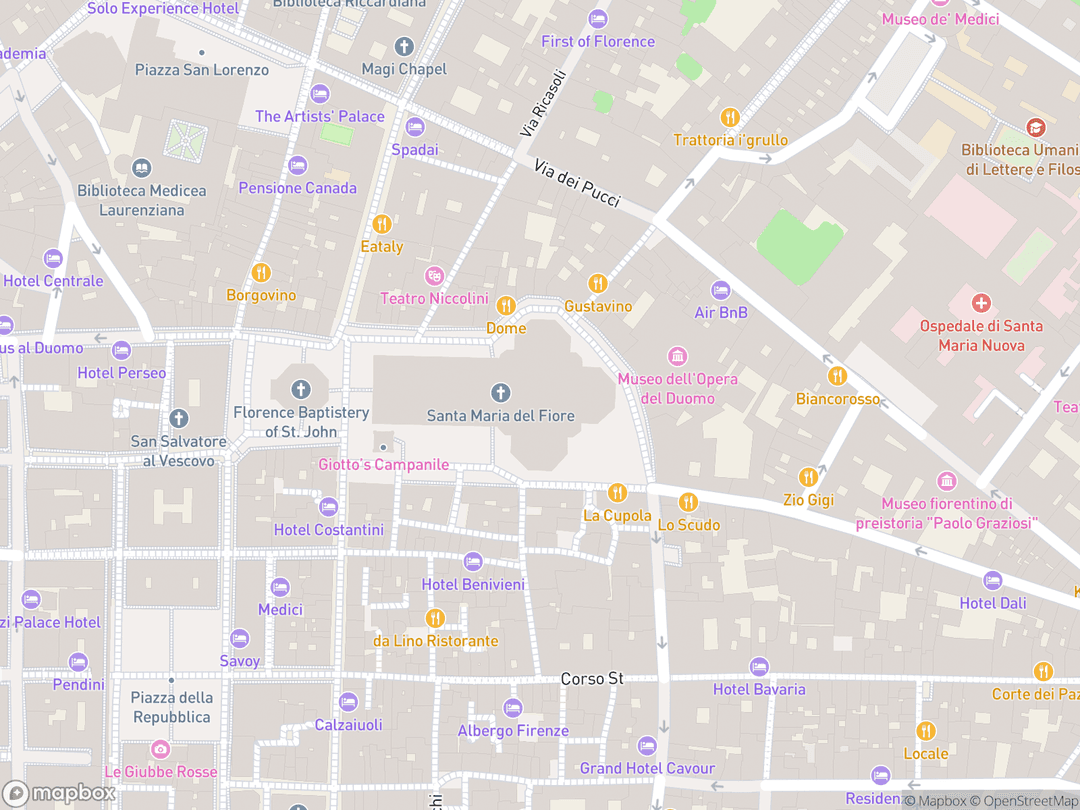
Piazza del Duomo, 50122 Firenze FI, Tuscany, Italy
Hours: Monday to Saturday 10:15 AM to 3:45 PM; closed to tourism on Sundays for Mass
Getting There: Located in the heart of pedestrianized Florence, a ten-minute walk from Santa Maria Novella railway station.
Get DirectionsTips for Your Visit
Book Dome Climbs Weeks Ahead
Access to the 463-step cupola climb requires strict timed-entry tickets that sell out well in advance.
Respect Sacred Liturgy
Sightseeing is suspended during Sunday services, but visitors may quietly attend Holy Mass.
Explore the Excavated Crypt
Descend into the Santa Reparata crypt to view early Christian mosaics and Filippo Brunelleschi's simple tomb slab.
About
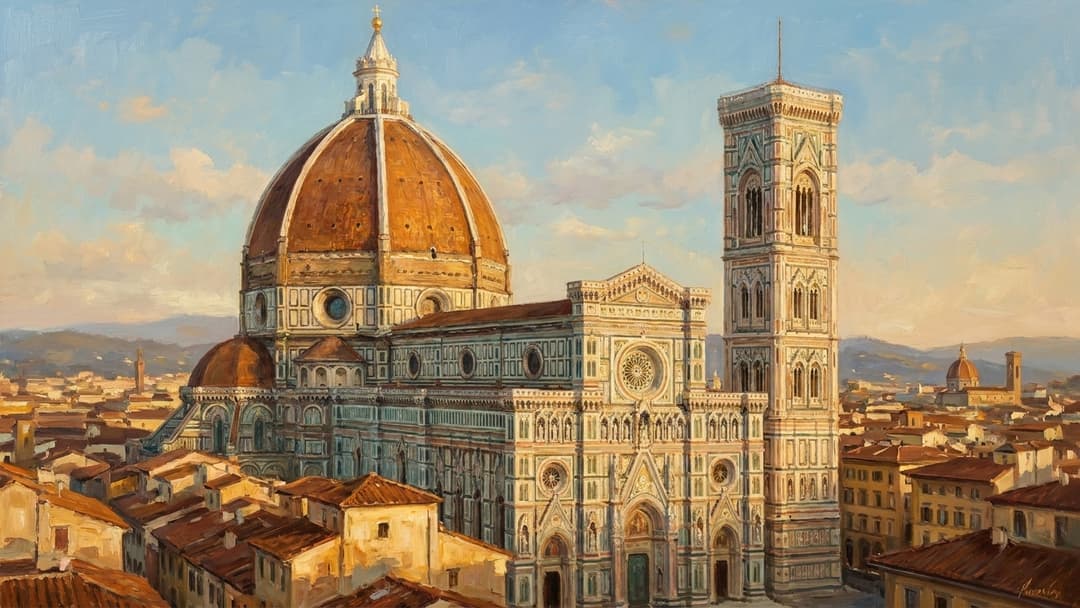
Florence Cathedral, dedicated as Santa Maria del Fiore, stands as the ecclesiastical heart of Florence and one of Christendom's greatest architectural monuments. Conceived in 1296 to surpass the cathedrals of rival Tuscan cities, it was erected over the remains of the ancient fifth-century church of Santa Reparata.
The cathedral represents a monumental transition from Italian Gothic spatial massing to Renaissance structural humanism. Its defining feature, the soaring octagonal dome engineered by Filippo Brunelleschi without ground scaffolding, remains the largest unreinforced masonry cupola ever constructed.
Consecrated by Pope Eugene IV in 1436, the cathedral functions as the seat of the Archbishop of Florence. Adorned with geometric Tuscan polychrome marble, monumental stained glass, and vast Renaissance frescoes, it endures as a beacon of artistic and spiritual devotion.
Gallery
Symbolic Elements
The temple's exterior features intricate carvings, each rich with spiritual meaning:

The Octagon of Resurrection
The eight-sided drum and crossing symbolize the biblical Eighth Day of spiritual renewal and Christ's resurrection.

Vasari's Last Judgment Fresco
Concentric heavenly and demonic registers depict divine judgment descending upon the gathered mortal assembly.

Paolo Uccello Liturgical Clock
The 24-hour counter-façade fresco measures Italian time from sunset, reminding worshippers of mortal ephemerality.

Stained Glass Oculi
Large circular stained glass windows designed by Renaissance masters transform physical sunlight into theological illumination.

Gilded Copper Sphere and Cross
Verrocchio's crowning orb proclaims Christ's supreme universal dominion over the temporal realm.

Reliquary Shrine of Saint Zenobius
Ghiberti's bronze shrine venerates Florence's early holy bishop as the protector of the local episcopal lineage.

White Carrara Marble Cladding
Pristine white marble panels from Carrara provide structural framing and symbolize divine purity.

Verde di Prato Serpentine Inlay
Dark green stone bands from Prato articulate crisp geometric boundaries across the outer walls.
Interesting Facts
Brunelleschi's dome remains the largest unreinforced masonry cupola on Earth six centuries after its completion (Tier A).
Construction proceeded without timber falsework thanks to an interlocking herringbone brickwork pattern (Tier A).
During the 1478 Pazzi Conspiracy, Giuliano de' Medici was murdered before the high altar while Lorenzo escaped (Tier A).
A young Leonardo da Vinci assisted in hoisting Verrocchio's heavy gilded copper ball atop the lantern in 1471 (Tier B).
Guillaume Du Fay composed the motet Nuper rosarum flores with proportions matching the biblical Temple of Solomon (Tier B).
A bronze astronomical gnomon installed in the dome in 1475 casts a solar beam across the floor on the summer solstice (Tier B).
The elaborate polychrome marble façade was built between 1871 and 1887, replacing bare medieval brickwork (Tier A).
Brunelleschi's long-lost burial vault was rediscovered inside the cathedral crypt during post-flood excavations in 1972 (Tier A).
Common Questions
Is entry into Florence Cathedral free?
Sightseeing access to the main cathedral nave is free, though monuments like the dome and crypt require paid passes.
How many steps are required to climb the dome?
Visitors must climb 463 stone steps between the two masonry shells, with no elevator access.
Why is the cathedral named Santa Maria del Fiore?
The title refers to Christ as the divine flower blooming from Mary, echoing Florence's heraldic lily symbol.
Where is architect Filippo Brunelleschi buried?
Brunelleschi is buried beneath the cathedral floor within the excavated crypt of Santa Reparata.
Featured Stories
Brunelleschi's Audacious Bet
August 7, 1420
When the Opera del Duomo faced an impossibly wide 42-meter drum that could not be scaffolded with Tuscan timber, Filippo Brunelleschi proposed building a self-supporting dome without falsework. Rivals mocked his secret designs, yet his brilliant herringbone brickwork and tension chains locked the cupola together as it climbed skyward. His engineering triumphant silence silenced detractors and heralded the dawn of Renaissance architecture.
Source: Opera di Santa Maria del Fiore Historical Archives
The Pazzi Bloodbath at the High Altar
April 26, 1478
On Easter Sunday during the sacred elevation of the Host, assassins unsheathed daggers in a desperate bid to overthrow Medici rule. Giuliano de' Medici fell mortally wounded on the sanctuary floor while his brother Lorenzo brandished his sword and retreated into the North Sacristy. The heavy bronze doors forged by Luca della Robbia swung shut in the nick of time, preserving Lorenzo's life.
Source: Archivio di Stato di Firenze
The Musical Architecture of Dedication
March 25, 1436
Pope Eugene IV consecrated the magnificent basilica on the Feast of the Annunciation amidst resplendent liturgical fanfare. Papal singers performed Guillaume Du Fay's polyphonic motet Nuper rosarum flores, whose proportional tempo structure precisely mirrored the sacred biblical dimensions of the Temple of Solomon. The ceremony united celestial harmony with human architectural triumph.
Source: Papal Liturgical Annals
Timeline
Foundation Stone Laid
Arnolfo di Cambio initiates construction on the Feast of the Nativity of the Virgin Mary.
MilestoneGiotto Appointed Master of Works
Giotto di Bondone assumes leadership and commences erection of the monumental bell tower.
MilestoneThe Black Death
The bubonic plague halts construction across the Florentine republic.
EventExpansion Under Talenti
Francesco Talenti modifies the basilican layout to enlarge the nave and radiating apses.
RenovationDismantling of Santa Reparata
The ancient predecessor church is systematically demolished inside the expanding Gothic walls.
EventDome Construction Begins
Filippo Brunelleschi launches work on the self-supporting double-shell cupola.
MilestoneSolemn Consecration
Pope Eugene IV consecrates the completed cathedral with Guillaume Du Fay's motet.
DedicationDome Oculus Sealed
Masons place the final brick sealing the cupola before lantern construction begins.
MilestoneThe Pazzi Conspiracy
Assassins strike the Medici brothers during High Mass at the cathedral altar.
EventDome Frescoes Completed
Federico Zuccari finishes the vast Last Judgment fresco begun by Giorgio Vasari.
MilestoneNeo-Gothic Façade Unveiled
Emilio De Fabris's tricolor marble west front is unveiled after centuries of bare brick.
MilestoneUNESCO World Heritage Inscription
The cathedral complex is inscribed as the centerpiece of Historic Florence.
MilestoneHistory by Decade
5th to 12th Century — The Era of Santa Reparata
For over eight centuries, the Paleo-Christian basilica of Santa Reparata served as the spiritual center of Florence. Built in the late Roman period, the venerable sanctuary featured early mosaic pavements and episcopal tombs, but gradually proved inadequate for the bustling medieval merchant republic.
1290s to 1330s — Arnolfo's Grand Foundation
In 1296, the Signoria commissioned master architect Arnolfo di Cambio to design an immense replacement basilica that proclaimed Florentine civic preeminence. Following Arnolfo's death, stewardship was assigned to the Wool Merchants Guild, who established the Opera del Duomo and appointed Giotto to erect the campanile.
1340s to 1370s — Plague and Vault Expansion
Despite devastation caused by the 1348 Black Death, master mason Francesco Talenti significantly expanded the nave bays and tri-apsidal crossing. Workers slowly dismantled the ancient walls of Santa Reparata within the rising exterior envelope until the old basilica was cleared in 1375.
1410s to 1430s — Raising the Great Cupola
With the massive octagonal drum standing unroofed, Filippo Brunelleschi won the celebrated 1418 engineering competition. His ingenious double shell and herringbone brick laying enabled masons to close the vault, culminating in Pope Eugene IV's solemn cathedral consecration in 1436.
1440s to 1580s — Renaissance Finishing and Turmoil
Following Brunelleschi's death, Michelozzo completed the marble lantern, crowned in 1471 by Verrocchio's bronze cross. Giorgio Vasari and Federico Zuccari painted the Last Judgment across the vast dome interior, while Arnolfo's unfinished medieval façade was dismantled in 1587.
1870s to Present — Modern Renewal and Preservation
Architect Emilio De Fabris brought centuries of bare brick to a close with his vibrant Neo-Gothic polychrome façade in 1887. The cathedral survived the catastrophic Arno flood of 1966, leading to archaeological excavations that uncovered Santa Reparata and established the monument's global UNESCO stewardship.
Architecture & Facilities
Florence Cathedral represents an extraordinary convergence of Italian Gothic monumentality and Renaissance rational engineering, rejecting French flying buttresses in favor of broad horizontal clarity, massive piers, and a world-renowned double-shelled dome.
Building Materials
Carrara White Marble
Pristine white marble quarried from Carrara forms the architectural framing and carved statuary.
Prato Green Serpentine
Verde di Prato serpentine provides dark horizontal geometric inlays across the facades.
Maremma Pink Marble
Red and pinkish marble sourced from Maremma lends chromatic warmth to decorative wall borders.
Pietra Serena Sandstone
Grey Tuscan sandstone is utilized for the interior monumental nave piers and rib moldings.
Interior Features
Vast Basilican Nave
Four enormous square bays defined by wide pointed arches create an austere, cavernous worship hall.
The Cupola Vault
Over 3,600 square meters of fresco painted by Vasari and Zuccari depict the Last Judgment.
Crypt of Santa Reparata
Excavated subterranean foundations preserve Roman mosaics and Filippo Brunelleschi's tomb.
North Sacristy (Sagrestia delle Messe)
Famous for its carved intarsia woodwork and heavy bronze doors where Lorenzo de' Medici took refuge.
Temple Grounds
The cathedral anchors the pedestrianized Piazza del Duomo, integrated with Giotto's Campanile and the historic Romanesque Baptistery of San Giovanni.
Additional Facilities
The nearby Museo dell'Opera del Duomo houses original cathedral sculptures, choir lofts, and historic construction models.
Religious Significance
Within Catholic theology, Santa Maria del Fiore stands as the mother church of the Archdiocese of Florence, consecrated as a sacred threshold where heaven and earth intersect.
To serve as the seat of the diocesan bishop, celebrating the liturgical mysteries and nurturing Christian discipleship across the Tuscan capital.
Sacred Ordinances
The Holy Mass
Daily Eucharistic celebrations offering praise, thanksgiving, and the sacrament of Christ's body and blood.
Episcopal Ordinations and Consecrations
Sacraments administered from the archbishop's cathedra conferring holy orders upon new clergy.
The Sacrament of Reconciliation
Confession offered to pilgrims seeking spiritual cleansing and restoration within the sacred precinct.
Marian Title of the Flower
The dedication to Saint Mary of the Flower honors Christ as the prophesied branch of Jesse, aligning biblical prophecy with the civic dignity of Florence.
Sources & Research
Every fact on Temples.org is backed by verified Sources & Research. Each piece of information is rated by source tier and confidence level.
View All Sources (8)
| Field | Source | Tier | Retrieved |
|---|---|---|---|
| About & Historical Background | Opera di Santa Maria del Fiore (opens in a new tab) | A | 2026-03-31 |
| Ecclesiastical Administration | The Catholic Hierarchy (opens in a new tab) | A | 2026-03-31 |
| Structural Analysis & Materials | WikiArquitectura (opens in a new tab) | B | 2026-03-31 |
| Symbolism & Consecration Motet | Touchstone Journal (opens in a new tab) | B | 2026-03-31 |
| Liturgical Art & Paolo Uccello Clock | OAPEN Library (opens in a new tab) | B | 2026-03-31 |
| Cultural Monument Preservation | MSCOE Cultural Heritage Protection (opens in a new tab) | B | 2026-03-31 |
| Vasari Frescoes & Art History | DailyArt Magazine (opens in a new tab) | C | 2026-03-31 |
| Crypt Excavations & Santa Reparata | ItalyScapes Heritage Guide (opens in a new tab) | C | 2026-03-31 |