Visitor Insights
Visiting Siena Cathedral
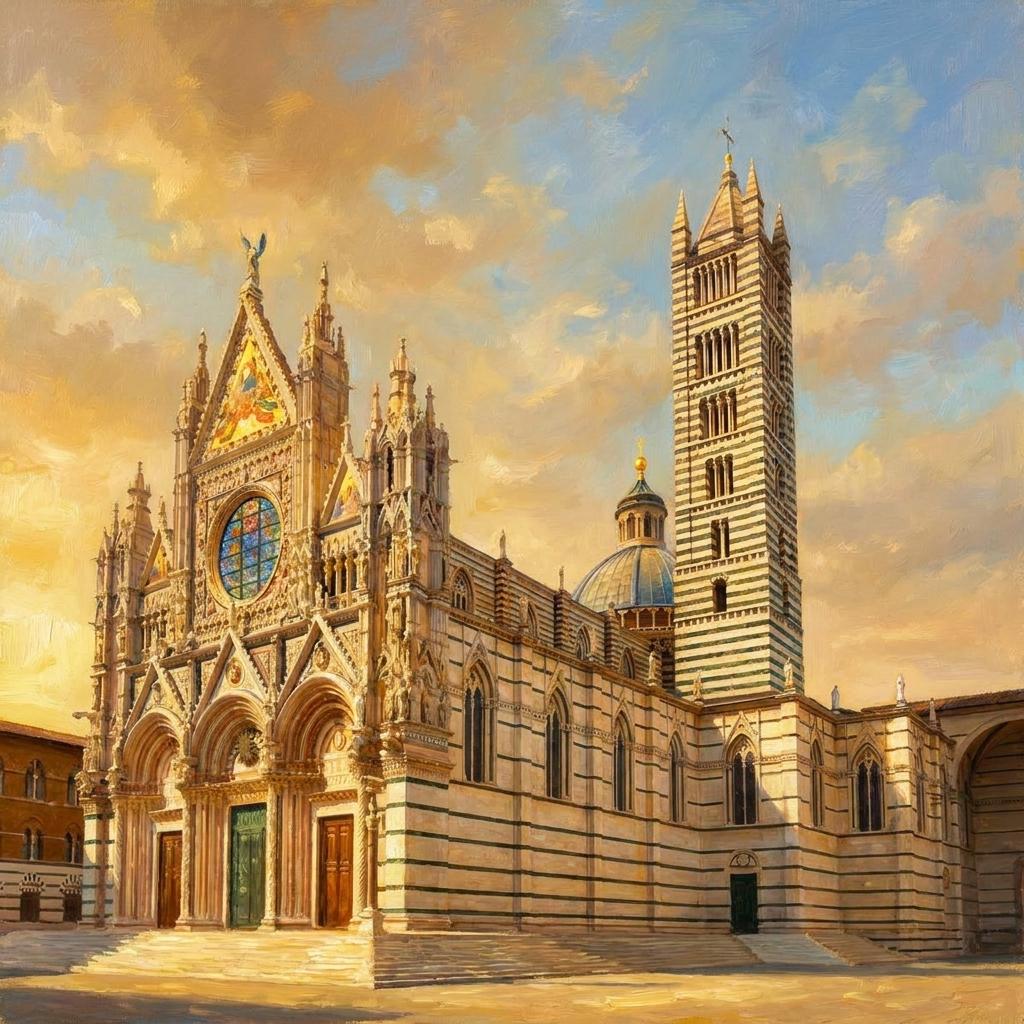
Visiting Siena Cathedral requires mindful navigation of an active Catholic pilgrimage shrine and museum complex. The interior is renowned for its figurative marble pavement, which is uncovered only during designated periods in late summer and autumn. A complete visit includes the Piccolomini Library, the subterranean Crypt, and the panoramic terraces of the unfinished façade.
Highlights
- Breathtaking Italian Gothic nave adorned with black and white striped marble.
- Intricate figurative marble pavement comprising fifty-six Renaissance and medieval panels.
- Masterwork pulpits and sculptures by Nicola Pisano, Michelangelo, and Donatello.
- Vibrant Renaissance frescoes by Pinturicchio inside the Piccolomini Library.
Things to Know
- Strict modest dress code enforced requiring covered shoulders and knees.
- The full pavement is covered for conservation except during special late-summer unveilings.
- The historic city center is entirely pedestrianized and involves uphill walking.
Location
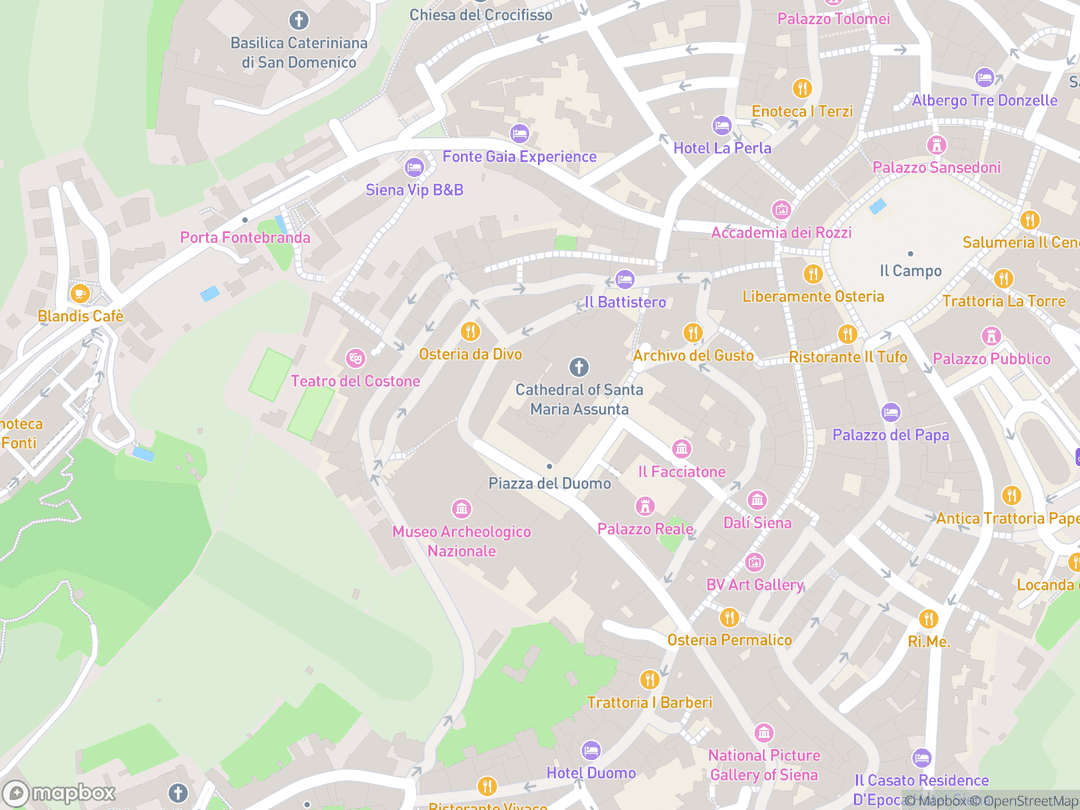
Piazza del Duomo, 8, 53100 Siena SI, Italy
Hours: Monday to Saturday 10:00 AM – 7:00 PM; Sundays 1:30 PM – 6:00 PM (seasonal variations apply)
Getting There: Located in central Siena within the restricted traffic zone; accessible by foot from Piazza del Campo or via local shuttle buses from the central train station.
Get DirectionsTips for Your Visit
Time the Floor Unveiling
Plan your trip between late June and October to view the uncovered marble floor panels.
Acquire an OPA SI Pass
Purchase a combined pass to enter the Cathedral, Crypt, Baptistery, and panoramic Facciatone.
Ascend the Porta del Cielo
Book rooftop tickets in advance to tour the upper triforium galleries and attic walkways.
About
Within the broad Abrahamic tradition, sacred architecture mirrors the heavenly court on earth. Originating in the Biblical typology of the ancient Tabernacle, the sanctuary provides an earthly threshold where humanity encounters divine presence through communal worship and sacred scripture.
As a Roman Catholic metropolitan cathedral, Siena Cathedral embodies the mother church of the archdiocese and the seat of apostolic authority. Dedicated to Santa Maria Assunta, it was conceived as an earthly palace for the Virgin Mary, synthesizing civic devotion, scriptural revelation, and Christian dogma.
Erected between the twelfth and fourteenth centuries, the complex reflects a transition from Romanesque solidity to Italian Gothic elegance. Its dramatic black-and-white striped marble, soaring hexagonal dome, and world-renowned inlaid marble floor create a space saturated with theological symbolism.
Surviving the catastrophic Black Death of 1348, which halted an ambitious expansion, the cathedral remains an active house of prayer, a pilgrimage sanctuary, and a monument of Western religious heritage.
Gallery
Symbolic Elements
The temple's exterior features intricate carvings, each rich with spiritual meaning:

Zebra Striping (Balzana)
The alternating black and white marble bands symbolize Siena's civic colors and the spiritual interplay between sin and grace.

Inlaid Marble Floor
Fifty-six stone marquetry panels lead the believer along an iconographic ascent from secular wisdom to divine truth.

Nicola Pisano Pulpit
Supported by carved lions, the octagonal pulpit depicts the Redemption through detailed proto-Renaissance marble reliefs.

Hexagonal Dome
Rising over the crossing, the gilded dome represents the vault of heaven suspended above earthly worship.

Piccolomini Library
Decorated by Pinturicchio, the hall honors humanistic scholarship and papal service under divine providence.

The Subterranean Crypt
Preserving early Passion frescoes, the undercroft reflects Christ's descent into death before His resurrection.

Clerestory Papal Busts
A continuous frieze of 172 portrait busts anchors the cathedral within apostolic succession from Saint Peter onward.

The Facciatone
The skeletal wall of the abandoned new cathedral serves as a reminder of human mortality and historical humility.
Interesting Facts
Had the fourteenth-century expansion finished, the cathedral would have been the largest church in medieval Christendom. (Tier A)
The Black Death of 1348 decimated Siena's population and permanently ended the colossal Duomo Nuovo expansion. (Tier A)
It is one of the few Catholic cathedrals featuring pagan sibyls and Hermes Trismegistus across its sacred floor. (Tier A)
A hidden thirteenth-century crypt with vivid Passion frescoes remained buried and forgotten for seven centuries until 1999. (Tier B)
The Piccolomini Library was commissioned by Cardinal Francesco Piccolomini, who later served as pope for just twenty-six days. (Tier A)
A young Raphael Sanzio assisted Pinturicchio in painting the narrative cartoons for the Piccolomini Library frescoes. (Tier B)
Michelangelo carved four saint statues for the cathedral before departing to sculpt his famous David in Florence. (Tier B)
Popes Alexander VII and Benedict XVI each bestowed the prestigious Golden Rose upon the cathedral. (Tier A)
Common Questions
Why does the cathedral have black and white horizontal stripes?
The stripes reflect the Balzana, the official civic coat of arms of Siena derived from ancient municipal legend.
When is the famous marble floor visible to visitors?
The marble pavement is fully uncovered for public viewing twice a year, typically from late June to mid-October.
What is the unfinished wall standing next to the cathedral?
It is the Facciatone, the surviving skeletal wall of the ambitious Duomo Nuovo project abandoned after the 1348 plague.
Is the cathedral still used for regular religious services?
Yes, it remains the active metropolitan cathedral of the Archdiocese of Siena with regular Catholic Masses and liturgies.
Featured Stories
The City of the Virgin at Montaperti
1260
Facing imminent defeat by Florentine forces in 1260, Sienese leaders walked barefoot to the cathedral high altar. Entrusting the commune's keys to the Madonna, they dedicated Siena as the City of the Virgin. Their miraculous victory at Montaperti cemented the cathedral as the spiritual heart of the republic.
Source: Opera della Metropolitana di Siena
The Ambition and Tragedy of the Duomo Nuovo
1348
In 1339, Sienese citizens began constructing a colossal expansion that would have made the cathedral the largest in Christendom. When the bubonic plague struck in 1348, it claimed the lives of master masons and over half the population. Plagued by shifting foundations and municipal grief, the vast new nave was abandoned forever.
Source: Opera della Metropolitana di Siena
The Secret Crypt Revealed
1999
During structural conservation beneath the choir in 1999, workmen broke through a forgotten stone barrier to discover a buried thirteenth-century chamber. Walled up around 1310, the crypt held pristine Passion frescoes with vivid mineral pigments. The discovery reshaped modern understanding of pre-Renaissance Tuscan painting.
Source: New Liturgical Movement
Timeline
Papal Consecration
Sienese Pope Alexander III formally consecrates the Romanesque cathedral complex.
DedicationOrdo Officiorum Established
Canon Oderigo compiles the liturgical customary establishing the cathedral rites.
MilestoneConsecration as Civitas Virginis
Siena dedicates itself to Mary on the cathedral high altar before the Battle of Montaperti.
EventNicola Pisano Pulpit Commission
Nicola Pisano is contracted to carve the monumental marble pulpit for the nave.
MilestoneFaçade Construction Under Pisano
Giovanni Pisano initiates the sculpted lower tiers of the west façade.
MilestoneDuccio Maestà Installation
Duccio di Buoninsegna's iconic polyptych is carried in solemn civic procession to the high altar.
EventLaunch of the Duomo Nuovo
Civic authorities launch an ambitious project to erect a colossal new nave.
MilestoneBlack Death Halts Work
The bubonic plague wipes out the cathedral workforce and decimates the Sienese population.
EventDuomo Nuovo Abandoned
Structural failures and population collapse force the city to abandon the expansion.
RenovationMetropolitan Elevation
Pope Pius II elevates the diocese of Siena to a metropolitan archdiocese.
MilestonePiccolomini Library Founded
Cardinal Francesco Piccolomini founds the library to preserve Pope Pius II's collection.
MilestoneDiscovery of the Undercroft Crypt
Excavations beneath the choir uncover forgotten thirteenth-century Passion frescoes.
EventHistory by Decade
1150s–1190s — Romanesque Foundations and Consecration
Builders constructed an expanded Romanesque basilica atop earlier sacred foundations. In November 1179, Sienese Pope Alexander III formally consecrated the altar following his historic peace with Emperor Frederick Barbarossa. The cathedral works board (Opera della Metropolitana) was created shortly after to supervise ongoing masonry.
1250s–1290s — Gothic Transformation and the Pisano Workshop
Under the direction of Nicola Pisano and his son Giovanni, the church was transformed into an Italian Gothic tour de force. Nicola finished his monumental relief pulpit in 1268, while Giovanni designed the lower tiers of the west façade with expressive stone prophet statues. The banded campanile was raised over Romanesque piers.
1330s–1350s — The Duomo Nuovo and the Black Death
At the pinnacle of its wealth, Siena launched the Duomo Nuovo in 1339 to dwarf rival churches in Florence. The disastrous Black Death of 1348 wiped out the masons and bankrupted the city. Structural fissures in the southern piers forced the municipal council to officially abandon the colossal expansion in 1355.
1360s–1400s — Façade Completion and Early Pavements
Builders refocused their attention on finishing the original building, adding three soaring Gothic gables to the west façade. Master craftsmen began carving the earliest figurative marble pavement panels inside the nave using graffito techniques. The cathedral emerged as the premier symbol of civic resilience.
1450s–1500s — Renaissance Splendor and the Piccolomini Library
Pope Pius II raised Siena to an archdiocese in 1459, fueling major patronage from Renaissance artists. In 1492, Cardinal Francesco Piccolomini commissioned a library within the north aisle to house his humanist uncle's manuscripts. Pinturicchio began painting the library's brilliant narrative frescoes at the turn of the century.
1650s–1700s — Baroque Additions and Chigi Patronage
Sienese Pope Alexander VII commissioned Gian Lorenzo Bernini to renovate the Chapel of the Vow in the south transept. Bernini added dynamic baroque sculptures of Saint Jerome and Saint Mary Magdalene alongside gilded lanterns. These embellishments balanced the cathedral's Gothic austerity with Roman baroque theatricality.
1870s–1900s — Comprehensive Nineteenth-Century Restoration
Master craftsmen under Leopoldo Maccari launched extensive restorations of the worn marble pavement, replacing degraded panels with fresh local stone. Artists added gleaming gold-leaf mosaics depicting Marian scenes across the west façade gables. The cathedral was documented and stabilized as an essential national monument.
1990s–Present — Crypt Discovery and Universal Heritage
In 1995, UNESCO inscribed Siena's historic center on the World Heritage register. Four years later, conservationists unearthed the buried thirteenth-century crypt filled with intact Passion frescoes. Today, the cathedral continues to balance ancient Catholic liturgical life with world-class heritage stewardship.
Architecture & Facilities
Siena Cathedral exemplifies Italian Gothic architecture, harmonizing Romanesque structural mass with Gothic verticality and polychrome marble decoration. Rather than adopting Northern European skeletal stone armatures, the master builders retained solid wall surfaces to accommodate expansive fresco cycles and inlaid marble marquetry beneath round and pointed arches.
Building Materials
White Statuary Marble
Fine crystalline white marble quarried from the Montagnola Senese hills and Carrara used across the exterior skin and pavement.
Dark Serpentine Stone
Dark greenish-black serpentine limestone from Prato and bituminous Montieri limestone forming the horizontal banding.
Rosso di Siena Marble
Vibrant deep red Tuscan marble accenting the portal surrounds, interior framing, and floor panels.
Tuscan Travertine
Durable light-colored travertine providing dense structural ashlar for the lower façade and foundations.
Interior Features
The Striped Nave
A monumental three-aisled hall characterized by composite piers clad in bold horizontal black-and-white marble.
The Piccolomini Library
A rectangular Renaissance hall covered in vibrant Pinturicchio frescoes illustrating the life of Pope Pius II.
The Chigi Chapel (Madonna del Voto)
A gilded baroque sanctuary designed by Gian Lorenzo Bernini housing a venerated Marian icon.
The Thirteenth-Century Crypt
A subterranean frescoed hall preserving brilliant pre-Renaissance narrative scenes of Christ's Passion and Resurrection.
Temple Grounds
The cathedral dominates the summit of the ancient Colle di Santa Maria in the Piazza del Duomo. Surrounding plazas feature the historic Hospital of Santa Maria della Scala, the Baptistery undercroft down the steep hillside steps, and the colossal stone arcades of the unfinished Duomo Nuovo.
Additional Facilities
The complex incorporates the Museo dell'Opera del Duomo, displaying original façade statues, Duccio's Maestà altarpiece, and an elevated viewing platform atop the Facciatone.
Religious Significance
As the mother church of the Archdiocese of Siena-Colle di Val d'Elsa-Montalcino, the cathedral serves as the theological axis of Sienese Catholicism. Within the broader Christian sanctuary tradition, the cathedral unites the Old Testament anticipation of the Divine Presence with the New Covenant celebration of the Eucharist.
To serve as the seat of the Archbishop's pastoral teaching, the sacramental center of the diocese, and the sacred dwelling of the Virgin Mary, Queen and Protectress of Siena.
Sacred Ordinances
The Holy Mass (Sacrifice of the Eucharist)
The daily celebration of Christ's sacrifice, celebrated at the high altar beneath the crossing dome.
Liturgy of the Hours
Communal daily prayer chanted by the cathedral canons according to the Roman Breviary.
Sacrament of Reconciliation
Regular confession administered in dedicated confessionals lining the side chapels.
Marian Veneration
Devotional prayers and civic supplications offered before the venerated Madonna del Voto.
Civitas Virginis and Marian Dogma
The cathedral is dedicated to the Assumption of the Virgin Mary, affirming the Catholic dogma that Mary was taken body and soul into heavenly glory. For the people of Siena, this theological doctrine merged with civic identity, establishing the city as Mary's earthly territory and honoring her as their ultimate protector during times of famine, plague, and warfare.
The Floor as a Theological Journey
The inlaid marble pavement functions as an intellectual ascent toward Christian revelation. Beginning outside with pagan philosophers and ancient sibyls who unwittingly prophesied Christ's arrival to the Gentile nations, the panels progress eastward through Old Testament covenant narratives, culminating in the Eucharistic sacrifice of the New Covenant at the high altar.
Sources & Research
Every fact on Temples.org is backed by verified Sources & Research. Each piece of information is rated by source tier and confidence level.
View All Sources (7)
| Field | Source | Tier | Retrieved |
|---|---|---|---|
| About & Historical Background | Opera della Metropolitana di Siena (opens in a new tab) | A | 2026-03-31 |
| Liturgical Architecture & Rites | New Liturgical Movement (opens in a new tab) | B | 2026-03-31 |
| Art Historical Studies | Apollo Magazine (opens in a new tab) | B | 2026-03-31 |
| Sienese Gothic Architecture | Siena Historical Society (opens in a new tab) | B | 2026-03-31 |
| Cathedral Marbles & Masonry | International Stoneworks (opens in a new tab) | D | 2026-03-31 |
| Regional Tourism & Preservation | Terre di Siena (opens in a new tab) | C | 2026-03-31 |
| Visitor Itineraries | Earth Trekkers (opens in a new tab) | D | 2026-03-31 |