Visitor Insights
Visiting St. Mark's Basilica
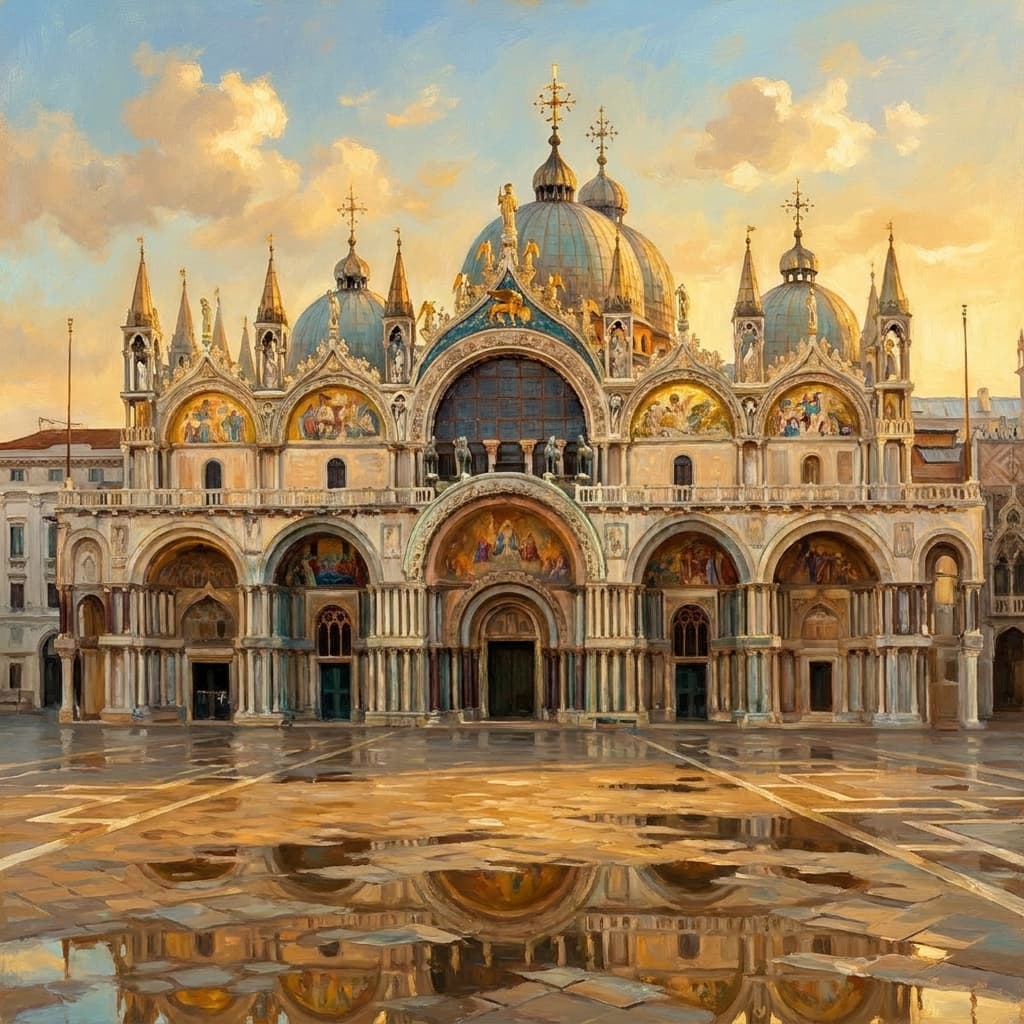
Visiting St. Mark's Basilica offers an unforgettable encounter with celestial Byzantine art and Catholic ceremonial heritage. The interior glows with extraordinary luminescence during midday lighting intervals when electric illumination ignites the golden vaults. Visitors should dress modestly and prepare for airport-style security before entering Piazza San Marco's crown jewel.
Highlights
- Dazzling central Ascension Dome mosaic depicting Christ seated upon a celestial rainbow
- The Pala d'Oro, an unequaled medieval altarpiece studded with nearly two thousand gems
- High Loggia dei Cavalli offering sweeping views across Piazza San Marco and the lagoon
- Intricate eleventh-century marble pavement undulating like ocean waves beneath the nave
Things to Know
- Strict dress code requires shoulders and knees to be entirely covered for entry
- Large luggage and backpacks are prohibited and must be checked on Calle San Basso
- Seasonal autumn and winter high tides can submerge the piazza, requiring elevated footbridges
- Flash photography is strictly prohibited throughout the sanctuary to protect delicate tesserae
Location
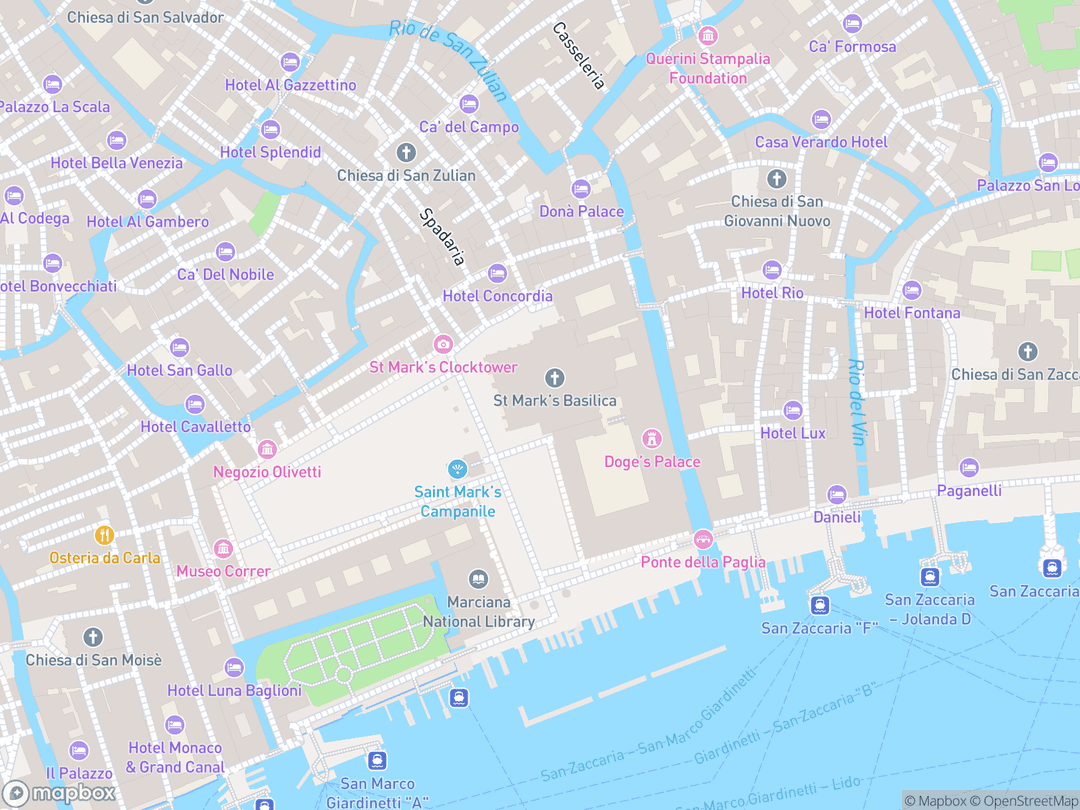
Piazza San Marco, 328, 30124 Venezia VE, Italy
Hours: Monday through Saturday 9:30 AM to 5:15 PM; Sundays and Holy Days 2:00 PM to 5:15 PM
Getting There: Take Actv vaporetto water bus Lines 1, 2, or 5.1 to San Zaccaria or San Marco Vallaresso, followed by a short walk to the piazza.
Get DirectionsTips for Your Visit
Optimal Illumination Hours
Visit on weekday mornings between 11:30 AM and 12:45 PM when the interior vault lights are switched on to experience the gold mosaics at full radiance.
Museum and Terrace Access
Book an integrated ticket for the Basilica Museum to inspect the original ancient gilded copper horses up close and access the exterior roof terrace.
Luggage Drop Off Early
Deposit backpacks at the free luggage facility in Calle San Basso before joining the primary security queue to avoid being turned away.
High Tide Navigation
Wear waterproof footwear during autumn storm surges and use the elevated wooden catwalks erected across Piazza San Marco.
About
St. Mark's Basilica stands as one of the most sublime architectural achievements of Christian civilization, bridging the theological cosmology of the Abrahamic traditions with Venetian civic majesty. Consecrated on October 8, 1094, the present basilica was conceived as both the personal chapel of the Doge of Venice and an inviolable reliquary shrine enshrining the body of Saint Mark the Evangelist.
Rooted in early Christian sacred geometry, the basilica's five-domed Greek cross layout evokes Justinian's 6th-century Church of the Holy Apostles in Constantinople. Over eight centuries, Venetian sea captains and crusaders enriched its brick mass with hundreds of antique marble columns, precious porphyry revetments, and looted imperial treasures, earning the sanctuary its timeless moniker, the 'Chiesa d'Oro' (Church of Gold).
Within Christian theology, the sanctuary functions as a physical icon of the New Jerusalem descending from heaven to earth. More than 8,500 square meters of shimmering gold ground mosaics blanket its vaults, narrating humanity's pilgrimage from the Genesis Creation through the Incarnation, Resurrection, and final heavenly triumph.
Elevated in 1807 to the cathedral seat of the Patriarch of Venice, St. Mark's remains a flourishing heart of Roman Catholic liturgy and an enduring monument to Venetian faith, resilience, and artistic communion between East and West.
Gallery
Symbolic Elements
The temple's exterior features intricate carvings, each rich with spiritual meaning:

Winged Lion of Saint Mark
Symbolizes Saint Mark and Christ's royal resurrection, brandishing the divine decree of peace over the Venetian Republic.
The Pala d'Oro
Glorifies the heavenly Jerusalem through nearly two thousand precious gems surrounding Christ Pantocrator in majesty.

The Triumphal Quadriga
Embodies classical imperial sovereignty appropriated by Venice following the Fourth Crusade as a emblem of divine triumph.

Portrait of the Four Tetrarchs
Carved from Egyptian porphyry to symbolize imperial unity, concord, and civic vigilance guarding the state threshold.

The Ascension Dome Mosaic
Depicts Christ rising to heaven on a celestial rainbow, illustrating the union of human nature with eternal divine glory.

Porta di Sant'Alipio Mosaic
Chronicles the thirteenth-century translation of Saint Mark's sacred relics through the basilica's monumental western portal.

Peacock Floor Inlays
Intertwined peacocks sipping from amphorae represent immortality and resurrection, rooted in early Christian theological symbolism.

Icon of Madonna Nicopeia
The Byzantine 'Bringer of Victory' icon venerated by the Venetian Senate as the heavenly patroness and protector of the city.
Interesting Facts
Venetian merchants smuggled Saint Mark's relics from Alexandria in 828 concealed beneath layers of salted pork to repel Muslim port inspectors. (Tier A)
Virtually all exterior marble columns, capitals, and porphyry panels were imported as spoils of war from Constantinople and the Levant. (Tier A)
A porphyry stone in the narthex floor commemorates where Emperor Frederick Barbarossa knelt in submission to Pope Alexander III in 1177. (Tier B)
The missing foot of the porphyry Four Tetrarchs statue was discovered in Istanbul in the 1960s, confirming its Constantinopolitan origin. (Tier A)
Napoleon Bonaparte plundered the basilica's treasury in 1797 and carted the famous four bronze horses to Paris before their return in 1815. (Tier A)
St. Mark's served exclusively as the private state chapel of the Doge for nearly a millennium before becoming Venice's cathedral in 1807. (Tier B)
Metallurgical analysis revealed the four horses are made of 98 percent pure copper rather than bronze to facilitate mercury fire-gilding. (Tier B)
During the 1094 consecration, Saint Mark's lost relics reportedly revealed themselves when a pillar masonry face miraculously cracked open. (Tier B)
The undulating waves of the interior marble floor are caused by centuries of uneven settlement into the lagoon's mud subsoil. (Tier B)
Laminated structural glass sea walls were installed around the narthex perimeter in 2022 to protect ancient mosaics from seasonal flooding. (Tier B)
Common Questions
Is St. Mark's Basilica an active Roman Catholic church?
Yes, it is the active cathedral of the Patriarch of Venice, hosting regular daily Masses, confessions, and choral liturgies.
Why is the floor of the basilica uneven and wavy?
Centuries of differential settlement of the heavy masonry columns into the soft mud beneath the wooden piles caused the floor to undulate.
Are the bronze horses on the exterior facade the original statues?
No, the statues on the exterior loggia are bronze replicas, while the ancient copper originals are preserved in the museum.
What is the best time of day to view the interior gold mosaics?
The mosaics are best viewed on weekday mornings between 11:30 AM and 12:45 PM when full interior electric lighting is activated.
Featured Stories
The Clandestine Journey from Alexandria
828
In 828, Venetian merchants Buono da Malamocco and Rustico da Torcello resolved to rescue Saint Mark's earthly remains from Alexandria. They concealed the sacred body beneath cabbage leaves and pickled pork, causing inspecting Muslim customs officers to withdraw in disgust. The ship reached the Venetian lagoon unhindered, forever tying the spiritual destiny of the Republic to the Evangelist.
Source: Translatio Sancti Marci Chronicles
The Imperial Submission of Frederick Barbarossa
July 24, 1177
Amid the grand peace negotiations ending open warfare between the Holy Roman Empire and the Papacy, Emperor Frederick Barbarossa entered the basilica's narthex. Overwhelmed by the sacred atmosphere and ecclesiastical authority, the proud Hohenstaufen monarch shed his imperial mantle and knelt before Pope Alexander III. A red porphyry lozenge in the vestibule floor marks the exact threshold of this historic submission.
Source: Civic Records of the Venetian Republic
The Miraculous Revelation of the Hidden Relics
October 8, 1094
Following the catastrophic fire of 976, the precise location of Saint Mark's secret hiding chamber had been lost to public memory. During the 1094 reconsecration ceremonies, the assembled populace joined Doge Vitale Falier in three days of communal fasting and prayer. According to tradition, a pillar in the right aisle suddenly fractured, revealing the coffin of the Apostle amidst an ethereal fragrance.
Source: Archival Records of the Procuratoria di San Marco
Timeline
Translation of Saint Mark's Relics
Venetian merchants transport the body of Saint Mark from Alexandria to Venice, establishing the Evangelist as patron saint.
MilestoneDedication of the First Basilica
The original stone ducal church is completed and consecrated under Doge Giovanni I Participazio.
DedicationDestructive Ducal Insurrection
A civic revolt against Doge Pietro IV Candiano ignites a fire that severely damages the first basilica structure.
EventReconstruction of the Second Church
Doge Pietro I Orseolo repairs structural damage and restores regular liturgical rites within the repaired sanctuary.
RenovationInitiation of the Monumental Third Basilica
Doge Domenico I Contarini launches the complete rebuilding on a grand five-domed Byzantine Greek cross plan.
MilestoneSolemn Consecration and Inventio
The completed brick basilica is formally consecrated under Doge Vitale Falier as Saint Mark's relics are rediscovered.
component.timeline.consecrationPeace of Venice Reconciliation
Emperor Frederick Barbarossa kneels before Pope Alexander III in the narthex, concluding years of imperial-papal war.
MilestoneFourth Crusade Imperial Spolia
Venetian forces bring home the Triumphal Quadriga, the Four Tetrarchs, and hundreds of classical marble columns.
MilestoneErection of Bulbous Outer Domes
Timber-framed lead-covered cupolas are added atop the lower brick vaults to magnify the basilica's silhouette.
RenovationEnrichment of the Pala d'Oro
Goldsmith Gian Paolo Bonesegna refashions the high altar retable into a breathtaking Gothic jewel-encrusted masterpiece.
RenovationJacopo Sansovino Named Chief Architect
Renaissance master Jacopo Sansovino assumes the role of Proto, stabilizing dome settlements and crafting bronze sacristy doors.
MilestoneElevation to Patriarchal Cathedral
Napoleon decrees the transfer of the Patriarchal seat from San Pietro di Castello to St. Mark's Basilica.
MilestoneInstallation of Protective Glass Barriers
Engineers erect transparent armored perimeter walls to shield the fragile narthex floor from rising lagoon waters.
RenovationHistory by Decade
820s–890s — Foundation and First Ducal Chapel
Following the daring acquisition of Saint Mark's relics from Alexandria in 828, Doge Giustiniano Participazio directed the construction of a permanent sanctuary. Dedicated in 832, this initial stone church replaced Saint Theodore with Saint Mark as Venice's spiritual guardian. The structure functioned as an exclusive palatine chapel physically joined to the Doge's fortress residence.
970s–990s — The Great Conflagration and Second Basilica
A violent popular revolt against the tyrannical Doge Pietro IV Candiano in 976 set the ducal palace ablaze, spreading infernos into the adjacent church. The original timber roofs and artistic treasures were gutted by flames. Doge Pietro I Orseolo immediately sponsored a comprehensive rebuild, dedicating his personal fortune to reconstruct the sanctuary's stone walls and liturgical heart.
1060s–1090s — Monumental Byzantine Reconstruction
In 1063, Doge Domenico I Contarini ordered the complete razing and redevelopment of the church on an imperial scale inspired by Constantinople's Church of the Holy Apostles. Byzantine architects laid out a five-domed Greek cross footprint using solid brick masonry. Consecrated on October 8, 1094 under Doge Vitale Falier, this monumental building established the core architectural skeleton that survives today.
1200s–1260s — Fourth Crusade Spolia and Outer Domes
Venice's capture of Constantinople during the Fourth Crusade in 1204 flooded the city with imperial treasures, sculptures, and rare marbles. Builders encrusted the bare brick facade with hundreds of ancient foreign columns and erected the famous lead-clad bulbous outer domes to crown the lagoon skyline. The narthex Old Testament mosaic cycle was meticulously created during this golden era of civic expansion.
1340s–1450s — Gothic Embellishments and the Pala d'Oro
During the fourteenth and fifteenth centuries, the basilica underwent opulent ornamental transformations overseen by master Venetian goldsmiths and Gothic stonemasons. Gian Paolo Bonesegna redesigned the Pala d'Oro altarpiece in 1345, setting hundreds of Byzantine enamels into Gothic traceries. Master sculptors Niccolò and Pietro Lamberti subsequently crowned the upper exterior balustrade with flamboyant foliage, pinnacles, and statues of the Evangelists.
1520s–1580s — Renaissance Fortification and Master Artists
The appointment of Jacopo Sansovino as Proto in 1529 launched a critical era of Renaissance engineering and structural reinforcement. Sansovino inserted heavy iron tie-rods to stabilize spreading arches and cast bronze masterworks for the presbytery. Eminent High Renaissance painters Titian, Tintoretto, and Veronese provided dramatic compositional cartoons to renew deteriorated medieval mosaics across the central vaults.
1790s–1810s — Fall of the Republic and Patriarchal Cathedral
The fall of the Venetian Republic to Napoleon Bonaparte in 1797 devastated the basilica's sovereign standing, resulting in the looting of its treasury and the temporary removal of the four horses to Paris. In 1807, Napoleon reorganized Venetian diocesan boundaries, closing the ancient cathedral of San Pietro di Castello and elevating St. Mark's to the official patriarchal cathedral. The return of the quadriga in 1815 restored the city's beloved civic icons to their loggia.
1960s–2020s — Safeguarding the Church of Gold from High Tides
The catastrophic 1966 high tide surged 194 centimeters through Venice, drowning the crypt in corrosive seawater and spurring international safeguarding initiatives. Another devastating flood in November 2019 accelerated long-term engineering defenses, leading to the activation of the MOSE lagoon tidal gates. In 2022, transparent armored glass walls were completed around the narthex perimeter, effectively insulating the priceless marble pavements against destructive storm surges.
Architecture & Facilities
St. Mark's Basilica represents an extraordinary synthesis of Byzantine structural geometry, Western Romanesque spatial massing, and Venetian Gothic ornamentation. Built upon a centralized Greek cross plan featuring five monumental domes, the design translates the celestial architecture of Constantinople into an opulent Latin rite sanctuary clad in foreign spolia and radiant gold ground mosaics.
Building Materials
Petrified Timber Foundations
Hundreds of thousands of petrified alder and oak piles driven deep into the lagoon subsoil to support the masonry.
Roman-Format Brick Core
Dense kiln-fired brickwork laid with hydraulic pozzolana mortar forming the primary structural domes, arches, and piers.
Imperial Stone Revetment
Book-matched slabs of Proconnesian marble, Thessalian green serpentine, and Egyptian red porphyry imported from the Mediterranean.
Gold Leaf Glass Tesserae
Millions of hand-cut glass cubes sandwiching microscopic 24-karat gold leaf angled precisely to reflect ambient candlelight.
Interior Features
The Narthex Vestibule
A low barrel-vaulted entryway clad in thirteenth-century Genesis mosaics introducing the biblical covenants of the Old Testament.
The Central Ascension Dome
A soaring golden cupola portraying the ascending Christ surrounded by the Virgin Mary, angels, and the Twelve Apostles.
The Elevated Presbytery
The sacred sanctuary housing the high altar, the tomb of Saint Mark, and the fourteenth-century marble iconostasis.
The Romanesque Crypt
A vaulted subterranean chamber resting on marble columns that historically safeguarded the relics of the Evangelist.
Temple Grounds
The basilica opens directly onto Piazza San Marco and Piazzetta dei Leoncini, commanding the civic heart of Venice adjacent to the Doge's Palace.
Additional Facilities
The complex incorporates Saint Mark's Museum, the High Loggia terrace, the Historic Treasury of spolia reliquaries, and administrative offices of the Procuratoria di San Marco.
Religious Significance
Within the broader Abrahamic and Christian theological tradition, a consecrated sanctuary embodies the meeting place of heaven and earth, echoing the biblical tabernacle where divine glory dwells among humanity. St. Mark's Basilica expresses this theology by leading worshippers through the Old Testament covenants depicted in the narthex into the celestial radiance of Christ's New Covenant beneath the golden domes.
To serve as the cathedral seat of the Patriarch of Venice, the apostolic reliquary of Saint Mark the Evangelist, and the spiritual fountainhead of the Venetian archdiocese.
Sacred Ordinances
The Holy Sacrifice of the Mass
Daily celebration of the Roman Catholic Eucharist at the high altar presbytery and the Chapel of the Madonna of Nicopeia.
Liturgy of the Hours
The rhythmic recitation of the Divine Office by the Cathedral Chapter of Canons echoing through the marble choir stalls.
Sacrament of Reconciliation
Continuous administration of sacramental confession offered in multiple languages for local parishioners and international pilgrims.
Solemn Consecration and Benediction
Episcopal consecrations and patriarchal blessings conferred during the historic Feasts of Saint Mark and the Redentore.
The Apostolic Legacy of Saint Mark
As the traditional author of the second Gospel, Saint Mark bridges the apostolic witness of Peter with the Gentile nations. Venice's custody of his relics established the city as an apostolic see in spiritual prestige, inspiring generations of maritime believers to seek his heavenly intercession.
The Golden Theology of Divine Light
Drawing deeply from Eastern Christian patristic theology, the basilica's gold mosaics do not merely decorate physical surfaces; they materialize the uncreated light of God. The tesserae reflect natural and liturgical illumination, reminding the faithful that through Christ humanity is transfigured into eternal life.
Sources & Research
Every fact on Temples.org is backed by verified Sources & Research. Each piece of information is rated by source tier and confidence level.
View All Sources (10)
| Field | Source | Tier | Retrieved |
|---|---|---|---|
| About & Historical Background | History Hit (opens in a new tab) | A | 2026-02-15 |
| Core Dimensions & Coordinates | Wikidata (opens in a new tab) | B | 2026-02-15 |
| Byzantine Liturgical Architecture | Mainly Museums (opens in a new tab) | A | 2026-02-15 |
| Apostolic Relics & Foundation | Marefa Archive (opens in a new tab) | A | 2026-02-15 |
| Historical Timeline & Eras | Encyclopaedia Britannica (opens in a new tab) | B | 2026-02-15 |
| Sanctuary Redesign & Pala d'Oro | Caffè Florian Cultural Archive (opens in a new tab) | C | 2026-02-15 |
| Tetrarchs & Classical Spolia | Gemarkt (opens in a new tab) | C | 2026-02-15 |
| Interior Pavement & Spolia Inlays | Tuscany Now & More (opens in a new tab) | D | 2026-02-15 |
| Exterior Mosaics & Portal Reliefs | Venice Museum (opens in a new tab) | D | 2026-02-15 |
| Structural Dimensions & Mosaic Surface | The Tour Guy (opens in a new tab) | D | 2026-02-15 |