Visitor Insights
Visiting Temple of Vesta & House of the Vestals
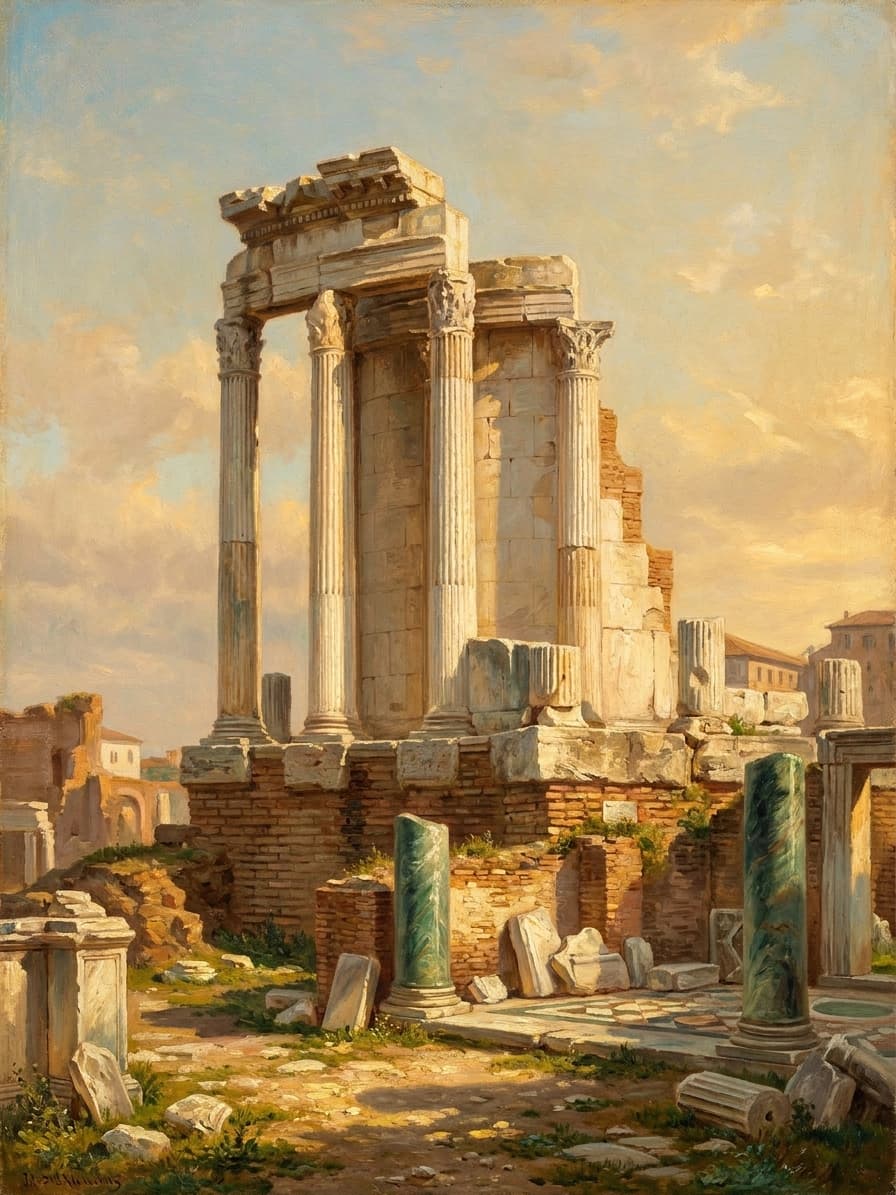
Located at the eastern edge of the Roman Forum near the foot of the Palatine Hill, the Temple of Vesta is easily identified by its partially re-erected circular colonnade and adjacent reflecting pools. Visitors can walk through the expansive courtyard of the Atrium Vestae to inspect the pedestals of the Chief Vestals.
Highlights
- Three re-erected Corinthian marble columns and entablature restored via 1930 anastylosis.
- The rectangular central courtyard of the Atrium Vestae featuring open-air water basins.
- Inscribed statue bases honoring high-ranking Virgines Vestales Maximae.
- Elevated scenic viewpoint looking down onto the sanctuary from the Palatine Hill terrace.
Things to Know
- The site consists of open-air ruins with limited direct shade during peak summer hours.
- Pathways across the ancient Forum feature uneven basalt cobblestones and gravel.
- The inner sanctuary area is fenced off for archaeological preservation.
Location
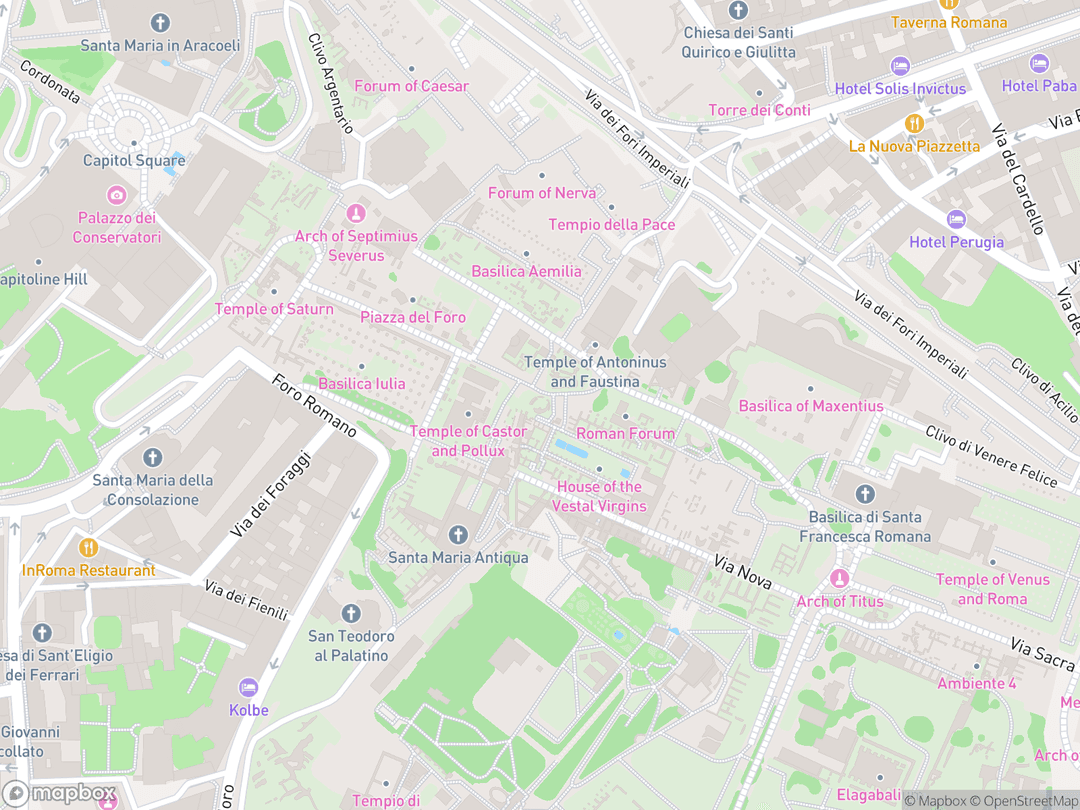
Via Sacra, Forum Romanum, 00186 Rome, Italy
Hours: Daily 8:30 AM until 1 hour before sunset (closed Jan 1 and Dec 25).
Getting There: Metro Line B to Colosseo station, followed by a 5-minute walk along Via dei Fori Imperiali to the Forum entrance.
Get DirectionsTips for Your Visit
Best Photo Angle
Ascend to the Palatine Hill overlook directly above the temple for a bird's-eye view of the circular cella and courtyard pools.
Avoid Misidentification
Do not confuse this shrine with the round Temple of Hercules Victor in the Forum Boarium near the Tiber River.
Combine Tickets
Standard Forum tickets include entry to the Colosseum and Palatine Hill valid for a single day.
About
The Temple of Vesta (Aedes Vestae) and the adjacent House of the Vestals (Atrium Vestae) formed the spiritual heart of ancient Rome. Situated along the Via Sacra in the Roman Forum, this sanctuary housed the sacred eternal flame of Vesta, the goddess of the hearth. Roman state theology held that as long as the sacred fire burned, the Roman state would endure.
Uniquely designed as a circular tholos to honor primitive Latin hearth huts, the sanctuary was guarded by six Vestal Virgins. Chosen in childhood from patrician families, these priestesses maintained strict vows of chastity while holding extraordinary legal independence. Behind the temple's cella lay the Penus Vestae, a secret sanctum holding Rome's most venerated protective relics, including the mythological Palladium.
Although repeatedly damaged by catastrophic fires over more than a millennium, the complex was rebuilt by emperors and empresses, culminating in the Severan marble restoration of AD 191–205. Forced to close when Emperor Theodosius I banned pagan rites in AD 394, the ruins remain one of the most evocative archaeological landmarks of classical civilization.
Gallery
Symbolic Elements
The temple's exterior features intricate carvings, each rich with spiritual meaning:

Sacred Hearth Fire
The perpetual flame representing the eternal life and civilizational survival of the Roman state.

Palladium of Troy
An archaic wooden image of Athena believed to have been brought from Troy by Aeneas as a divine pledge of empire.

Mola Salsa Paste
Sacred salted grain paste prepared by the Vestals for sprinkling over state animal sacrifices.

Circular Tholos Architecture
A round floor plan honoring primitive Latin family hearth huts from the founding era of Rome.

Suffimen Purifying Substance
Purification mixture made from calf ashes and horse blood used during the annual Parilia festival.

Reflecting Pools of the Atrium
Central water basins providing cooling and ritual washing space inside the Vestals' courtyard.

Vestal Statue Pedestals
Inscribed marble bases recording the civic virtues and religious devotion of Chief Vestals.

Conical Oculus Roof
A pointed roof vent allowing smoke from the continuous hearth fire to escape skyward.
Interesting Facts
In ancient Roman ritual law, the building was an 'aedes sacra' rather than an inaugurated 'templum' to prevent political meetings inside. (Tier A)
Vestal Virgins were the only women in Rome completely freed from male legal authority under patria potestas. (Tier A)
A condemned criminal who accidentally met a Vestal Virgin on the way to execution was instantly pardoned. (Tier A)
Breaking the 30-year vow of chastity was punished by burying the offender alive at the Campus Sceleratus. (Tier B)
Prominent Romans like Julius Caesar deposited confidential state wills inside the temple for divine protection. (Tier B)
The temple was swept clean during the annual Vestalia festival, and dirt was ritually cast into the Tiber River. (Tier B)
One statue pedestal in the Atrium has a name chiseled away, likely erasing a Vestal who converted to Christianity. (Tier A)
The standing columns seen by modern tourists were reassembled in 1930 using archaeological anastylosis. (Tier A)
Renaissance artists frequently confused this shrine with the round Temple of Hercules Victor near the Tiber. (Tier B)
When the flame was extinguished in AD 394, it had burned continuously for over 1,100 years. (Tier A)
Common Questions
Why is the Temple of Vesta round?
Its circular tholos shape honors primitive 8th-century BC Latin huts where early communities gathered around central hearth fires.
Who were the Vestal Virgins?
Six priestesses selected in childhood who served 30-year vows guarding the sacred flame and state relics.
Is the temple still standing?
Part of the podium, cella wall, and three Corinthian columns were reassembled in 1930 and remain standing in the Roman Forum.
Where was the secret Palladium kept?
Inside the Penus Vestae, a windowless inner room beneath or behind the cella that was closed to the public.
Can visitors walk inside the House of the Vestals?
Yes, visitors can walk through the open-air courtyard and examine the statue pedestals of the Chief Vestals.
Featured Stories
The Heroism of Lucius Caecilius Metellus
241 BC
When a raging fire engulfed the Roman Forum in 241 BC, the blaze threatened to consume the sacred Penus Vestae and the Palladium. High Priest Lucius Caecilius Metellus charged into the burning cella without hesitation, rescuing the ancient talisman at the cost of his own eyesight, an act of supreme devotion honored by the Senate.
Source: Parco Archeologico del Colosseo Historic Archives
The Extinguishing of the Eternal Flame
394
In AD 394, Emperor Theodosius I issued a decree banning traditional pagan worship across the empire. Imperial officers entered the sanctuary, forcibly extinguished the eternal fire after eleven centuries, and disbanded the Vestal order, a moment contemporaries viewed as the symbolic end of the classical Roman era.
Source: Soprintendenza Speciale Archeologia di Roma
The Anastylosis of 1930
1930
During archaeological interventions in the Roman Forum in 1930, Italian architects gathered marble fragments from the Severan reconstruction scattered near the podium. Using precision anastylosis techniques, they re-erected three Corinthian columns and a section of the entablature, creating the iconic silhouette visible to travelers today.
Source: Capitoline Museums Cultural Heritage Archive
Timeline
Monarchic Foundation
King Numa Pompilius establishes the state cult of Vesta and builds the original circular sanctuary.
MilestoneGallic Evacuation
The Vestal Virgins rescue the eternal fire and sacred relics during the Senones Gallic sack of Rome.
EventFirst Republican Fire
Lucius Caecilius Metellus saves the sacred Palladium from a burning sanctuary, losing his eyesight.
EventSecond Republican Fire
Citizens save the shrine from destruction, leading to a major restoration in tufa and travertine.
RenovationAugustan Marble Cladding
Emperor Augustus assumes the role of Pontifex Maximus and thoroughly clads the shrine in white marble.
RenovationGreat Fire of Rome
Nero rebuilds the temple and expands the House of the Vestals into a grand palace complex.
RenovationSeveran Reconstruction
Empress Julia Domna commissions the final Corinthian tholos overhaul following a catastrophic blaze.
DedicationExtinction of the Flame
Emperor Theodosius I disbands the Vestal order and forcibly extinguishes the eternal hearth fire.
EventRenaissance Quarrying
Marble cladding and intact columns are dismantled under Papal decree to supply Renaissance lime kilns.
EventArchaeological Excavation
Archaeologist Rodolfo Lanciani fully unearths the courtyard and residential suites of the Atrium Vestae.
EventPartial Anastylosis
Architects re-erect three Corinthian columns, a section of the frieze, and the cella wall fragment.
RenovationHistory by Decade
8th–6th Century BC — Regal Origins
According to early historical tradition, King Numa Pompilius founded the state hearth of Vesta near the royal residence to unify Rome's early tribes. The early building was a round wattle-and-daub hut thatched with reeds, reflecting archaic Latin domestic homes.
5th–3rd Century BC — Republican Trials
Throughout the Roman Republic, the temple suffered repeated burnings due to the open hearth inside. Following the Gallic invasion of 390 BC and the fire of 241 BC, the sanctuary was repeatedly rebuilt on its original circular footprint using durable tufa and travertine.
1st Century BC–1st Century AD — Imperial Cladding
Emperor Augustus transformed the sanctuary into a grand imperial monument by cladding its walls in Carrara marble in 12 BC. After the Great Fire of AD 64, Emperor Nero reconstructed the Atrium Vestae into a luxury residential palace equipped with porticos and fountains.
2nd–3rd Century AD — The Severan Golden Era
Following a ruinous fire in AD 191, Empress Julia Domna orchestrated a complete reconstruction finished around AD 205. This campaign produced the elegant Corinthian peristyle and expanded two-story residency whose concrete podium and marble bases remain visible today.
4th–15th Century AD — Closure and Dismantling
In AD 394, Emperor Theodosius I abolished the order, ending over eleven centuries of sacred worship. Stripped of its state protection, the abandoned complex fell into decay, and by 1549 papal builders systematically quarried its fine marble for Renaissance churches.
19th–20th Century — Unearthing and Restoration
Systematic excavations began in 1883, uncovering the statue galleries of the Chief Vestals. In 1930, Italian conservators reassembled fragments of the Severan colonnade using anastylosis, creating the iconic partial tholos standing today.
Architecture & Facilities
Classical Greek-inspired Roman tholos architecture featuring a circular peripteral colonnade surrounding a inner cella on an elevated podium, designed to recall archaic Latin round huts.
Building Materials
Podium Core
Dense Roman concrete faced with thick slabs of white marble.
Colonnade Columns
Fluted Corinthian shafts sculpted from Proconnesian and Carrara marble.
Residency Courtyard
Cipollino green marble pillars framing central reflecting pools.
Interior Paving
Polished polychrome marble opus sectile tile patterns.
Interior Features
Sacred Hearth
Central brazier containing the continuously burning eternal flame of Vesta.
Penus Vestae
Windowless inner sanctum housing Rome's secret protective state talismans.
Atrium Courtyard
Elongated garden surrounded by statue pedestals honoring Chief Vestals.
Vestal Suites
Multi-room private quarters featuring hypocaust underfloor heating systems.
Temple Grounds
Situated along the Via Sacra, flanked by the Regia, the Temple of Castor and Pollux, and the steep slope of the Palatine Hill.
Additional Facilities
Public pathways through the Roman Forum archaeological park provide viewing areas around the entire outer perimeter.
Religious Significance
The Temple of Vesta served as the symbolic domestic hearth for the entire Roman civilization. Roman religious tradition held that the continuous burning of the sacred flame maintained the covenant between Rome and the gods (pax deorum).
To maintain the eternal hearth fire, safeguard Rome's secret protective relics, and prepare purifying substances for state religious rituals.
Sacred Ordinances
Tending the Eternal Flame
Continuous day-and-night watch maintained by the Vestal Virgins to ensure the fire never went out.
Ritual Rekindling
Annual extinguishing and rekindling of the hearth on March 1 using primitive wood friction.
Preparation of Mola Salsa
Thrice-yearly preparation of sacred salted spelt paste for state animal sacrifices.
Vestalia Cleanse
Annual June cleaning of the sanctuary ending with the ritual disposal of sacred sweepings into the Tiber.
Legal and Social Status of the Vestals
The six Vestal Virgins enjoyed unique legal rights in Roman society, including freedom from male guardianship, financial independence, and executive power to pardon condemned criminals.
The Secret Relics (Pignora Imperii)
Stored within the hidden Penus Vestae, seven sacred talismans were kept guarded from public view to ensure the eternal security of the Roman state.
Sources & Research
Every fact on Temples.org is backed by verified Sources & Research. Each piece of information is rated by source tier and confidence level.
View All Sources (7)
| Field | Source | Tier | Retrieved |
|---|---|---|---|
| About & Historical Background | Parco Archeologico del Colosseo (opens in a new tab) | A | 2026-01-30 |
| Architecture & Structural Layout | UNESCO World Heritage Centre (opens in a new tab) | B | 2026-01-30 |
| Architecture & Structural Layout | Perseus Digital Library - Tufts University (opens in a new tab) | B | 2026-01-30 |
| Symbolism & Religious Significance | Journal of Roman Studies - Cambridge University Press (opens in a new tab) | B | 2026-01-30 |
| Timeline & Historical Eras | Bryn Mawr Classical Review (opens in a new tab) | B | 2026-01-30 |
| Visitor Insights & Access | Capitoline Museums Cultural Heritage Archive (opens in a new tab) | A | 2026-01-30 |
| Visitor Insights & Access | Vanderbilt Digital Humanities Roman Forum Project (opens in a new tab) | B | 2026-01-30 |