Visitor Insights
Visiting Ryōan-ji
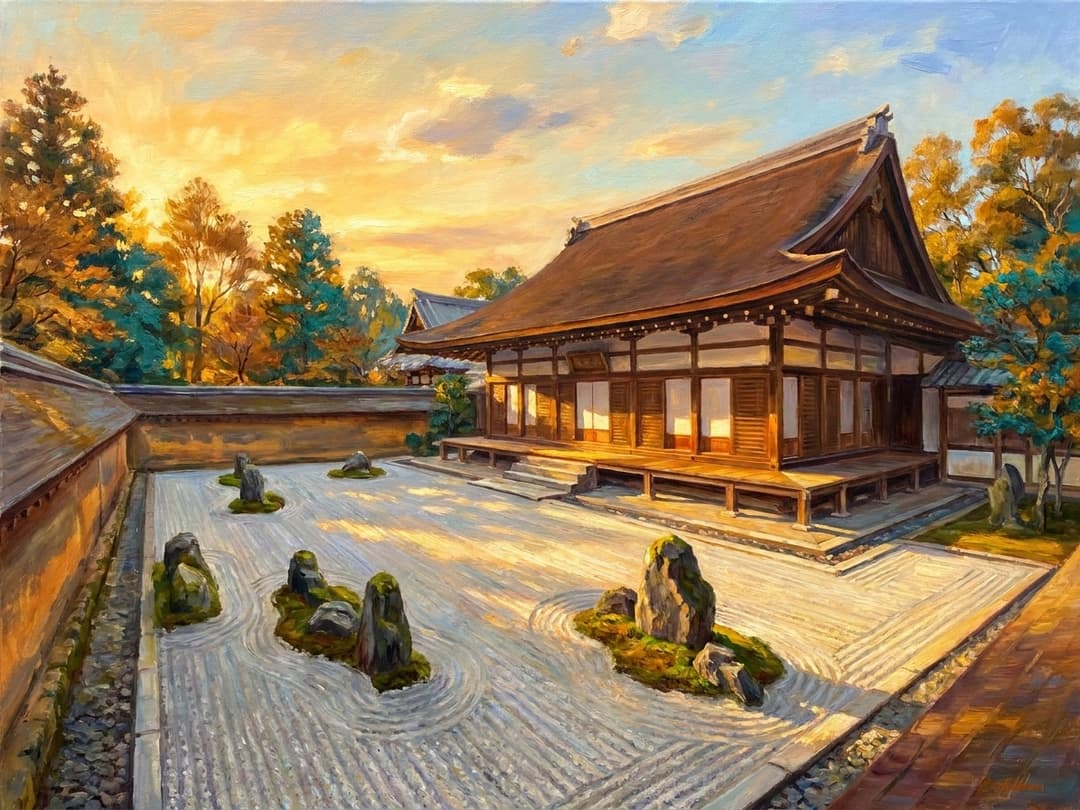
Ryōan-ji offers an exceptional encounter with contemplative Zen aesthetics across both stark mineral courts and verdant pond grounds. Visitors find the most profound tranquility by sitting along the southern veranda of the Abbot's Quarters during the morning hours.
Highlights
- Contemplating the famous dry landscape garden from the polished wooden veranda.
- Deciphering the clever philosophical riddle inscribed on the replica tsukubai water basin.
- Strolling the circuitous pathways around the water lily-covered Kyōyōchi Pond.
Things to Know
- Footwear must be removed upon entering the Kuri before stepping onto the temple verandas.
- Stepping onto the raked gravel garden is strictly prohibited at all times.
- Arrive near the morning opening hour to experience the rock garden without crowds.
Location
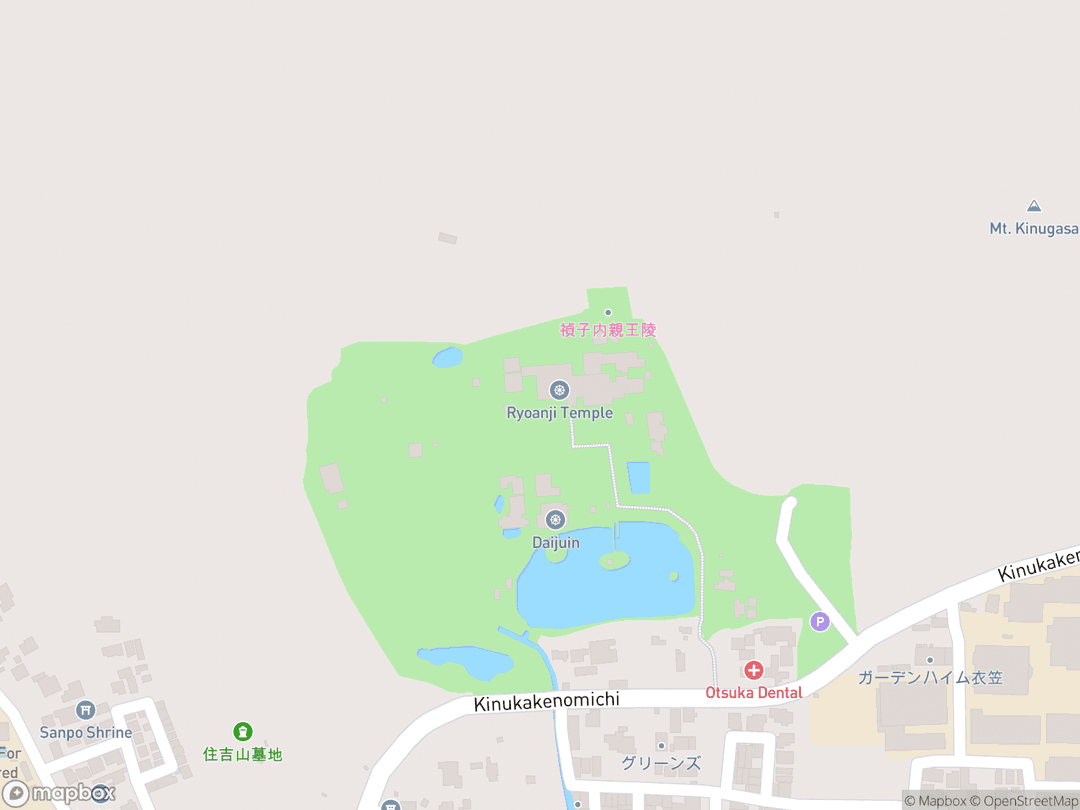
13 Ryoanji Goryonoshitacho, Ukyo Ward, Kyoto, Kyoto Prefecture 616-8001, Japan
Hours: 8:00 AM – 5:00 PM (March–November), 8:30 AM – 4:30 PM (December–February)
Getting There: Take the Keifuku Randen tram to Ryōanji Station and walk 7 minutes north, or take Kyoto City Bus Line 59 directly to the Ryoanji-mae stop.
Get DirectionsTips for Your Visit
Morning Lighting
Visit at opening time when angled sunlight accentuates the ripples raked into the granitic sand.
Rainy Day Contemplation
Light rain darkens the fifteen rocks into rich charcoal hues and enlivens the verdant moss borders.
Walking the Silk Road
Combine your pilgrimage with Kinkaku-ji by walking 20 minutes along the scenic Kinukake-no-Michi.
About
Ryōan-ji stands as the pinnacle of Rinzai Zen Buddhist landscape art within the Dharmic continuum. Rooted in the ancient Indian philosophical traditions of saṃsāra and karma, it uniquely directs spiritual seekers toward liberation through direct, experiential intuition rather than scholarly abstraction. The sanctuary embodies the Mahāyāna revelation that form and emptiness are inseparable.
Established in 1450 by Hosokawa Katsumoto, the temple preserves the renowned karesansui dry landscape courtyard. Rather than using lush flora, the garden strips physical nature down to mineral rock, granitic quartz gravel, and moss cushions. This stark environment functions as an architectural kōan designed to quiet the conceptual mind.
Complementing the austere upper rock garden is the lower precinct featuring the Heian-era Kyōyōchi Pond. This deliberate dialogue between stark mineral void and verdant seasonal nature creates a multifaceted setting where pilgrims experience the living truth of impermanence (anitya) and interdependent arising.
Gallery
Symbolic Elements
The temple's exterior features intricate carvings, each rich with spiritual meaning:

Fifteen Boulders
Natural volcanic stones representing completion in lunar numerology, deliberately masked so human sight cannot capture all fifteen simultaneously.

Raked Shirakawa Gravel
Light-gray granitic quartz sand representing the pregnant void of śūnyatā and the ocean of cosmic consciousness.

The Tsukubai Basin
A stone purification reservoir displaying a four-character visual puzzle teaching the Buddhist virtue of self-sufficiency.

Abura-bei Earthen Wall
An oil-tempered clay wall whose organic weathering exemplifies the wabi-sabi appreciation of impermanence and age.

Engawa Viewing Veranda
A broad cedar platform under sheltering eaves designed to frame perception downward onto the stones while excluding outer distractions.

Kyōyōchi Mirror Pond
A serene Heian water body reflecting seasonal change and anchoring the lush terrestrial counterpart to the dry garden.

Benzaiten Islet
A verdant island sanctuary within the pond dedicated to the Buddhist guardian goddess of water, wisdom, and the arts.
Interesting Facts
A 2002 computational study in Nature showed the garden's visual negative space converges on a tree shape centered on the Abbot's seat (Tier B).
Carved into one boulder are the names Kotarō and Hikojirō, indicating marginalized medieval riverbed craftsmen helped sculpt the terrace (Tier B).
The surrounding clay wall owes its warm amber patina to boiled rapeseed oil mixed into the earth over five centuries ago (Tier A).
Avant-garde composer John Cage traced the contours of Ryōan-ji's stones to write an entire microtonal music series (Tier B).
The southern perimeter wall subtly slopes downward toward the west to generate a forced perspective making the court seem larger (Tier B).
For its first three centuries, Ryōan-ji was famed for duck watching on Kyōyōchi Pond rather than for its dry landscape terrace (Tier B).
The famous stone water basin displayed in the courtyard is an exact replica, while the 17th-century original is safely sequestered (Tier A).
Queen Elizabeth II's quiet contemplation of the stones in 1975 triggered a massive domestic and international tourism wave (Tier B).
Common Questions
Why is one of the fifteen rocks always hidden from view?
The deliberate arrangement ensures viewers realize conceptual perception is inherently incomplete, requiring internal enlightenment to perceive wholeness.
Who was the architect or designer of the rock garden?
The original designer remains officially unrecorded, though scholars suspect collaboration between Zen masters and riverbed stonemasons.
What does the inscription on the stone water basin mean?
The four kanji share a central square mouth radical and translate as 'I know only sufficiency' or contentment.
How often is the gravel garden raked by the monks?
Monastic caretakers rake the gravel every morning before gates open as a mindful meditative discipline.
Featured Stories
The Royal Contemplation of 1975
May 1975
When Queen Elizabeth II paid a state visit to Japan in 1975, she chose to sit in undisturbed silence along Ryōan-ji's cedar veranda. Her genuine praise of its radical simplicity captivated Japanese broadcasters and introduced the temple's austere Zen aesthetic to a worldwide modern audience. This single diplomatic moment transformed the monastery from a quiet scholarly retreat into a global icon of contemplative architecture.
Source: Kyoto City Official Cultural Archives
The Hidden Riverbed Artisans
1488
While imperial records traditionally ascribed the garden's balance to high-born aristocrats or painters, the reverse side of a central boulder tells a deeper human tale. Incised into the stone are the personal names Kotarō and Hikojirō, marking the labor of medieval riverbed craftspeople who endured outcast social status while composing the world's most refined arrangement of form. Their enduring stonework quietly dismantled the rigid caste hierarchies of medieval Japan.
Source: Kyoto Municipal Heritage Board
The Phoenix of the Seigen-in Hall
1800
In 1797, a catastrophic blaze swept across the temple mountain, reducing the historic 1499 Abbot's Quarters to cinder while miraculously sparing the dry garden. Unwilling to leave the sacred viewing terrace abandoned, the monastic community dismantled an entire 1606 hall from the nearby Seigen-in hermitage and transported every heavy cedar timber by hand. Their tireless preservation effort provided the rock garden with its permanent architectural partner for centuries to come.
Source: Rinzai Zen Head Temple Myōshin-ji Chronicles
Timeline
Tokudaiji Estate Establishment
The Fujiwara clan establishes an aristocratic villa and excavates the sprawling Kyōyōchi Pond.
MilestoneFounding of Ryōan-ji
Deputy Shōgun Hosokawa Katsumoto converts the mountain estate into a Rinzai Zen monastery.
DedicationDestruction in Ōnin War
The temple is consumed by fire during the outbreak of devastating factional warfare across Kyoto.
EventMonastic Reconstruction
Hosokawa Masamoto rebuilds the sanctuary and commissions the renowned dry landscape rock terrace.
RenovationCompletion of the Hōjō
Construction finishes on the Abbot's Quarters, creating the primary viewing veranda for the garden.
MilestoneToyotomi Hideyoshi Visit
The military leader visits the grounds, composes poetry on its blossoms, and grants land protections.
EventThe Great Kansei Fire
A catastrophic fire destroys the original Hōjō and Butsuden, though the rock garden survives undamaged.
EventRelocation of Replacement Hōjō
The 1606 hall from Seigen-in is dismantled and reconstructed at Ryōan-ji as its permanent main hall.
RenovationSpecial Place of Scenic Beauty
The Japanese government designates the rock garden as a National Special Place of Scenic Beauty.
MilestoneRoyal Visit of Queen Elizabeth II
Queen Elizabeth II tours the dry landscape garden, igniting widespread international acclaim.
EventUNESCO Inscription
Ryōan-ji is inscribed as a UNESCO World Heritage Site among the Historic Monuments of Ancient Kyoto.
MilestoneCypress Bark Roof Restoration
Craftsmen complete a meticulous rethatching of the Hōjō roof using traditional hiwada-buki techniques.
RenovationHistory by Decade
1180s — The Aristocratic Country Villa
During the late Heian period, the northern Fujiwara lineage developed the forested site into the Daiju-in country retreat. Nobles excavated the massive Kyōyōchi Pond for aristocratic boating excursions, seasonal cherry-blossom viewing, and classical poetry recitation.
1450s — Founding the Zen Mountain
Deputy Shōgun Hosokawa Katsumoto purchased the mountain estate in 1450 and consecrated it as a Rinzai monastery affiliated with Myōshin-ji. Zen master Giten Genshō took residence as the founding abbot, establishing monastic meditation disciplines on the slopes of Mount Kinugasa.
1470s — Ash of the Ōnin War
The devastating Ōnin conflict pitted Katsumoto against rival warlords, turning the newly established monastery into a fortified military command center. Fierce battles reduced the sanctuary halls to ash in 1467, leaving Katsumoto's son to oversee monastic reconstruction decades later.
1480s–1490s — Emergence of the Dry Landscape
Under Hosokawa Masamoto and Abbot Tokuhō Zenketsu, the monastic compound rose anew, culminating in the construction of the 1499 Abbot's Quarters. It was during this creative era that the celebrated dry landscape rock garden was arranged beside the residential hall.
1790s–1800s — Fire and Timber Relocation
The Great Fire of Kansei decimated the main sanctuary buildings in 1797, though the mineral rock garden survived unharmed. Monks painstakingly dismantled the 1606 Hōjō from the Seigen-in sub-temple and rebuilt it on site to serve as the new viewing pavilion.
1930s–1950s — Modern Architectural Rediscovery
Japanese modernists and international architects reevaluated the rock terrace as a masterpiece of spatial abstraction during the mid-twentieth century. The Japanese government designated it a Special Place of Scenic Beauty in 1954, securing stringent national preservation funding.
1970s–1990s — Global Icon and World Heritage
A 1975 state visit by Queen Elizabeth II ignited worldwide fascination with Ryōan-ji's minimalist rock formations. In 1994, the temple gained international protection when UNESCO inscribed it as a component of the Historic Monuments of Ancient Kyoto.
Architecture & Facilities
Ryōan-ji embodies the classical shoin-zukuri timber architectural tradition integrated with Zen monastic austerity. Its buildings utilize unadorned native timbers, sliding fusuma panels, and broad perimeter verandas that intentionally channel the observer's gaze across contemplative courtyard spaces.
Building Materials
Shirakawa Granitic Quartz Gravel
Weathered light-gray crushed stone drawn from the Shirakawa River basin that scatters daylight softly across the courtyard.
Natural Volcanic Boulders
Fifteen naturally sculpted, moss-encircled stones carefully balanced across five distinct compositional groupings.
Oil-Tempered Clay (Abura-bei)
Local earth kneaded with boiled rapeseed oil, yielding a warm amber patina that resists environmental weathering.
Hinoki Cypress Bark (Hiwada-buki)
Layers of dense native cypress bark hand-fastened with bamboo nails to form the main hall's gracefully curved hip-and-gable roof.
Interior Features
The Hōjō Main Hall
A relocated 1606 wooden pavilion divided into six tatami-mat rooms separated by painted sliding screens.
Six Tatami Chambers
Quiet ceremonial and meditation rooms containing minimalist furnishings and monochromatic ink-wash landscape paintings.
Engawa Outer Corridor
A polished wooden gallery running alongside the dry terrace that serves as the primary seating area for meditation.
Kuri Entrance Hall
A robust monastic storehouse featuring soaring open rafters and whitewashed gables that welcomes arriving visitors.
Temple Grounds
The grounds span nearly fifty acres across Mount Kinugasa, transitioning seamlessly between the austere upper courtyard of the dry rock terrace and the lower strolling park centered on the vast Heian-period Kyōyōchi Pond. Meandering paths wind beneath weeping willows, cryptomeria pines, and maple trees that burst into vibrant crimson every autumn.
Additional Facilities
The Zoroku-an tea house arbor sits secluded within the private garden quarters, housing the original historic tsukubai water basin donated by Tokugawa Mitsukuni.
Religious Significance
Ryōan-ji stands within the Dharmic spiritual family as a sublime monument to Rinzai Zen Buddhist practice. It translates the Indian philosophical realities of saṃsāra, karma, and liberation into a direct, non-verbal visual encounter with emptiness (śūnyatā).
To strip consciousness of conceptual clutter and awaken sudden intuitive enlightenment (satori) through the contemplation of pure form and spacious void.
Sacred Ordinances
Zazen (Seated Meditation)
Silent seated contemplation cultivating single-pointed awareness and insight into the non-dual nature of mind and world.
Kōan Contemplation
Meditation on paradoxical philosophical riddles that exhaust discursive intellect to trigger sudden awakening.
Samu (Physical Work Practice)
Daily manual tasks such as raking courtyard gravel, undertaken as rigorous mindful meditation without attachment.
Form and Emptiness
Drawing directly from the Heart Sutra's core teaching that 'form is emptiness, emptiness is form,' the garden refuses narrative representation. The gravel sea does not depict literal water, nor do the stones simply represent islands; rather, they present the interdependence of physical phenomena arising within pure awareness.
The Practice of Contentment
The temple's tsukubai basin reinforces the fundamental Buddhist path of overcoming craving (taṇhā). By contemplating the riddle of 'I know only sufficiency,' practitioners recognize that spiritual completion requires no external accumulation, but only the realization of one's innate Buddha-nature.
Sources & Research
Every fact on Temples.org is backed by verified Sources & Research. Each piece of information is rated by source tier and confidence level.
View All Sources (8)
| Field | Source | Tier | Retrieved |
|---|---|---|---|
| About & Historical Background | Daijizan Ryōan-ji Temple Official Registry (opens in a new tab) | A | 2026-03-31 |
| Historical Timeline & Monastic Lineage | Rinzai Zen Head Temple Myōshin-ji (opens in a new tab) | A | 2026-03-31 |
| Architecture & Facilities | Agency for Cultural Affairs, Government of Japan (opens in a new tab) | A | 2026-03-31 |
| Visitor Insights & Ground Regulations | Kyoto City Tourism Association (opens in a new tab) | C | 2026-03-31 |
| Heritage Inscription & Conservation | UNESCO World Heritage Centre (opens in a new tab) | B | 2026-03-31 |
| Visual Structure & Computational Studies | Nature International Journal of Science (opens in a new tab) | B | 2026-03-31 |
| Zen Aesthetics & Architectural History | Encyclopaedia Britannica (opens in a new tab) | B | 2026-03-31 |
| Visitor Logistics & Transit Routes | Japan-Guide Heritage & Travel Directory (opens in a new tab) | D | 2026-03-31 |