Visitor Insights
Visiting Sefa-Utaki
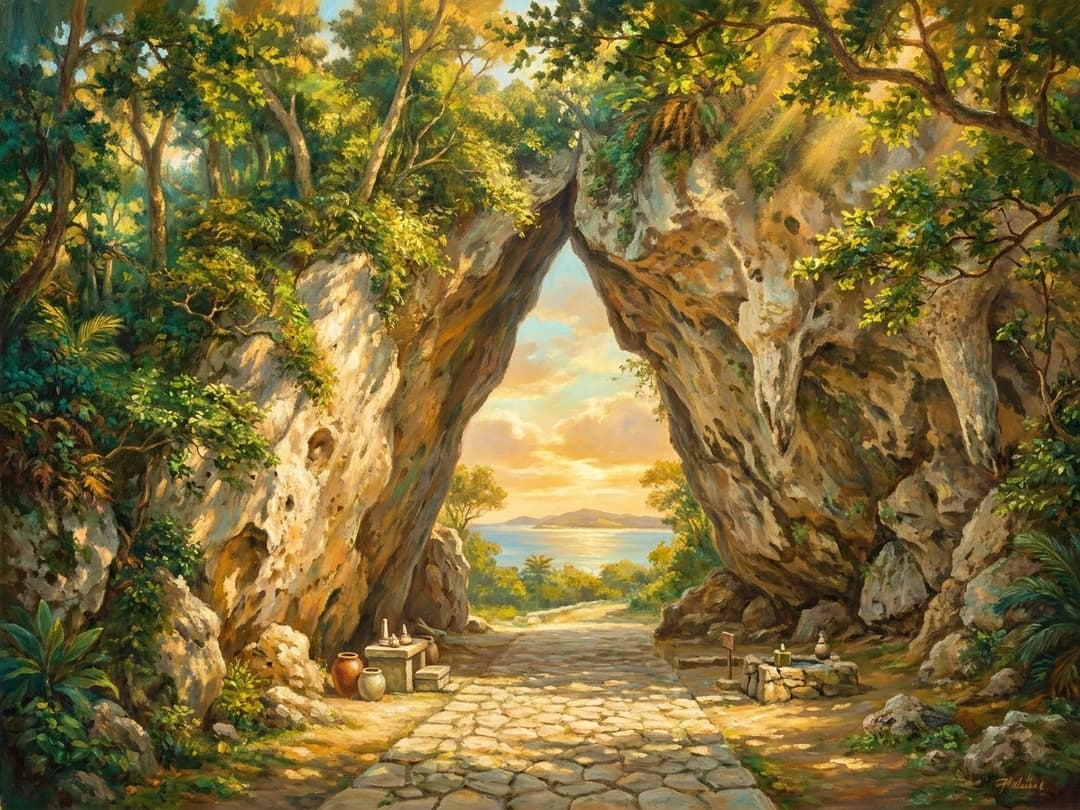
Visiting Sefa-Utaki provides an immersive journey through a tranquil coastal jungle and ancient limestone geological formations. Guests walk along ancient cobble paths once reserved for royal priestesses, experiencing the sacred quietude of Okinawa's spiritual heartland.
Highlights
- Walking through the dramatic Sangui triangular limestone portal framed by forest and stone.
- Gazing across the Pacific Ocean toward Kudaka Island from the sacred Chonohana viewpoint.
- Observing ancient earthenware jars catching sacred water drops beneath hanging stalactites.
Things to Know
- Tickets must be purchased at Ganju Station Nanjō before walking to the sanctuary entrance.
- Sensible slip-resistant footwear is required as stone paths can be slick and uneven.
- The site closes twice annually for six total days based on the lunar calendar for local worship.
Tips for Your Visit
Ticket Location Requirement
Purchase your admission ticket at Ganju Station Nanjō prior to approaching the sanctuary gate.
Wear Proper Footwear
Choose sturdy walking shoes with strong traction to navigate the wet limestone cobbles safely.
Respect Active Prayer
Maintain low noise levels and refrain from photographing local worshippers at prayer altars.
About
Sefa-Utaki is the most sacred sanctuary of the indigenous Ryukyuan religion (Ryūkyū Shintō), situated on the lush sea-facing cliffs of the Chinen Peninsula in Okinawa. Designed by nature rather than human hands, this ancient sacred grove eschews built halls, wooden gates, and statues, serving instead as a living sanctuary where limestone rock formations, ocean vistas, and dense broadleaf foliage embody the divine presence of the creation goddess Amamikiyo.
Historically governed under the doctrine of Onarigami—the spiritual superiority of women in Ryukyuan cosmology—Sefa-Utaki was accessed exclusively by female clerical hierarchies led by the Kikoe-ogimi (Supreme High Priestess). As the spiritual apex of the Ryukyu Kingdom, it hosted royal enthronement rituals and served as the destination of the sacred Agariumai pilgrimage, maintaining its role as an enduring sanctuary for indigenous prayer and ancestor reverence today.
Gallery
Symbolic Elements
The temple's exterior features intricate carvings, each rich with spiritual meaning:

Sangui Triangular Portal
Massive leaning limestone boulders creating an acute triangular fissure that symbolizes the threshold between mundane physical reality and divine power.

Kudaka Island Sightline
An unhindered eastern ocean vista pointing toward the mythic birthplace of Ryukyuan humanity and ancestral spirits in Nirai Kanai.

Stalactite Holy Water Jars
Twin earthenware vessels placed beneath stalactites to collect sacred mineral water used in royal consecration and priestess inauguration rites.

Gold Magatama Beads
Sacred comma-shaped ornaments representing spiritual authority and divine female guardianship unearthed beneath the Sangui portal.

Stone Incense Burners
Rectangular limestone altars where incense and offerings are presented to invisible ancestral deities in place of constructed statues.

White Coral Sand
Pure white sand transported from Kudaka Island to carpet the dark forest floor during state consecration rituals.
Ujoguchi Cobblestone Path
An ancient stone-paved entry path ascending through subtropical rainforest that defined historical access thresholds for visitors.

Ryukyu Limestone Formations
Natural coral-based limestone structures functioning as unbuilt altars and living physical manifestations of the creation goddess Amamikiyo.
Interesting Facts
Under historical rules, kings entering Sefa-Utaki had to wear female priestess robes to comply with female spiritual dominance. (Tier B)
Key ritual sites inside the grove share exact names with major ceremonial rooms in Shuri Castle. (Tier B)
Archaeologists discovered three solid gold magatama beads buried under the Sangui rock portal in 1995. (Tier A)
Sefa-Utaki contains no constructed buildings, statues, or roofs, honoring nature as the pure divine sanctuary. (Tier A)
Priestesses historically transported white coral sand from Kudaka Island across the ocean to carpet the sanctuary floor. (Tier B)
The Sangui triangular rock fissure creates a natural optical frame directed precisely at sacred Kudaka Island. (Tier A)
The site closes voluntarily twice each year according to the lunar calendar to allow spiritual rest and environmental recovery. (Tier A)
World War II naval artillery destroyed nearby positions but left Sefa-Utaki's rock monoliths undamaged. (Tier B)
Common Questions
What religion does Sefa-Utaki belong to?
Sefa-Utaki belongs to the indigenous Ryukyuan religion, an animist tradition centered on ancestor reverence and nature worship.
Are men allowed to enter Sefa-Utaki today?
Yes, modern visitors of all genders are permitted to enter, though historical access was strictly restricted to female priestesses.
Where do I buy tickets for Sefa-Utaki?
Tickets must be purchased at Ganju Station Nanjō, located about 400 meters before reaching the entrance gate.
Why does Sefa-Utaki close twice a year?
It closes for three consecutive days during the 5th and 10th lunar months to host traditional prayers and allow ecosystem rejuvenation.
Featured Stories
The Oaraori Night Ritual of Spiritual Rebirth
Ryukyu Kingdom Era
During the inauguration of a new Kikoe-ogimi high priestess, a nocturnal procession traversed the island from Shuri Castle to Sefa-Utaki. Inside the darkened Sangui rock chamber, carpeted with pure white coral sand, the priestess underwent a symbolic spiritual death and rebirth to receive divine authority directly from Nirai Kanai.
Source: Nanjō City Board of Education Historical Records
The King's Sacred Disguise
15th–19th Century
Guided by the doctrine of Onarigami, which assigned supreme spiritual authority to women, male rulers were barred from entering the inner sanctuary as men. To participate in royal state prayers at Ujo-guchi, the King of Ryukyu was required to wear female priestess robes before stepping past the sacred threshold.
Source: Ryukyuan Royal Court Documents (Chūzan Seikan)
The Discovery of the Golden Magatama
November 12, 1995
Archaeologists conducting excavations beneath the Sangui rock portal uncovered nine ancient magatama beads, including three crafted from solid gold alongside Chinese dynasty coins. This historical finding confirmed long-held oral traditions regarding royal treasures buried as offerings to consecrate the sanctuary.
Source: Okinawa Prefectural Museum & Art Museum Archaeological Survey
Timeline
Ryukyu Unification
King Shō Hashi unifies Okinawa and elevates Sefa-Utaki as the state's paramount spiritual protector.
MilestoneCodification of State Religion
King Shō Shin establishes the Kikoe-ogimi high priestess office and codifies Sefa-Utaki state rituals.
MilestoneChūzan Seikan Records
Official royal chronicles record Sefa-Utaki's mythic establishment by the goddess Amamikiyo.
EventAnnexation of Ryukyu Kingdom
Japan annexes the kingdom and abolishes the official Kikoe-ogimi office, though local priestesses continue rites.
EventBattle of Okinawa Survival
Despite intense regional military bombardment, the natural rock structures of Sefa-Utaki survive intact.
EventNational Historic Site Designation
Upon Okinawa's reversion to Japan, Sefa-Utaki is designated as a National Historic Site of Japan.
MilestoneGolden Magatama Discovery
Archaeological excavations reveal nine sacred magatama beads, including three made of solid gold, beneath Sangui.
EventUNESCO World Heritage Inscription
UNESCO inscribes Sefa-Utaki as part of the Gusuku Sites and Related Properties of the Kingdom of Ryukyu.
MilestoneHistory by Decade
15th Century
Following the unification of Okinawa in 1429, King Shō Hashi designated Sefa-Utaki as the primary divine sanctuary of the state. King Shō Shin later codified Ryukyuan state religion, creating the office of the Kikoe-ogimi high priestess and linking royal governance with the natural grove.
17th Century
Despite the 1609 invasion by Japan's Satsuma Domain, the Ryukyu Kingdom preserved its sacred traditions at Sefa-Utaki. The publication of the Chūzan Seikan in 1650 formally documented the goddess Amamikiyo's mythic creation of the sanctuary.
1870s–1940s
Japan's 1879 annexation of Ryukyu dissolved the official Kikoe-ogimi role, shifting rituals to local Noro priestesses. During the 1945 Battle of Okinawa, heavy coastal artillery bombardment scorched the peninsula, but Sefa-Utaki's rock monoliths remained miraculously intact.
1970s–2000s
With Okinawa's reversion to Japan in 1972, Sefa-Utaki was named a National Historic Site. Major archaeological discoveries in 1995 preceded UNESCO's World Heritage designation in 2000, establishing global recognition for the ancient sanctuary.
Architecture & Facilities
Sefa-Utaki represents an unbuilt architecture defined by spatial topology and natural geometry. Rejecting constructed walls, roofed halls, and human statues, the sanctuary relies entirely on natural Ryukyu limestone formations, dense subtropical rainforest canopy, and ancient stone walkways to define sacred spaces dedicated to animist Ryukyuan worship.
Building Materials
Ryukyu Limestone
Porously weathered ancient coral limestone forming natural rock walls, caverns, and triangular arches.
Cobblestone Paving
Hewn local limestone cobblestones lining historical ascent paths and sacred prayer platforms.
Earthenware Jars
Traditional Okinawan ceramic vessels placed on stone bases to collect holy stalactite water.
Subtropical Canopy
Dense indigenous forest featuring banyan, broadleaf trees, and ferns providing shaded natural enclosures.
Interior Features
Ufugui (Main Hall)
A broad limestone rock face and stone platform sharing its name with the throne room of Shuri Castle.
Yuinchi (Hearth Sanctuary)
A sheltered rock overhang historically designated for prayers concerning agricultural abundance and royal food security.
Sangui (Triangular Portal)
A dramatic fissure between two giant leaning limestone boulders framing the eastern sea horizon.
Chonohana (Inner Altar)
An inner sanctum housing fifteen stone incense burners representing successive reigns of high priestesses.
Temple Grounds
The grounds cover a heavily forested coastal slope on the Chinen Peninsula, traversed by cobblestone paths connecting distinct sacred clearings (ibi), natural rock overhangs, stalactite water collection stations, and eastern ocean viewpoints.
Additional Facilities
Visitor reception and educational media orientation are conducted at the Midori no Yakata entrance building, supported by ticket sales and cultural exhibits at nearby Ganju Station Nanjō.
Religious Significance
Sefa-Utaki is the spiritual heart of indigenous Ryukyuan religion, embodying animist reverence for nature and deep ancestor worship. In Ryukyuan cosmology, natural features serve as direct vessels for deities rather than mere physical backdrops.
Serves as the supreme natural sanctuary for divine communion, priestess consecration, national protection prayers, and eastward orientation toward Nirai Kanai.
Sacred Ordinances
Oaraori (Priestess Consecration)
Historical midnight ritual where the incoming Kikoe-ogimi received divine spiritual energy (seji) inside Sangui.
Agariumai (Eastward Pilgrimage)
Sacred eastern pilgrimage route connecting fourteen sacred sites across the Chinen Peninsula to celebrate sun origin and life renewal.
Oshimugai (Purification Water Harvesting)
Collection of sacred stalactite water drops (amadayuru) used for royal ritual purification and high priestess inaugurations.
The Cosmic Realm of Nirai Kanai
Ryukyuan theology holds that all life, agricultural seeds, and ancestral spirits originate from Nirai Kanai, a divine paradise beyond the eastern sea horizon visible from Sefa-Utaki.
The Doctrine of Onarigami
Central to Ryukyuan faith is the belief that women hold inherent spiritual power (seji) to protect male relatives and intercede with divine forces, placing sacred sites exclusively under female clerical guardianship.
Sources & Research
Every fact on Temples.org is backed by verified Sources & Research. Each piece of information is rated by source tier and confidence level.
View All Sources (8)
| Field | Source | Tier | Retrieved |
|---|---|---|---|
| About & Historical Background | Nanjō City Official Tourism & Cultural Heritage Board (opens in a new tab) | A | 2026-02-15 |
| Architecture & Sacred Topology | UNESCO World Heritage Centre (opens in a new tab) | B | 2026-02-15 |
| Timeline & Cultural History | Okinawa Prefectural Government Cultural Affairs Bureau (opens in a new tab) | B | 2026-02-15 |
| Visitor Insights & Etiquette | Japan National Tourism Organization (JNTO) (opens in a new tab) | A | 2026-02-15 |
| Archaeological Artifacts & Discoveries | Okinawa Prefectural Museum & Art Museum (opens in a new tab) | B | 2026-02-15 |
| Religious Significance & Onarigami | japan-guide.com (opens in a new tab) | B | 2026-02-15 |
| Geographical Coordinates & Survey Data | Geospatial Information Authority of Japan (opens in a new tab) | A | 2026-02-15 |
| Tourism & Access Guidelines | Okinawa Convention & Visitors Bureau (opens in a new tab) | D | 2026-02-15 |