Visitor Insights
Visiting Mausoleum of Khoja Ahmed Yasawi
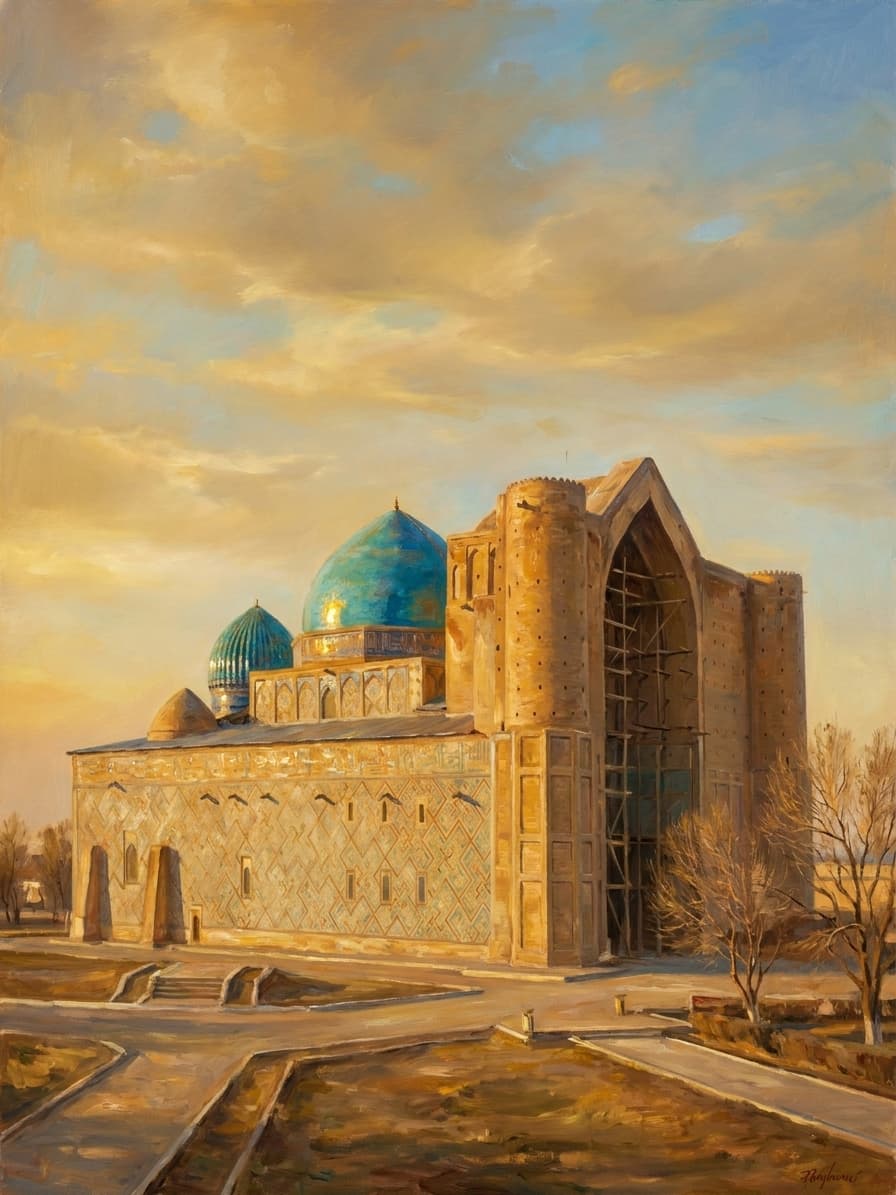
The sanctuary stands within the Khazret Sultan Reserve in the historic center of Turkistan. Visitors experience an active place of Islamic worship, pilgrimage, and preserved fourteenth-century architecture. Modest attire covering shoulders and knees is strictly observed throughout all interior chambers.
Highlights
- The colossal two-ton bronze Taykazan ritual water cauldron resting in the central Kazanlyk hall.
- The fluted turquoise double dome rising 38.7 meters over the sacred Gurkhana tomb chamber.
- Monumental banna'i brickwork spelling sacred kufic phrases across towering exterior facades.
- The underground Halvet hermitage complex where Yasawi lived out his final contemplative years.
Things to Know
- Shoes must be removed before stepping onto carpeted prayer areas within the mosque.
- Interior photography inside the Gurkhana tomb sanctuary is prohibited during active prayer.
- Visiting during spring or autumn avoids the extreme summer temperatures of the steppe.
Location
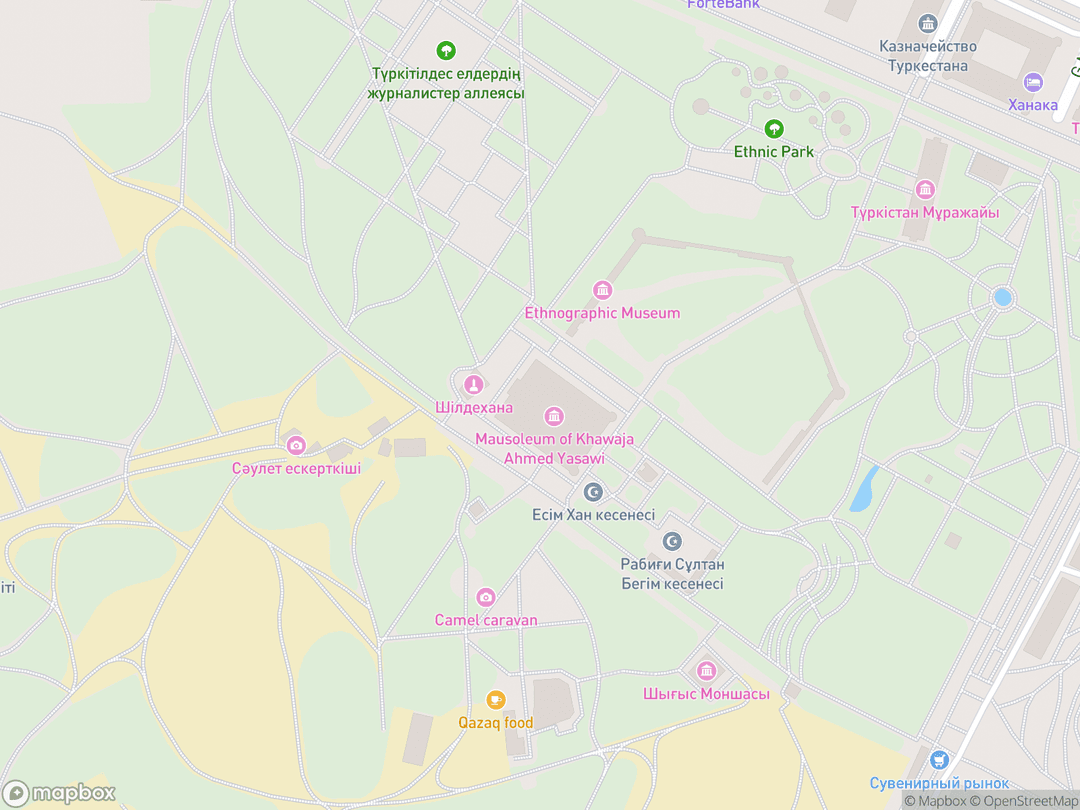
Khazret Sultan State Historical and Cultural Reserve Museum, Turkistan 161200, Republic of Kazakhstan
Hours: 08:00 - 19:00 (May to September); 09:00 - 18:00 (October to April)
Getting There: Located 15 km from Hazrat Sultan International Airport and 3 km from Turkistan Railway Station.
Get DirectionsTips for Your Visit
Dress Modestly
Wear loose clothing covering shoulders and ankles, and bring a headscarf for mosque entry.
Respect Prayer Hours
Access to the Gurkhana may briefly pause during congregational daily prayers.
Explore the Halvet
Visit the nearby sunken brick hermitage to witness the historic ascetic dwelling.
About
In the Abrahamic spiritual traditions, honoring righteous teachers and seekers of divine wisdom remains an enduring practice of faith. Within Islamic theology, this devotion took root through Tasawwuf (Sufi mysticism), which emphasizes interior spiritual purification and divine remembrance. Khoja Ahmed Yasawi was an influential twelfth-century Turkic mystic and poet who articulated Islamic theological concepts in vernacular Turkic verse, deeply inspiring the nomadic communities of Central Asia.
Between 1389 and 1405, the imperial ruler Amir Timur commissioned a monumental complex in Turkistan to replace Yasawi's earlier Karakhanid tomb. Conceived as a multi-functional khanqah and spiritual sanctuary, the building integrated Iranian engineering with nomadic steppe culture. The pioneering architectural methods developed here directly influenced subsequent imperial Timurid landmarks across Samarkand and Bukhara.
Today, the Mausoleum of Khoja Ahmed Yasawi remains an active center of pious pilgrimage (ziyarat) and communal prayer, as well as Kazakhstan's pioneering UNESCO World Heritage property. Standing sheer against the open steppe, the monumental brick complex continues to symbolize communal unity, hospitality, and historical devotion across the Muslim world.
Gallery
Symbolic Elements
The temple's exterior features intricate carvings, each rich with spiritual meaning:

The Taykazan
A monumental cast-bronze cauldron representing spiritual hospitality, generosity, and communal unity.

Turquoise Fluted Dome
The ribbed double dome symbolizes the celestial vault and divine transcendence in Turkic Islamic tradition.

Banna'i Geometric Kufic
Interlocking glazed blue bricks and terracotta form monumental sacred phrases of divine remembrance.

Carved Cedar Portal Doors
Finely carved fourteenth-century timber doors mark the passage between mundane and sacred ground.
Plaster Muqarnas Squinch
Cascading stalactite vaulting provides a visual metaphor for celestial order bridging square walls to circular domes.
The Underground Halvet
The subterranean brick cell reflects the prophet-centered humility and contemplative withdrawal of Yasawi.
Mosaic Tile Mihrab
The faïence-tiled prayer niche in the mosque aligns the congregation toward the sacred direction of Mecca.

Bronze Shamdan Candlesticks
Imperial ceremonial torches symbolize the radiant light of divine knowledge dispelling spiritual ignorance.
Interesting Facts
Three pilgrimages to the shrine historically held the spiritual merit of one Minor Hajj on the steppe (Tier B).
The two-ton bronze Taykazan was held in Leningrad's Hermitage for fifty-four years before returning in 1989 (Tier A).
Amir Timur personally modified the blueprints and supervised vaulting designs for the complex (Tier B).
Medieval cedar scaffolding timbers remain embedded in the portal wall more than six centuries later (Tier A).
The cauldron was cast from an alloy traditionally described as containing seven metals (Tier B).
The sanctuary served as the royal pantheon holding the tombs of twenty-one Kazakh khans (Tier B).
At age sixty-three, Yasawi moved into an underground hermitage to emulate the Prophet Muhammad's lifespan (Tier B).
The central hall features an 18.2-meter dome, the largest medieval brick dome in Central Asia (Tier A).
The building withstood eleven direct artillery shell hits during the Tsarist siege of 1864 (Tier B).
In 2003, the mausoleum became the very first UNESCO World Heritage Site in Kazakhstan (Tier A).
Common Questions
Why is the southern entrance portal unfinished?
Work abruptly halted when Amir Timur died in 1405, leaving original wooden scaffolding intact.
What is the spiritual purpose of the Taykazan cauldron?
It held sweetened holy water distributed to pilgrims after Friday prayers as an act of hospitality.
Is the site an active place of religious worship?
Yes, it functions as an operating mosque and a revered destination for pious visitation.
Why did Yasawi retire to an underground cell at age sixty-three?
He chose to live underground to avoid living in sunlight beyond the lifespan of the Prophet Muhammad.
Featured Stories
The Return of the Great Cauldron
September 18, 1989
In 1935, the two-ton bronze Taykazan was sent to Leningrad for an academic exhibition and remained there for over five decades. Following persistent petitions by Kazakh scholars and community elders, Soviet authorities agreed to its repatriation. Its homecoming to the Kazanlyk hall on the eve of Kazakh independence was celebrated as the restoration of the nation's spiritual heart.
Source: Khazret Sultan State Reserve Records
A Monument Frozen in Time
1405
Amir Timur oversaw the construction of Yasawi's shrine with meticulous care, frequently adjusting architectural plans. In February 1405, while encamped at Otrar on his campaign to China, Timur died suddenly of illness. The conscripted craftsmen laid down their tools immediately, leaving the massive southern arch and projecting wooden scaffolds unaltered for centuries.
Source: Timurid Imperial Chronicles
The Underground Dwelling of Hazrat Yasawi
1156
Upon reaching his sixty-third year, Khoja Ahmed Yasawi resolved that he would no longer walk under the open sun out of devotion to the Prophet Muhammad. He retreated into the Halvet, an underground brick hermitage excavated beneath the steppe. There he composed the verses of his Book of Wisdom until his passing.
Source: Yasawiyya Oral Tradition and Divan-i Hikmet
Timeline
Passing of Khoja Ahmed Yasawi
A modest brick Karakhanid mausoleum is built over Yasawi's grave in ancient Yasi.
MilestoneImperial Decree of Amir Timur
Timur orders the demolition of the older tomb to build a monumental complex.
component.timeline.groundbreakingCasting of the Taykazan
Metalsmith Abd al-Aziz al-Tabrizi casts the massive ritual bronze cauldron in Karnak.
EventDeath of Timur and Halted Construction
Timur dies at Otrar, leaving the grand southern portal permanently unfinished.
MilestoneShaybanid Restoration
Abdullah Khan II of Bukhara repairs and reinforces the unfinished southern facade arch.
RenovationPantheon of the Kazakh Khanate
Prominent Kazakh khans and judges are interred around the mausoleum sanctuary.
EventSiege of Turkistan
Tsarist artillery shells strike the mausoleum during the Russian imperial advance.
EventRelocation of the Taykazan
Soviet authorities transfer the historic cauldron to the State Hermitage Museum in Leningrad.
EventRestitution of the Great Cauldron
The Taykazan is returned to the central hall after fifty-four years of exile.
MilestoneUNESCO World Heritage Designation
The mausoleum is inscribed as Kazakhstan's inaugural UNESCO World Heritage property.
DedicationHistory by Decade
1160s — Passing of the Mystic
Seek wisdom with a humble heart and share your bread with the traveler.
Following decades of teaching the Yasawiyya Sufi way, Khoja Ahmed Yasawi passed away in 1166. A modest brick tomb was constructed over his burial site in Yasi, drawing nomadic pilgrims from across the region.
1380s–1390s — Imperial Timurid Commission
Amir Timur ordered the construction of a grand complex in 1389 to honor Yasawi and legitimize his authority over the steppe. Master craftsmen gathered from Shiraz and Tabriz to engineer unprecedented vaults and cast ritual bronze vessels.
1400s — The Halted Portal
Timur's sudden demise in 1405 halted building work across the site. The monumental southern portal remained unfinished, preserving the medieval scaffolding sockets that remain visible today.
1580s–1590s — Shaybanid Consolidation
Abdullah Khan II of Bukhara directed essential structural preservation on the unfinished portal arch. Builders secured the masonry with cedar beams, stabilizing the immense entryway against earthquakes.
1600s–1700s — Royal Pantheon of the Steppe
Turkistan flourished as the political capital of the Kazakh Khanate. The mausoleum became the pantheon where khans, warriors, and judges were laid to rest beside the holy mystic.
1860s — Russian Expansion and Shelling
During the siege of Turkistan in 1864, Tsarist artillery fired heavy shells that damaged the outer portal and punctured the tiled dome. Despite direct hits, the robust medieval masonry remained structurally sound.
1930s–1980s — Soviet Conservation and Repatriation
The Taykazan was relocated to Leningrad in 1935 as Soviet authorities curtailed religious practice. Following decades of scholarly advocacy, the cauldron was repatriated to Turkistan in 1989.
1990s–2000s — Independence and Global Recognition
Joint Kazakh-Turkish restoration projects preserved the dome and stabilized internal microclimates during the 1990s. In 2003, the complex was inscribed as Kazakhstan's first UNESCO World Heritage Site.
Architecture & Facilities
The Mausoleum of Khoja Ahmed Yasawi stands as the prototype of high Timurid monumentalism, synthesizing Persian spatial engineering with the vast communal scale of the Central Asian steppe. Master architect Khwaja Hosein Shirazi consolidated civic, educational, and religious functions beneath a single colossal rectangular structure, pioneering structural vaults and double-shelled ribbed domes that later defined Samarkand and Bukhara.
Building Materials
Fired Plinthite Brick
Dense kiln-fired square clay bricks form the load-bearing walls and monumental vaulting.
Ganch Mortar
Fast-setting gypsum and lime mortar used throughout the intricate vaulting and squinches.
Glazed Ceramic Tiles
Cobalt, turquoise, and white glazed ceramic tiles adorn the exterior banna'i calligraphy.
Carved Walnut and Cedar
Historic fourteenth-century timber beams and carved panels frame the ceremonial doors.
Seven-Metal Bronze Alloy
Cast bronze containing multiple metals forms the two-ton ceremonial Taykazan cauldron.
Interior Features
Kazanlyk
The primary 18.2-meter square hall crowned by the largest medieval brick dome in Central Asia.
Gurkhana
The northern tomb chamber containing Yasawi's cenotaph sheltered beneath the turquoise dome.
Mezgithana
The vaulted communal mosque chamber featuring an intact mosaic-tiled prayer niche.
Aksaray Chambers
Flanking assembly halls utilized for scholarly debates, monastic councils, and royal interments.
Ashkhana
The monastic refectory retaining historic hearths where food was ritually prepared for pilgrims.
Temple Grounds
The mausoleum sits in a protected historical reserve encompassing archaeological ruins, landscaped pathways, and the sunken Halvet hermitage.
Additional Facilities
The site features a visitor center, the Khazret Sultan Reserve Museum, and preserved medieval bathhouses.
Religious Significance
In the Islamic tradition, sacred sanctuaries cultivate closeness to God through prayer, communal service, and remembrance of righteous teachers. Khoja Ahmed Yasawi's shrine represents an enduring center of Sufi spirituality and steppe Islamic identity.
To serve as a center for congregational prayer, spiritual contemplation, and charitable hospitality for pilgrims.
Sacred Ordinances
Ziyarat
Pious visitation to the tomb accompanied by Quranic recitation and supplications for peace.
Dhikr
Rhythmic communal remembrance of God practiced historically by the Yasawiyya Sufi order.
Salah
The performance of the five daily congregational Islamic prayers in the adjoining mosque.
Futuwwa
Spiritual generosity and communal hospitality exemplified by sharing water and food with travelers.
The Legacy of Hazrat Yasawi
Khoja Ahmed Yasawi harmonized Islamic teachings with Turkic nomadic heritage. His poetic collection, the Divan-i Hikmet, spread spiritual knowledge across the steppe and fostered an enduring culture of tolerance, hospitality, and communal devotion.
The Steppe Pilgrimage Tradition
Historically, nomadic believers who faced immense obstacles traveling to Mecca journeyed to Turkistan instead. A venerated regional tradition held that three pious visits to Yasawi's shrine offered the spiritual merit of a minor pilgrimage.
Sources & Research
Every fact on Temples.org is backed by verified Sources & Research. Each piece of information is rated by source tier and confidence level.
View All Sources (7)
| Field | Source | Tier | Retrieved |
|---|---|---|---|
| About & Historical Background | Official Portal of South Kazakhstan / Turkistan Region (opens in a new tab) | A | 2026-03-31 |
| Architecture & Structural Survey | UNESCO World Heritage Centre (opens in a new tab) | B | 2026-03-31 |
| Historical Timeline & Inscription | UNESCO World Heritage Convention Advisory Body (opens in a new tab) | B | 2026-03-31 |
| Visitor Insights & Regional Tourism | Kazakh Tourism National Company (opens in a new tab) | A | 2026-03-31 |
| Academic Research on Yasawi Complex | L.N. Gumilyov Eurasian National University (opens in a new tab) | B | 2026-03-31 |
| Heritage Assessment | World Heritage Sites Registry (opens in a new tab) | B | 2026-03-31 |
| Cultural Studies & Relic History | Siberian Steppes Heritage Review (opens in a new tab) | B | 2026-03-31 |