Visitor Insights
Visiting Kek Lok Si Temple
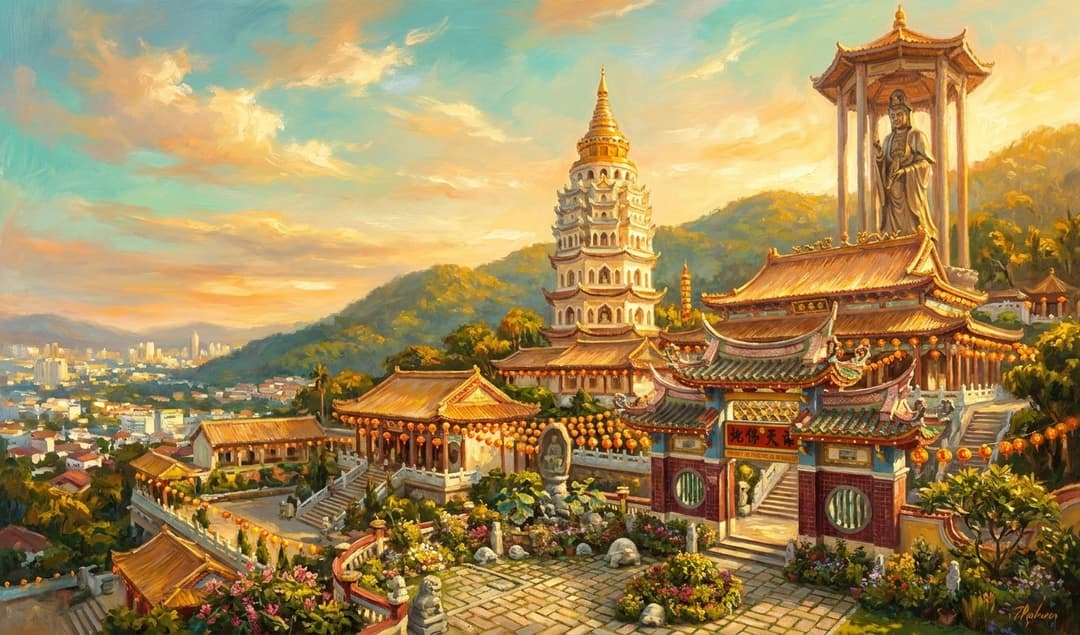
Kek Lok Si Temple offers a multi-tiered journey up Crane Mountain through terraced prayer halls, lotus ponds, and sweeping lookouts over George Town. Visitors can experience both quiet monastic chanting and monumental architectural feats across the thirty-acre complex.
Highlights
- Panoramas of Penang from the upper Guanyin pavilion
- The seven-story Pagoda of Ten Thousand Buddhas blending three national architectural styles
- Thousands of hanging silk lanterns during the Chinese New Year festival
- The peaceful Liberation Pond filled with hundreds of sanctuary tortoises
Things to Know
- Steep climbing and stairs between tiers, though funicular lifts are available for a nominal fee
- Modest dress covering shoulders and knees is required inside all sacred halls
- Shoe removal is mandatory when entering active prayer and altar rooms
Location
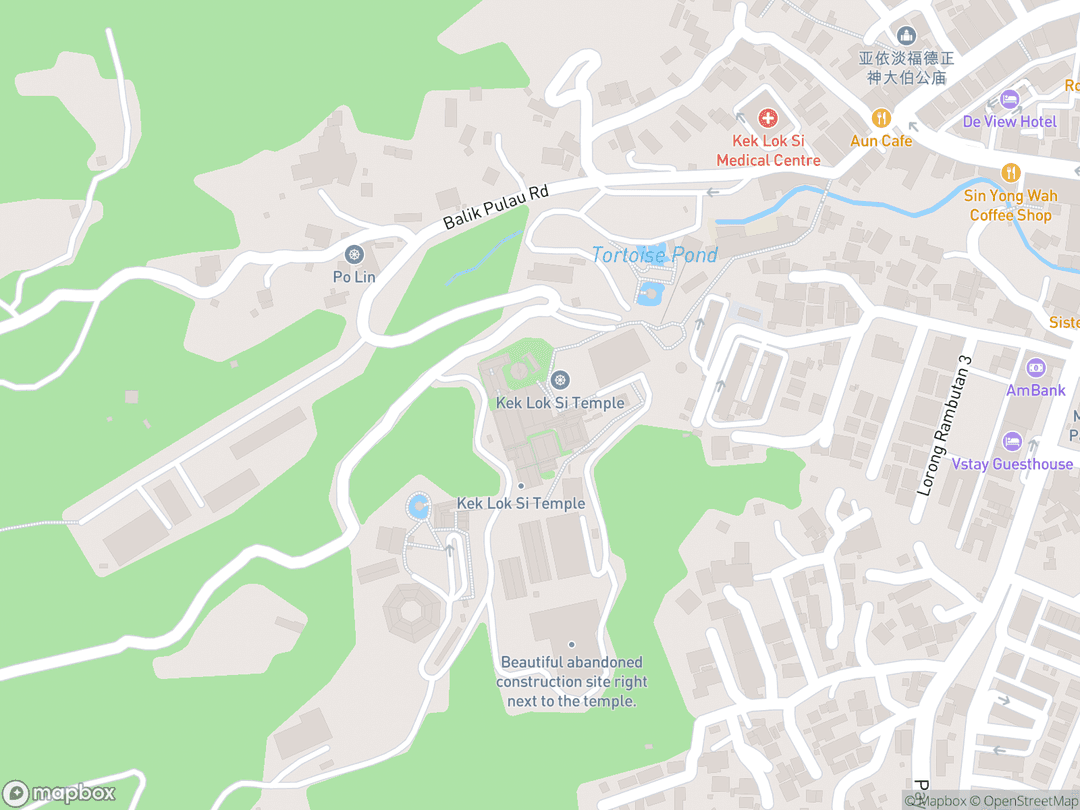
1000-L, Jalan St. Station, Ayer Itam, 11500 George Town, Penang, Malaysia
Hours: Daily 8:30 AM – 5:30 PM (Extended hours during Chinese New Year)
Getting There: Take Rapid Penang Bus 201, 203, or 204 from Komtar Bus Terminal in George Town to Ayer Itam market, followed by a short walk to the lower temple entrance.
Get DirectionsTips for Your Visit
Best Time for Photography
Visit during early morning light to capture the pagoda without heavy crowds, or during Chinese New Year evenings when the hill is lit by over 20,000 lanterns.
Funicular Railway
Use the inclined elevator from the middle tier to reach the upper Guanyin statue easily if mobility is a concern.
About
Set upon the granite slopes of Ayer Itam in Penang, Kek Lok Si Temple stands as the largest Buddhist complex in Malaysia and one of Southeast Asia's most revered pilgrimage sites. Founded in 1890 by Venerable Beow Lean, an ascetic monk from Fujian, China, the monastery was conceived as a sanctuary where the core philosophical principles of Buddhism could flourish in the Nanyang region.
Situated within the Dharmic spiritual family, Kek Lok Si grounds its teaching in the universal framework of Buddhism: the Four Noble Truths, the Noble Eightfold Path, and the doctrine of karmic cause and effect. Architecturally and spiritually, the temple synthesizes Chinese Mahayana traditions—combining Chan meditation with Pure Land devotion—while harmoniously integrating Theravada motifs from Thailand and Myanmar.
Spanning over thirty acres of terraced gardens, prayer halls, and monumental shrines, the complex reflects over a century of continuous devotion. From its imperial endorsement by Qing Dynasty Emperor Guangxu to its patronage by Siamese royalty and local Penang philanthropists, Kek Lok Si remains an active center of monastic practice and spiritual shelter.
Gallery
Symbolic Elements
The temple's exterior features intricate carvings, each rich with spiritual meaning:

Bronze Guanyin Statue
Represents infinite compassion with her right hand raised in protection and left hand holding healing nectar.
Pagoda of Ten Thousand Buddhas
Symbolizes global Buddhist harmony through a three-tiered combination of Chinese, Thai, and Burmese design.

Liberation Pond
Embodies the Buddhist virtue of ahimsa through the practice of releasing captive tortoises to cultivate karmic merit.

Ten Thousand Alabaster Buddhas
Lines the interior walls of the pagoda to reflect the Mahayana doctrine that all beings possess inherent Buddha-nature.

Carved Fujian Granite Pillars
Supports the upper pavilion with dragon reliefs that anchor the spiritual sanctuary into Crane Mountain.
Heavenly Kings Statues
Guards the outer monastic thresholds to symbolise spiritual protection against worldly ignorance.
Interesting Facts
Kek Lok Si stands as the largest Buddhist temple complex in Malaysia, encompassing over thirty acres of terraced hillside. (Tier A)
Emperor Guangxu of the Qing Dynasty personally endorsed the monastery in 1906, bestowing a seven-thousand-volume imperial sutra collection. (Tier A)
The grand pagoda combines Chinese, Thai, and Burmese architectural tiers into a single vertical monument. (Tier A)
Two consecutive Siamese kings, Rama V and Rama VI, visited and financially supported the temple's pagoda construction. (Tier B)
During the Chinese New Year festival, over twenty thousand silk lanterns illuminate the mountain complex for thirty-three consecutive nights. (Tier A)
The protective octagonal pavilion over the Guanyin statue rests on sixteen massive dragon-carved granite pillars imported from Fujian. (Tier B)
Founder Venerable Beow Lean chose the site because Crane Mountain's topography resembled a crane spreading its wings in traditional feng shui. (Tier B)
The Liberation Pond houses hundreds of tortoises released by pilgrims as a physical practice of karmic mercy. (Tier A)
An automated inclined funicular railway carries visitors up the steep grade between the middle courtyards and upper statue plateau. (Tier A)
Common Questions
What is the primary spiritual focus of Kek Lok Si Temple?
The temple practices Chinese Mahayana Buddhism, combining Pure Land devotion to Amitabha Buddha with Chan meditation and reverence for Guanyin.
Why is the Pagoda of Ten Thousand Buddhas architecturally famous?
It unites three distinct national styles into one tower: a Chinese base, Thai midsection, and Burmese crown.
Is there an entrance fee for visiting Kek Lok Si?
General admission to the temple grounds is free, though small fees apply for the funicular elevator and entry to the pagoda tower.
When does the famous lantern illumination take place?
The annual display occurs during Chinese New Year, lighting over 20,000 silk lanterns across thirty acres for thirty-three nights.
Featured Stories
The Search for Crane Mountain
1885
In 1885, Venerable Beow Lean left Mount Guoshan in China to serve as head priest at Penang's Kwan Im Teng shrine. While surveying the surrounding hills of Ayer Itam, he recognized a landform resembling a crane spreading its wings, indicating superior spiritual energy. Supported by five Chinese merchant leaders known as the Towkays, he secured the hillside land that would become Malaysia's chief Buddhist monastery.
Source: Penang Heritage Trust Records
The Imperial Qing Endorsement
1906
Following fourteen years of construction, Venerable Beow Lean journeyed to Beijing in 1906 to present his monastic achievement to the imperial court. Moved by his devotion, Emperor Guangxu granted royal patronage, presenting Kek Lok Si with official imperial seals and a handwritten copy of the seven-thousand-volume Dragon Sutra. This royal recognition elevated the Penang monastery into a premier international seat of Chinese Buddhism.
Source: Kek Lok Si Monastic Archives
Royal Sponsorship Across Borders
1915
In 1915, King Rama VI of Siam traveled to Penang and visited Crane Mountain to inspect the proposed site for a monumental pagoda. Demonstrating unity between Mahayana and Theravada communities, the Siamese monarch laid the foundation stone and sponsored the middle tier's Thai architectural elements. His patronage ensured the pagoda stood as a physical testament to international Buddhist solidarity.
Source: Journal of the Siam Society
Timeline
Arrival of Venerable Beow Lean
Fujian monk Beow Lean arrives in Penang and identifies Crane Mountain as a sacred geomantic location.
MilestoneGroundbreaking and Foundation
Construction begins on central prayer halls with financial support from Chinese business leaders.
component.timeline.groundbreakingInitial Monastic Complex Dedication
The core lower and middle tier halls are officially consecrated for monastic residency.
DedicationQing Imperial Decree
Emperor Guangxu bestows the 7,000-volume Dragon Sutra and royal imperial seals upon the temple.
EventSiamese Royal Foundation Stone
King Rama VI of Siam visits Penang and lays the cornerstone for the grand multi-tiered pagoda.
MilestoneCompletion of Ban Po Thar Pagoda
The seven-story Pagoda of Ten Thousand Buddhas is completed after delays during World War I.
DedicationUpper Plateau Master Plan
Temple leaders initiate expansion plans for a monumental bronze statue of Guanyin.
RenovationGuanyin Statue Consecration
The 36.57-meter solid bronze statue of the Bodhisattva of Compassion is dedicated.
DedicationGuanyin Pavilion Completion
A ninety-one-meter octagonal shelter supported by granite pillars is built to protect the statue.
Milestone125th Anniversary Modernization
Upgraded funicular access and infrastructure enhancements are completed for regional pilgrims.
EventHistory by Decade
1880s — Geomantic Discovery
Venerable Beow Lean arrived in Penang in 1885 and spent several years surveying the island's topography. Recognizing the favorable feng shui of Crane Mountain in Ayer Itam, he organized local Chinese business leaders to finance land purchases for a grand monastic center.
1890s — Foundational Construction
Formal groundbreaking took place in 1890, initiating extensive granite terracing along the steep hillsides. Laborers hand-carved retaining walls, prayer halls, and monastic quarters to form the lower and middle tiers of the complex.
1900s — Imperial Consecration
The original core complex was consecrated in 1904 as a refuge for Mahayana monks. In 1906, Qing Emperor Guangxu officially endorsed the monastery, granting imperial sutras and seals that secured its prestige across Southeast Asia.
1910s — Siamese Royal Patronage
King Rama VI of Siam visited in 1915 and laid the cornerstone for the grand pagoda. His royal sponsorship introduced Thai architectural features into the design, creating an unprecedented cross-tradition sanctuary.
1920s–1930s — The Great Pagoda Dedication
Construction on the Pagoda of Ten Thousand Buddhas resumed after World War I with substantial local funding. Dedicated in 1930, the seven-story tower became an immediate regional architectural and pilgrimage landmark.
1980s–2000s — The Monumental Guanyin
Temple leaders launched an ambitious upper hill expansion in the late twentieth century. A thirty-six-meter bronze Guanyin statue was dedicated in 2002, followed by a massive octagonal granite pavilion completed in 2009.
2010s–Present — Heritage Modernization
Modern inclined funicular lifts and expanded visitor plazas were constructed to improve accessibility. Today, Kek Lok Si hosts hundreds of thousands of international pilgrims while remaining an active place of Chan monastic training.
Architecture & Facilities
Kek Lok Si exhibits an architectural style synthesizing Southern Chinese Min-nan timber traditions, Qing imperial court motifs, and regional Theravada Buddhist stupa geometry across thirty acres.
Building Materials
Granite Block Retaining Walls
Forms the terraced foundations anchored into Crane Mountain bedrock.
Glazed Ceramic Roof Tiles
Covers sweeping gables with golden and green protective glazes.
Cast Bronze Alloy
Composes the thirty-six-meter figure of the Bodhisattva Guanyin.
Carved Fujian Granite Columns
Supports the octagonal pavilion shelter spanning ninety-one meters high.
Interior Features
Hall of Great Heroes
Houses three gilded historical Buddha statues framed by carved wooden altars.
Hall of the Heavenly Kings
Enshrines Maitreya surrounded by four massive polychrome guardian statues.
Pagoda Shrine Chambers
Features thousands of alabaster and bronze Buddha plaques lining multi-tiered walls.
Monastic Ancestor Hall
Preserves memorial tablets honoring founding lineage masters and benefactors.
Temple Grounds
Spanning thirty acres across Crane Mountain, the terraced grounds feature granite stairways, koi ponds, turtle sanctuaries, and landscaped flower gardens.
Additional Facilities
Includes an internal funicular railway, vegetarian dining halls, devotional souvenir bazaars, and extensive pilgrimage parking areas.
Religious Significance
Rooted in the broader Dharmic tradition of Indian and Asian Buddhism, Kek Lok Si grounds its spiritual life in the Four Noble Truths and the Noble Eightfold Path taught by Shakyamuni Buddha. Within Mahayana theology, it serves as a central beacon for the pursuit of enlightenment and universal compassion across Southeast Asia.
To cultivate karmic merit, facilitate monastic discipline, and offer a sacred pilgrimage center for Pure Land devotion and Chan meditation.
Sacred Ordinances
Nianfo and Sutra Chanting
Recitation of Amitabha Buddha's name and Mahayana sutras to cultivate mental focus and pure devotion.
Fangsheng (Animal Release)
The ritual release of turtles into sanctuary ponds as an act of compassion for all sentient beings.
Light Offering (Deng Gong)
Lighting oil lamps and silk lanterns to symbolize wisdom dispelling spiritual ignorance.
Chan Silent Sitting
Monastic meditation practices aimed at realizing direct insight into non-self and Buddha-nature.
Dharmic Unity in the Tri-Cultural Pagoda
The Pagoda of Ten Thousand Buddhas embodies the core Dharmic concept of spiritual harmony. By placing a Chinese octagonal base beneath a Thai middle tier and a Burmese crown, the architecture physically demonstrates that diverse regional traditions share the same fundamental path toward awakening.
Pure Land Devotion and Western Paradise Imagery
The name Kek Lok translates directly to Sukhāvatī, the Western Paradise of Supreme Bliss. Devotees visit the monastery to align their minds with Amitabha Buddha, using chanting and visualization to secure rebirth in a realm free from spiritual obstacles.
Devotion to Guanyin and Infinite Compassion
The monumental bronze Guanyin statue serves as an icon of Avalokiteshvara's vow to postpone ultimate nirvana until all suffering beings are liberated. Pilgrims ascend Crane Mountain to seek spiritual protection, healing, and moral inspiration.
Sources & Research
Every fact on Temples.org is backed by verified Sources & Research. Each piece of information is rated by source tier and confidence level.
View All Sources (8)
| Field | Source | Tier | Retrieved |
|---|---|---|---|
| About & Historical Background | Penang Global Tourism (opens in a new tab) | A | 2026-02-23 |
| Visitor Insights & Timeline | Malaysian Ministry of Tourism, Arts and Culture (opens in a new tab) | A | 2026-02-23 |
| Visitor Insights & Timeline | Tourism Malaysia Official Portal (opens in a new tab) | A | 2026-02-23 |
| Architecture & Layout | Penang Heritage Trust (opens in a new tab) | B | 2026-02-23 |
| Architecture & Layout | Journal of the Siam Society (opens in a new tab) | B | 2026-02-23 |
| About & Historical Background | Oxford University Press (DeBernardi Monograph) (opens in a new tab) | B | 2026-02-23 |
| Religious Significance | UNESCO World Heritage Centre (opens in a new tab) | B | 2026-02-23 |
| Religious Significance | Kek Lok Si Temple Management Committee (opens in a new tab) | A | 2026-02-23 |