Visitor Insights
Visiting Great Mosque of Djenné
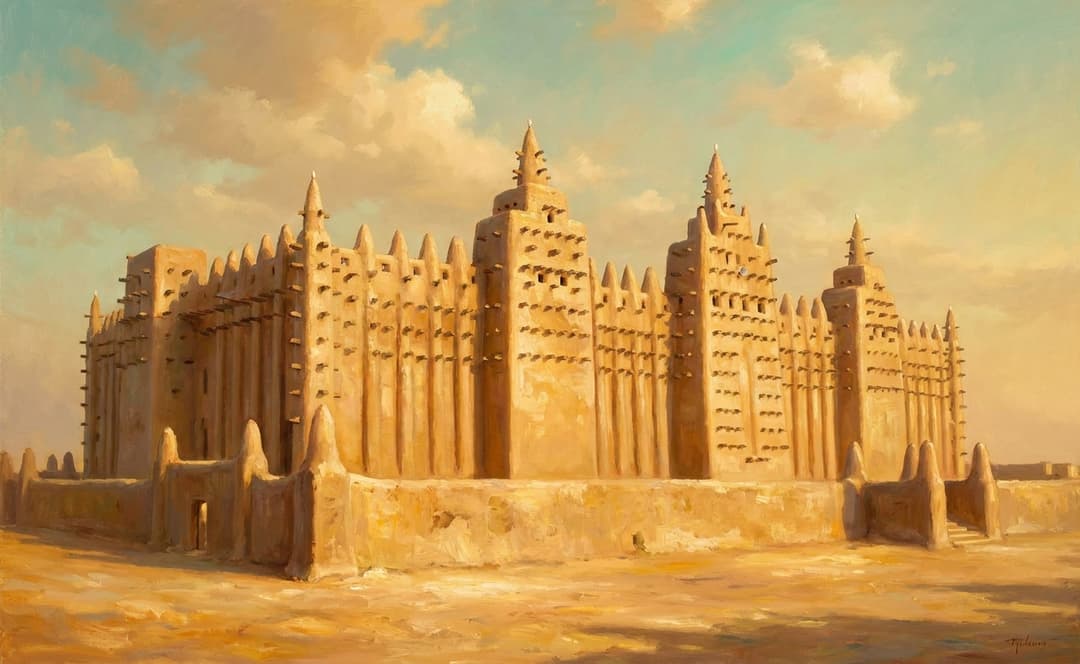
Djenné presents an awe-inspiring vision of organic African architecture rising directly from the Sahelian floodplains. Visitors encounter a bustling cultural crossroad framed by centuries of sacred scholarship and mud-masonry heritage.
Highlights
- Vibrant weekly Monday market spreading across the vast plaza before the eastern façade
- Monumental three-towered qibla wall adorned with projecting palm timbers
- Panoramic views of the roofline and courtyard from adjacent rooftop terraces
Things to Know
- Interior prayer hall is strictly closed to non-Muslim visitors since 1996
- Reaching the island city requires crossing the Bani River via vehicle ferry
- Regional security advisories must be consulted prior to travel in central Mali
Location
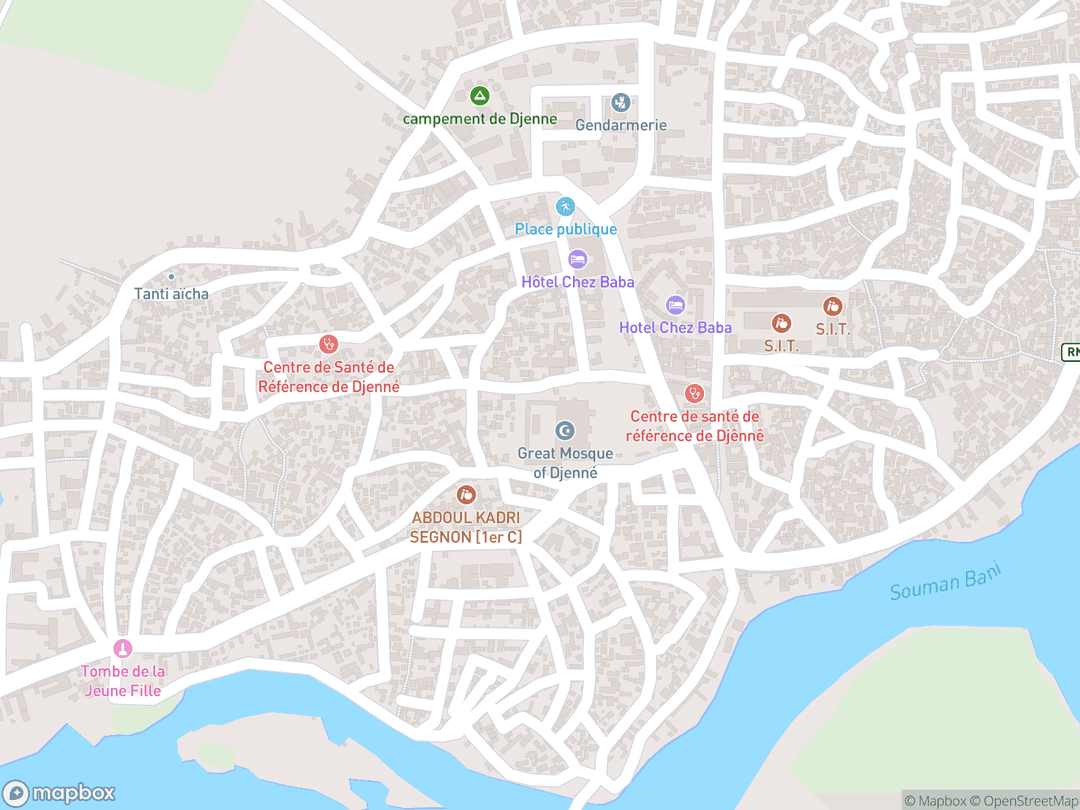
Place du Marché, Djenné, Mopti Region, Mali
Hours: Open 24 hours daily for Muslim prayer; exterior plaza viewable during daylight
Getting There: Located 130 km southwest of Mopti; accessible by road and motorized ferry across the Bani River.
Get DirectionsTips for Your Visit
Monday Market Timing
Arrive at sunrise on Mondays to watch colorful merchant caravans set up before the earthen towers.
Rooftop Vantage Points
Arrange access with local market residents to photograph the sweeping roofline from upper terraces.
Respectful Attire
Dress conservatively around the perimeter plinth in keeping with local Islamic customs.
About
The Great Mosque of Djenné rises above the Inland Niger Delta as the largest load-bearing earthen structure on Earth. First established around 1280 by Sultan Koi Kunboro upon his conversion to Islam, the sanctuary embodies centuries of devout West African craftsmanship.
Within Abrahamic sacred geography, the mosque serves as an earthly sanctuary where the faithful assemble before the Creator. The building translates the principle of divine unity into rhythmic mud-brick arches, turning humble river clay into a soaring monument of communal devotion.
Rebuilt in 1907 by master builder Ismaila Traoré and the indigenous Barey Ton masons' guild, the current complex maintains ancient Sudano-Sahelian traditions. Inscribed as a UNESCO World Heritage site in 1988, it remains an active Friday congregational mosque continuously renewed by its community.
Gallery
Symbolic Elements
The temple's exterior features intricate carvings, each rich with spiritual meaning:
Ostrich Egg Finials
Sacred emblems of purity and cosmic fertility that crown each earthen spire while deflecting driving rain.

Toron Palm Timbers
Projecting rodier palm beams that visually represent communal interdependence while providing permanent scaffolding.

Qibla Minaret Towers
Three monumental earthen towers orienting the assembly toward Mecca and anchoring the eastern civic façade.

Hypostyle Column Grid
A dense interior forest of unadorned mud piers reflecting absolute equality of all believers before God.

Elevated Earthen Plinth
A raised foundational platform separating sacred worship from floodplain mud and bustling marketplace commerce.

Parapet Crenellations
Stepped decorative merlons lining the roof that evoke Sahelian bastions and spiritual vigilance.

Mihrab Niche
The recessed prayer alcove set into the central tower marking the sacred direction of prayer.
Interesting Facts
The Great Mosque is recognized as the largest freestanding earthen architectural structure in the world (Tier A).
The entire exterior of the complex is resurfaced in fresh clay by thousands of citizens in a single day during the Crépissage (Tier B).
The distinctive three-towered silhouette of the mosque's eastern wall is featured on the national coat of arms of Mali (Tier A).
Thick adobe walls provide natural bioclimatic insulation, absorbing desert heat by day and releasing it during cold nights (Tier B).
Founding ruler Sultan Koi Kunboro demolished his own royal palace so the grandest house in Djenné would belong to God (Tier B).
Real ostrich eggs top each earthen spire, serving as spiritual emblems of cosmic renewal and rain deflectors (Tier B).
The masons' guild rejected modern synthetic cement because it traps internal moisture and accelerates adobe erosion (Tier B).
A comprehensive millimeter-precise 3D laser model was created by the Zamani Project to aid future restorations (Tier B).
Common Questions
Can non-Muslim travelers go inside the Great Mosque of Djenné?
No, non-Muslim visitors are strictly restricted to viewing the exterior plinth following a council ruling in 1996.
Why are wooden beams sticking out of the walls?
The rodier palm toron beams serve as built-in permanent scaffolding and absorb structural stresses across the mud walls.
What is the Crépissage festival?
It is an annual community festival where thousands of citizens resurface the entire earthen exterior with fresh clay mortar.
What material makes up the mosque's structure?
The complex is constructed from sun-baked mud bricks, river clay mortar, palm timber, and organic straw.
Featured Stories
The Royal Sacrifice of Sultan Kunboro
1280
Upon accepting Islam in the late thirteenth century, Sultan Koi Kunboro sought an act of genuine humility before his people and his Creator. He ordered his magnificent ancestral palace demolished to its foundations, declaring that only the house of God deserved the finest location in Djenné. Kunboro subsequently relocated to a modest home nearby, setting a standard of piety that established the sacred site.
Source: Tarikh al-Sudan
The Crépissage: A City in Motion
1907
Each spring before the Sahelian rains begin, a ceremonial whistle pierces the early morning air to inaugurate the Crépissage. Thousands of townspeople surge forward, with young boys churning river clay, women carrying fresh water, and men scaling the toron beams with wet mud. By late afternoon, the community finishes resurfacing the entire monument in a joyful demonstration of shared civic faith.
Source: Barey Ton Oral Tradition
Ismaila Traoré and the Masons' Defense
1906
When reconstruction was commissioned in 1906, colonial overseers contemplated imposing foreign architectural concepts upon the historic mound. Master mason Ismaila Traoré and the Barey Ton guild firmly defended indigenous building methods, insisting on authentic Sudano-Sahelian forms and alluvial mud bricks. Their unwavering commitment preserved an ancient West African architectural identity for modern generations.
Source: Municipal Archives of Djenné
Timeline
Royal Conversion and Foundation
Sultan Koi Kunboro converts to Islam and demolishes his royal palace to erect Djenné's first grand congregational mosque.
MilestoneEarly Expansion
Successors of Kunboro expand the prayer hall and construct defensive crenellated enclosures.
MilestoneSonghai Imperial Era
Sonni Ali captures Djenné, preserving the Great Mosque as a regional center of Islamic learning.
MilestoneTarikh al-Sudan Chronicle
Chronicler Abd al-Sadi documents the mosque's origins and its pivotal civic and spiritual stature.
MilestoneMassina Jihad Conquest
Seku Amadu establishes the Massina Empire and takes control of Djenné.
MilestoneIntentional Abandonment
Judging the original building too opulent, Seku Amadu blocks rainwater spouts to let seasonal downpours dissolve the earthen structure.
EventBarth's Documentation
Explorer Heinrich Barth sketches the eroded towers and crumbling earthen ruins of the medieval sanctuary.
MilestoneReconstruction Initiated
Djenné's municipal elders and the Barey Ton guild commence rebuilding upon the historic medieval footprint.
component.timeline.groundbreakingMosque Completion
Master builder Ismaila Traoré completes the majestic three-towered earthen mosque.
DedicationWorld Heritage Inscription
UNESCO inscribes the Old Towns of Djenné and the Great Mosque on the World Heritage List.
MilestoneAga Khan Conservation Project
The Aga Khan Trust for Culture collaborates with the masons' guild to restore structural timbers and earthen plaster.
RenovationInscribed on Danger List
UNESCO places the site on the Danger List due to regional conflict and security challenges across Mali.
EventHistory by Decade
1280s — Foundation of the First Sanctuary
The sultan converted to Islam and made his palace a mosque dedicated to the worship of God.
Sultan Koi Kunboro converts to Islam and consecrates his palace grounds as Djenné's premier congregational mosque. The original earthen structure establishes the city as a thriving spiritual and commercial beacon along trans-Saharan trading paths.
1470s — Imperial Songhai Preservation
Following the conquest of Djenné by Sonni Ali, the Great Mosque flourishes under Songhai rule. It operates in close intellectual concert with the Sankoré university networks of Timbuktu, drawing jurists and Islamic scholars from across the Sahara.
1830s — Devastation Under Seku Amadu
Fulani jihadist leader Seku Amadu takes control of Djenné and condemns the thirteenth-century mosque as excessively decorative. He blocks its gutters and closes its gates, leaving seasonal rains to dissolve the ancient mud monument into melting ruins.
1900s — Masterful Indigenous Reconstruction
Under the leadership of master builder Ismaila Traoré, Djenné mobilizes its masons' guild to resurrect the grand mosque on its historic foundation. Completed in 1907, the majestic three-towered masterpiece revives ancestral Sudano-Sahelian architectural sovereignty.
1980s — Global Heritage Recognition
Following decades of serving as the visual symbol of independent Mali, the Great Mosque and the Old Towns of Djenné receive UNESCO World Heritage status in 1988. International recognition honors both the physical monument and its continuous living traditions.
2000s — Modern Conservation and Resilience
The Aga Khan Trust for Culture and local master masons conduct comprehensive structural repairs to timber supports and interior plaster. Despite regional instability across Mali, the local community gathers faithfully each year to protect and plaster their beloved earthen sanctuary.
Architecture & Facilities
The Great Mosque of Djenné is the world's quintessential masterpiece of Sudano-Sahelian architecture, characterized by monumental load-bearing earthen construction, dramatic vertical pilasters, and exterior palm timber buttresses that fuse traditional African forms with Islamic spatial geometry.
Building Materials
Ferey Bricks
Sun-cured adobe bricks formed by hand from local alluvial river clay and silt.
Banco Mortar
Fermented mud render enriched with rice husks, straw, and organic shea butter.
Toron Palm Timbers
Rot-resistant Borassus palm stakes providing internal structural reinforcement and exterior scaffolding.
Ceramic Rain Spouts
Perforated terracotta drainage pipes projecting outward to cast destructive storm waters far from mud walls.
Interior Features
Hypostyle Prayer Hall
A cool, contemplative sanctuary filled with ninety massive adobe piers supporting a flat earthen ceiling.
Mihrab Alcove
A recessed devotional prayer niche sculpted directly into the central eastern minaret facing Mecca.
Minbar
An elevated earthen and timber pulpit from which the Imam delivers the Friday congregational sermon.
Terracotta Roof Vents
Removable ceramic tiles set into the ceiling that release hot daytime air to cool worshippers.
Temple Grounds
The mosque sits atop an expansive elevated platform measuring seventy-five meters square, flanked by six staircases and overlooking the grand open-air market plaza.
Additional Facilities
An open-air western courtyard surrounded by shaded porticos accommodates thousands of overflow worshippers during Friday prayers and religious festivals.
Religious Significance
Within Abrahamic monotheism and Islamic tradition, the Great Mosque of Djenné stands as a sacred precinct where the gathered community submits before God in an atmosphere of radical equality and spiritual purity.
To provide a sanctified congregational sanctuary for the five daily prayers and Friday community worship, uniting believers in shared physical devotion.
Sacred Ordinances
Salāt (Daily Prayers)
The five obligatory daily prayers performed in disciplined unison across the earthen hypostyle aisles.
Jumuʿah (Friday Congregational Prayer)
The weekly midday assembly gathering thousands of worshippers from across the delta for community prayer and the sermon.
Crépissage Communal Renewal
The annual sacred replastering ritual uniting the civic and religious body in preserving the house of God.
Tawhīd and Spatial Harmony
Rejecting figurative imagery, the mosque articulates the divine unity of Allah through the rhythmic repetition of massive unadorned earthen arches and filtered natural light.
Earth and Ritual Purity
Crafted from the dust of the Niger Delta, the sanctuary connects the worshipper to the humility of creation, mirroring the Islamic prostration upon the earth.
Sources & Research
Every fact on Temples.org is backed by verified Sources & Research. Each piece of information is rated by source tier and confidence level.
View All Sources (10)
| Field | Source | Tier | Retrieved |
|---|---|---|---|
| Historical Foundation & Imperial Eras | UNESCO World Heritage Centre (opens in a new tab) | B | 2026-02-18 |
| Architectural Survey & Structural Laser Mapping | CyArk Heritage Foundation (opens in a new tab) | B | 2026-02-18 |
| Sudano-Sahelian Masonry & Barey Ton Guild | Smarthistory (opens in a new tab) | B | 2026-02-18 |
| Earthen Architecture & Conservation Studies | Earth Architecture (opens in a new tab) | B | 2026-02-18 |
| Construction Technology & Palm Toron Timbers | Designing Buildings (opens in a new tab) | B | 2026-02-18 |
| Islamic Sacred Architecture in West Africa | OAPEN Library (opens in a new tab) | B | 2026-02-18 |
| Community Crépissage & Intangible Heritage | Gestalten Publishing (opens in a new tab) | B | 2026-02-18 |
| Vernacular Architecture & Sahelian Heritage | MDPI Heritage Journal (opens in a new tab) | B | 2026-02-18 |
| Cultural History of Mali and Djenné | This Is Africa (opens in a new tab) | C | 2026-02-18 |
| Mosques of the World Registry | Mosques of the World (opens in a new tab) | C | 2026-02-18 |