Visitor Insights
Visiting University and Mosque of al-Qarawiyyin
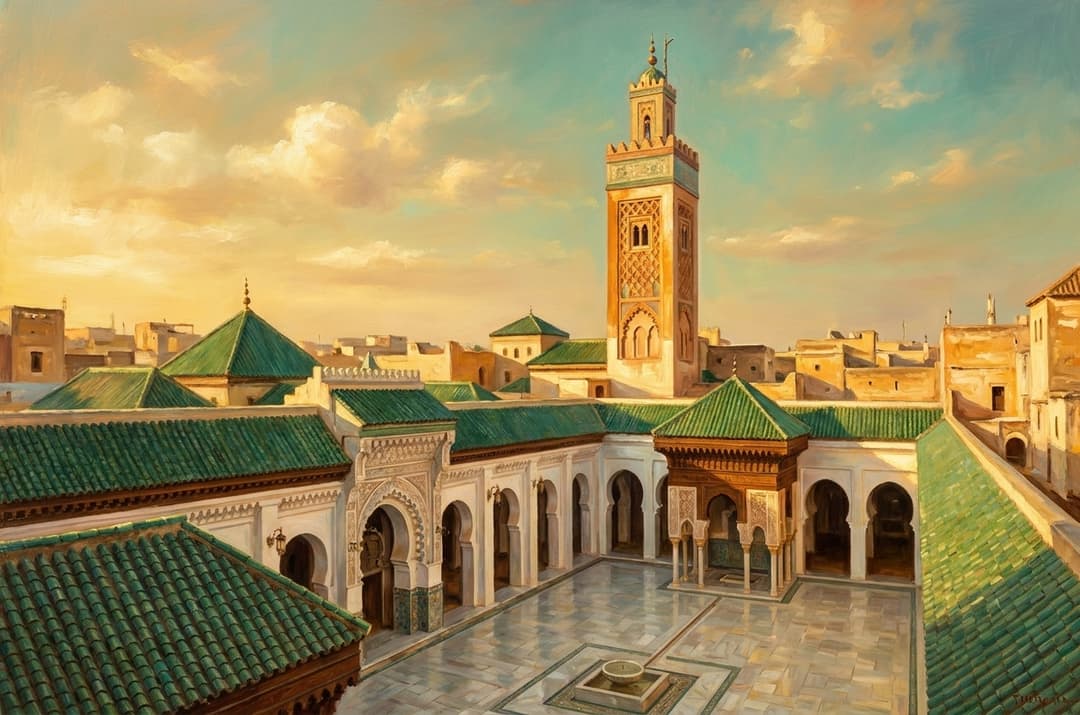
The mosque prayer halls and central marble courtyard remain actively consecrated for Muslim worship and are strictly closed to non-Muslim visitors. Respectful travelers can admire glimpses of the monumental courtyard, carved arches, and zellij tilework through open perimeter doorways such as Bab al-Ward. Surrounding historic madrasas and elevated rooftop terraces across the medina provide breathtaking panoramic views of its emerald-green tiled roofs.
Highlights
- Glimpses into the open-air marble courtyard through Bab al-Ward and Bab al-Shamma'in
- Elevated rooftop views of the emerald-tiled rooflines from Medersa al-Attarine
- The historic 956 CE square minaret visible across the skyline of Fes el-Bali
- The restored 14th-century Marinid library containing ancient scholarly manuscripts
Things to Know
- Interior prayer halls are strictly reserved for Muslim worship only
- Modest attire covering shoulders and knees is mandatory when approaching the perimeter gates
- Navigating the 9,000 car-free medina alleyways is best done with an official licensed guide
- Alleyways surrounding the complex become extremely crowded during Friday noon congregational prayers
Location
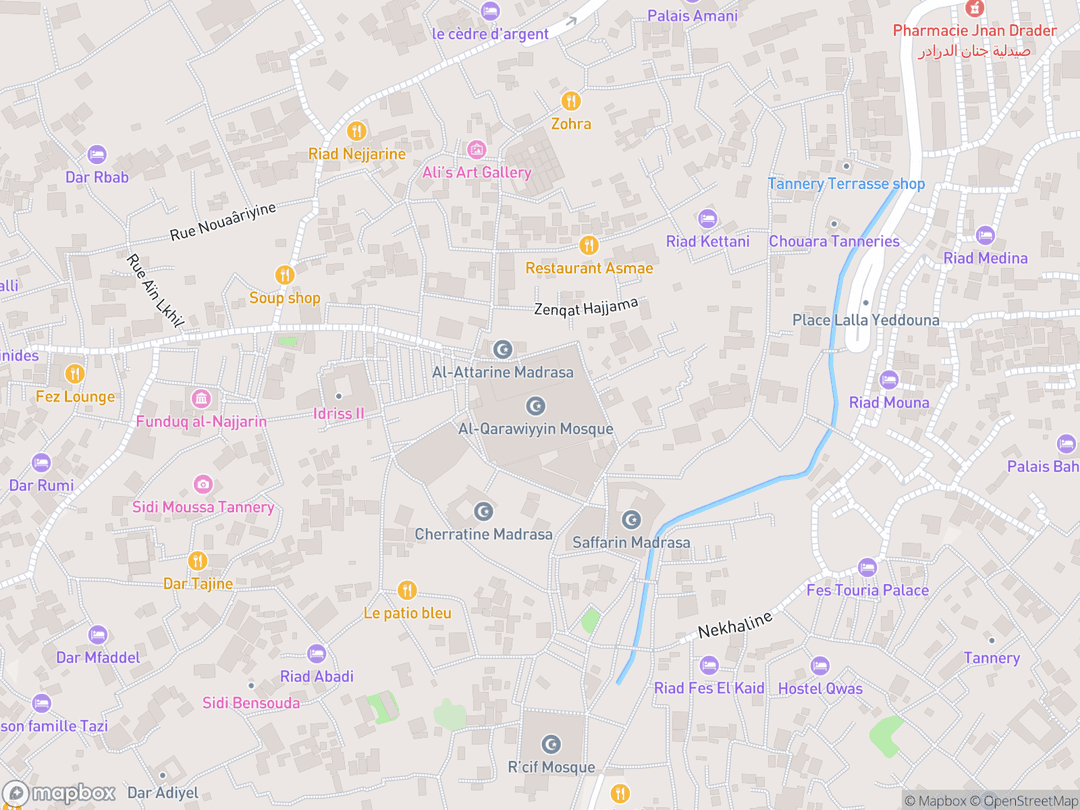
Qayruwan Quarter, Fes el-Bali, Fez, Fès-Meknès, Morocco
Hours: Exterior gates viewable daily between prayer times from 9:00 AM to 6:00 PM; active liturgical services occur five times daily.
Getting There: Located in central car-free Fes el-Bali, reachable on foot from Bab Bou Jeloud via the main pedestrian thoroughfare of Talaa Kebira.
Get DirectionsTips for Your Visit
Rooftop Vantage Points
Visit the rooftop terrace of the nearby Medersa al-Attarine for an unobstructed vantage point overlooking the courtyard and green roofs.
Respect Prayer Times
Avoid congregating near the exterior doorways during Friday midday prayers when thousands of worshippers enter and exit.
Hire a Licensed Guide
Engage an official local guide near Bab Bou Jeloud to effortlessly navigate the dense medina streets surrounding the complex.
About
Founded in 859 CE during the Islamic Golden Age, the University and Mosque of al-Qarawiyyin stands as an enduring monument to faith, scholarship, and pious endowment. Consecrated by a devout Muslim woman named Fatima al-Fihriya, the sanctuary was established through a perpetual religious trust (waqf) dedicated to the worship of God and the pursuit of divine knowledge.
Within the broader Abrahamic family of traditions, physical sanctuaries have long represented sacred spaces where humanity encounters the Divine. While early temples and tabernacles centered on sacrificial altars, Islamic worship emphasizes Tawhid (the absolute unicity of God), eliminating anthropomorphic imagery in favor of pure prayer, Quranic recitation, and intellectual contemplation.
Over eleven centuries, al-Qarawiyyin expanded under successive North African dynasties into a colossal hypostyle congregational mosque capable of holding more than 22,000 worshippers. Recognized by UNESCO as the world's oldest continually operating university, the complex remains the vibrant spiritual heart of medieval Fez.
Gallery
Symbolic Elements
The temple's exterior features intricate carvings, each rich with spiritual meaning:

Tawhid Geometric Zellij
Endless kaleidoscopic mosaic patterns symbolize the indivisible and infinite nature of God. (Tier B)

Kufic Sacred Calligraphy
Chiseled Quranic inscriptions across archways proclaim divine majesty without the use of anthropomorphic imagery. (Tier B)

Paradise Arabesques
Intricately carved floral and foliate stucco ribbons evoke the eternal beauty of heavenly gardens. (Tier B)

The Wooden Anaza
A monumental carved cedar screen demarcates the qibla prayer direction for worshippers gathered in the open courtyard. (Tier B)
Muqarnas Vaulting
Honeycomb ceiling stalactites dissolve structural weight into crystalline geometry reflecting divine light. (Tier B)
Almohad Chandelier
The inverted bronze bell chandelier holding over five hundred oil lamps signifies spiritual light dispelling ignorance. (Tier B)

Ablution Marble Basins
Courtyard fountains provide fresh flowing water for ritual purification before approaching God in solemn prayer. (Tier B)

Emerald Glazed Roof Tiles
Vibrant green glazed terracotta tiles represent spiritual vitality, blessing, and the revered color of Islamic tradition. (Tier B)
Interesting Facts
UNESCO and Guinness World Records certify al-Qarawiyyin as the oldest continuously operating higher education institution in the world. (Tier B)
The entire sanctuary was funded and built through the private wealth and direct personal supervision of a woman, Fatima al-Fihriya. (Tier A)
Fatima's sister Mariam concurrently built the sister Mosque of the Andalusians across the river in Fez. (Tier B)
Future Pope Sylvester II studied here in the tenth century, introducing Arabic numerals and zero to Christian Europe. (Tier B)
Renowned Jewish philosopher and scholar Moses Maimonides lived in Fez and studied among the teachers of al-Qarawiyyin. (Tier B)
The central bronze chandelier holding 509 oil lamps was cast from a massive medieval church bell seized in Andalusia. (Tier B)
Fatima al-Fihriya insisted all construction stone, clay, and timber be quarried exclusively from her own purchased land. (Tier A)
The institution developed the Ijazah, a formal academic teaching license that served as the historical forerunner of modern university degrees. (Tier B)
The mosque preserves its medieval timekeeper chamber containing functional astronomical astrolabes and water clocks. (Tier B)
Common Questions
Can non-Muslims enter the mosque or courtyard?
No, active prayer halls and the central courtyard are strictly restricted to Muslim worshippers.
Why is al-Qarawiyyin famous in world history?
It is recognized by UNESCO and Guinness World Records as the oldest continually operating university on Earth.
Who founded the mosque and university?
It was founded in 859 CE by Fatima al-Fihriya, a pious Muslim woman who dedicated her entire inheritance.
Can visitors tour the famous historic library?
The library is primarily accessible to certified academics and researchers by advance institutional appointment.
Where is the best place to see the mosque's green roof?
The upper terrace of the neighboring Medersa al-Attarine offers the premier elevated panorama of the roofscape.
Featured Stories
The Fast of Fatima al-Fihriya
Ramadan 859
Grief-stricken by the passing of her father and husband, Fatima al-Fihriya pledged her entire inheritance to erect a perpetual sanctuary for her community. Chroniclers record that she maintained a rigorous personal fast every single day from the initial groundbreaking until the first congregational prayers were offered. Her selfless devotion transformed a modest oratory into one of the most influential academies in human history.
Source: The Foundation for Science, Technology and Civilisation
A Pope's Encounter with the East
980
Centuries before the Renaissance, the French scholar Gerbert of Auvergne traveled across the Mediterranean to study the scientific advances of Islamic North Africa. Immersing himself in the lecture circles of al-Qarawiyyin, he encountered Arabic numerals, decimal mathematics, and the revolutionary concept of zero. Upon his elevation as Pope Sylvester II in 999 CE, he introduced these essential mathematical foundations across Christian Europe.
Source: Archnet Digital Library
The Bell of Light
1203
During the campaigns of the Almohad Empire, a colossal church bell was carried from southern Spain across the Strait of Gibraltar to Fez. Rather than melting the bronze down for weapons of war, craftsmen hollowed the bell, inverted its heavy shell, and forged tiers of oil lamp brackets. Suspended beneath the central dome, this former instrument of siege was permanently dedicated to illuminating nightly recitations of the Holy Quran.
Source: Museum With No Frontiers
Timeline
Land Acquisition
Fatima al-Fihriya purchases land in the Kairouanese quarter of Fez using her inherited family wealth.
MilestoneOriginal Consecration
The initial four-nave mosque is consecrated for congregational worship on the first day of Ramadan.
DedicationCordoban Minaret Erection
Caliph Abd al-Rahman III of Córdoba finances the construction of the enduring square stone minaret.
MilestoneAlmoravid Unification
The Almoravid dynasty unifies the twin banks of Fez and establishes al-Qarawiyyin as the chief urban sanctuary.
MilestoneGreat Almoravid Expansion
Sultan Ali ibn Yusuf enlarges the prayer hall into its current 16-nave layout with ornate stucco arches.
RenovationBronze Chandelier Installed
An Almohad bronze chandelier crafted from a repurposed Spanish church bell is suspended in the axial aisle.
MilestoneMarinid Library Founded
Sultan Abu Inan Faris establishes the monumental research library housing thousands of Islamic manuscripts.
MilestoneSaadian Courtyard Pavilions
Sultan Ahmad al-Mansur erects two ornate kiosks in the courtyard modeled on Granada's Alhambra.
RenovationAstronomical Timekeeping Modernized
Alaouite rulers refurbish the timekeeper room with water clocks and astrolabes to regulate solar prayer hours.
MilestoneState University Integration
King Hassan II reorganizes the institution into Morocco's national public university system.
EventComprehensive Library Restoration
Architect Aziza Chaouni completes a multi-year conservation project restoring the historic library and rare codices.
RenovationHistory by Decade
850s — Pious Consecration
Following the migration of Kairouan families to the newly established city of Fez, Fatima al-Fihriya acquired hillside land in the river valley. She initiated quarrying and timber harvesting directly from the property to ensure absolute spiritual purity for the new house of worship. The original four-nave mosque opened for prayer on the first day of Ramadan in 859 CE.
950s — Umayyad Splendor
As the regional influence of the sanctuary expanded, Zenata rulers secured financial backing from the Umayyad Caliphate of Córdoba. Caliph Abd al-Rahman III funded the construction of the monumental square minaret that became the standard for Maghrebi architecture. The city's primary Friday congregational sermon was transferred permanently to al-Qarawiyyin.
1130s–1140s — Almoravid Transformation
Sultan Ali ibn Yusuf initiated the most dramatic architectural expansion in the sanctuary's history, extending the prayer hall to its modern sixteen-nave footprint. Andalusian artisans introduced intricate carved stucco friezes, muqarnas vaulting, and hundreds of whitewashed horseshoe arches. The expansion firmly established al-Qarawiyyin as the supreme theological authority of western Islam.
1270s–1350s — The Marinid Golden Age
The Marinid sultans transformed Fez into their capital, constructing residential colleges around al-Qarawiyyin to feed students into its advanced lecture circles. Sultan Abu Inan founded the historic library in 1349 CE, assembling thousands of scientific, medical, and theological codices. Polymaths such as Ibn Khaldun and Ibn Rushd delivered discourses under its hypostyle colonnades.
1590s — Saadian Refinements
Sultan Ahmad al-Mansur added two magnificent open pavilions at the eastern and western edges of the central marble courtyard. Echoing the celebrated Court of the Lions at the Alhambra in Granada, these kiosks introduced ornate plasterwork, marble columns, and carved cedar eaves. The library collections were simultaneously reorganized and enriched with royal Saadian manuscripts.
1960s–Present — Modern Renaissance
In 1963, King Hassan II integrated the venerable institution into Morocco's modern state university system while safeguarding its traditional madrasa roots. A landmark restoration completed in 2016 preserved its ancient water channels, modernized library security, and restored thousands of delicate medieval texts. Today, it remains an active house of prayer and a beacon of Islamic learning.
Architecture & Facilities
The University and Mosque of al-Qarawiyyin is the quintessential masterpiece of classical Moorish and Hispano-Moresque architecture, characterized by a sprawling hypostyle prayer hall configured in a North African T-plan. Enclosed seamlessly within the urban fabric of the medieval medina, its whitewashed horseshoe colonnades, carved Atlas cedar timber ceilings, and crystalline muqarnas domes create a transcendent environment of rhythmic spatial harmony.
Building Materials
Middle Atlas Cedar
Hand-carved timber beams, corbels, and decorative ceiling panels sourced from Morocco's mountain forests.
Carved Gypsum Stucco
Dense, hand-chiseled plasterwork featuring delicate floral arabesques and Kufic calligraphic friezes.
Zellij Glazed Ceramic
Intricately hand-cut terracotta mosaic tessellations forming vibrant geometric dados and fountain revetments.
Imported Italian Marble
Polished white marble shafts and basins lining the central open-air courtyard and Saadian pavilions.
Glazed Terracotta Tiles
Vibrant emerald-green roof tiles covering dozens of pitched gables across the vast complex.
Interior Features
Hypostyle Prayer Hall
A cavernous worship space supported by 270 pillars arranged across 16 long transversal naves.
The Mihrab Niche
An elaborately decorated prayer niche directing the faithful toward Mecca through intricate plaster carvings.
Almoravid Central Cupola
A monumental 12th-century ribbed dome featuring cascading tiers of delicate muqarnas honeycomb plasterwork.
The Marinid Library
An ancient manuscript chamber containing vaulted reading rooms and climate-controlled historic codex vaults.
Dar al-Muwaqqit
An astronomical chamber housing antique brass astrolabes and water clocks used to calculate daily prayer times.
Temple Grounds
The sanctuary is centered around an open-air marble courtyard measuring 47 by 17 meters, featuring central ablution fountains, polished flagstones, and twin Saadian pavilions.
Additional Facilities
The complex is surrounded by an interconnected ring of medieval residential madrasas, scholarly lecture halls, and specialized research facilities.
Religious Significance
Within Islamic theology, sacred space serves as a dedicated sanctuary for encountering God through disciplined prayer, Quranic recitation, and the communal pursuit of wisdom.
To provide a consecrated center for daily congregational prayer (Salah) and a perpetual charitable endowment (waqf) for advancing Islamic scholarship and moral learning.
Sacred Ordinances
Salah (Daily Congregational Prayer)
The performance of the five prescribed daily prayers in synchronized rows oriented toward the Holy Kaaba in Mecca.
Jumu'ah (Friday Assembly)
The weekly congregational gathering featuring a formal religious sermon (khutbah) followed by collective prayer.
Taharah (Ritual Purification)
Ablution performed at courtyard marble basins to achieve physical and spiritual cleanliness before worship.
I'tikaf (Spiritual Retreat)
Voluntary seclusion within the prayer hall during the final days of Ramadan devoted to meditation and Quran study.
The Waqf as a Sacred Covenant
In Islamic jurisprudence, a waqf represents an irrevocable donation of material property dedicated perpetually to the service of God. By endowing al-Qarawiyyin, Fatima al-Fihriya established a sacred trust that financed professors, sustained impoverished students, and provided continuous maintenance for the house of worship across eleven centuries.
The Unity of Faith and Reason
Al-Qarawiyyin embodies the foundational Islamic conviction that seeking knowledge is itself an essential act of religious worship. Within its arcades, theology, astronomy, mathematics, and medicine were taught beneath the same arches where worshippers bowed in prostration, demonstrating the harmonious synthesis of divine revelation and human intellect.
Sources & Research
Every fact on Temples.org is backed by verified Sources & Research. Each piece of information is rated by source tier and confidence level.
View All Sources (8)
| Field | Source | Tier | Retrieved |
|---|---|---|---|
| About & Historical Background | Archnet Digital Library (opens in a new tab) | B | 2026-03-31 |
| Timeline & Architectural History | Museum With No Frontiers (opens in a new tab) | B | 2026-03-31 |
| Academic Legacy & Foundation | Foundation for Science, Technology and Civilisation (opens in a new tab) | B | 2026-03-31 |
| Scholastic Circles & History | Brown University (opens in a new tab) | B | 2026-03-31 |
| Spatial Analysis & Restoration | Studio MatrX Architecture (opens in a new tab) | B | 2026-03-31 |
| Islamic Architectural Studies | Madain Project (opens in a new tab) | B | 2026-03-31 |
| Geographic Location | Mapcarta Geographic Database (opens in a new tab) | D | 2026-03-31 |
| Entity Disambiguation Data | Wikidata Foundation (opens in a new tab) | B | 2026-03-31 |