Visitor Insights
Visiting Hassan II Mosque
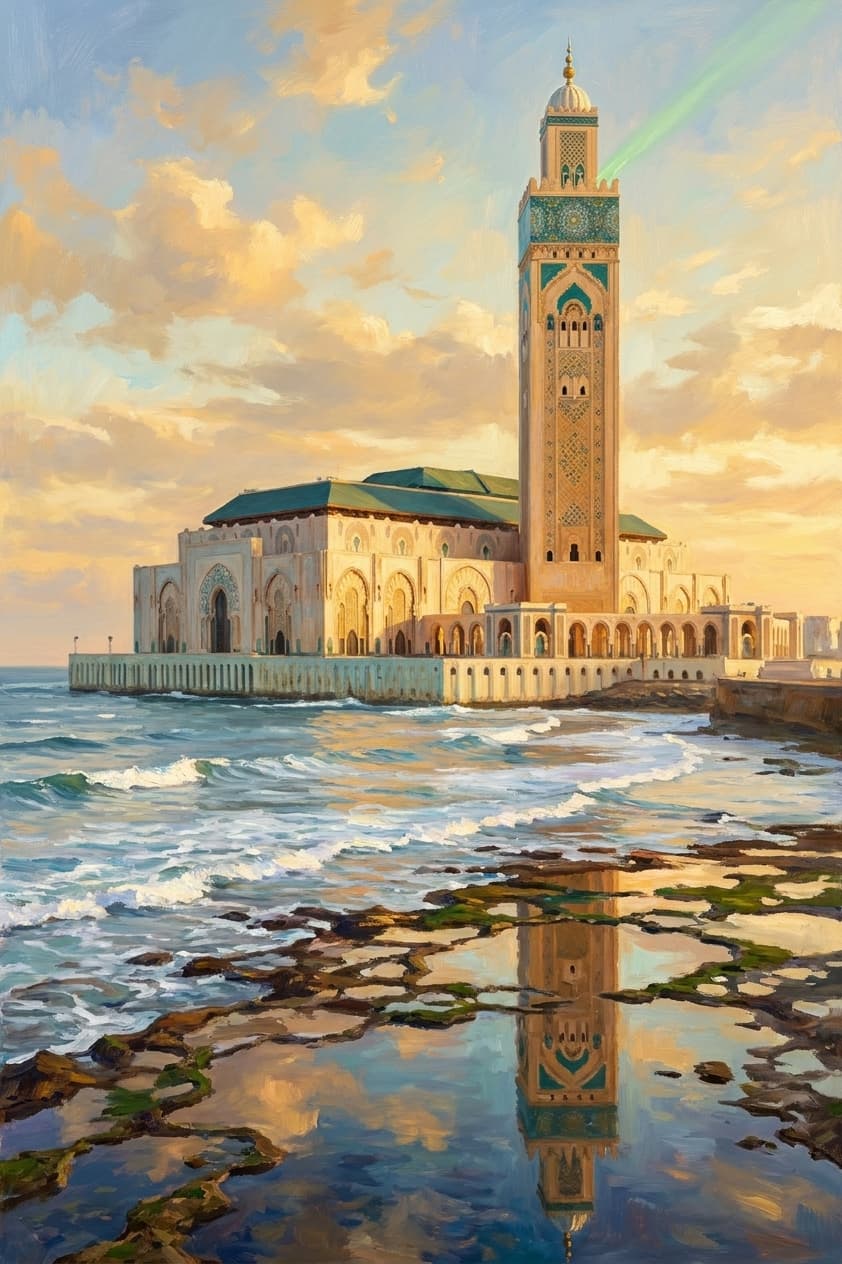
The Hassan II Mosque offers non-Muslim visitors structured guided tours through its primary hall and subterranean ablution facilities. Modest clothing covering shoulders and knees is mandatory, and shoes must be removed before entering carpeted prayer areas. Paved oceanfront esplanades remain open throughout the day for sweeping Atlantic sunset views.
Highlights
- Guided interior access to one of the largest hypostyle prayer halls in the Islamic world.
- View the soaring 1,100-ton retractable roof and delicate hand-carved Atlas cedar ceilings.
- Explore the subterranean ablution level containing 41 carved marble lotus fountains.
- Experience the dramatic oceanfront promontory where Atlantic waves crash against reinforced seawalls.
Things to Know
- Non-Muslim interior admission is permitted solely through ticketed foundation tours outside prayer times.
- Tour schedules are curtailed on Fridays around congregational Jumu'ah prayer and during Ramadan.
- Flash photography, tripods, and drone operations are strictly prohibited inside the complex.
- Visitors receive complimentary tote bags to carry their footwear while inside.
Location
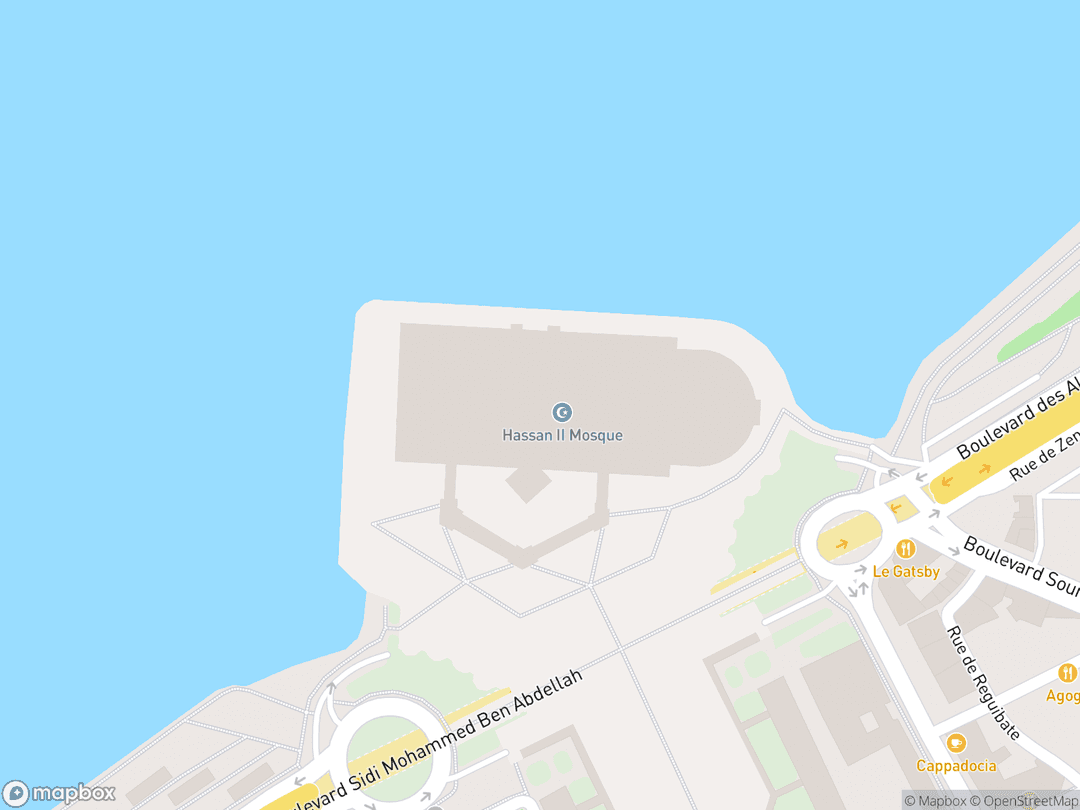
Boulevard Sidi Mohammed Ben Abdallah, 20000 Casablanca, Morocco
Hours: Saturday to Thursday: scheduled tours at 9:00 AM, 10:00 AM, 11:00 AM, 12:00 PM, and 3:00 PM; Friday morning tours at 9:00 AM and 10:00 AM.
Getting There: Located along Boulevard Sidi Mohammed Ben Abdallah; accessible by a 5-minute red taxi ride from Casa-Port railway station or via the underground on-site parking deck.
Get DirectionsTips for Your Visit
Plan Around Prayer Times
Interior tours pause during scheduled daily prayers; plan to arrive early in the morning for uninterrupted access.
Appropriate Attire
Ensure shoulders, knees, and upper arms are completely covered to avoid being denied entrance at security checkpoints.
Sunset on the Esplanade
Walk the outer coastal plazas at dusk when the minaret's green laser illuminates toward Mecca.
About
The Hassan II Mosque (Masjid al-Hassan al-Thani) in Casablanca stands as one of the most ambitious modern sacred complexes in the Islamic world. Conceived by King Hassan II and designed by architect Michel Pinseau, the sanctuary projects into the Atlantic Ocean as an architectural realization of the Quranic verse describing God's throne resting upon the waters.
Completed in 1993, the complex serves as a primary center of Sunni Maliki scholarship, devotion, and communal life within the wider Abrahamic monotheistic lineage. More than ten thousand master artisans collaborated to craft its hand-chiseled zellige mosaics, carved cedar woodwork, and polished marble arcades.
Beyond the vast central prayer hall, the fifteen-hectare cultural complex encompasses an Islamic school (madrasa), an academic library, traditional public baths (hammams), and the Academy of Traditional Arts. It remains one of Morocco's few functioning mosques welcoming global travelers through guided educational tours.
Gallery
Symbolic Elements
The temple's exterior features intricate carvings, each rich with spiritual meaning:

Oceanic Foundation
The sanctuary's projection over the waves reflects Quranic cosmology celebrating water as the primordial element of life.
The Minaret Laser
A continuous green laser beam projects eastward to align the nation's spiritual focus toward Mecca.
The Jamour Finial
Three gilded bronze spheres atop the minaret signify the cosmic realms and the core doctrine of Divine Unity.

Lotus Ablution Fountains
Carved marble lotus petals signify spiritual cleansing and renewal before standing before God.
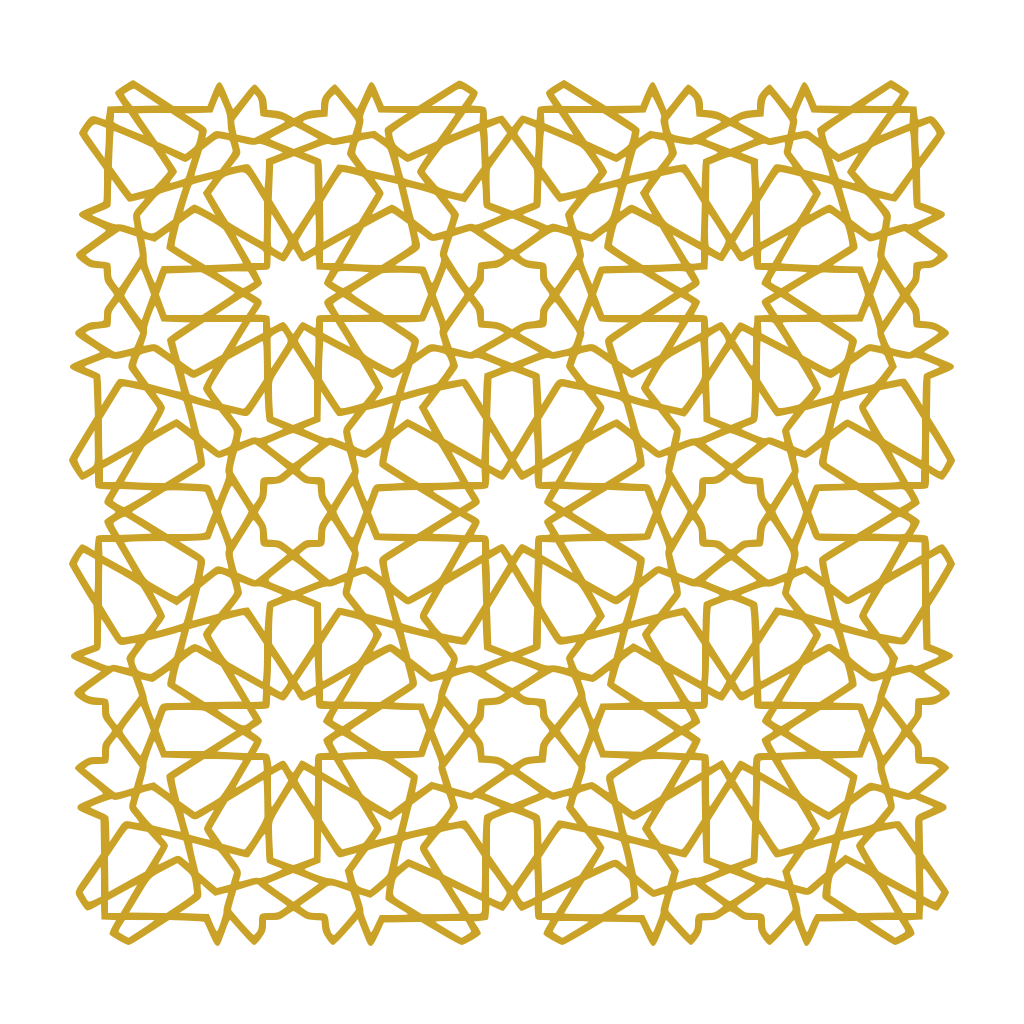
Zellige Geometric Stars
Hand-cut polychromatic terracotta star patterns express the infinite symmetry and orderly beauty of the cosmos.
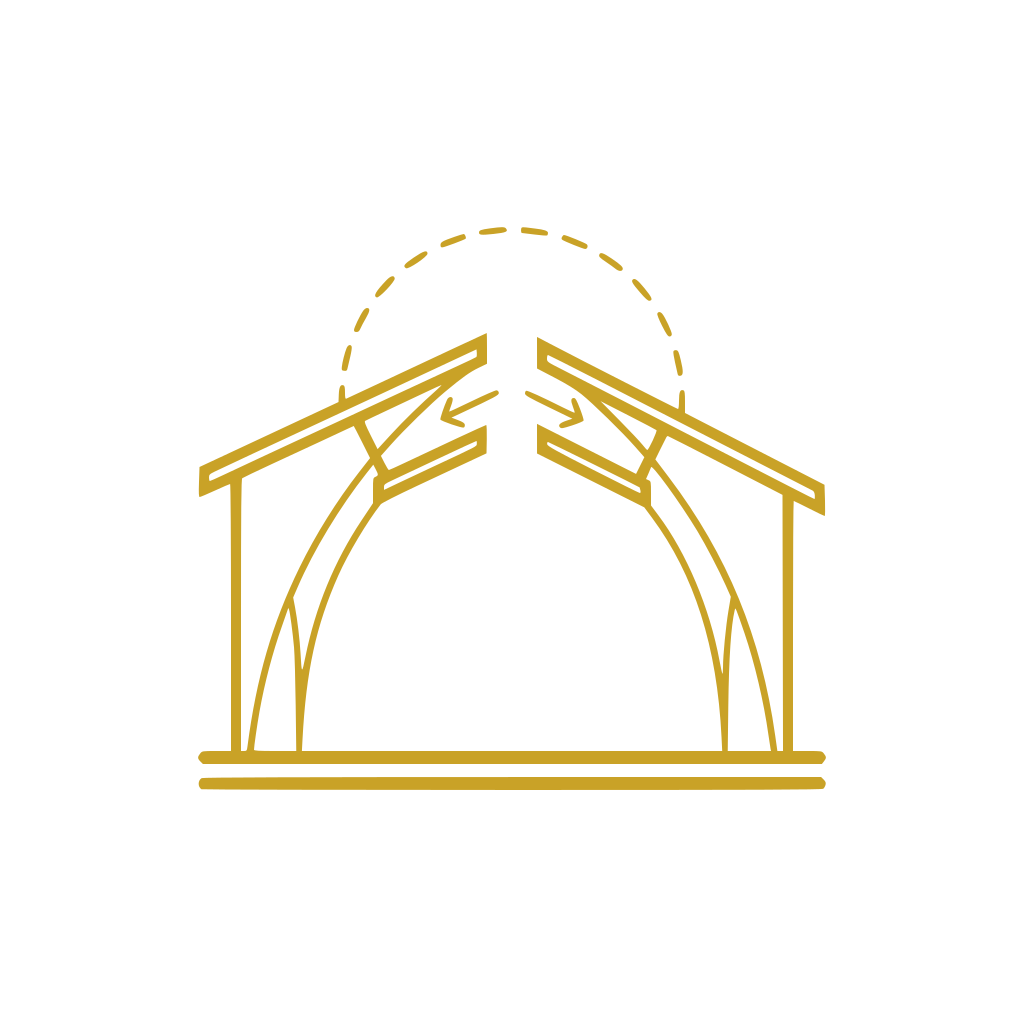
Retractable Cedar Vault
The split sliding roof opens heavenward, underscoring the theological belief that the open sky is God's true dome.
Emerald Glazed Tiles
Vibrant green rooftop ceramics symbolize spiritual serenity, the prophetic tradition, and paradise.

Polylobed Horseshoe Arches
Cusped Moorish arches mark the sacred transition from worldly distraction into consecrated peace.
Interesting Facts
Over twelve million Moroccan citizens contributed to a nationwide public subscription to fund the building (Tier A).
Thirty-six directional speakers concealed within column bases provide crystal-clear acoustic balance across the hall (Tier B).
The 1,100-ton cedar and steel ceiling can retract completely in under five minutes to reveal the open sky (Tier A).
Subterranean levels feature forty-one lotus-shaped ablution fountains carved from Moroccan and Italian marble (Tier A).
Marine caissons and foundation pylons were reinforced to withstand earthquakes reaching 7.0 on the Richter scale (Tier B).
More than 53,000 square meters of fragrant Atlas cedar wood were hand-carved and painted by regional craft guilds (Tier A).
A thirty-kilometer laser beam atop the minaret illuminates every evening pointing directly toward Mecca (Tier A).
Exterior curtain gates were cast from marine bronze and titanium alloys to resist corrosive salt sea spray (Tier B).
The entire marble interior floor includes hydronic underfloor heating to warm barefoot worshippers during winter (Tier A).
Common Questions
Are non-Muslim visitors allowed inside the mosque?
Yes, non-Muslim visitors can enter the main prayer hall and ablution chambers via official foundation-guided tours.
Why is the mosque built over the ocean?
It physically embodies the Quranic verse stating that the throne of God was built upon the waters.
What is the green light shining from the minaret?
It is a directional argon laser that projects thirty kilometers eastward toward the Holy Kaaba in Mecca.
How large is the indoor prayer space?
The hypostyle interior accommodates 25,000 worshippers, with space for another 80,000 on the outdoor esplanade.
Featured Stories
The Royal Vision and the Sea
July 12, 1986
King Hassan II envisioned a monument in Casablanca that would honor his late father while celebrating Morocco's maritime destiny. Standing on the jagged coastline, he sought to ground the sacred architecture in the scripture of divine creation above the waves. The resulting engineering reclaimed fifteen hectares of wild Atlantic shelf, creating a spiritual lighthouse visible to inbound ocean vessels.
Source: Fondation de la Mosquée Hassan II
The Sovereign Subscription
July 1988
When the crown announced a nationwide public subscription to construct the mosque, citizens from every province responded enthusiastically. Millions of families, expatriates, and local merchants purchased symbolic certificates that funded nearly half of the vast project. This shared sacrifice transformed the modern engineering marvel into a beloved collective patrimony owned by the people.
Source: Fondation de la Mosquée Hassan II
The Gathering of Ten Thousand Guilds
1989
To adorn the colossal concrete frame, the royal cabinet assembled more than ten thousand traditional artisans from historic craft strongholds like Fez, Meknes, and Marrakech. Master sculptors carved geometric arabesques into fresh plaster, while ceramicists cut millions of colored enamel tiles by hand. Their tireless round-the-clock labor revitalized centuries-old guild lineages that now train new generations.
Source: Académie des Arts Traditionnels
Timeline
Conceptual Genesis
King Hassan II ascends the throne and envisions a monument honoring King Mohammed V in Casablanca.
EventRoyal Announcement
King Hassan II announces plans to construct a landmark oceanfront mosque in Morocco's economic capital.
MilestoneGroundbreaking
The royal foundation stone is officially laid upon a reclaimed Atlantic coastal promontory.
component.timeline.groundbreakingNational Subscription
Millions of Moroccan citizens contribute several billion dirhams during a nationwide public fundraising campaign.
EventCraftsmen Mobilization
Over 10,000 master guild artisans assemble in Casablanca to carve stone, plaster, and cedar.
EventMinaret Completion
The 210-meter square masonry tower is capped with its crowning gilded bronze finial spheres.
MilestoneDedication & Consecration
The mosque is inaugurated by King Hassan II on the eve of the Prophet's birthday.
DedicationCultural Tour Protocols
Morocco institutes formal multilingual guided tours for international non-Muslim visitors.
MilestoneMarine Rehabilitation
Specialized engineering teams initiate comprehensive cathodic protection across underwater caissons.
RenovationMosque Foundation Established
Royal decree establishes the Fondation de la Mosquée Hassan II to manage structural conservation.
MilestoneAcademy Inauguration
The Academy of Traditional Arts opens on the mosque grounds to preserve historic Moroccan crafts.
EventNational Patrimony Classification
The complex is formally protected as Moroccan National Material Patrimony by ministerial decree.
MilestoneHistory by Decade
1960s–1970s — Conceptual Genesis
I wish Casablanca to be endowed with a large, fine building of which it may be proud.
Following the passing of King Mohammed V in 1961, King Hassan II observed that Morocco's primary industrial port lacked a spiritual sanctuary matching ancient royal cities. Initial cabinet discussions during the 1970s focused on establishing a landmark structure along the coastal frontier. Architectural concepts centered on anchoring Moroccan cultural sovereignty through monumental sacred design.
1980s — Mobilization and Craft Renaissance
Construction commenced in 1986 under general contractor Bouygues, requiring extensive coastal reclamation along the rocky Atlantic ledge. A historic national fundraising campaign in 1988 mobilized millions of citizens to financially support the ambitious building. Over ten thousand guild craftsmen relocated to Casablanca to hand-cut zellige mosaics, carve plaster arches, and shape Atlas cedar vaults.
1990s — Dedication and Cultural Openness
The mosque was officially consecrated on August 30, 1993, coinciding with the birth anniversary of the Prophet Muhammad (Mawlid al-Nabi). International dignitaries attended the inaugural prayers beneath the illuminated minaret. In 1994, the royal administration established structured guided tour guidelines, welcoming international non-Muslim visitors to experience Islamic architecture directly.
2000s — Marine Preservation and Foundation
Aggressive marine humidity and ocean wave action necessitated major structural interventions to combat chloride corrosion along underwater concrete caissons. Moroccan engineers carried out comprehensive repairs from 2005 to 2008, introducing cathodic electrical protection systems. In 2009, King Mohammed VI established a dedicated royal foundation to ensure ongoing institutional stewardship.
2010s–Present — Education and Material Patrimony
The opening of the Academy of Traditional Arts on site in 2012 ensured that traditional Moroccan building techniques would be taught as accredited academic disciplines. Classified as National Material Patrimony in 2015, the mosque complex remains Casablanca's spiritual centerpiece. Today, the complex integrates green lighting retrofits and structural monitoring to preserve its oceanic setting.
Architecture & Facilities
The Hassan II Mosque exemplifies the Neo-Moorish and Moroccan-Andalusian revivalist tradition, expanding medieval Almohad and Marinid proportions into an epic twentieth-century framework. Designed by Michel Pinseau, its reinforced concrete superstructure is completely cloaked in traditional hand-carved stone, ornamental plasterwork, and polychromatic tilework, fusing historic architectural geometry with contemporary civil engineering over the ocean.
Building Materials
Tafraoute Granite
Quarried from the Anti-Atlas mountains to face heavy structural load-bearing piers.
Khemisset and Agadir Marble
Polished native Moroccan marble used for interior wall paneling and columns.
Atlas Cedar
Sustainably harvested from Middle Atlas forests and intricately carved for ceilings.
Glazed Terracotta Zellige
Hand-cut enamel tiles manufactured in traditional ceramic kilns of Fez and Meknes.
Venetian Murano Crystal
Fifty-six monumental cast chandeliers imported from Italy to illuminate the hall.
Marine Bronze and Titanium
Corrosion-resistant custom alloys cast for massive outer hydraulic curtain gates.
Interior Features
Central Hypostyle Nave
Vast three-aisled prayer hall sheltering 25,000 congregants beneath soaring polylobed arches.
Cedar Mezzanine Galleries
Elevated screening galleries along north and south flanks accommodating 5,000 women.
Subterranean Ablution Hall
Sprawling chamber featuring forty-one hand-carved marble lotus purification fountains.
Traditional Moroccan Hammams
Six-thousand-square-meter thermal bathing complex with heated, warm, and cold pools.
Temple Grounds
A nine-hectare paved esplanade made of polished granite and ceramic mosaics accommodates 80,000 outdoor worshippers, encircled by formal gardens and oceanfront promenades.
Additional Facilities
The complex incorporates an academic research library, an Islamic madrasa, a cultural museum, and the Academy of Traditional Arts.
Religious Significance
Within the Islamic theological tradition and the broader Abrahamic lineage, the sanctuary serves as a dedicated dwelling of congregational worship, spiritual purification, and humble submission (sujud) before the One God (Allah). As an active Sunni Maliki cathedral-mosque, the Hassan II Mosque brings classical scriptural devotion into dialogue with the natural cosmos.
To serve as a national spiritual sanctuary, theological academy, and architectural embodiment of divine praise upon the ocean.
Sacred Ordinances
Salat (Congregational Prayer)
Five daily prayers facing eastward toward Mecca, uniting believers across social divisions.
Jumu'ah (Friday Assembly)
Weekly congregational service featuring the khutbah (sermon) and unified communal prostration.
Wudu (Ritual Purification)
Prescribed ablution with running water before formal worship, symbolizing spiritual cleansing.
I'tikaf and Tarawih
Extended nocturnal prayers and spiritual retreats during the holy month of Ramadan.
The Theology of Divine Signs in Nature
Islamic scripture emphasizes that the natural elements serve as living signs (ayat) testifying to the Creator's power. Cantilevering the mosque over Atlantic breakers honors the Quranic depiction of the celestial throne over the waters, allowing worshippers to perceive the ocean's expanse during prayer.
Aniconism and Geometric Order
Upholding the strict Abrahamic prohibition against idolatry and graven images, the interior relies entirely on geometric interlaces, arabesques, and Quranic calligraphy. These infinite repeating patterns turn the human mind toward the transcendence, order, and eternal nature of God.
Sources & Research
Every fact on Temples.org is backed by verified Sources & Research. Each piece of information is rated by source tier and confidence level.
View All Sources (9)
| Field | Source | Tier | Retrieved |
|---|---|---|---|
| About & Historical Background | Fondation de la Mosquée Hassan II de Casablanca (opens in a new tab) | A | 2026-03-31 |
| Architecture & Structural Specifications | BYMARO (Bouygues Construction) (opens in a new tab) | B | 2026-03-31 |
| Artisanal Craftsmanship & Traditional Guilds | Académie des Arts Traditionnels (opens in a new tab) | A | 2026-03-31 |
| Timeline & Dedication Records | Atalayar Entre dos Orillas (opens in a new tab) | B | 2026-03-31 |
| Religious Significance & Architectural Legacy | Islamic Heritage Foundation (opens in a new tab) | B | 2026-03-31 |
| Materials & Marine Engineering History | Historic Buildings Research (opens in a new tab) | C | 2026-03-31 |
| Visitor Logistics & Operational Guidelines | Sahara Discovery Tours (opens in a new tab) | D | 2026-03-31 |
| Monographic Architectural Review | Morocco Travel Land (opens in a new tab) | C | 2026-03-31 |
| Civic Heritage & Historical Classification | Marrakech Cultural Heritage Records (opens in a new tab) | C | 2026-03-31 |