Visitor Insights
Visiting Koutoubia Mosque
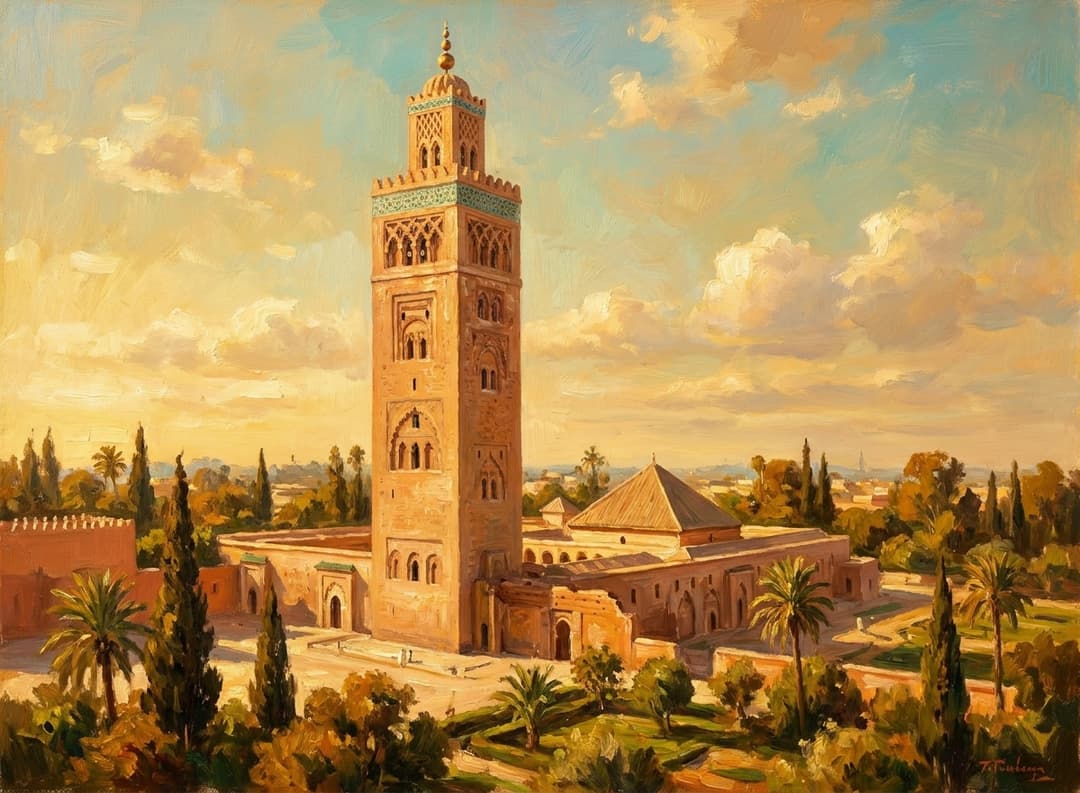
The Koutoubia Mosque stands at the physical and cultural core of Marrakesh, immediately southwest of Jemaa el-Fnaa square. While the interior prayer hall is strictly reserved for Muslim worship, the exterior foundations, towering minaret, and fragrant surrounding gardens remain fully accessible to all visitors.
Highlights
- Excavated stone pillar bases of the twelfth-century First Koutoubia Mosque
- The 77-meter sandstone minaret decorated with Almohad sebka tracery
- Lalla Hasna gardens filled with orange groves, rose beds, and water basins
Things to Know
- Non-Muslim travelers may not enter the interior prayer hall or climb the minaret
- Modest clothing covering shoulders and knees is recommended out of respect for worshippers
- The surrounding plaza grows vibrant at twilight during the Maghrib call to prayer
Location
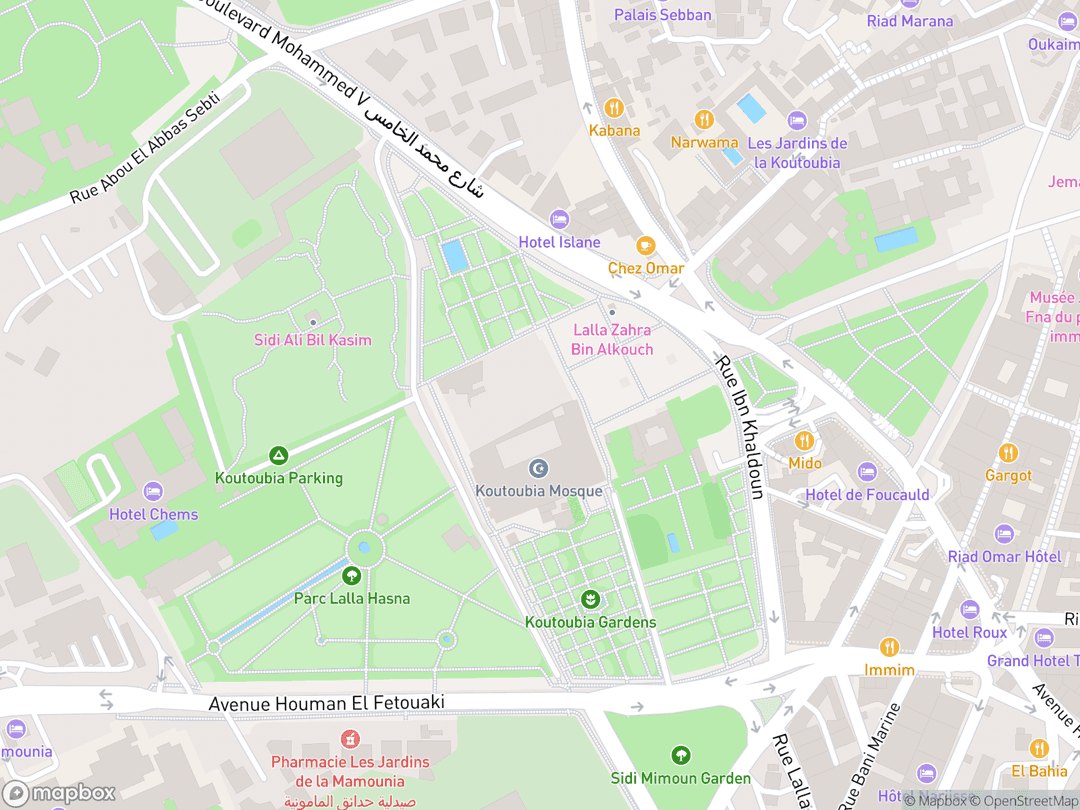
Avenue Mohammed V, Medina of Marrakesh, 40000, Morocco
Hours: Exterior gardens and plazas open 24 hours daily; interior open exclusively to practicing Muslims during prayer times.
Getting There: Located a two-minute walk southwest of Jemaa el-Fnaa along Avenue Mohammed V, with convenient taxi drop-off along Avenue Hommane Al Fatouaki.
Get DirectionsTips for Your Visit
Golden Hour Photography
Visit the southern gardens at sunset when fading desert light illuminates the pink sandstone in deep amber and crimson tones.
Quiet Respect at Prayer Call
Pause respectfully along the garden walkways as the melodious adhan echoes from the upper lantern across the medina.
About
Rooted in the shared Abrahamic tradition of pure monotheism (Tawhid), the Koutoubia Mosque serves as Marrakesh's premier congregational sanctuary. Like early tabernacles and biblical houses of assembly, it provides a sacred space for scriptural recitation, spiritual renewal, and communal prostration before the indivisible Creator.
Unlike liturgical traditions centered upon sacrificial altars or sacred iconography, the mosque's architecture is purely directional. Every structural line aligns the congregation horizontally toward Mecca along the qibla axis, uniting worshippers in egalitarian rows behind the imam without distinction of rank.
Commissioned in 1158 by Caliph Abd al-Mu'min, the standing sanctuary was built to rectify an astronomical misalignment discovered in an earlier adjacent structure. Its monumental seventy-seven-meter sandstone minaret stands as the enduring architectural beacon of southern Morocco and the prototype for sister towers across the Mediterranean.
Gallery
Symbolic Elements
The temple's exterior features intricate carvings, each rich with spiritual meaning:
The Directional Mihrab
The arched prayer niche focuses the communal devotion of all worshippers directly toward the Holy Kaaba in Mecca.
Ascending Finial Spheres
The tiered metallic globes crowning the spire symbolize the progressive ascension of earthly, angelic, and divine cosmic realms.

Sebka Diamond Relief
Interlacing lozenge brickwork on the upper tower faces represents the infinite mathematical unity and order of creation.

The Muezzin Platform
Elevated high above urban distractions, the open lantern platform amplifies the daily vocal proclamation of divine oneness.
Qur'anic Epigraphic Bands
Carved stucco and turquoise tile inscriptions proclaim divine sovereignty without relying on physical figurative depictions.
The Prophetic Minbar
The stepped pulpit signifies the continuity of moral instruction descending directly from the historical platform of the Prophet Muhammad.

Purification Water Fountains
Courtyard basins provide the fresh flowing water required for ceremonial ablutions before entering sacred prostration.
Atlas Cedar Coffering
Carved geometric timber ceilings evoke the majesty of natural creation while shielding the sprawling congregation below.
Interesting Facts
Visitors can still walk among the excavated column bases and floor trenches of the ruined First Koutoubia directly beside the active mosque (Tier B).
Satellite surveys reveal that the second mosque is ironically oriented slightly further south than the original structure it sought to correct (Tier B).
Over one hundred manuscript copyists and legal scribes once clustered around the plaza, giving the monument its enduring name (Tier B).
The tower served as the direct architectural prototype for the Giralda in Seville and the Hassan Tower in Rabat (Tier A).
Municipal zoning laws in Marrakesh legally prohibit modern structures from exceeding the 77-meter height of the minaret (Tier B).
The minaret interior contains a wide inclined cobblestone ramp rather than stairs, allowing a horse or mule to reach the upper balcony (Tier A).
Medina legend claims the fourth sphere of the finial was cast from pure gold jewelry melted down by a caliph's wife in fasting penance (Tier C).
British Prime Minister Winston Churchill was so captivated by the minaret that he painted it for President Franklin D. Roosevelt in 1943 (Tier B).
Common Questions
Can non-Muslim visitors enter the interior of the Koutoubia Mosque?
Entry into the active prayer hall is strictly reserved for practicing Muslims in accordance with Moroccan heritage regulations.
Why were two sister mosques built right next to each other?
The second mosque was commissioned in 1158 to correct an astronomical misalignment toward Mecca identified in the first hall.
Why is the site called the Mosque of the Booksellers?
The name commemorates over one hundred manuscript scribes and bookbinders who maintained market stalls around its base.
How tall is the Koutoubia minaret?
The tower reaches seventy-seven meters from the ground to the pinnacle of its uppermost bronze orb.
Featured Stories
The Dual Sanctuary Paradox
1158
When Caliph Abd al-Mu'min discovered that his freshly consecrated congregational mosque leaned five degrees off the idealized azimuth toward Mecca, his commitment to sacred alignment led him to commission a replacement immediately adjacent. Rather than tearing down the active sanctuary, both massive halls operated in parallel for decades to accommodate the swelling capital. The adjoining ruins remain a visible testament to the Almohad insistence on liturgical precision.
Source: Historical & Architectural Records
The Masterpiece Spared by Conquerors
April 1147
Upon taking Marrakesh, puritanical Almohad soldiers dismantled nearly every royal and religious monument of the preceding dynasty to cleanse the city. Yet when Caliph Abd al-Mu'min inspected the breathtaking wooden minbar crafted in Córdoba, its sublime Marquetry and ivory inlay moved him to spare it from destruction. Reverently relocated into the new sanctuary, the sacred pulpit survived for centuries as a summit of Islamic craft.
Source: Historical Chronicles
The Wartime Sunset of 1943
January 1943
Following the historic Casablanca Conference during World War II, Winston Churchill insisted that Franklin D. Roosevelt travel with him to Marrakesh to witness the sunset over the Koutoubia minaret. Watching the desert dusk cast warm crimson light across the tower with the snowy Atlas Mountains behind, Churchill declared the vista the loveliest on earth. He subsequently rendered the scene in oil paint, producing his only wartime artistic canvas.
Source: Diplomatic Memoirs
Timeline
Almohad Conquest of Marrakesh
Caliph Abd al-Mu'min captures the city and orders the construction of a new imperial congregational mosque.
MilestoneCompletion of the First Mosque
The initial sanctuary is consecrated atop the grounds of the former Almoravid royal fortress.
DedicationInauguration of the Second Mosque
Inaugural prayers commence in the newly aligned southern hall following astronomical recalculations.
DedicationPassing of Caliph Abd al-Mu'min
The founding caliph passes away with both sister sanctuaries operating simultaneously side by side.
MilestoneMinaret Construction Commences
Caliph Abu Ya'qub Yusuf begins erection of the monumental square sandstone minaret shaft.
MilestoneInstallation of the Gilded Finial
Caliph Abu Yusuf Ya'qub al-Mansur completes the tower with its upper lantern and bronze finial spheres.
DedicationFlourishing of the Booksellers Market
More than one hundred manuscript stalls surround the sanctuary, permanently giving the mosque its enduring name.
EventSaadian Dynasty Restoration
Saadian rulers restore Marrakesh as capital and safeguard the historic wooden minbar within the prayer hall.
EventSkyline Height Ordinance
Urban planning bylaws establish the 77-meter minaret as the definitive maximum building height in Marrakesh.
MilestoneUNESCO World Heritage Inscription
The mosque is formally protected as a central landmark within the Medina of Marrakesh World Heritage site.
MilestoneEarthquake Structural Resilience
The 800-year-old minaret withstands a magnitude 6.8 earthquake with only superficial surface cracking.
EventHistory by Decade
1140s–1150s — Conquest and Imperial Alignment
Following the Almohad capture of Marrakesh in 1147, Caliph Abd al-Mu'min commissioned a grand mosque atop the ruins of the Almoravid royal citadel. When religious scholars detected a slight deviation from Mecca's true direction, construction commenced immediately on a corrected sister sanctuary. Congregational prayers officially commenced in the second hall in September 1158, establishing the architectural heart of the empire.
1180s–1190s — Erection of the Great Minaret
Under Caliph Abu Yusuf Ya'qub al-Mansur, master stonemasons completed the towering 77-meter square minaret. Fitted with an ascending internal ramp instead of stairs, the tower was crowned with polylobed arches, turquoise tile friezes, and gleaming bronze globes. Its disciplined proportions became the standard for major minarets across Morocco and Moorish Spain.
1200s–1500s — The Golden Age of the Booksellers
During the medieval period, the exterior esplanade became an intellectual hub occupied by over one hundred manuscript copyists, binders, and scriptural scholars. While the original northern mosque gradually fell into disuse, the southern hall remained the civic and religious centerpiece of the city. Saadian sultans subsequently fortified the sanctuary and preserved its priceless Andalusian furnishings.
1910s–1980s — Heritage Legislation and Global Status
Early twentieth-century preservation bylaws established the minaret as the immutable height ceiling of Marrakesh, preventing modern developments from overshadowing the monument. In 1962, the historic twelfth-century wooden minbar was moved to El Badi Palace for specialized conservation. UNESCO inscribed the mosque within the Medina of Marrakesh World Heritage site in 1985.
2020s — Seismic Endurance and Living Devotion
In September 2023, a magnitude 6.8 earthquake struck the High Atlas range southwest of Marrakesh, causing widespread devastation across the region. The Koutoubia minaret demonstrated astonishing structural integrity, sustaining only superficial plaster fissures. Today, the mosque continues its historic calling, gathering tens of thousands of worshippers for daily congregational devotion.
Architecture & Facilities
The Koutoubia Mosque stands as the preeminent masterpiece of mature Almohad architecture, embodying an austere refinement of the Hispano-Moorish tradition that favors balanced proportions and disciplined geometry over flamboyant decorative excess.
Building Materials
Gueliz Pink Sandstone
Quarried from Jbel Gueliz, this local stone forms the monumental foundation courses and lower minaret shaft.
High-Fired Terracotta Brick
Dense baked bricks construct the structural vaults, internal chambers, and delicate ornamental sebka lozenges.
Atlas Mountain Cedarwood
Aromatic cedar timbers support the sprawling pitched roofs and frame the intricately carved interior ceiling panels.
Zellij Glazed Ceramic
Turquoise, white, and green enameled ceramic tiles form the prominent decorative frieze around the minaret platform.
Interior Features
Hypostyle Prayer Hall
A vast carpeted sanctuary featuring seventeen parallel naves supported by over one hundred whitewashed horseshoe arches.
Central Axial Nave
A heightened central aisle that guides congregants from the open northern courtyard to the primary prayer niche.
The Mihrab Niche
A deep semicircular horseshoe arch set into the southern wall that establishes the spatial orientation toward Mecca.
Internal Ramp Shaft
A broad cobblestone-paved incline winding through six stacked vaulted rooms to access the upper battlements.
Temple Grounds
The sanctuary is surrounded by the picturesque Lalla Hasna gardens, encompassing tranquil rose gardens, citrus groves, and the excavated stone footings of the First Koutoubia.
Additional Facilities
Public facilities include paved pedestrian promenades, visitor orientation displays, and segregated subterranean ablution chambers adjacent to the perimeter gates.
Religious Significance
Within Islamic theology, the mosque embodies pure Abrahamic monotheism (Tawhid), providing an unadorned sanctuary where creation stands before the Creator without physical mediators, sacrificial altars, or representational images.
To gather the faithful in unified egalitarian rows for communal prayer, scriptural reflection, and daily remembrance facing the Holy Kaaba in Mecca.
Sacred Ordinances
Salah (Daily Prayers)
Five prescribed daily liturgical services performed in neat horizontal rows behind the congregational leader.
Jumu'ah (Friday Gathering)
The weekly congregational service highlighted by a two-part moral and theological sermon delivered from the minbar.
Adhan (The Call to Prayer)
The public proclamation of divine oneness chanted across the city five times daily from the summit of the minaret.
Wudu (Ritual Ablution)
The ceremonial purification of face, hands, and feet with fresh water before crossing onto the prayer rugs.
The Spatial Orientation of the Qibla
Unlike temples oriented toward internal relics or rising celestial bodies, every architectural element of the Koutoubia directs attention toward Mecca. This horizontal alignment unites the local assembly into a global circle of worship converging upon the sacred Kaaba.
Aniconism and Geometric Harmony
Rejecting figurative portraiture, Almohad designers deployed endless geometric arabesques and Qur'anic calligraphy to convey the infinite harmony, balance, and majesty of the divine realm.
Sources & Research
Every fact on Temples.org is backed by verified Sources & Research. Each piece of information is rated by source tier and confidence level.
View All Sources (9)
| Field | Source | Tier | Retrieved |
|---|---|---|---|
| Architecture & Structural History | Aga Khan Documentation Center at MIT (opens in a new tab) | B | 2026-03-30 |
| Historical Minbar & Artisanal Woodwork | The Metropolitan Museum of Art (opens in a new tab) | A | 2026-03-30 |
| About & Architectural Overview | Islamic Architectural Heritage Database (opens in a new tab) | A | 2026-03-30 |
| Qibla Alignment & Liturgical Orientation | Qibla Orientation Studies (opens in a new tab) | A | 2026-03-30 |
| Archaeological Surveys & Orientation | Nabataea Islamic Studies Survey (opens in a new tab) | B | 2026-03-30 |
| Art History & Medieval Architecture | Art of the Middle Ages (opens in a new tab) | B | 2026-03-30 |
| Visitor Insights & Regional Heritage | Feel Morocco Travel (opens in a new tab) | C | 2026-03-30 |
| Visitor Experience & Logistics | Marrakech Insiders (opens in a new tab) | D | 2026-03-30 |
| Visitor Access & Medina Context | Private Tours Marrakech (opens in a new tab) | D | 2026-03-30 |