Visitor Insights
Visiting Boudhanath Stupa
Boudhanath is an active, open-air sanctuary immersed within a vibrant circular urban plaza. Visitors participate in kinetic devotion by circumambulating clockwise alongside red-robed monastics, resident Tibetan elders, and international pilgrims. Early mornings and twilight offer the most transcendent atmospheres of butter lamps, chanting, and juniper incense.
Highlights
- Circumambulating the massive plinth terraces alongside chanting Tibetan elders and monks.
- Spinning the hundreds of embossed brass prayer wheels lining the perimeter wall.
- Ascending to the whitewashed upper terraces for panoramic views of the gilded spire.
- Viewing the radiant saffron-wash patterns applied during major lunar celebrations.
Things to Know
- Always walk around the stupa and spin all prayer wheels in a clockwise direction.
- Remove footwear before stepping onto the whitewashed upper terraces.
- Dress respectfully with shoulders and knees covered throughout the sacred precinct.
- Modest entrance fees are collected at municipal booths for foreign and SAARC visitors.
Location
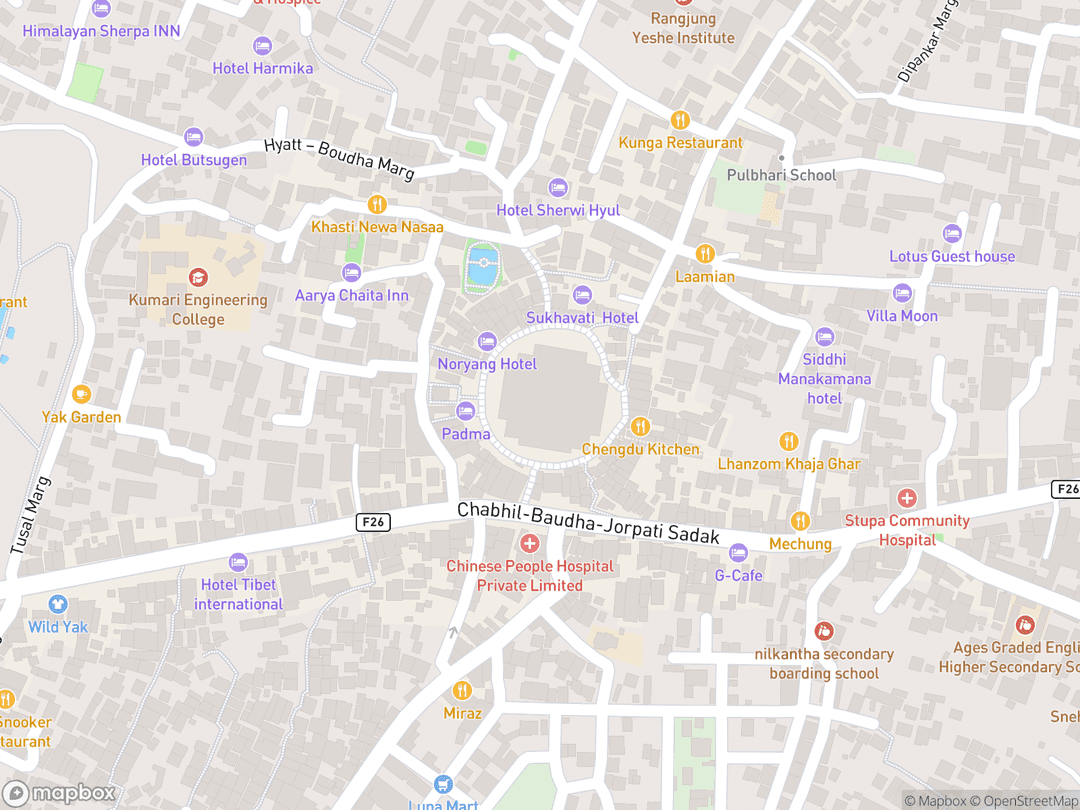
Boudha Road, Boudha, Kathmandu 44600, Bagmati Province, Nepal
Hours: Open 24 hours daily; ticketing booths operate from 06:00 to 19:00
Getting There: Located in northeastern Kathmandu, approximately 4.5 km from Tribhuvan International Airport and 6.5 km from Thamel via local taxi or bus.
Get DirectionsTips for Your Visit
Dawn Circumambulation
Visit between 05:30 and 07:30 to experience the morning kora when monks and locals circumambulate amidst aromatic juniper smoke.
Rooftop Perspectives
Visit surrounding terrace cafes around dusk to observe butter lamp illuminations and capture sweeping views of the painted harmika.
Butter Lamp Offerings
Devotees can sponsor and light traditional butter lamps at dedicated prayer houses along the ground-level ambulatory.
Monastery Courtyards
Take time to explore the historic gompas tucked into the adjacent alleyways just off the main circular plaza.
About
Boudhanath Stupa stands as one of the largest spherical stupas in the world and the paramount center of Tibetan Buddhist life in Nepal. Rooted in the shared Dharmic continuum of karma, samsara, and merit-making, the monument serves as an architectural embodiment of the Dharmakaya, the enlightened mind of all Buddhas. Founded during the Licchavi dynasty and expanded across centuries of Newar and Tibetan devotion, it anchors an ancient trans-Himalayan trade route.
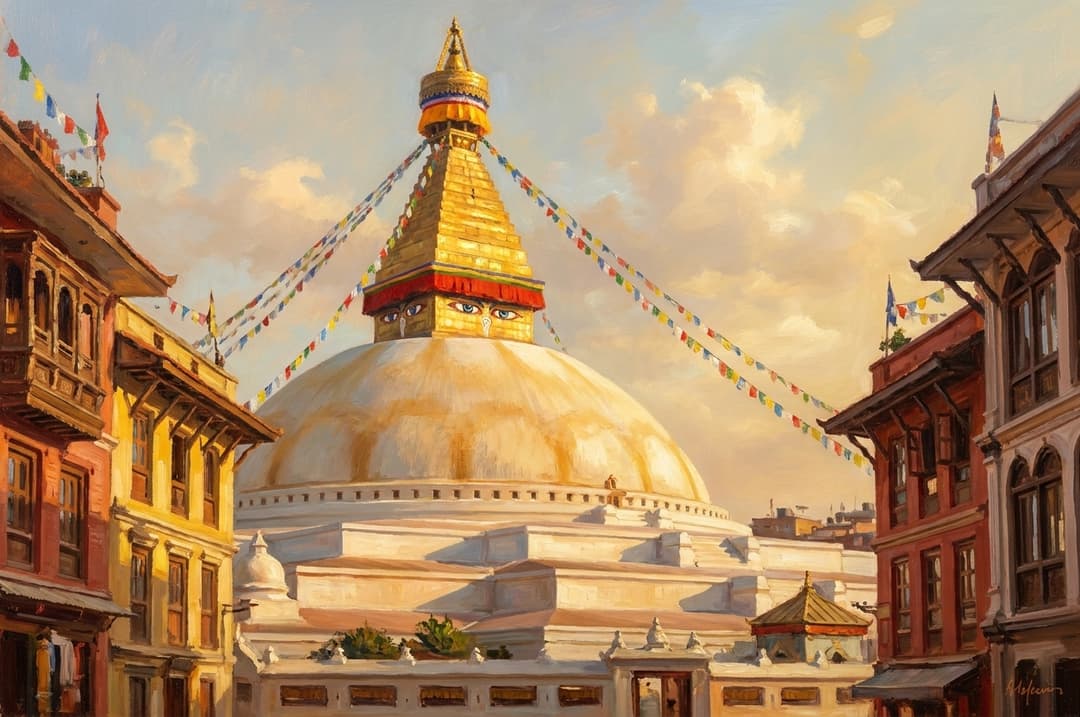
Rising above the Kathmandu Valley floor, the stupa forms a three-dimensional cosmic mandala resting on stepped octagonal terraces. Its whitewashed dome symbolizes the element of water, while the square harmika displays the painted All-Seeing Eyes of the Buddha gazing across the cardinal directions. Above, a thirteen-tiered gilded spire represents the successive stages of spiritual awakening leading to complete liberation.
Following the mid-twentieth-century diaspora, Boudhanath transformed into an international sanctuary for Himalayan monasticism, ringed by over fifty active monasteries. Surviving foreign invasions and devastating seismic events, including the 2015 earthquake, the stupa was swiftly restored through autonomous community effort. Today, it remains a perpetual wheel of prayer where thousands gather daily for mindful circumambulation.
Gallery
Symbolic Elements
The temple's exterior features intricate carvings, each rich with spiritual meaning:

Wisdom Eyes
Painted pairs of eyes on all four harmika faces signify the all-seeing omniscience and boundless compassion of the Buddha.

Nose of Non-Duality
The curly Devanagari numeral one evokes the unity of all phenomena and the singular path toward spiritual liberation.

Third Eye
The central forehead mark represents awakening spiritual insight that transcends ordinary dualistic physical vision.

Thirteen Spire Tiers
The tapering golden rings symbolize the thirteen progressive spiritual grounds a Bodhisattva navigates toward Buddhahood.

Five Cosmic Elements
The layered vertical architecture physically maps the cosmic elements of Earth, Water, Fire, Air, and Space.

Mani Prayer Wheels
Embossed copper and brass cylinders around the base release the Chenrezig compassion mantra through kinetic rotation.

Lungta Prayer Flags
Radiant lines of five-color flags disperse blessings of peace and harmony into the atmosphere via Himalayan winds.

Central Life Tree
The concealed interior juniper mast embodies the cosmic axis and channels enlightened vitality through millions of mantras.
Interesting Facts
Legend says the builder cut a single buffalo hide into thin cords to encircle the entire vast perimeter granted by the king. (Tier B)
Known locally as Khāsti Chaitya or the Dewdrop Stupa, builders gathered nightly dew on cotton sheets to mix mortar during a drought. (Tier B)
It was the very first major heritage site in Nepal fully restored after the 2015 earthquake, taking just 18 months. (Tier A)
A massive straight juniper tree harvested under strict astrological ritual forms the hidden central energetic axis of the spire. (Tier A)
For over a thousand years, it was the final Himalayan staging and thanksgiving station for Tibetan merchants crossing into India. (Tier B)
Within a one-kilometer radius of the dome, more than fifty active monasteries preserve all four major Tibetan Buddhist lineages. (Tier A)
Workmen suspended on ropes splash saffron-tinted lime wash across the dome on full moon days to paint curving lotus petals. (Tier B)
When viewed from airplanes approaching Kathmandu Airport, the terraced base clearly displays a complex geometric tantric mandala. (Tier C)
Unlike classic Indian stupas at Sanchi, Boudhanath features no freestanding torana gates, integrating directly into the urban square. (Tier B)
The surrounding circular ring of four-story buildings forms an acoustic barrier that buffers out the noisy Kathmandu traffic. (Tier C)
Common Questions
Why are there eyes painted on all four sides of the stupa?
They represent the all-seeing wisdom eyes of the Buddha looking in all directions with universal compassion.
Which direction should I walk around the stupa?
You must always circumambulate the stupa and spin the prayer wheels in a clockwise direction.
What do the five colors of the prayer flags signify?
The colors symbolize the cosmic elements: blue for space, white for air, red for fire, green for water, and yellow for earth.
Can visitors walk on the upper white platforms?
Yes, visitors may ascend the steps to walk the whitewashed terraces after removing their shoes.
What is the meaning of the curly symbol between the eyes?
It is the Devanagari numeral one, symbolizing the unity of existence and the single path to enlightenment.
Featured Stories
The Poultry Woman's Wish
8th Century
Tibetan chronicles recount that a humble poultry keeper named Ma Jhyazima petitioned the local king for building land no larger than a buffalo hide. By cutting the hide into hair-thin strips and tying them end-to-end, she cordoned off a vast perimeter to establish this monumental sanctuary. Her four sons dedicated their lives to finishing the reliquary, ensuring it became a wish-fulfilling jewel for future generations.
Source: Himalayan Art Resources
The 18-Month Post-Earthquake Miracle
November 22, 2016
When the 2015 Gorkha earthquake fractured the gilded spire and cracked the harmika, the local Buddhist community mobilized autonomously without state delays. Supported entirely by international donations and thirty-one kilograms of gold, master artisans rebuilt the spire in eighteen months. Consecrated with three days of purification rites by hundreds of monks, it was the first major national monument restored in Nepal.
Source: Foundation for the Preservation of the Mahayana Tradition
The Sacred Saffron Whitewashing
1950s
For centuries on auspicious full moon days, devoted patrons have funded the ritual lime washing of the great earthen dome. Fearless artisans abseil from the dome shoulder on thick ropes, swinging dynamically to cast buckets of saffron-infused lime across the curved surface. The resulting golden arcs trace graceful lotus petals, refreshing the monument's vibrant purity before crowds of cheering pilgrims.
Source: Himalayan Art Resources
Timeline
Licchavi Dynasty Foundation
The earliest historical records attribute the stupa's foundation to King Śivadeva I along the northeastern trade route.
MilestoneProphetic Trans-Himalayan Vision
Tibetan tradition records Padmasambhava prophesying that the stupa would preserve the Dharma during future spiritual declines.
EventRegional Invasion and Medieval Repair
The monument suffered damage during the raid of Sultan Shamsuddin Ilyas Shah before being restored by early Malla rulers.
RenovationYolmo Tulku Reconstruction
Tibetan Nyingma master Ngagchang Shakya Zangpo rediscovered the sacred site and undertook a monumental reconstruction.
RenovationChiniya Lama Guardianship
Following the Nepal-Tibet Treaty, hereditary administrative and ritual guardianship was formally entrusted to the Chiniya Lama.
MilestoneTibetan Diaspora Settlement
Tens of thousands of Tibetan refugees settled around the stupa, transforming rural farmlands into a global monastic hub.
MilestoneUNESCO World Heritage Inscription
Boudhanath was inscribed as a central monument zone of the UNESCO World Heritage Kathmandu Valley site.
MilestonePedestrianization of the Inner Ring
Vehicular transit was removed from the surrounding perimeter to protect historic masonry and enhance pedestrian pilgrimage.
MilestoneThe Gorkha Earthquake
A 7.8-magnitude earthquake damaged the upper harmika and shifted the spire, prompting immediate dismantling for public safety.
EventPost-Quake Reconsecration
Following an eighteen-month community reconstruction, the stupa was formally reconsecrated by Buddhist dignitaries and the Prime Minister.
DedicationHistory by Decade
c. 5th–7th Century — Licchavi Inception
Built on the ancient caravan routes, this sanctuary granted blessing and refuge before travelers dared the Himalayan passes.
Constructed under the patronage of Licchavi monarchs such as Śivadeva I and Vṛṣadeva, the stupa was positioned strategically along the trans-Himalayan trade highway linking Lhasa with Patan. It functioned as an indispensable spiritual sanctuary where merchants, monastics, and caravans sought safe transit through the treacherous mountain passes. Early Nepalese chronicles celebrate its foundational role in anchoring the Mahayana and Vajrayana traditions in the valley.
14th–16th Century — Malla Renewal & Yolmo Tulku
Following medieval raids across the Kathmandu Valley in 1349, local Newar trading guilds executed extensive structural restorations to the base and dome. In the early sixteenth century, the Tibetan treasure revealer Ngagchang Shakya Zangpo arrived following prophetic visions, organizing a major refurbishment of the brickwork and commissioning 108 stone sculpture niches. This era cemented permanent institutional bonds between Newar craftsmanship and Tibetan Vajrayana lineages.
1850s–1950s — Treaty Era & The Great Diaspora
The conclusion of the 1856 Nepal-Tibet Treaty established formal diplomatic protections, creating the hereditary office of the Chiniya Lama to steward the stupa complex. Following the geopolitical upheaval of 1959, thousands of Tibetan refugees settled around the rural agrarian plinth, creating a bustling international community. The perimeter rapidly evolved from peaceful agricultural terraces into a dense cultural capital of thangka painting, weaving, and Buddhist scholarship.
1970s–1990s — Global Heritage & Monastic Flourishing
Boudhanath gained global recognition in 1979 with its formal inscription as a UNESCO World Heritage Site. Concurrently, all four major schools of Tibetan Buddhism—Nyingma, Kagyu, Sakya, and Gelug—erected grand monasteries in the surrounding quarter, attracting thousands of international scholars. The stupa became the foremost international gathering point for Losar festivals and the Monlam Chenmo Great Prayer assemblies.
2015–Present — Seismic Resilience & Modern Rebirth
The catastrophic Gorkha earthquake of April 2015 severely fractured the upper harmika and shifted the gilded pinnacle tiers. In a remarkable demonstration of community solidarity, international donors and local lamas funded an autonomous restoration that bypassed governmental delays. Completed in November 2016, the fully renewed monument reopened adorned with thirty-one kilograms of gold, standing as an enduring symbol of Himalayan resilience.
Architecture & Facilities
Boudhanath embodies classical Newar and Himalayan stupa architecture, engineered as an expansive three-dimensional cosmic mandala that integrates sacred geometry with Vajrayana cosmological metaphysics.
Building Materials
Traditional Brick Masonry
Dense kiln-fired traditional Nepalese dachi appa bricks laid with lime mortar and packed earth form the solid core.
Gilded Copper Repoussé
Heavy copper sheets clad in over thirty kilograms of fine gold leaf form the harmika revetment and thirteen spire tiers.
Metamorphic Schist Carvings
Hand-chiseled grey stone reliefs portraying Buddhas and Bodhisattvas enshrine the 108 perimeter niches around the dome shoulder.
Sacred Juniper Timber
A consecrated central juniper trunk known as the Sokshing spans the core axis of the gilded upper spire.
Interior Features
Relic Chamber Vault
Concealed interior chambers enshrine consecrated bone relics of Kassapa Buddha alongside dharani scrolls and precious gems.
Axial Sokshing Channel
The interior spinal mast is inscribed with millions of tantric seed syllables to channel spiritual vitality through the reliquary.
Base Foundation Core
The lower interior contains packed earth and sacred mandalas deposited during initial Licchavi construction.
Harmika Support Matrix
Reinforced brick masonry piers support the weight of the thirteen gilded copper pyramid tiers above the dome shoulder.
Temple Grounds
The monument sits within a circular pedestrian urban plaza ringed by multi-story residential dwellings, traditional craft shops, and historic monastic courtyards. Three stepped octagonal terraces provide raised walkways for pilgrims, while the perimeter wall features over one hundred prayer wheels inset into stone alcoves.
Additional Facilities
Surrounding the plaza are monastic prayer houses, butter lamp pavilions, administrative pilgrimage offices, and an array of adjacent Tibetan gompas offering daily teachings.
Religious Significance
Within the Dharmic continuum, Boudhanath operates as a living reliquary of the Buddha's enlightened mind. It provides a kinetic field of merit where physical circumambulation aligns body, speech, and mind with primordial cosmic wisdom.
To serve as a three-dimensional mandala and wish-fulfilling reliquary that preserves the Dharma and generates vast spiritual merit for all sentient beings.
Sacred Ordinances
Kora (Circumambulation)
Clockwise walking around the perimeter platforms while reciting mantras to accumulate spiritual merit and purify negative karma.
Mani Turning
Spinning inscribed cylindrical prayer wheels to disperse blessings of the Avalokiteshvara compassion mantra across the world.
Butter Lamp Offering
Lighting clarified butter lamps at dedicated altars to dispel mental ignorance and cultivate illuminating wisdom.
Prostration (Chag)
Performing full-body prostrations on wooden boards facing the stupa to surrender pride and demonstrate devotion to the Three Jewels.
The Cosmic Reliquary
Unlike temples designed solely as homes for anthropomorphic deities, the stupa is the literal architectural manifestation of the Dharmakaya. The bone relics encased within its core radiate the living presence and moral energy of the enlightened state.
The Bodhisattva's Path
The thirteen tapering tiers of the gilded spire map the thirteen spiritual grounds (bhumis) through which an aspiring practitioner advances toward complete awakening, crowned by the umbrella of universal sovereignty.
Sources & Research
Every fact on Temples.org is backed by verified Sources & Research. Each piece of information is rated by source tier and confidence level.
View All Sources (11)
| Field | Source | Tier | Retrieved |
|---|---|---|---|
| Religious Significance & Practices | Foundation for the Preservation of the Mahayana Tradition (opens in a new tab) | A | 2026-03-30 |
| About & Historical Background | Himalayan Art Resources (opens in a new tab) | A | 2026-03-30 |
| Architecture & Symbolism | Nagarik Network (opens in a new tab) | A | 2026-03-30 |
| Timeline & Modern Reconstruction | South China Morning Post (opens in a new tab) | A | 2026-03-30 |
| Post-Earthquake Reconstruction | CBS News (opens in a new tab) | C | 2026-03-30 |
| Visitor Insights & Etiquette | Nirvana Mala (opens in a new tab) | C | 2026-03-30 |
| Interesting Facts & Folklore | Footprint Adventure (opens in a new tab) | D | 2026-03-30 |
| Regional Context & Geography | Third Rock Adventures (opens in a new tab) | D | 2026-03-30 |
| Monastic Expansion & Pilgrimage | Haven Holidays Nepal (opens in a new tab) | D | 2026-03-30 |
| Pilgrimage Traditions & Kora | Nepal Trek Adventures (opens in a new tab) | D | 2026-03-30 |
| Mandala Architecture & Design | India Odyssey Tours (opens in a new tab) | D | 2026-03-30 |