Visitor Insights
Visiting Osun-Osogbo Sacred Grove
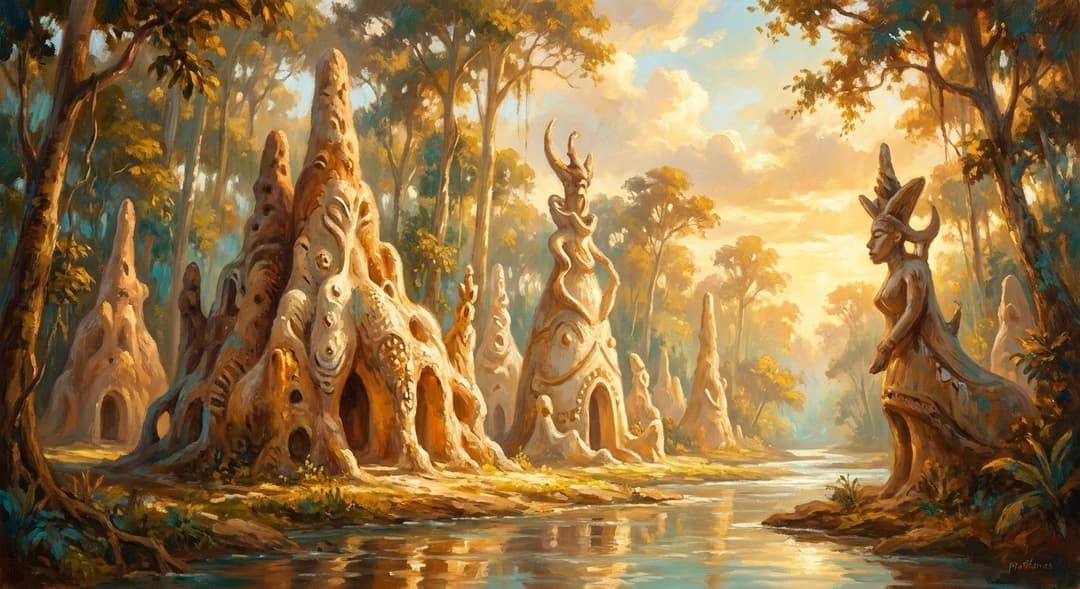
The grove offers a deeply reverent walk through primary equatorial rainforest dotted with monumental cement shrines and traditional mud palaces. Visitors should observe silent respect along ritual paths and avoid disturbing active worshipers and sacred wildlife.
Highlights
- Monumental organic sculptures created by the New Sacred Art movement along forest clearings.
- The serene riverside altar and 1935 pedestrian suspension footbridge over the Osun River.
- Historic mud-brick courtyards of the First Palace of Oba Larooye.
- Thriving troops of protected white-throated guenon and mona monkeys canopying overhead.
Things to Know
- Footwear must be removed before entering active shrine verandas and inner sanctorums.
- Photography of initiated priests, active rites, and inner sanctuaries is strictly restricted.
- A certified National Commission for Museums and Monuments guide is required for all tours.
- Visiting during the August festival requires preparing for massive crowds of pilgrims.
Location
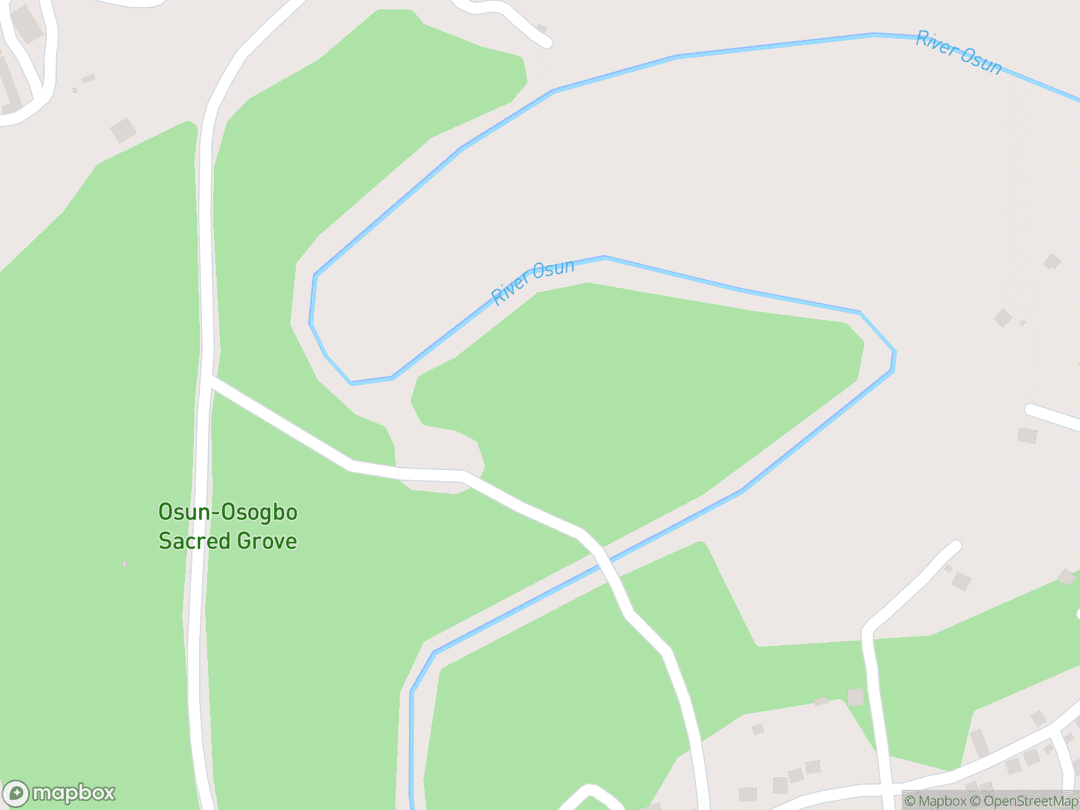
Osun Grove Road, P.M.B. 4383, Osogbo, Osun State, Nigeria
Hours: Open daily from 8:00 AM to 6:00 PM; last entrance registration at 5:00 PM.
Getting There: Located 3 kilometers south of central Osogbo via Osun Grove Road, accessible by private taxi or motorized tricycle.
Get DirectionsTips for Your Visit
Footwear Etiquette
Wear slip-on shoes since footwear must be removed repeatedly when entering consecrated shrine precincts.
Forest Hydration
Carry bottled drinking water as the high tropical canopy traps heat and humidity along unpaved dirt trails.
Photography Permits
Register professional camera equipment at the visitor pavilion before setting out onto sacred paths.
About
The Osun-Osogbo Sacred Grove is a 75-hectare primary rainforest sanctuary along the winding banks of the Osun River on the southern outskirts of Osogbo, Nigeria. Consecrated over four centuries ago, it stands as the largest and most intact surviving sacred grove of the Yoruba civilization.
Within Yoruba cosmology, the dense forest forms the living terrestrial dwelling of Osun, the Orisha of fertility, fresh waters, maternal care, and civic sovereignty. The sacred river waters are revered as living liquid grace capable of curing illness and bestowing children upon faithful petitioners.
In the mid-20th century, the grove was revitalized through the New Sacred Art movement led by Susanne Wenger and local Yoruba master artisans. Their monumental reinforced cement sculptures restored decaying traditional shrines and created a formidable physical barrier against urban encroachment.
Designated a UNESCO World Heritage Site in 2005, the grove remains an active epicenter of traditional worship and global African diaspora pilgrimage. It represents an unbroken spiritual pact between the monarch of Osogbo and the river goddess.
Gallery
Symbolic Elements
The temple's exterior features intricate carvings, each rich with spiritual meaning:

Living River Waters
The physical earthly manifestation of Osun providing spiritual cleansing, maternal grace, and healing.

The Sacred Calabash
A brass-adorned vessel containing ancestral relics that represents cosmic fertility and the divine royal covenant.

The Votary Virgin
A specially chosen royal virgin who personifies ritual purity while carrying the sacred vessel during processions.

Sacred Brass
The primary ceremonial metal of Osun signifying divine endurance, regal wealth, and radiant spiritual purity.
The Sacred Brass Fish
A sacred emissary symbolizing the primeval gift presented by Osun to seal the founding of the city.

Sixteen-Wick Lamp
An ancient palm-oil lamp lit at midnight during festivals to purge spiritual discord and invite divine favor.

Termite Mound Textures
Organic sculptural cement surfaces symbolizing earth spirits, industrious collaboration, and natural protection.

White Kaolin Chalk
Purified sacred earth symbolizing supreme ethical integrity, peaceful disposition, and ritual transcendence.
Interesting Facts
Osun-Osogbo is the sole surviving primary high forest sacred grove of its size and antiquity in all of Yorubaland (Tier A).
Austrian modernist artist Susanne Wenger was initiated as a Yoruba priestess and dedicated over fifty years to safeguarding the grove (Tier B).
The monumental sculptures were deliberately erected across perimeter lines to make the ground unplowable and block developers (Tier A).
Ethnobotanists have documented over four hundred botanical species in the grove, half of which are used in traditional medicine (Tier B).
The grove shelters rare populations of the endangered white-throated guenon monkey that have vanished from surrounding regions (Tier B).
The royal title Ataoja translates to 'he who stretches out his hands to receive the sacred fish from the river' (Tier A).
The consecrated bronze-filled calabash carried during the August festival procession weighs up to twenty kilograms (Tier A).
Yoruba builders consecrated modern Portland cement by treating it as an industrial evolution of sacred riverbank mud (Tier B).
Common Questions
What is the primary spiritual focus of the Osun-Osogbo Grove?
The grove is the living physical sanctuary of Osun, the Yoruba goddess of fresh water, fertility, and maternal protection.
Can regular tourists enter the grove on non-festival days?
Yes, the grove is open daily for educational and guided tours accompanied by accredited heritage guides.
Why are modern cement sculptures built throughout the ancient forest?
The New Sacred Art movement erected cement sculptures on iron armatures to replace decaying mud shrines and physically deter land encroachment.
When does the famous Osun-Osogbo Festival occur?
The festival takes place annually over two weeks in August, culminating in a grand royal procession on the second Friday.
Featured Stories
The Felled Tree and the Divine Lament
1570
When the hunter Olutimehin and King Larooye felled a riverbank tree to build shelter, a melodious voice echoed from the water lamenting the shattered dyeing pots of the forest spirits. Recognizing the divine presence of the goddess Osun, Larooye offered immediate propitiation. In response, the deity established a perpetual covenant guaranteeing water, fertility, and protection in exchange for the forest remaining forever untouched by farming or axes.
Source: Adunni Olorisha Trust Archive
The Defeat of the Invading Cavalry
1840
During the critical Battle of Osogbo, invading forces threatened to overrun Yorubaland and sweep toward the Atlantic coast. Citizens fled to the sacred grove, praying fervently along the riverbank for deliverance under the shelter of Osun. Local tradition recalls that Osun transformed into an unassuming market vendor selling poisoned food to the enemy army, paving the way for a decisive defensive triumph that permanently secured Osogbo.
Source: Yoruba Heritage Institute Documentation
The Sculptural Shield of Adunni Olorisha
1960
When post-colonial real estate speculation threatened to bulldoze the unprotected borders of the sacred forest, artist Susanne Wenger partnered with traditional Yoruba bricklayers to erect massive cement monuments along the perimeter. By transforming delicate earthen shrines into towering, immovable reinforced concrete totems, the artisan guild physically blocked commercial plows and bulldozers from destroying the woodland. This innovative artistic intervention saved the ancient sanctuary from being subdivided into residential lots.
Source: UNESCO World Heritage Nomination File
Timeline
The Founding Covenant
Oba Larooye and the hunter Olutimehin establish modern Osogbo after making a sacred peace pact with the river goddess Osun.
MilestoneSanctification of the Forest
Flooding prompts the town to relocate uphill, consecrating the original river settlement as an exclusive sanctuary for the Orisha.
EventCustomary Environmental Edicts
Yoruba leaders establish five sacred ritual zones and impose severe spiritual penalties on hunting, farming, and logging.
MilestoneBattle of Osogbo
Allied Yoruba defenders halt the southern advance of northern cavalry, crediting the goddess Osun for military deliverance.
EventSuspension Bridge Construction
Engineers erect a timber and cable suspension pedestrian bridge across the Osun River to link opposite riverbanks.
EventNew Sacred Art Collaboration
The Ataoja of Osogbo invites Austrian artist Susanne Wenger and local artisans to restore deteriorating mud shrines.
RenovationNational Monument Gazetting
The Federal Republic of Nigeria officially gazettes the core sacred grove as a protected National Monument.
MilestoneIya Moopo Shrine Dedication
Artisans complete the sweeping thirty-foot sculpted cement shrine dedicated to the patron goddess of female craftsmanship.
MilestoneSanctuary Boundary Expansion
Federal authorities legally expand the protected cultural reserve to encompass seventy-five hectares and a buffer zone.
MilestoneUNESCO World Heritage Inscription
UNESCO inscribes the grove onto the World Heritage List under cultural criteria for its exceptional universal significance.
DedicationPassing of Adunni Olorisha
Susanne Wenger dies at age 93 and is interred within the grove following sacred traditional funerary honors.
EventHistory by Decade
1570s–1600s — The Primeval Settlement
Larooye and Olutimehin, you have broken all my dyeing pots.
Following severe regional drought, Ijesha migrants led by King Larooye settled in the fertile river basin and entered into a sacred covenant with Osun. The settlers established the First Palace directly within the river plain alongside initial earthen alters.
1620s–1650s — Sacred Relocation
Seasonal deluges forced the royal court to move uphill to higher ground at Oja-Oba. The original river settlement was consecrated exclusively as a royal burial site and sacred precinct, forbidding private domestic settlement.
1700s–1790s — Environmental Codification
Traditional taboos were systematically codified to preserve the sanctuary from economic exploitation. The forest was divided into ritual sectors with capital spiritual sanctions against timber extraction and river fishing.
1840s–1890s — Citadel of Deliverance
The grove served as both an emotional haven and tactical refuge during regional conflicts. The decisive 1840 victory cemented Osogbo's reputation as a divinely shielded city under the maternal aegis of Osun.
1950s–1960s — The New Sacred Art Revival
The art was not an embellishment; it was a physical wall to defend the sacred grove.
Facing rampant termite damage and land speculation, the Ataoja appointed Susanne Wenger to restore the shrines. Wenger partnered with indigenous guilds, inventing reinforced cement techniques and earning National Monument status in 1965.
2000s–2020s — Global Heritage and Ecological Stewardship
UNESCO inscribed the grove as a World Heritage Site in 2005, celebrating its living cultural traditions. Contemporary conservation focuses on combating upstream river pollution and preserving the historic cement monuments.
Architecture & Facilities
The grove represents a singular architectural fusion of traditional Yoruba vernacular courtyard complexes and 20th-century monumental expressionist reinforced cement sculpture. Rather than forming a single monolithic temple building, the architecture is distributed across seventy-five hectares of primary rainforest where the towering natural canopy functions as an organic cathedral nave. Sculptures and open-air shrines are rooted directly into the riparian soil, mediating between human devotion and the untamed forest.
Building Materials
Reinforced Cement Mortar
Bendable iron rebar armatures wrapped in wire mesh and plastered with wet Portland cement mortar.
Laterite Mud Brick
Sun-dried red lateritic earth bound with natural vegetal oils for inner palace and shrine sanctums.
Seasoned Iroko Timber
Dense, termite-resistant local hardwood carved into figurative veranda columns, doors, and lintels.
Corrugated Metal and Thatch
Pitched roofing covered in thatch or zinc sheeting sheltered beneath dense overhanging branches.
Interior Features
First Palace of Oba Larooye
Vernacular mud-walled courtyard sanctuary featuring carved wooden figurative posts and historic royal altars.
Iya Moopo Shrine Complex
Soaring multi-tiered open-air cement pavilion designed with fluid arches mimicking nesting birds.
Iledi Ontotoo Lodge
Enclosed subterranean ceremonial courtyard utilized by traditional Ogboni elders for sacred earth deliberations.
Riverside Osun Main Sanctorum
Intimate riverside worship veranda directly overlooking consecrated waters where the sacred covenant is renewed.
Temple Grounds
The seventy-five-hectare grounds encompass dense primary rainforest, winding dirt paths, forty individual shrines, and nine consecrated river landing sites.
Additional Facilities
The site features an official NCMM interpretive reception center, an open-air cultural pavilion, and artisanal craft markets.
Religious Significance
The Osun-Osogbo Sacred Grove stands as the supreme spiritual sanctuary of Yoruba traditional cosmology, embodying the tangible earthly dwelling of the goddess Osun.
To serve as the living physical covenant site between humanity and the Orisha of fertility, clean water, and civic survival.
Sacred Ordinances
Arugba Procession
A consecrated virgin maid carries the ancient relic-filled calabash from the palace to the riverbank without stumbling.
Omi Osun Libations
Devotees collect and drink blessed river water to petition the goddess for physical healing and children.
Lighting of the Sixteen-Wick Lamp
Priests ignite an ancestral palm-oil lamp at midnight to illuminate the spirit realm and dispel civic malevolence.
Royal Covenant Renewal
The Ataoja of Osogbo sits upon the sacred riverside rock to offer ritual prayers renewing divine civic protection.
Cosmological Interpenetration
In Yoruba theology, the physical plane and spiritual realm continually intersect. The sacred grove preserves this balance by maintaining virgin forest where sacred power remains completely undisturbed by urban commercialism.
The Diaspora Connection
The grove serves as an emotional and spiritual homeland for millions of African diaspora adherents across the Americas. Practitioners of Candomblé, Santería, and Orisha traditions make pilgrimages to retrace their spiritual roots to this river.
Sources & Research
Every fact on Temples.org is backed by verified Sources & Research. Each piece of information is rated by source tier and confidence level.
View All Sources (8)
| Field | Source | Tier | Retrieved |
|---|---|---|---|
| About & Historical Background | UNESCO World Heritage Centre (opens in a new tab) | B | 2026-03-31 |
| Architecture & Facilities | UNESCO World Heritage Centre (opens in a new tab) | B | 2026-03-31 |
| Religious Significance & Customs | Adunni Olorisha Trust (opens in a new tab) | A | 2026-03-31 |
| Timeline & Restoration | Metropolitan Museum of Art (opens in a new tab) | B | 2026-03-31 |
| Ecological & Site Heritage | African World Heritage Sites (opens in a new tab) | B | 2026-03-31 |
| Cultural Preservation | Yoruba Heritage Institute (opens in a new tab) | A | 2026-03-31 |
| Artistic Documentation | AWARE Research Centre (opens in a new tab) | B | 2026-03-31 |
| Civic History | Gods Collections Heritage (opens in a new tab) | A | 2026-03-31 |