Visitor Insights
Visiting Badshahi Mosque
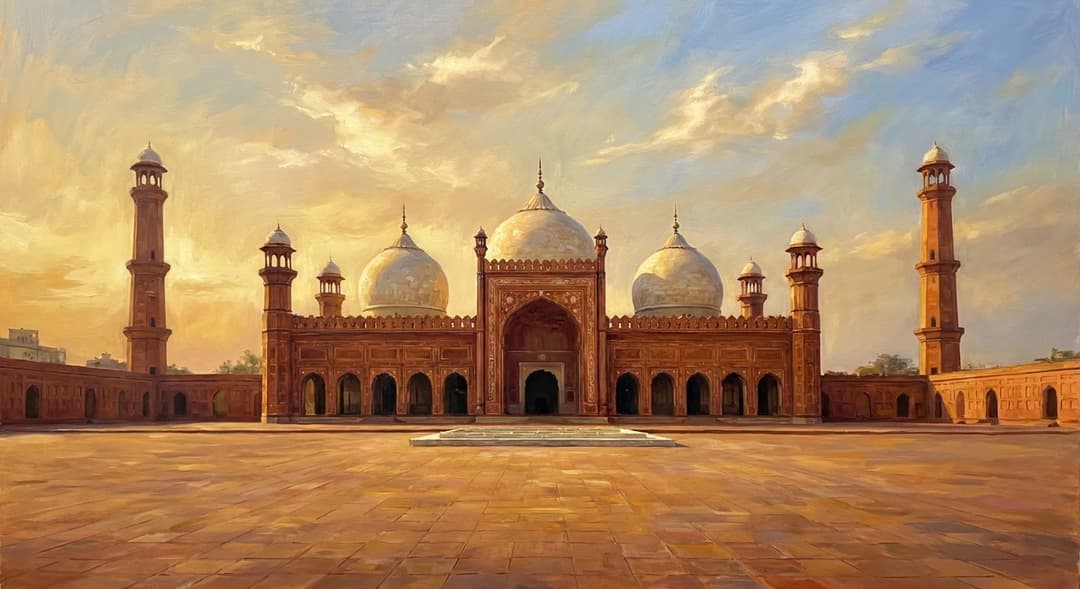
Visiting the Badshahi Mosque offers a transcendent journey into the pinnacle of Mughal craftsmanship and communal devotion. The sheer openness of the red sandstone courtyard against the white marble domes creates an unforgettable sense of peace. Visitors should plan their arrival during the late afternoon to experience the changing light and evening illumination.
Highlights
- Vast central courtyard that ranked as the world's largest mosque enclosure for over three centuries.
- Three bulbous white marble double-domes set against the vibrant red sandstone facade.
- Intricate carved plaster relief arabesques and floral frescoes within the primary prayer hall.
- Historic upper gatehouse gallery preserving sacred calligraphic and venerated Islamic relics.
Things to Know
- Shoes must be removed at the monumental gateway steps before entering the sacred courtyard.
- Modest dress covering shoulders and knees is mandatory; women are required to cover their heads.
- Sightseeing inside the prayer hall pauses during the five daily prayer services and Friday congregation.
- Courtyard stone paving can become very warm under direct summer sunlight.
Location
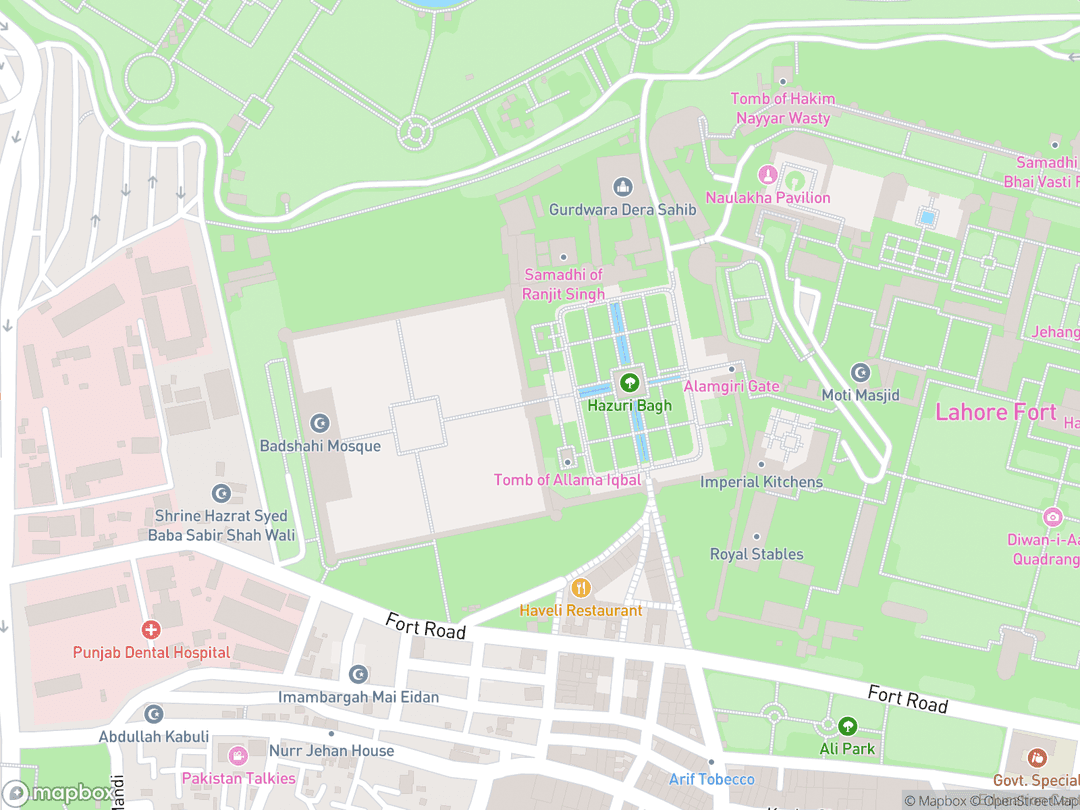
Fort Road, Walled City of Lahore, Lahore, Punjab 54000, Pakistan
Hours: Open daily from 8:00 AM to 8:00 PM (prayer services continue from dawn to night)
Getting There: Located along Fort Road opposite Alamgiri Gate; reachable by taxi, rickshaw, or a short walk from Azadi Chowk Metrobus Station.
Get DirectionsTips for Your Visit
Time Your Visit for Sunset
Arriving around an hour before sunset allows you to witness the sandstone glowing warm amber before dramatic night illumination begins.
Wear Thick Socks in Summer
Because shoes are removed at the gate, thick socks help protect feet from hot red sandstone tiles during sunny afternoons.
Combine with Adjacent Heritage Sites
Hazuri Bagh and the historic Lahore Fort sit directly opposite the mosque entrance steps, making them ideal companions for a single walking itinerary.
About
Rooted in the shared Abrahamic tradition of sacred sanctuaries dedicated to the worship of the one true God, the Badshahi Mosque stands as an imperial masterpiece of Islamic architectural devotion. Built across from the historic Lahore Fort, the complex translates the core theology of divine transcendence into monumental space, balancing awe-inspiring scale with serene spiritual geometry.
Commissioned in May 1671 by the Mughal Emperor Muhi-ud-Din Muhammad Aurangzeb Alamgir and supervised by his foster brother Fidai Khan Koka, the mosque was consecrated in April 1673. Constructed primarily of carved red sandstone inlaid with white marble, the compound was designed to serve as both an imperial Friday congregational mosque and an enduring monument to divine sovereignty.
Throughout centuries of regional upheaval, foreign conquest, military repurposing, and modern independence, the Badshahi Mosque has persevered as a living center of faith. Today, under the custodianship of the Auqaf and Religious Affairs Department of Punjab, the mosque continues to welcome tens of thousands of worshippers daily and remains one of the world's most revered monuments of Islamic civilization.
Gallery
Symbolic Elements
The temple's exterior features intricate carvings, each rich with spiritual meaning:

The Mihrab (Prayer Niche)
Marks the unswerving orientation toward Mecca, symbolizing a portal to divine presence empty of any physical representation.

Triadic Marble Domes
The three double-domes represent the celestial vault of heaven and the infinite transcendence of the Creator.

Padma and Kalasa Finials
Inverted lotus crestings and brass finials synthesize regional craft with Islamic ideals of spiritual awakening.

The Elevated Takht (Plinth)
The twenty-two steps raise the sanctuary above secular bustle, symbolizing intentional spiritual ascent into sacred ground.

Manbatkari (Arabesque Relief)
Continuous interlocking floral arabesques evoke the infinite, self-sustaining harmony of God's universal creation.

Eightfold Minaret Balance
Four massive corner towers paired with four inner turrets mirror the eight traditional paradisiacal realms of Islamic cosmology.

Central Hauz (Ablution Basin)
The open pool embodies the fundamental prerequisite of ritual purity where outward cleansing precedes internal prayer.

Musalla Pavement Pattern
Individual prayer-mat stone outlines across the courtyard embody universal spiritual equality before God.
Interesting Facts
The mosque held the record as the world's largest mosque courtyard for 313 years until 1986. (Tier B)
Engineers built a three-mile stone dyke along the River Ravi to shield the mosque plinth from river floods. (Tier B)
Light artillery swivel-guns were once placed atop the corner minarets during Sikh civil warfare in 1841. (Tier B)
Acoustic plaster vaulting allows whispers spoken at the pulpit to carry clearly across the vast hall. (Tier C)
The corner minarets stood without their upper marble cupolas for over a century following an 1840 earthquake. (Tier A)
The vast courtyard was converted into an imperial cavalry stable housing over a thousand horses in the early 1800s. (Tier B)
Authentic red sandstone was shipped from Rajasthan across international borders to complete mid-20th-century repairs. (Tier A)
Thirty-nine world leaders prayed together in the sanctuary during the 1974 Islamic Summit Conference. (Tier A)
Common Questions
Is the Badshahi Mosque an active place of worship?
Yes, it functions continuously as an active congregational mosque hosting five daily prayers and massive Friday and Eid services.
Are non-Muslim visitors permitted inside the mosque?
Yes, respectful visitors of all backgrounds are welcome outside of active prayer services when adhering to the modest dress code.
Why are shoes removed before entering the courtyard?
Removing footwear preserves the purity and cleanliness of the consecrated stone where worshippers prostrate during prayer.
Who built the Badshahi Mosque?
It was commissioned by the sixth Mughal Emperor, Aurangzeb Alamgir, and built under the supervision of his foster brother Fidai Khan Koka.
What are the historic relics housed in the gatehouse?
The upper gallery contains rare historical artifacts, sacred calligraphy, and items traditionally associated with early Islamic figures.
Featured Stories
Taming the River Ravi
May 1, 1671
When Emperor Aurangzeb selected the elevated grounds west of the Lahore Fort, the unruly River Ravi flowed immediately along the proposed northern ramparts. Recognizing the peril of seasonal inundations, master builder Fidai Khan Koka marshaled thousands of laborers to construct a colossal stone dyke stretching over three miles. This monumental civil engineering triumph diverted the river and permanently safeguarded the holy foundation plinth.
Source: Mughal Imperial Chronicles & Auqaf Records
The Cannon of the High Minarets
January 15, 1841
During the bitter succession disputes following the demise of Maharaja Ranjit Singh, the sanctity of the imperial mosque faced severe violation. Troops under Maharaja Sher Singh hoisted light swivel cannons up the winding staircases to the open platforms of the 176-foot minarets. From these lofty perches, gunners bombarded rival regiments besieged within the Lahore Fort, leaving battle scars that remained visible for generations.
Source: Historical Records of Lahore
The Historic Friday Prayer of 1974
February 22, 1974
During the Second Islamic Summit Conference held in Lahore, the Badshahi Mosque hosted the most significant diplomatic assembly in its modern history. Thirty-nine heads of state and government from across Africa, the Middle East, and Asia stood shoulder to shoulder in the main prayer hall. Worshipping together without rank, the world leaders transformed the historic sanctuary into an enduring symbol of global fraternity.
Source: Second Islamic Summit Archives
Timeline
Imperial Commission
Emperor Aurangzeb commissions the construction of an imperial Friday mosque under the supervision of Fidai Khan Koka.
MilestoneInaugural Consecration
The mosque is formally completed in 1084 AH and opened for communal Friday worship.
DedicationRegional Upheaval
Persian forces under Nadir Shah occupy Lahore, using the city as military headquarters.
EventBhangi Misl Occupation
Sikh misl forces take control of Lahore, beginning decades of interrupted religious services.
EventMilitary Repurposing
Maharaja Ranjit Singh establishes the Sikh Empire and commandeers the courtyard as cavalry stables.
EventEarthquake Damage
A major earthquake strikes Lahore and topples the white marble cupolas atop the four corner minarets.
EventArtillery Bombardment
Maharaja Sher Singh stations swivel guns on the mosque minarets during dynastic civil conflict.
EventColonial Garrison
The British East India Company annexes the Punjab and converts the complex into an army garrison.
EventRestoration of Sacred Worship
British administrators formally restore the mosque to the Muslim community following sustained petitions.
EventEstablishment of Mosque Authority
Sir Sikandar Hayat Khan creates the Badshahi Mosque Authority to direct comprehensive structural restorations.
RenovationRestoration Campaign Completed
A two-decade rebuilding initiative successfully reconstructs the four fallen marble minaret cupolas.
RenovationIslamic Summit Congregation
Thirty-nine heads of Muslim states offer joint Friday prayers during the Second Islamic Summit Conference.
MilestoneUNESCO Tentative Inscription
Pakistan successfully places the Badshahi Mosque onto the UNESCO World Heritage Tentative List.
MilestoneHistory by Decade
1670s — Imperial Conception and Consecration
In May 1671, Emperor Aurangzeb commissioned a grand Friday mosque to rival the great congregational mosques of Delhi and Agra. Supervised by Nawab Muzaffar Husain (Fidai Khan Koka), thousands of artisans completed the massive red sandstone structure in just two years. Consecrated in April 1673, the mosque immediately became the premier spiritual heart of Mughal Lahore.
1680s–1730s — Zenith of Mughal Lahore
Throughout the closing decades of Aurangzeb's reign and into the early eighteenth century, the sanctuary flourished as an imperial hub of Islamic jurisprudence. Sacred relics were formally enshrined in the gateway chambers, drawing pilgrims from across the region. Even as imperial authority fractured after 1707, local governors maintained the daily prayers and educational cloisters.
1740s–1790s — Regional Invasions and Turmoil
The mid-eighteenth century brought severe political turbulence as Persian and Afghan invasions repeatedly swept through the Punjab. In 1739, Nadir Shah occupied the city, followed by devastating incursions by Ahmad Shah Durrani. By 1767, rule by the Sikh Bhangi Misl resulted in the suspension of formal communal upkeep across the complex.
1790s–1830s — Desecration under the Sikh Empire
Following Maharaja Ranjit Singh's capture of Lahore in 1799, the sacred sanctuary was secularized for state military purposes. The immense courtyard became a cavalry garrison for horses and camels, while the surrounding chambers served as powder magazines. Neighboring architectural projects stripped ornamental marble from the site, severely degrading its fabric.
1840s — Civil Conflict and Colonial Annexation
The 1840s inflicted grievous structural harm when a massive earthquake toppled the four marble cupolas crowning the corner minarets. During the 1841 Sikh civil conflict, the towers were utilized as sniper and artillery bastions against the Lahore Fort. Following the Second Anglo-Sikh War in 1849, the British military occupied the compound as an armed garrison.
1850s–1880s — Restoration of Muslim Custodianship
Persistent appeals by Lahore's Muslim leaders culminated in the British colonial administration returning the mosque for worship in 1856. Although temporarily reoccupied during the 1857 uprising, Muslim custodians subsequently established an enduring management committee. Modest structural repairs began, though the damaged minarets remained truncated without their marble domes.
1930s–1960s — The Great Restoration Initiative
Under the leadership of Punjab Premier Sir Sikandar Hayat Khan, the Badshahi Mosque Authority was established in 1938 to orchestrate full-scale reconstruction. Guided by chief architect Nawab Zen Yar Jang Bahadur, conservationists imported authentic red sandstone from Rajasthan to match original quarries. By 1960, the four fallen marble cupolas were fully rebuilt, restoring the mosque's imperial skyline.
1970s–Present — Global Icon and Heritage Stewardship
Transferred to the Punjab Auqaf Department in 1969, the mosque gained worldwide recognition hosting the 1974 Islamic Summit prayer. In 1993, the complex was inscribed on Pakistan's UNESCO World Heritage Tentative List. Ongoing conservation led by the Walled City of Lahore Authority preserves its sandstone masonry and intricate frescoes for generations to come.
Architecture & Facilities
The Badshahi Mosque represents the monumental culmination of imperial Mughal architecture, blending Persian spatial symmetry with refined regional stone-carving traditions. Emphasizing muscular dignity over polychrome ornamentation, the composition relies on deep red sandstone accented by white Makrana marble inlays, soaring cusped arches, and crowning bulbous double-domes.
Building Materials
Sang-e-Surkh (Red Sandstone)
Quarried historically from Rajasthan, these dense slabs form the exterior cladding, courtyard paving, and minaret towers.
Sang-e-Marmar (White Makrana Marble)
Fine white marble forms the triple bulbous domes and delicate floral inlay tracery across the primary facade.
Kiln-Burnt Clay Bricks
Millions of traditional small Mughal bricks form the thick structural core of the foundations and vaulted cloister walls.
Kankar Lime Mortar
Hydraulic lime mortar mixed with crushed stone provides enduring structural cohesion across all foundational arches.
Gilded Copper Finials
Crowning inverted lotus capitals atop the domes, these finials evoke imperial majesty against the open sky.
Interior Features
Central Vaulted Nave (Peshtaq)
Rises to an imposing height with deeply recessed cusped arches and refined calligraphic friezes.
Main Mihrab Chamber
Recessed marble prayer niche oriented precisely toward Mecca, framed by elegant relief carvings.
Flanking Arcaded Bays
Seven interconnected compartments divided by heavy masonry piers adorned with floral fresco plasterwork.
Acoustic Whispering Arches
Curved stucco masonry channels designed to amplify spoken recitations throughout the expansive interior.
Upper Reliquary Chamber
Secure gateway repository housing historical manuscripts, sacred calligraphy, and venerated relics.
Temple Grounds
The complex is raised on a monumental terraced plinth over five meters above street level, entered from Hazuri Bagh via twenty-two wide red sandstone steps. The square paved courtyard spans 528 feet on each side, enclosed by eighty vaulted dalan cloisters and centered on a 50-foot square ablution fountain.
Additional Facilities
Facilities include modernized shoe-storage counters, extensive underground ablution rooms, administrative Auqaf offices, and illuminated public viewing areas connected to the Fort Road cultural corridor.
Religious Significance
Within the Islamic theological tradition shared with earlier Abrahamic faiths, the mosque serves as an uncompromised sanctuary for worshipping the Creator. Structured upon the doctrine of Tawhid (the absolute oneness of God), the architecture eliminates all figurative representation, turning the believer's inward contemplation entirely toward the transcendent through geometry, calligraphy, and light.
To serve as a consecrated space of prostration (masjid) where communal worship unites believers in absolute spiritual equality before God.
Sacred Ordinances
Salah (The Five Daily Prayers)
Prescribed liturgical prayers performed horizontally in uniform rows facing the Kaaba in Mecca.
Jumu'ah (Friday Congregational Prayer)
The weekly communal gathering featuring a sermon (khutbah) followed by congregational midday prayer.
Wudu (Ritual Ablution)
Prescribed purification washing hands, face, and feet before presenting oneself in prayer.
Itikaf (Spiritual Retreat)
Devotional seclusion undertaken within the mosque cloisters during the final ten days of Ramadan.
The Kaaba Orientation (Qibla)
Every physical component of the Badshahi Mosque, from the primary western niche to the individual flagstone outlines in the courtyard, aligns believers toward Mecca. This universal geographic focus unites local worshippers with millions across the global Muslim community.
Equality in Prostration (Sujud)
The vast open courtyard embodies the Islamic concept of human equality under divine law. Whether prince or laborer, all worshippers stand shoulder to shoulder on identical stone markers, dissolving temporal social rank during the act of humble prostration.
Sources & Research
Every fact on Temples.org is backed by verified Sources & Research. Each piece of information is rated by source tier and confidence level.
View All Sources (7)
| Field | Source | Tier | Retrieved |
|---|---|---|---|
| Visitor Insights & Administration | Government of the Punjab (opens in a new tab) | A | 2026-03-31 |
| About & Historical Background | UNESCO World Heritage Centre (opens in a new tab) | B | 2026-03-31 |
| Architecture & Structural Plan | Islamic Architectural Heritage Database (opens in a new tab) | B | 2026-03-31 |
| Timeline & Construction Chronology | Mogulesque Architectural Studies (opens in a new tab) | B | 2026-03-31 |
| Symbolic Elements & Relics | Mosque Philately and Monument Index (opens in a new tab) | C | 2026-03-31 |
| Minarets & Structural Measurements | Universitas Islam Negeri Maulana Malik Ibrahim Malang (opens in a new tab) | B | 2026-03-31 |
| Religious Significance & Modern History | New World Encyclopedia (opens in a new tab) | C | 2026-03-31 |