Visitor Insights
Visiting Jasna Góra Monastery
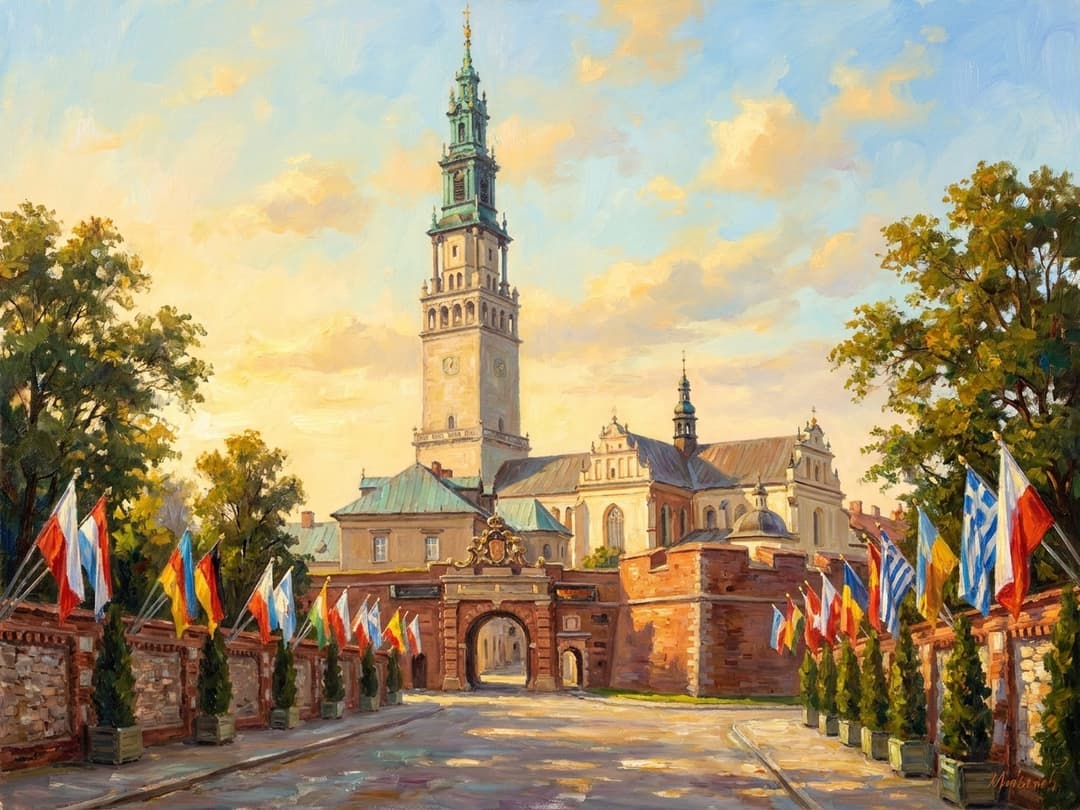
Jasna Góra welcomes millions of international pilgrims and travelers into an active monastic citadel. Visitors can experience the moving unveiling of the miraculous icon, scale the historic ramparts, and tour exceptional Baroque sacred spaces. Respectful attire and reverent demeanor are expected throughout all liturgical areas.
Highlights
- Witnessing the solemn ceremonial unveiling of the Black Madonna icon with royal brass fanfares.
- Climbing the 106.3-meter bell tower for expansive views over Częstochowa and the Silesian highlands.
- Walking the elevated 17th-century bastion walls featuring 14 monumental bronze Stations of the Cross.
- Viewing historic treasures in the Skarbiec, including royal coronation regalia and Lech Wałęsa's Nobel medal.
Things to Know
- Modest dress covering shoulders and knees is strictly required inside the Chapel of Our Lady and Basilica.
- Foot pilgrimages peak heavily around the August 15 Assumption and August 26 Marian feasts.
- Photography without flash is permitted in select areas but prohibited during active liturgies and the Jasna Góra Appeal.
- The icon shutter closes daily between 12:00 and 13:30 for monastic prayer.
Location
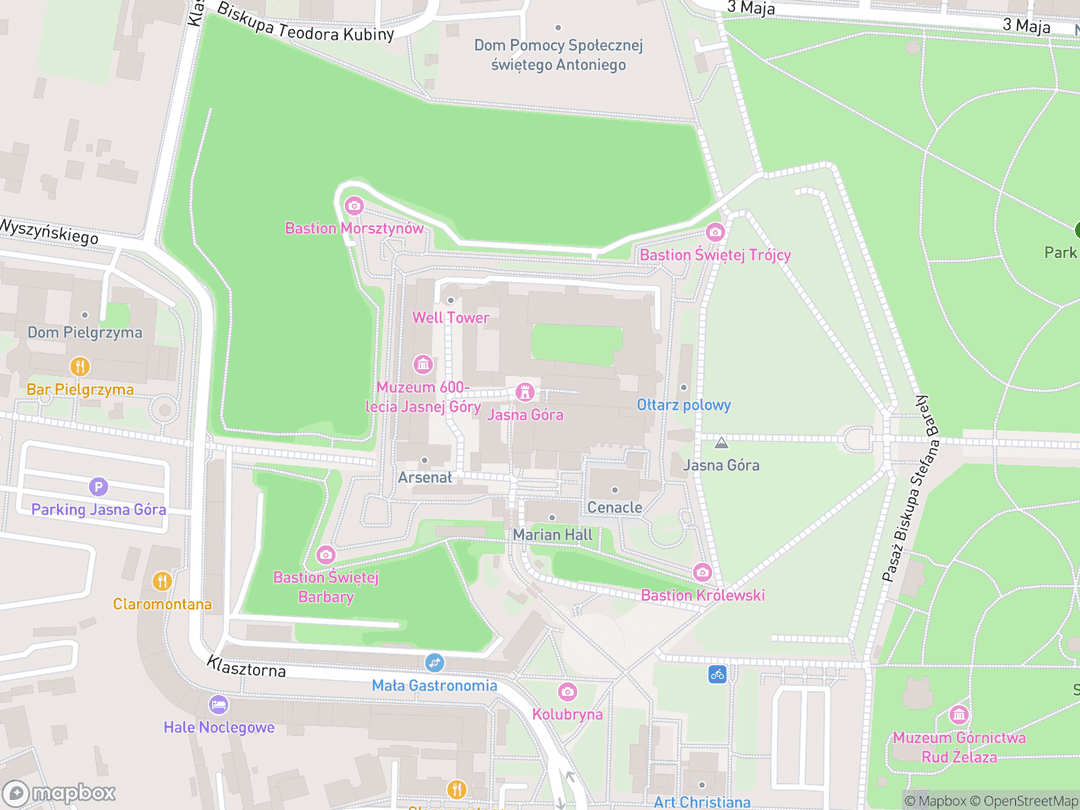
ul. o. Augustyna Kordeckiego 2, 42-225 Częstochowa, Silesian Voivodeship, Poland
Hours: Monastery gates open daily from 05:00 to 21:30; Chapel open from 06:00 to 21:30.
Getting There: Located 2 km west of Częstochowa Główna railway station, accessible on foot via Aleja NMP or by local city buses.
Get DirectionsTips for Your Visit
Arrive for the Morning Unveiling
Experience the icon's dramatic 06:00 unveiling when the silver screen rises to traditional trumpet fanfares.
Attend the Evening Appeal
Join the nightly 21:00 Jasna Góra Appeal for reflective hymns and prayers before the icon is veiled.
Visit the Bastion Casemates
Explore the Bastion of Saint Roch to discover ancient masonry crypts and military defense artifacts.
Plan for Summer Feast Crowds
Mid-August draws hundreds of thousands of walking pilgrims; reserve regional lodging several months in advance.
About
The Sanctuary of Our Lady of Częstochowa at Jasna Góra is the premier spiritual citadel of Poland and a prominent pilgrimage sanctuary within the global Catholic Church. Founded in 1382 by Duke Władysław of Opole and entrusted to the Pauline Fathers, the hill of Clarus Mons stands within the Christian Abrahamic heritage as a place where the faithful seek continuous intercession before God.
Central to Jasna Góra's identity is the miraculous icon of the Black Madonna (Hodegetria), adorned with enduring facial scars from a 1430 sacrilege. In Roman Catholic theology, the Virgin Mary is venerated as the Theotokos and Queen of Poland (Regina Poloniae), an official royal title stemming from the historic 1656 Lwów Oath following the monastery's heroic defense against Swedish forces.
Operating as an active monastery, minor basilica, and defensive bastion, the complex blends Gothic masonry with High Baroque splendor. Throughout partitions, foreign occupations, and communist suppression, Jasna Góra has served as Poland's enduring spiritual sanctuary and a cradle of moral resistance.
Gallery
Symbolic Elements
The temple's exterior features intricate carvings, each rich with spiritual meaning:
Black Madonna Hodegetria
The Byzantine Marian portrait gestures toward Christ as the true path to salvation.

Facial Sabre Scars
Cut marks left from the 1430 raid represent enduring suffering and resilience under trial.

Jeweled Robes (Sukienki)
Detachable vestments embroidered with rubies, diamonds, and amber symbolize royal reverence.

Pauline Order Raven
A heraldic raven holding bread recalls divine sustenance provided to Saint Paul the First Hermit.

Angevin Fleurs-de-Lis
Golden emblems on Mary's blue mantle reflect the royal dynasty of King Louis I of Hungary.

Votive Silver Hearts
Thousands of miniature silver hearts adorning the sanctuary walls commemorate miraculous personal healings.

Bastion Fortress Ramparts
Star-shaped brick fortifications signify spiritual vigilance and national physical sanctuary.
Interesting Facts
The Warsaw walking pilgrimage has taken place every single August since 1711 without interruption through wars and foreign occupations (Tier A).
Prior Augustyn Kordecki repelled a six-week siege by three thousand Swedish troops in 1655 with only seventy monks and regional nobility (Tier A).
Jasna Góra is recognized as the spiritual capital of Poland despite Warsaw being the administrative capital and Kraków the royal seat (Tier B).
During the 1956 national vows, an empty chair draped in red and white flowers represented the imprisoned Cardinal Stefan Wyszyński (Tier A).
Lech Wałęsa donated his 1983 Nobel Peace Prize medal to the Jasna Góra Treasury as a votive offering of thanksgiving (Tier A).
Pope Clement XI granted the sanctuary the first formal Vatican canonical coronation of an icon outside Italy in 1717 (Tier A).
General Casimir Pulaski sharpened his cavalry and siege tactics while defending Jasna Góra during the 1770s Bar Confederation (Tier B).
The 106.3-meter bell tower ranks among the tallest masonry church spires in Central Europe (Tier B).
Common Questions
Why is the painting called the Black Madonna?
Centuries of exposure to soot from votive candles and the natural oxidation of the lime wood panel darkened the skin tones.
Can non-Catholics visit Jasna Góra?
Yes, visitors of all backgrounds are welcome to explore the sanctuary grounds, museums, and basilica quietly.
What is the meaning of the cuts on the Virgin's face?
They commemorate the 1430 Hussite sabre attack and symbolize Mary sharing in the historical wounds of the Polish people.
How long does the walking pilgrimage to Częstochowa take?
Traditional foot pilgrimages from Warsaw or Kraków typically cover hundreds of kilometers over nine to twelve days.
Featured Stories
The Heroic Defense of 1655
1655
During the Swedish invasion known as the Deluge, Jasna Góra stood isolated against three thousand enemy soldiers. Father Augustyn Kordecki inspired his tiny garrison to endure six grueling weeks of bombardment. The Swedish retreat rallied the entire Polish nation, prompting King John II Casimir to declare Mary Queen of Poland.
Source: Kuria Generalna Zakonu Paulinów
The Empty Throne of 1956
August 26, 1956
With Cardinal Stefan Wyszyński imprisoned by the communist regime, one million pilgrims assembled on the monastery ramparts to recite his Jasna Góra Vows of the Nation. An empty episcopal chair draped in red and white flowers stood in poignant protest. The overwhelming moral demonstration forced the communist authorities to release the Primate weeks later.
Source: National Heritage Board of Poland
The Nobel Peace Prize Votive
December 13, 1983
Following the oppressive era of martial law, Solidarity trade union leader Lech Wałęsa arrived at Jasna Góra with his Nobel Peace Prize medal. Wałęsa permanently placed the gold medal in the monastery treasury as an ex-voto offering to the Black Madonna. The gift honored the spiritual backing of the Catholic Church during Poland's struggle for democracy.
Source: Urząd Miasta Częstochowy
Timeline
Monastery Foundation
Duke Władysław of Opole brings Pauline monks from Hungary to build a monastery on Jasna Góra.
MilestoneArrival of the Icon
Duke Władysław transfers the ancient Black Madonna icon from Belz Castle to the Jasna Góra sanctuary.
EventRoyal Foundation Privilege
King Władysław II Jagiełło and Queen Saint Jadwiga grant royal protection and funds for a stone church.
MilestoneHussite Desecration
Raiders strike the icon with sabres; King Jagiełło sponsors its meticulous royal restoration in Kraków.
EventGothic Basilica Consecration
The monumental brick Gothic church of the Finding of the Holy Cross is officially consecrated.
DedicationFortress Construction Begins
Architect Andrea dell'Aqua designs four corner bastions to transform the monastery into a secure fortress.
MilestoneRepulse of the Swedish Siege
Prior Augustyn Kordecki leads a small garrison to successfully withstand a six-week Swedish siege.
MilestoneProclamation of Mary as Queen
King John II Casimir makes the Lwów Oath, consecrating Poland to the Virgin Mary under the title Queen of Poland.
EventThe Great Basilica Fire
A catastrophic blaze destroys the basilica roofs and nave, sparing the miraculous Chapel of Our Lady.
RenovationFirst Papal Coronation
Bishop Krzysztof Szembek crowns the icon with Clementine gold crowns in the first canonical coronation outside Italy.
DedicationTower Reconstruction Completed
Architects Szyller and Dziekoński finish the eclectic 106.3-meter bell tower following the 1900 fire.
DedicationJasna Góra Vows of the Nation
One million Catholics gather around an empty floral throne for the imprisoned Cardinal Wyszyński's national vows.
EventHistory by Decade
1380s — Foundation on the Luminous Mount
Duke Władysław of Opole established the monastery in 1382, inviting Pauline hermits from Hungary to settle the limestone hill. In 1384, the Duke enshrined the venerable Black Madonna icon from Belz Castle within the sanctuary.
1430s — Sacrilege and Royal Restoration
Hussite raiders ransacked the shrine in 1430, slashing the holy painting and breaking the panel into fragments. King Władysław II Jagiełło ordered the icon brought to Kraków, where royal artists restored it while preserving the visible scars.
1620s — Bastion Fortress Transformation
In response to European religious conflicts, King Sigismund III Vasa financed the fortress conversion of the shrine. Military engineer Andrea dell'Aqua built four quadrilateral artillery bastions, dry moats, and reinforced stone ramparts.
1650s — The Swedish Deluge and Royal Oath
In 1655, a tiny force under Prior Augustyn Kordecki successfully withstood a massive Swedish siege. The miraculous repulse inspired King John II Casimir's 1656 Lwów Oath, formally proclaiming Mary Queen of the Polish Crown.
1690s — The Catastrophic Fire and Baroque Rebirth
A devastating fire destroyed the basilica's roofs and nave in 1690, though the Chapel of Our Lady remained unharmed. The Pauline Fathers immediately rebuilt the nave in opulent High Baroque architecture under master plasterer Giovanni Rossi.
1770s — Defense by Casimir Pulaski
During the Bar Confederation against Russian imperial intervention, future American Revolutionary War hero Casimir Pulaski commanded the Jasna Góra garrison. Pulaski defended the ramparts against repeated assaults before surrendering under honorable military terms.
1900s — Spire Inferno and National Renewal
A fire consumed the wooden monastery spire in 1900, prompting a nationwide restoration initiative. Architects Stefan Szyller and Józef Pius Dziekoński designed the towering 106.3-meter bell tower completed in 1906.
1940s — Nazi Occupation and Underground Sanctuary
Nazi authorities occupied Częstochowa in 1939, banning walking pilgrimages and keeping the Pauline Fathers under Gestapo surveillance. Monks hid the authentic icon inside a secret wall cavity, substituting a painted copy while harboring underground Polish resistance fighters.
1980s — Solidarity and Papal Return
Pope John Paul II visited the sanctuary throughout his pontificate, presenting the bullet-pierced sash from his 1981 assassination attempt to the Virgin. During martial law, Jasna Góra became an indispensable safe haven for the Solidarity labor movement.
Architecture & Facilities
Jasna Góra exemplifies a historic palazzo in fortezza combining 15th-century brick Gothic ribbed chapels with a monumental late 17th-century High Baroque minor basilica, enclosed within Mannerist artillery bastions and crowned by an eclectic early 20th-century Neo-Renaissance bell tower.
Building Materials
Fired Ceramic Brick
Deep-red historic Polish brick constitutes the primary structural load-bearing walls and ramparts.
Jurassic Limestone
Local Kraków-Częstochowa limestone blocks form the foundations and decorative rusticated masonry gates.
Carrara and Dębnik Marble
Contrasting black Dębnik limestone and white Carrara marble grace interior columns and side altars.
Oxidized Copper
Durable green-patinated copper sheeting covers the complex roofs and multi-tiered tower dome.
Interior Features
Chapel of Our Lady
A ribbed Gothic presbytery housing the miraculous icon behind a silver repoussé screen.
Minor Basilica Nave
A 29-meter-high Baroque hall decorated with Karl Dankwart frescoes and Corinthian pillars.
Knights' Hall (Sala Rycerska)
A monumental 17th-century vaulted ceremonial hall lined with historic patriotic oil canvases.
The Treasury (Skarbiec)
A secure vaulted repository showcasing historical liturgical chalices, crowns, and monarchical ex-votos.
Temple Grounds
The five-hectare limestone hilltop features landscaped ramparts, four preserved bastion fortresses, an elevated outdoor Way of the Cross, and a vast open-air assembly field accommodating hundreds of thousands of pilgrims.
Additional Facilities
The sanctuary includes a pilgrim retreat house, pastoral counseling cloister, military arsenal museum, religious bookstores, and comprehensive multilingual visitor services.
Religious Significance
As part of the Christian Abrahamic tradition, Jasna Góra represents a sacred mountain where humanity enters continuous communion with God. In Catholic theology, the sanctuary exemplifies Marian intercession (hyperdulia), honoring the Mother of Jesus Christ as the supreme mediator and patroness of the faithful.
The monastery serves as the international spiritual heart of Polish Catholicism, offering unbroken eucharistic worship, reconciliation through penance, and maternal refuge for pilgrims worldwide.
Sacred Ordinances
The Holy Mass (Eucharist)
Continuous liturgies celebrated daily at the ebony altar before the enshrined Miraculous Icon.
The Sacrament of Penance
Dedicated confessional cloisters providing ongoing spiritual reconciliation for traveling pilgrims.
The Jasna Góra Appeal (Apel Jasnogórski)
A nightly 21:00 prayer service dedicated to spiritual vigilance and love of church and homeland.
Regina Poloniae (Queen of Poland)
Following the historic defense during the Swedish Deluge, King John II Casimir consecrated Poland to Mary in 1656, cementing her role as the country's sovereign protector throughout centuries of partition and oppression.
The Tradition of Walking Pilgrimage
Every summer, hundreds of thousands of pilgrims traverse hundreds of miles on foot across Poland to honor the Black Madonna, transforming the sanctuary into a living hub of sacrificial faith.
Sources & Research
Every fact on Temples.org is backed by verified Sources & Research. Each piece of information is rated by source tier and confidence level.