Visitor Insights
Visiting Kul Sharif Mosque
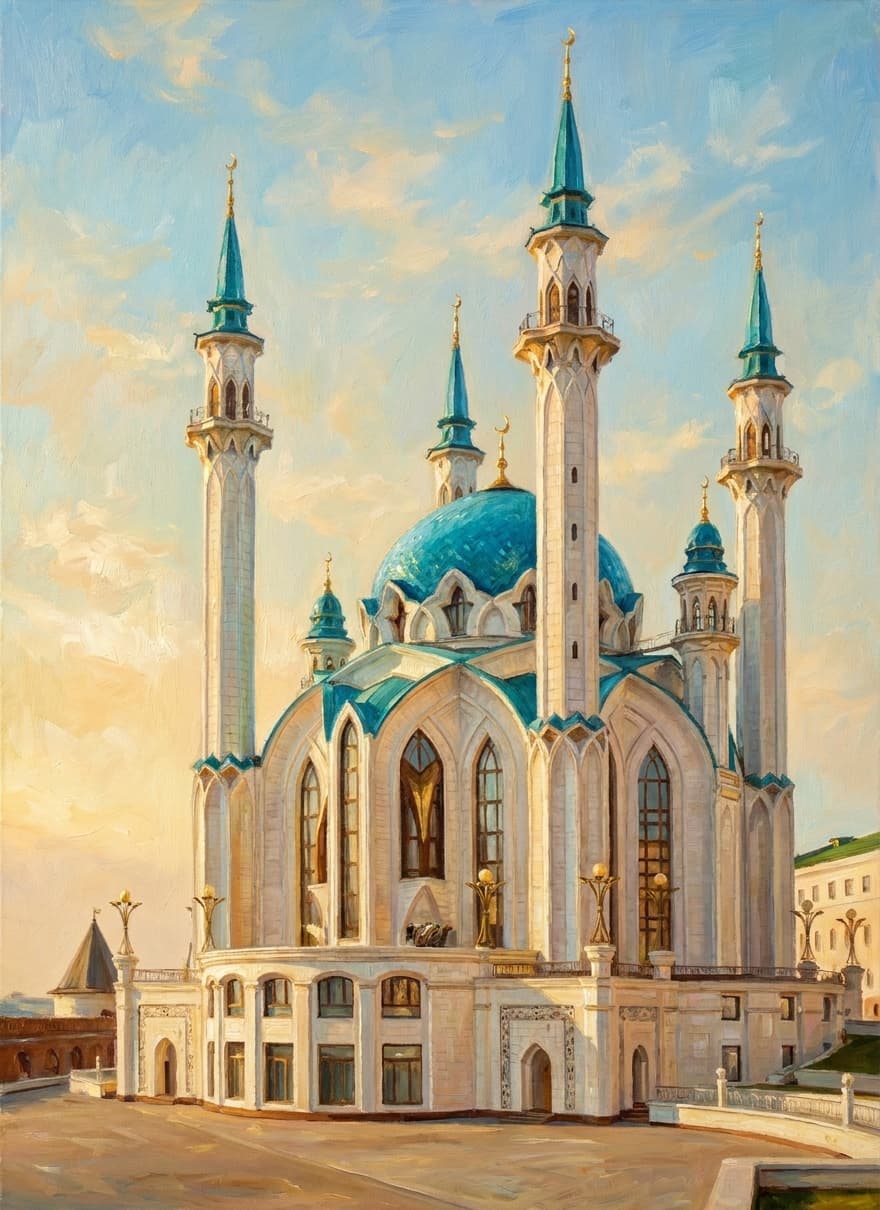
Visitors experience an active house of prayer seamlessly integrated with a world-class Islamic museum. The interior features soaring marble galleries, vibrant Czech crystal, and panoramic tourist mezzanine walkways designed to welcome travelers of all backgrounds.
Highlights
- Elevated tourist observation balconies overlooking the central prayer hall
- Museum of Islamic Culture of the Volga Region situated on the lower level
- Continuous live twenty-four-hour Quranic recitation broadcast softly through the sanctuary
- Striking visual dialogue with the Russian Orthodox Annunciation Cathedral across the citadel
Things to Know
- Modest attire covering shoulders, knees, and arms is strictly enforced for all guests
- Female visitors must wear a headscarf, available at the ground-level reception desk
- General tourist access inside the primary prayer floor is restricted during Friday Juma prayer
- Footwear must be removed or covered with protective booties before entering the sanctuary
Location
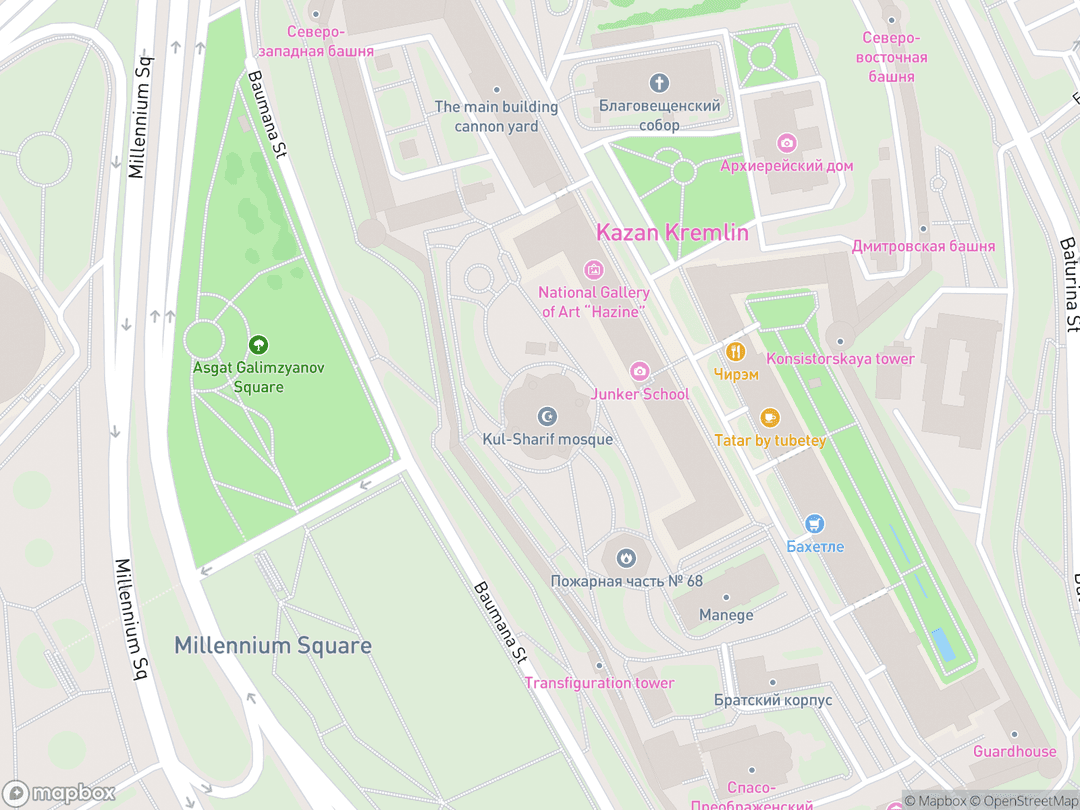
Ulitsa Sheynkmana, Kazan Kremlin, Kazan, Tatarstan 420014, Russia
Hours: Open daily from 9:00 AM to 7:00 PM, with extended hours until 8:00 PM in summer
Getting There: Take the Kazan Metro Central Line to Kremlyovskaya Station and walk five minutes uphill through the Spasskaya Tower gate.
Get DirectionsAbout
Rooted in the Abrahamic tradition of radical monotheism, the Kul Sharif Mosque serves as a sanctuary dedicated exclusively to the worship of God (Allah). Like ancient tabernacles and sanctuaries of prophetic tradition, the complex is oriented along a sacred axis, directing all prayer toward the Qibla in Mecca.
Located within the historic Kazan Kremlin citadel, the mosque stands as a triumphant revival of Tatar Islamic culture. The original capital mosque was destroyed during the 1552 siege by Tsar Ivan IV, remaining absent from the Kremlin skyline for more than four centuries.
Reconstructed between 1996 and 2005 through widespread civic donations, the contemporary structure balances historic Volga Bulgarian forms with modern Islamic geometry. Today, it functions as a vibrant house of congregational worship and an enduring symbol of peaceful interfaith coexistence.
Gallery
Symbolic Elements
The temple's exterior features intricate carvings, each rich with spiritual meaning:

Rub el Hizb Star Plan
The intersecting square footprint forms an eight-pointed star symbolizing the eight gates of Paradise and divine cosmic harmony.

Kazan Cap Dome
The faceted central dome recreates the crown of the Kazan Khans to celebrate sovereign Tatar heritage and identity.

Tulip Architectural Motif
The stylized tulip ornamentation represents spiritual rebirth and divine love in traditional Turkic-Islamic decorative art.
Eight Commemorative Spires
The eight structural spires honor the original sixteenth-century minarets lost during the siege of 1552.

White Ural Marble
Pristine white marble cladding across the facade reflects purity, peace, and the radiant light of divine truth.
Turquoise Roof Sheeting
The celestial turquoise domes evoke the vast heavens alongside traditional Turkic architectural aesthetics.
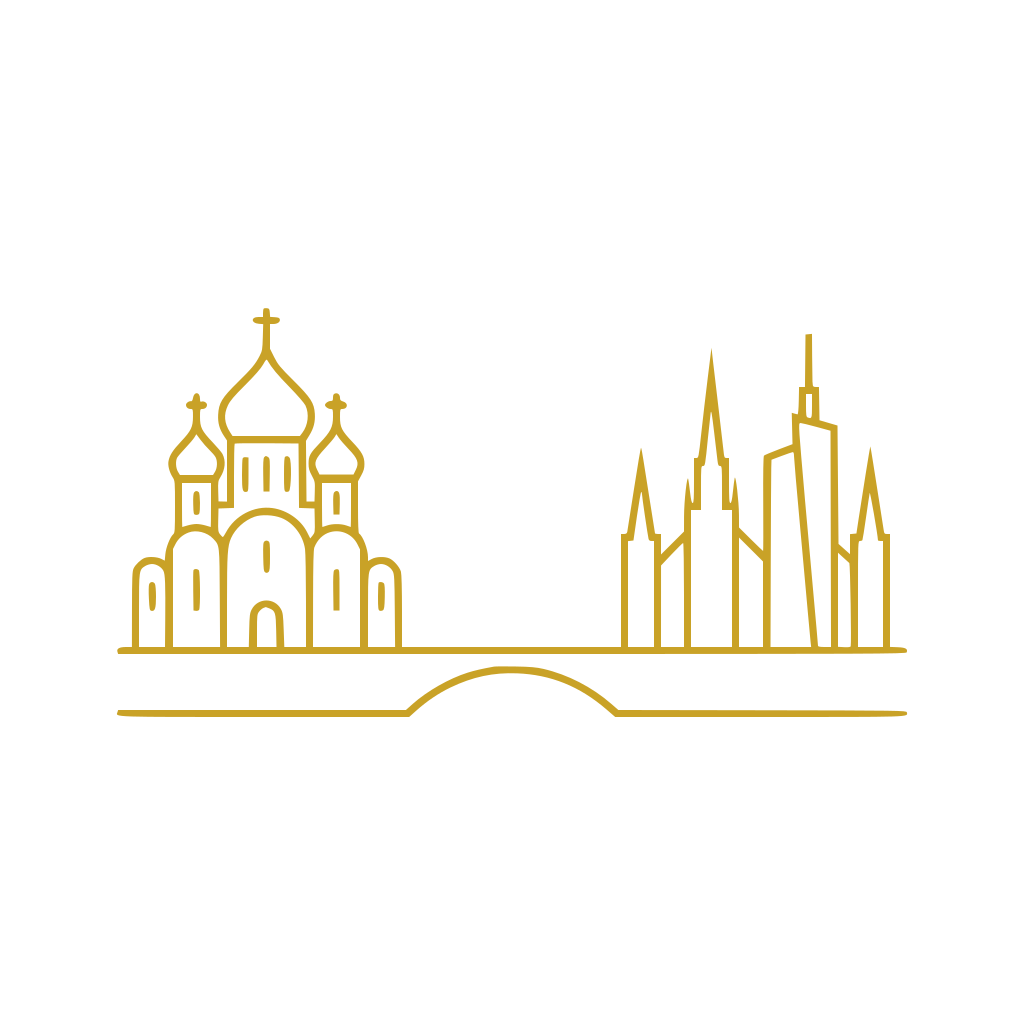
Dual Skyline Harmony
Positioned across from the Orthodox cathedral, the spires demonstrate interfaith balance and civic cooperation.
Interesting Facts
The sanctuary maintains live Quranic recitation chanted around the clock every day of the year (Tier A).
Reconstruction was financed by voluntary gifts from over 40,000 citizens whose names fill memorial museum registers (Tier A).
Historians suggest the eight-turreted design of Saint Basil's Cathedral in Moscow was inspired by the original eight-minaret Kul Sharif Mosque (Tier B).
The two-ton central Bohemian crystal chandelier was custom manufactured in the Czech Republic to exact Tatar artistic designs (Tier B).
The plush green and red prayer carpets spanning the floor were gifted directly by the government of Iran (Tier B).
By presidential decree, every ruble of state logistical support given to the mosque was matched to restore the adjacent Orthodox cathedral (Tier A).
Architects engineered specialized glass-walled mezzanine balconies so international tourists could visit without disturbing congregational worship (Tier B).
The complex has exhibited one of the world's largest printed Qurans, weighing approximately 800 kilograms (Tier B).
Its namesake, Imam Kul Sharif, was an accomplished classical Tatar poet in addition to being a religious statesman (Tier B).
Common Questions
Are non-Muslim visitors permitted inside the Kul Sharif Mosque?
Yes, non-Muslim visitors are warmly welcomed to explore the museum and view the prayer hall from dedicated upper balconies.
Is there an admission fee to enter the mosque?
Entry to the main sanctuary and viewing balconies is free, though a small fee applies for the lower-level museum.
What should visitors wear when visiting the sanctuary?
Visitors must wear modest clothing covering shoulders and knees, and women must cover their hair with a scarf.
Why does the mosque have eight minarets?
The eight minarets commemorate the legendary eight spires of the 16th-century mosque destroyed during Ivan the Terrible's conquest.
Featured Stories
The Last Defense of Imam Kul Sharif
October 2, 1552
When the forces of Ivan the Terrible breached the Kremlin walls, the revered scholar and poet Kul Sharif rallied his religious students in defense of the cathedral mosque. Refusing to surrender, they fought to protect their sacred texts and community until the sanctuary fell in flames. His sacrifice became a legendary touchstone of Tatar spiritual perseverance that inspired the modern reconstruction.
Source: Historical chronicles of the Kazan Khanate
The Historic Decree of Harmony
November 13, 1995
Following the fall of the Soviet Union, President Mintimer Shaimiev sought to heal centuries-old wounds by rebuilding the lost crown of the Kazan Kremlin. To foster genuine peace among Tatarstan's diverse citizens, he decreed that the mosque's reconstruction must proceed alongside the total restoration of the Orthodox Annunciation Cathedral. This bold pairing turned potential division into a globally recognized model of Abrahamic interfaith unity.
Source: State Archive of the Republic of Tatarstan
A Monument Built by the People
June 24, 2005
Rather than relying purely on state treasuries, the Kul Sharif Mosque was brought to life by over forty thousand individual donors from across the world. Schoolchildren, elders, and international benefactors contributed their own funds to purchase white marble and Czech crystal for the sacred halls. Every single donor's name was transcribed by hand into multi-volume leatherbound registries permanently safeguarded within the complex museum.
Source: Spiritual Administration of Muslims of Tatarstan
Timeline
Prominence of the Original Sanctuary
The multi-minaret capital mosque serves as the theological and cultural center of the Kazan Khanate.
MilestoneSiege and Destruction
Tsar Ivan IV captures the Kremlin, killing Imam Kul Sharif and destroying the sanctuary.
EventKremlin Sanctuary Ban Enacted
Russian imperial authorities prohibit Islamic places of worship within the Kremlin perimeter.
MilestoneCatherine II Edict of Toleration
Empress Catherine II permits stone mosque construction in Kazan settlements outside the citadel.
EventSoviet Secularization
The Kazan Kremlin is transformed into a military garrison, suppressing religious functions across all faiths.
EventPresidential Restoration Decree
President Mintimer Shaimiev decrees the simultaneous rebuilding of the mosque and restoration of the cathedral.
MilestoneGroundbreaking and Foundation Work
Work officially commences following an architectural design competition won by Tatar architects.
component.timeline.groundbreakingUNESCO World Heritage Inscription
The Kazan Kremlin complex is inscribed as a UNESCO World Heritage Site celebrating cultural dialogue.
MilestoneSolemn Inauguration and Dedication
The completed mosque complex is formally dedicated to launch the millennium celebrations of Kazan.
DedicationMuseum Expansion
The lower-level museum expands its permanent exhibit documenting the Volga region's Islamic history.
MilestoneHistory by Decade
1550s — The Golden Age of the Khanate
In the mid-sixteenth century, the capital mosque served as the supreme religious sanctuary of the Kazan Khanate. Under the guidance of Seyyid Kul Sharif, the complex nurtured generations of scholars through its extensive theological library and celebrated madrasa.
1552–1560s — Conquest and Annihilation
In October 1552, the citadel was stormed by the army of Tsar Ivan the Terrible, culminating in the death of Kul Sharif and his defenders. The original multi-minaret structure was completely dismantled, and Muslim worship was strictly banned within the Kremlin grounds.
1760s–1800s — The Dawn of Religious Toleration
Empress Catherine II visited Kazan in 1767 and issued landmark decrees permitting the construction of stone mosques in Tatar quarters outside the fortress. While the Kremlin remained an imperial Russian garrison, civic tolerance permitted the gradual resurgence of Tatar Islamic scholarly life.
1920s–1980s — The Soviet Secularization
Throughout the Soviet era, the Kremlin was sealed as a secular administrative and military headquarters, leaving historic religious monuments damaged or decommissioned. Both Islamic and Christian communities faced severe state suppression, preserving their sacred traditions quietly within private households.
1990s — Sovereignty and the Sacred Decree
Following Tatarstan's declaration of state sovereignty, public momentum demanded the restoration of the Tatar nation's destroyed historical heritage. In autumn 1995, President Shaimiev issued the historic decree mandating the reconstruction of Kul Sharif alongside the restoration of the Kremlin's Orthodox cathedral.
2000s — Millennium Dedication
Funded by thousands of private citizens, construction culminated on June 24, 2005, during the official celebration of Kazan's thousandth anniversary. The soaring white-marble sanctuary reopened its doors to worshippers and visitors, restoring the historic cultural balance of the Volga region.
2010s–Present — An Active Spiritual Hub
The mosque serves as the preeminent seat of the Spiritual Administration of Muslims of Tatarstan, hosting daily prayers and diplomatic visits. Through its lower-level museum and continuous Quran recitations, the complex stands as a vibrant global bridge between Islamic and European civilizations.
Architecture & Facilities
The mosque represents a contemporary synthesis of Volga Bulgarian architectural traditions, classical Ottoman proportions, and modern structural engineering, evoking the spirit of the lost 1552 cathedral mosque while harmonizing with the surrounding citadel.
Building Materials
Chelyabinsk White Ural Marble
Polished white marble panels quarried in the Ural Mountains clad the exterior facades with pristine luminescence.
Turquoise Copper-Zinc Alloy
Custom weather-resistant turquoise sheeting covers the stepped roof vaults and minaret spires to mimic historic patina.
Czech Bohemian Crystal
A monumental two-ton crystal chandelier adorned with gold leaf illuminates the central dome from Bohemia.
Hand-Knotted Iranian Wool
Custom Persian wool carpets with intricate floral arabesques cushion the congregational prayer hall floors.
Interior Features
Congregational Men's Prayer Hall
The expansive ground-floor hall features marble columns, calligraphic Quranic bands, and hand-knotted Persian carpets.
Gilded Marble Mihrab
The prayer niche is sculpted from pure white marble inlaid with mother-of-pearl and aligned precisely toward Mecca.
Mezzanine Women's Gallery
Suspended second-level balconies provide private, elevated prayer spaces with views of the illuminated central dome.
Raised Tourist Observation Loggias
Glazed upper walkways allow international visitors to observe liturgical activity without stepping onto consecrated carpets.
Temple Grounds
The mosque sits atop a vast granite podium on the Kremlin esplanade, offering sweeping vistas of the Volga River and the historic Annunciation Cathedral.
Additional Facilities
The complex houses the Museum of Islamic Culture of the Volga Region, conference halls, ceremonial ablution rooms, and administrative offices.
Religious Significance
The Kul Sharif Mosque stands firmly within the Abrahamic lineage of radical monotheism, honoring the oneness of God through worship, scripture, and sacred geometry.
To provide a consecrated House of God (Masjid) where the faithful offer ritual prayer facing Mecca, study the Quran, and celebrate communal life.
Sacred Ordinances
Salah (Ritual Prayer)
The five prescribed daily prayers offered in unison by congregants bowing toward the Kaaba in Mecca.
Juma (Friday Congregational Prayer)
The weekly communal gathering featuring a liturgical sermon (Khutbah) delivered from the ceremonial marble minbar.
Nikah (Islamic Marriage Ceremony)
Sacred marital covenants solemnized before religious authorities in the private ceremonial halls.
Tahfiz and Tilawa (Quranic Recitation)
The perpetual, twenty-four-hour continuous oral recitation of the Holy Quran maintained by resident Hafiz.
The Direction of Sacred Prayer (Qibla)
Like the ancient Solomonic temple and biblical tabernacle, the mosque directs all interior liturgical movement along a single sacred geodetic axis facing the Kaaba in Mecca.
Non-Figurative Sacred Arts
To safeguard divine transcendence, the sanctuary eschews figurative icons, expressing the infinite majesty of God through intricate arabesques, geometry, and Quranic calligraphy.
Sources & Research
Every fact on Temples.org is backed by verified Sources & Research. Each piece of information is rated by source tier and confidence level.
View All Sources (9)
| Field | Source | Tier | Retrieved |
|---|---|---|---|
| Architecture & Structural Planning | Abdullatif Al Fozan Award for Mosque Architecture (opens in a new tab) | A | 2026-02-17 |
| About & Historical Background | Islamic Architectural Heritage Database (opens in a new tab) | A | 2026-02-17 |
| Religious Significance & Ordinances | Islamic Landmarks Foundation (opens in a new tab) | A | 2026-02-17 |
| Timeline & Restoration History | Religiana European Heritage Network (opens in a new tab) | A | 2026-02-17 |
| About & Kremlin Citadel History | Société Internationale d'Ethnologie et de Folklore (opens in a new tab) | B | 2026-02-17 |
| Symbolic Elements & Artistry | Bi Dünya Haber Architectural Archives (opens in a new tab) | B | 2026-02-17 |
| Visitor Insights & Access | RussiaTrek Cultural Heritage Guide (opens in a new tab) | C | 2026-02-17 |
| Featured Stories & Civic Benefactors | Kupi Architectural Archives (opens in a new tab) | D | 2026-02-17 |
| Visitor Insights & Travel Logistics | Trip Travel Cultural Directory (opens in a new tab) | D | 2026-02-17 |