Visitor Insights
Visiting Church of the Savior on Spilled Blood
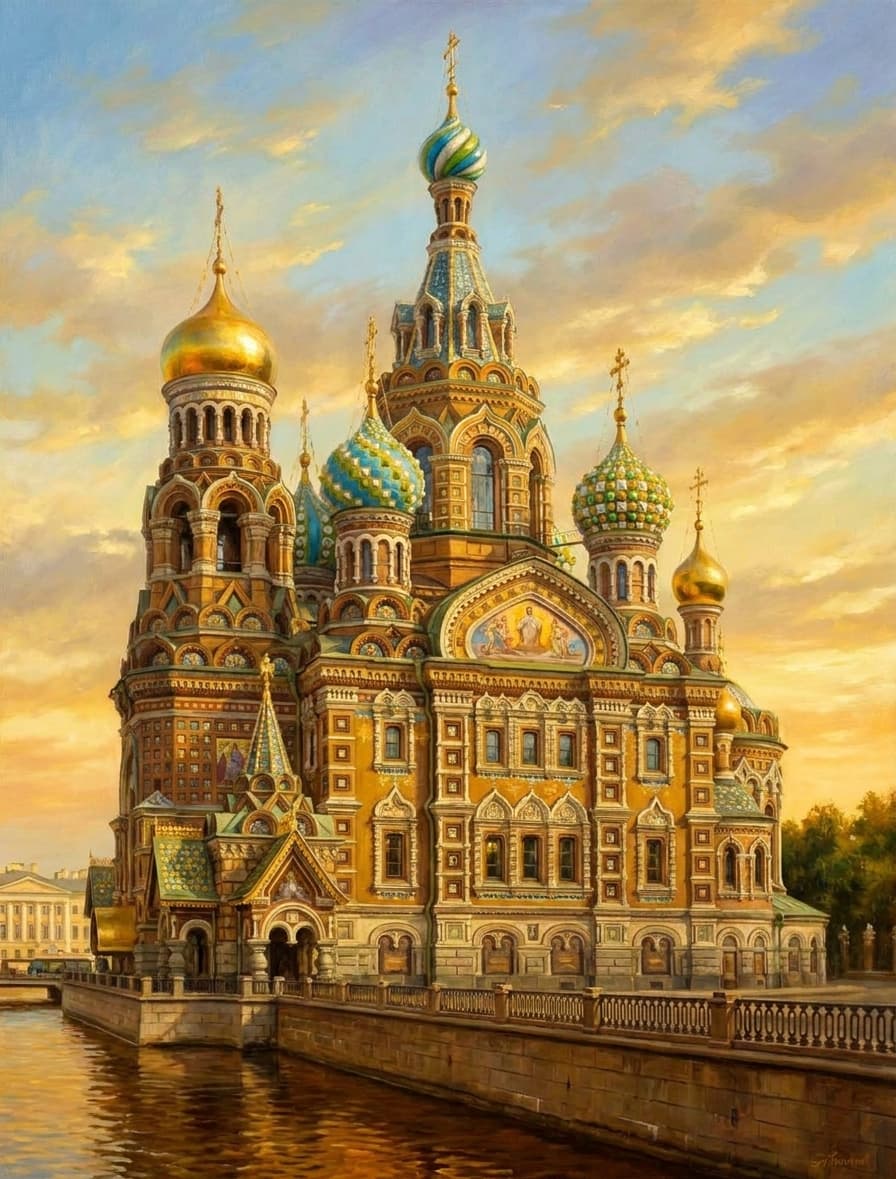
The Church of the Savior on Spilled Blood offers visitors an immersive encounter with the largest unified smalt mosaic collection in Europe. Stepping inside reveals wall-to-ceiling sacred iconography cast in brilliant gold leaf and colored glass.
Highlights
- The Pavement Baldachin sheltering the original canal cobblestones where Alexander II fell
- Over seven thousand square meters of biblical and martyrological mosaic art
- Polychromatic enameled exterior onion domes reflecting sixteenth-century Muscovite design
Things to Know
- Modest attire is expected within consecrated liturgical areas of the sanctuary
- Flash photography, tripods, and large backpacks are prohibited inside the museum
- The museum is closed on Wednesdays except during select holiday periods
Location
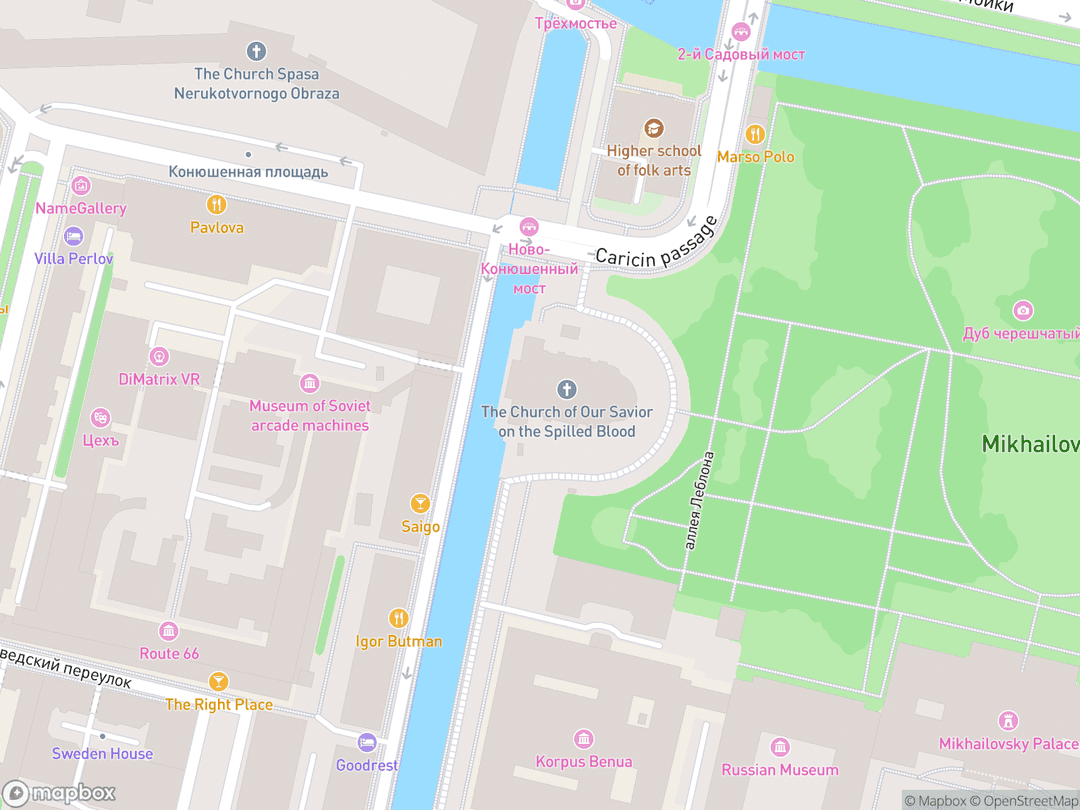
Griboyedov Canal Embankment, 2B, Saint Petersburg, 191186, Russian Federation
Hours: Daily from 10:00 AM to 6:00 PM; closed on Wednesdays
Getting There: Located a seven-minute walk north along Griboyedov Canal from Nevsky Prospekt and Gostiny Dvor metro stations.
Get DirectionsTips for Your Visit
Optimal Lighting
Visit during late afternoon when sunlight illuminates the gold tesserae of the high vaults.
Summer White Nights
Take advantage of evening summer hours to see the vibrant enameled domes glowing at twilight.
Cloakroom Requirement
Deposit large bags and umbrellas at the complimentary lower-level cloakroom before entry.
About
The Church of the Savior on Spilled Blood stands as a monumental landmark in Saint Petersburg, erected on the site where Emperor Alexander II was assassinated on March 13, 1881. Conceived by Alexander III as an imperial memorial, the cathedral serves as an intentional return to medieval Russian architecture, breaking radically with the neoclassical order of Peter the Great.
Designed collaboratively by architect Alfred Parland and Archimandrite Ignaty, the cathedral incorporates over 7,065 square meters of intricate glass smalt mosaics across its vaults, pillars, and exterior gables. Its silhouette evokes sixteenth-century Muscovite and Yaroslavl churches, crowned by polychromatic enameled onion domes.
Surviving wartime siege, artillery barrages, and municipal demolition plans during the Soviet era, the building underwent extensive structural conservation. Today, it operates as a state memorial museum under the Saint Isaac's Cathedral complex while hosting regular Orthodox divine services.
Gallery
Symbolic Elements
The temple's exterior features intricate carvings, each rich with spiritual meaning:

Central Tent Roof
Rises 81 meters to honor the year 1881 of Tsar Alexander II's martyrdom.

Western Bell Tower
Stands 63 meters tall to represent Alexander II's age at the time of his passing.
The Jasper Baldachin
Shelters the original bloodstained street pavement to sanctify the site of sacrificial suffering.

Nine Onion Domes
Symbolize the nine orders of angelic hierarchy surrounding the celestial throne in heaven.
Christ Pantocrator Mosaic
Affirms the universal sovereignty of Christ Almighty above earthly empires from the central dome.

Heraldic Granite Shields
Commemorate the Russian cities and provinces that sent municipal contributions for construction.

Pillar Martyr Iconography
Depicts hundreds of Christian martyrs on structural piers supporting the heavenly ceiling vaults.
Interesting Facts
The central spire stands exactly 81 meters tall to symbolize the year 1881 when Alexander II was assassinated (Tier A).
The western bell tower reaches 63 meters in height to commemorate the emperor's age at his death (Tier A).
A 240-mm German artillery shell lodged inside the central dome in World War II remained undetected until 1961 (Tier B).
Engineers diverted the Griboyedov Canal 8.5 meters into the riverbed to enclose the bloodstained cobblestones (Tier A).
The interior houses the largest collection of glass smalt mosaics in Europe, covering over 7,000 square meters (Tier B).
During the 872-day Siege of Leningrad, the unheated interior was utilized as a central municipal morgue (Tier B).
A persistent urban legend claimed the Soviet regime would fall once the church's scaffolding was dismantled (Tier C).
Chief architect Alfred Parland was of Baltic-German and Scottish descent and was raised in a Lutheran home (Tier B).
The five main domes are covered in hand-fired multi-colored vitreous enamel applied over copper plate (Tier B).
Common Questions
Why is the church named 'on Spilled Blood'?
It stands on the exact canal paving where Emperor Alexander II was assassinated in 1881.
Is the cathedral an active church or a museum?
It functions primarily as a state museum while holding regular Russian Orthodox liturgical services.
Are the interior images painted or mosaics?
Every figurative image inside is composed entirely of hand-cut glass smalt rather than paint.
Can visitors view the exact spot of the assassination?
The cobblestone pavement and canal railing are preserved under an ornate jasper baldachin in the nave.
Featured Stories
The Imperial Foundation
October 18, 1883
Determined to honor his slain father, Tsar Alexander III rejected European neoclassical models and demanded a purely national Russian church. Architects extended the canal bank into the water to encase the exact flagstones of the attack within the cathedral nave. This structural feat forever embedded the historic street into consecrated holy ground.
Source: State Museum-Memorial Saint Isaac's Cathedral Complex
The Undetected Bomb
April 14, 1961
During the Second World War, a heavy 240-millimeter German artillery shell crashed through the central dome without detonating. It remained wedged in the acoustic vaulting rafters for nearly two decades unnoticed by municipal officials. When discovered in 1961, sappers extracted the bomb without damaging the irreplaceable smalt mosaics.
Source: Committee for State Preservation of Historical Monuments
The Decades of Scaffolding
August 19, 1997
Throughout the late Soviet era, chronic shortages kept restoration scaffolding attached to the exterior for decades, sparking rumors that the Soviet Union would endure until the poles fell. Workers finally completed dismantling the outer framework in late 1991, shortly before the USSR dissolved. In 1997, the cathedral officially reopened to the world.
Source: Saint Petersburg Metropolia of the Russian Orthodox Church
Timeline
Assassination of Alexander II
Emperor Alexander II is mortally wounded on the Catherine Canal embankment by a revolutionary bomb.
EventConsecration of the Foundation
Tsar Alexander III lays the cornerstone for the permanent memorial cathedral on the canal bed.
component.timeline.groundbreakingAwarding of Mosaic Contract
The Frolov Mosaic Workshop is commissioned to execute the vast interior and exterior mosaic programs.
MilestoneSolemn Consecration
Emperor Nicholas II presides over the dedication on the Feast of the Transfiguration.
DedicationSoviet Closure
The Leningrad District Executive Committee officially shuts the church and slates it for demolition.
EventSiege of Leningrad Usage
The unheated building is requisitioned as a central city morgue during the catastrophic wartime blockade.
EventArtillery Shell Defused
Engineers extract an unexploded German high-explosive shell lodged inside the central dome structure.
MilestoneTransfer to Saint Isaac's
Demolition orders are rescinded, and the building becomes a branch of Saint Isaac's Cathedral Museum.
RenovationPublic Reopening
The cathedral reopens to the public as a restored mosaic museum ninety years after original consecration.
MilestoneReturn of Orthodox Liturgy
Metropolitan Vladimir celebrates the first Divine Liturgy inside the sanctuary in over seven decades.
MilestoneHistory by Decade
1880s — Regicide and Foundation
Following the assassination of Alexander II on March 13, 1881, Alexander III launched a national architectural contest. Ground was broken on October 18, 1883, after architect Alfred Parland and Archimandrite Ignaty secured approval for their Muscovite Revival concept. Heavy caissons diverted the canal embankment to preserve the street stones.
1890s — Structural Masonry and Mosaic Contracts
Masons raised the intricate yellow-brick walls, multi-tiered gables, and structural domes along the canal. In 1897, the Frolov Mosaic Workshop was awarded the massive assignment to decorate the interior and exterior walls. Renowned Russian artists supplied full-scale cartoon studies for the smalt artisans.
1900s — Consecration and Imperial Devotion
The monumental mosaic campaign reached completion across every ceiling vault and pier. On August 19, 1907, Nicholas II and the imperial family attended the cathedral's solemn dedication on the Feast of the Transfiguration. The building functioned as an imperial memorial chapel dedicated exclusively to commemorative services.
1910s–1920s — Revolution and Seizure
State funding terminated immediately after the October Revolution of 1917, placing the cathedral under an impoverished local parish council. In 1922, Soviet officials confiscated valuable liturgical vessels, gold chalices, and jeweled ornaments under secularization decrees. The parish navigated internal divisions before falling under heightened state surveillance.
1930s — Closure and Demolition Threats
The Leningrad municipal council shuttered the church on November 17, 1931, designating it for immediate demolition to widen tram tracks. Explosive charges were surveyed and mapped along the foundations to level the masonry. Resource reallocations and logistics repeatedly delayed the planned destruction.
1940s — Siege Morgue and Vegetable Storage
During the brutal Siege of Leningrad, city authorities utilized the freezing cathedral as a morgue for victims of starvation and shelling. After the siege lifted, local trusts stored surplus agricultural produce inside, leading locals to dub it 'Savior on Potatoes.' Scenic backdrops for the Maly Opera Theatre were also housed within.
1950s–1960s — Neglect and the Hidden Shell
Severe roof leaks, moisture, and unheated winters damaged the delicate mosaic mortar throughout the post-war period. In 1961, roofing technicians discovered an unexploded 150-kilogram German artillery shell lodged inside the central dome structure. Cultural preservationists successfully mobilized to avert renewed municipal plans for demolition.
1970s–1980s — Transfer to Saint Isaac's and Restoration
Custody of the ruined cathedral was granted to the Saint Isaac's Cathedral State Museum in July 1970. Heavy scaffolding was erected, launching a complex conservation effort to stabilize structural vaults and loose tesserae. Craftsmen reconstructed the damaged vitreous enamel plates covering the exterior onion cupolas.
1990s — Scaffolding Removal and Reopening
Longstanding exterior scaffolding was fully dismantled in 1996, transforming the city skyline. On August 19, 1997—exactly ninety years after its first consecration—the cathedral reopened its bronze doors as a state museum. Hundreds of thousands of visitors entered to view the restored mosaic interiors.
2000s–Present — Liturgical Renewal and Modern Stewardship
Metropolitan Vladimir celebrated the first Divine Liturgy in seventy-three years inside the cathedral on May 23, 2004. An active parish community was formally re-registered in 2014, establishing regular prayer services alongside museum operations. Ongoing conservation protects the delicate canal foundations and smalt murals.
Architecture & Facilities
The Church of the Savior on Spilled Blood is an intentional masterpiece of Russian Revival architecture, deliberately rejecting the Western Neoclassical and Baroque planning of Saint Petersburg in favor of sixteenth- and seventeenth-century Muscovite forms.
Building Materials
Glazed Siegelsdorf Brick
German-fired yellow-ochre glazed bricks form the decorative exterior facade.
Serdobol Granite
Durable Lake Ladoga grey granite forms the lower basement and foundational plinth.
Vitreous Enamel
Hand-fired multicolored vitreous enamel covers the five primary copper onion domes.
Glass Smalt Tesserae
Opaque glass tesserae with gold leaf laminates comprise the interior mosaic surfaces.
Siena Marble
Soft yellowish-pink Italian marble forms the delicately carved liturgical iconostasis.
Interior Features
The Shrine of the Crucifixion
A monumental jasper and nephrite baldachin shelters the historic cobblestone pavement.
The Main Iconostasis
A masterwork of carved Siena marble designed by Alfred Parland and sculpted in Genoa.
The Central Octagonal Drum
Rising toward the ceiling, it features the monumental Christ Pantocrator mosaic.
The Hardstone Mosaic Floor
Florentine marble and Ural jasper carpet the floor in geometric and floral patterns.
Temple Grounds
The cathedral occupies the eastern embankment of the Griboyedov Canal, directly bordering the historic Mikhailovsky Garden and adjacent Mars Field. Paved granite walkways line the water's edge, accommodating pedestrian access from Nevsky Prospekt.
Additional Facilities
A dedicated underground visitor pavilion provides ticketing, an audio guide desk, souvenir books, and a public cloakroom.
Religious Significance
The Cathedral of the Resurrection of Christ stands as an architectural icon of Russian Orthodox theology, transforming a scene of political violence into a monument of eternal redemption. Its rich iconographic design translates Christian doctrine into light and color.
To serve as a consecrated house of prayer, a national memorial to a slain sovereign, and a physical testament to the victory of the Resurrection over death.
Sacred Ordinances
Divine Liturgy
The primary Eucharistic worship service of the Eastern Orthodox Church celebrated on feast days.
Panikhida
Memorial prayer services offered for the repose of the departed, historically dedicated to Alexander II.
Moleben
Supplicatory prayer services offered for specific intentions, spiritual protection, and thanksgiving.
Theology of the Passion-Bearer
In Russian Orthodox tradition, rulers who accept death in sacrifice are revered as Strastoterptsy (Passion-Bearers). The memorial links the assassination of Alexander II directly to the self-sacrificing humility of Christ on Golgotha.
The Sacramental Iconography of Mosaics
In Orthodox ecclesiology, mosaics are regarded as windows into the Kingdom of Heaven. The reflective gold tesserae capture natural sunlight, symbolizing the uncreated Tabor Light of the Transfiguration filling the terrestrial church.
Sources & Research
Every fact on Temples.org is backed by verified Sources & Research. Each piece of information is rated by source tier and confidence level.
View All Sources (8)
| Field | Source | Tier | Retrieved |
|---|---|---|---|
| About & Historical Background | State Museum-Memorial Saint Isaac's Cathedral Complex (opens in a new tab) | A | 2026-02-18 |
| Consecration & Liturgical Life | Saint Petersburg Metropolia of the Russian Orthodox Church (opens in a new tab) | A | 2026-02-18 |
| Architectural & Mosaic Studies | eScholarship University of California (opens in a new tab) | B | 2026-02-18 |
| Restoration Ledger & Engineering | Committee for State Preservation of Historical Monuments (opens in a new tab) | A | 2026-02-18 |
| Imperial Memorial History | National Library of Russia (opens in a new tab) | B | 2026-02-18 |
| Architectural Conservation Ledger | The State Hermitage Museum Research Portal (opens in a new tab) | B | 2026-02-18 |
| Visitor Insights & Practical Guide | Russiable Travel Guides (opens in a new tab) | D | 2026-02-18 |
| Historical Timeline Documentation | Saint Petersburg Historical City Guide (opens in a new tab) | C | 2026-02-18 |