Visitor Insights
Visiting Ivolginsky Datsan
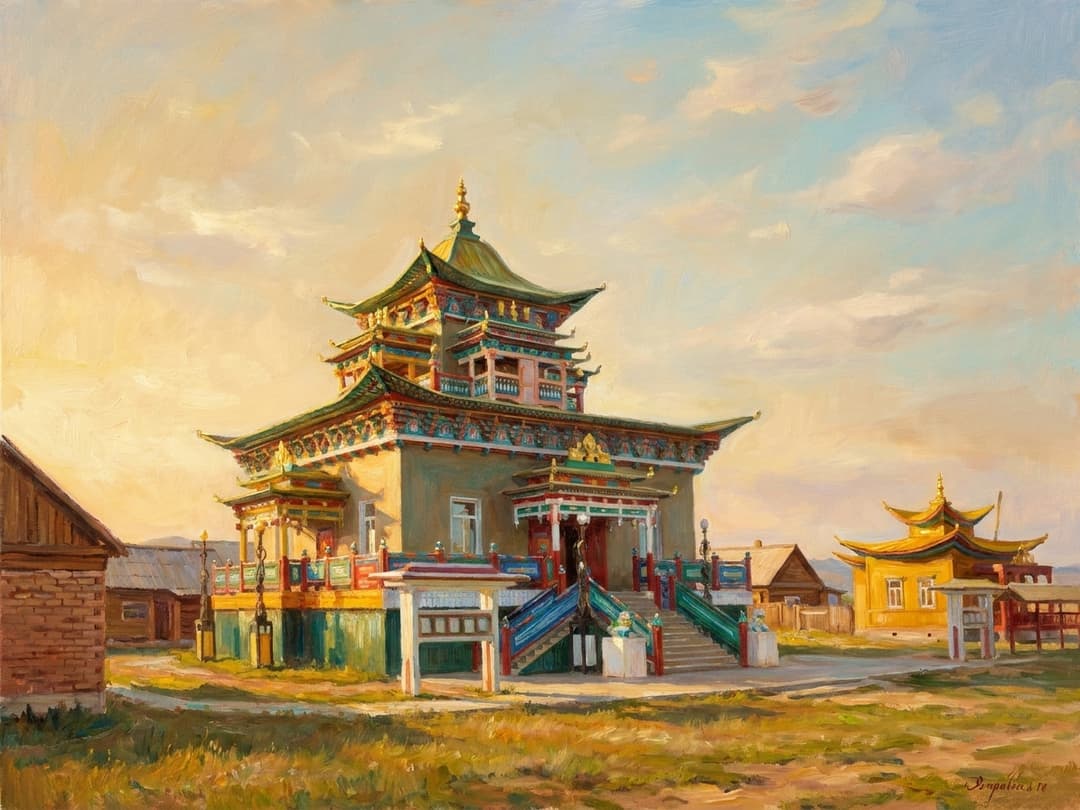
Ivolginsky Datsan welcomes visitors to explore its vibrant courtyard temples, active monastic university, and serene steppe grounds. The monastery operates daily as a thriving center of worship, traditional Tibetan medicine, and scholarly debate.
Highlights
- Circumambulate the sacred Tsogchen Dugan cathedral alongside resident lamas.
- Venerate the sacred Bodhi Tree thriving within an insulated Siberian greenhouse.
- View the ornate architecture of the Itigilov Palace, home of the incorruptible Khambo Lama.
- Spin hundreds of copper prayer wheels containing sacred mantras along the perimeter path.
Things to Know
- Always circumambulate the temple complex and individual shrines in a clockwise direction.
- Remove hats and sunglasses before entering active prayer halls, and never step on door sills.
- Photography is strictly forbidden inside all active sanctuaries without official monastic permission.
- The incorrupt body of Khambo Lama Itigilov is displayed to the public only eight times annually.
Location
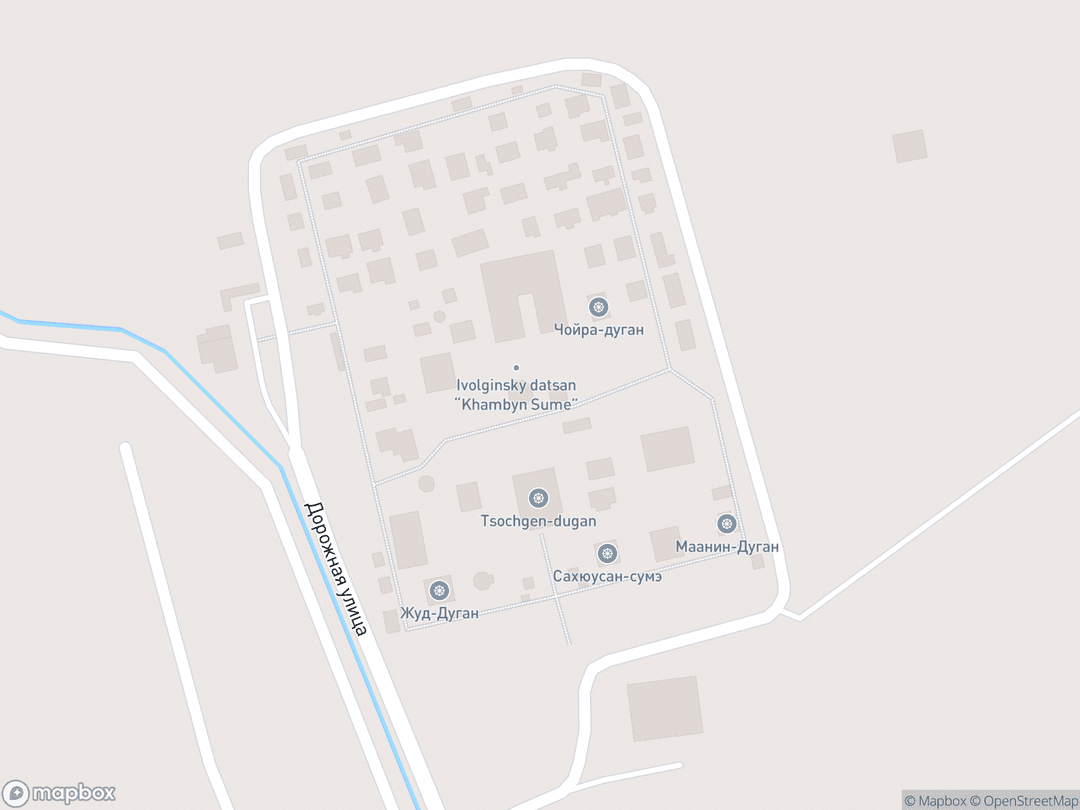
Verkhnyaya Ivolga, Ivolginsky District, Republic of Buryatia, 671120, Russian Federation
Hours: Daily from 9:00 AM to 5:00 PM; morning liturgies commence at 9:00 AM
Getting There: Located 36 km southwest of Ulan-Ude; accessible via minibus line 130 to Ivolginsk followed by a local transfer shuttle, or by taxi via the A340 highway.
Get DirectionsTips for Your Visit
Plan for Morning Liturgy
Arrive before 9:00 AM to hear the resonant chanting, horns, and cymbals during the daily morning khural service.
Engage Traditional Doctors
Consultations with resident Emchi lamas skilled in Tibetan herbal medicine and pulse diagnosis are available on site.
Dress for Sub-Zero Winters
Winter temperatures often fall below -30°C; dress warmly as walking between temples involves open steppe pathways.
About
Ivolginsky Datsan, known formally as Gandan Dashi Choynhorlin, is the principal monastic university and spiritual headquarters of the Buddhist Traditional Sangha of Russia. Established in the steppes of Eastern Siberia at the close of World War II, it represents the resilient survival and post-Soviet renaissance of the Gelug school of Tibetan-Mongolian Buddhism.
Rooted within the broader Dharmic family alongside Hinduism and Jainism, the datsan embodies foundational tenets of karma, samsara, and universal liberation through the Mahayana Bodhisattva ideal. Here, classical Indo-Tibetan scholasticism harmonizes seamlessly with indigenous Buryat craftsmanship and centuries-old Transbaikalian pastoral traditions.
The sprawling complex encompasses more than ten consecrated temples, philosophical courtyards, traditional medical colleges, and reliquary stupas. It is universally renowned as the sacred sanctuary preserving the incorruptible body of the 12th Pandito Khambo Lama Dashi-Dorzho Itigilov, drawing pilgrims across Eurasia.
Gallery
Symbolic Elements
The temple's exterior features intricate carvings, each rich with spiritual meaning:

Dharmachakra with Flanking Deer
Mounted on roof ridges, the golden wheel and two deer symbolize the Buddha's first sermon delivered in the Deer Park.

Ganjira Roof Finial
The gilded brass spire crowning temple roofs represents Mount Meru as the central cosmic axis of enlightenment.
Suburgan Stupas
Multi-tiered white reliquary monuments symbolize the elemental stages of the cosmos and the mind of enlightened Buddhas.

Khurde Prayer Wheels
Cylindrical drums holding thousands of paper mantras generate boundless spiritual merit when spun clockwise by pilgrims.

Khii Morin Wind Horse Flags
Five-colored fabric flags inscribed with sacred verses disperse spiritual fortune across the steppe winds.

Soyombo Emblem
The ancient Mongolian flame, sun, and moon crest symbolizes eternal spiritual life and cosmic wisdom.
Pure Land Mandala of Sukhavati
The intricate carved wooden palace inside Devazhin Dugan depicts the celestial paradise of Amitabha Buddha.
Interesting Facts
The monastery was authorized by Joseph Stalin in 1945 in recognition of Buddhist donations to the wartime defense fund (Tier A).
Khambo Lama Itigilov's body remains non-decayed with pliable joints 75 years after entering meditative death without embalming (Tier A).
The entire monastic complex grew outward from a single traditional wooden log homestead donated by a local Buryat family (Tier B).
A descendant of the sacred Bodhi Tree thrives here in an insulated greenhouse despite outdoor winters plunging past -40°C (Tier B).
The monastery founded Dashi Choinkhorling University, Russia's first accredited higher institute of Buddhist philosophy (Tier A).
The on-site foundry workshop Erkhim Darkhan has cast more than 1,000 bronze Buddha statues to supply newly restored temples (Tier B).
Monks maintain a sanctuary for live Siberian roe deer to evoke the sacred Deer Park where the Buddha taught at Sarnath (Tier B).
Before his passing in 1927, Lama Itigilov authored a manuscript accurately foretelling the Soviet purges and spiritual revival (Tier B).
Common Questions
Who was the 12th Pandito Khambo Lama Dashi-Dorzho Itigilov?
He was the supreme leader of Russian Buddhists who entered deep meditative death in 1927 and remains physically incorrupt.
Can regular visitors enter the temple sanctuaries?
Yes, visitors may enter during daylight hours provided they observe dress codes and walk clockwise around the perimeter.
Is the body of Lama Itigilov on permanent public display?
No, his sacred form is exhibited for pilgrim veneration only eight times a year during major religious holidays.
What should one wear when visiting the monastery?
Modest attire covering shoulders and knees is mandatory, and headwear must be removed upon crossing temple thresholds.
Featured Stories
The Miracle of Khambo Lama Itigilov
September 10, 2002
In 1927, the 12th Pandito Khambo Lama instructed disciples to exhume his body in thirty years before entering the meditative lotus posture. When forensic specialists officially opened his cedar sarcophagus in 2002, they uncovered a fully preserved human form with soft skin and flexible joints. His uncorrupted presence remains an enduring testament to deep meditative achievement and faith.
Source: Buddhist Traditional Sangha of Russia
Resurrection from the War Effort
May 2, 1945
Decimated by brutal religious persecution in the 1930s, Buryat Buddhists rallied to raise significant defense funds for the Red Army during World War II. Touched by their patriotism, Soviet authorities permitted the founding of a single Buddhist monastery in the Ivolga valley. Returning from Gulag camps, surviving lamas turned a humble donated farmhouse into a sanctuary of revival.
Source: Historical Archives of the Republic of Buryatia
Nurturing the Arctic Bodhi Tree
1972
When an Indian delegation gifted a sapling derived from the sacred Bodhi Tree in Bodh Gaya, skeptics doubted it could survive Siberia's brutal climate. Monks constructed a specialized glasshouse with coal and wood heating systems maintained around the clock. Against all environmental odds, the sacred tree continues to flourish beneath the sub-arctic skies of Buryatia.
Source: Datsan Monastic Chronicles
Timeline
Soviet Resolution of Establishment
Council of People's Commissars of the Buryat-Mongolian ASSR officially authorizes opening a Buddhist temple in the Ivolga valley.
MilestoneFirst Consecration
Elderly lamas consecrate a donated wooden homestead into Khambyn Sume, the lone legal Buddhist temple in the USSR.
DedicationSeat of the Central Spiritual Board
The Central Spiritual Board of Buddhists of the USSR is established, making Ivolginsky its official seat.
MilestonePermanent Land Grant
Monastery receives an official fourteen-hectare parcel from the state for permanent monastic development.
EventSecret Inspection of Khambo Lama Itigilov
Lamas secretly exhume and reinter the incorrupt body of the 12th Pandito Khambo Lama with protective salt packing.
MilestonePlanting of the Sacred Bodhi Tree
Indian Buddhist delegates gift a sapling of the Bodhi Tree, carefully established in a heated Siberian greenhouse.
EventDedication of Tsogchen Dugan
Consecration of the monumental three-tiered central cathedral fuses Sino-Tibetan architecture with Siberian timber.
DedicationFounding of Buddhist University
Establishment of Dashi Choinkhorling Buddhist University marks Russia's first accredited higher Buddhist academy.
MilestoneVisit of the 14th Dalai Lama
His Holiness the 14th Dalai Lama visits Ivolginsky Datsan to deliver public blessings and teachings.
EventExhumation of Khambo Lama Itigilov
The 12th Pandito Khambo Lama's incorrupt body is exhumed before medical examiners and transferred to the datsan.
MilestoneConsecration of the Itigel Dugan Palace
The two-story wooden palace dedicated exclusively to enshrining Lama Itigilov is consecrated.
DedicationOpening of the Datsan History Museum
The monastery establishes a museum curating ancient manuscripts, bronze castings, and preserved temple relics.
MilestoneHistory by Decade
1940s — Survival and Resurrection
From the ashes of suppression, a single wooden izba rekindled the light of the Dharma across Siberia.
Following the total destruction of Buryat temples in the 1930s, Soviet leadership authorized a single monastery in May 1945. Monks converted a donated wooden log home into Khambyn Sume, establishing the lone operating Buddhist center in the Soviet Union.
1950s — Land Grant and Monastic Consolidation
The state allocated fourteen hectares in Verkhnyaya Ivolga in 1951, providing permanent monastic legal grounds. Surviving lamas quietly gathered relics and conducted clandestine rituals to preserve their heritage.
1960s — Expansion Under Surveillance
Under tight state oversight, master craftsmen erected auxiliary shrines including Devazhin Dugan and Sakhiusan Sume. The monastery served as a curated diplomatic bridge for visiting Buddhist dignitaries across Asia.
1970s — Construction of the Great Cathedral
Between 1970 and 1976, workers and lamas erected the grand Tsogchen Dugan cathedral using local brick and timber. In 1972, a Bodhi Tree cutting from India was planted in an insulated greenhouse on site.
1980s — Glasnost and Cultural Awakening
Perestroika reforms allowed the datsan to expand beyond state-regulated rituals into public medicine, astrology, and teachings. Pilgrims from Kalmykia, Tuva, and Buryatia returned in massive numbers to revitalize the sangha.
1990s — Institutional Renaissance
In 1991, the datsan founded Dashi Choinkhorling Buddhist University to educate new generations of lamas in philosophy and art. The 14th Dalai Lama visited in 1992, blessing the monastic community and reestablishing lineage bonds.
2000s — The Return of Khambo Lama Itigilov
The exhumation of Lama Itigilov's incorrupt body in 2002 astounded global researchers and drew worldwide attention. In 2008, the datsan consecrated the splendid Itigel Dugan Palace to enshrine his sacred lotus-seated form.
2010s to Present — Sovereign Anchor of Russian Buddhism
The datsan inaugurated an expansive historical museum and revitalized traditional bronze metallurgy through the Erkhim Darkhan foundry. Today, the complex endures as the vibrant administrative and spiritual capitol of Russian Buddhism.
Architecture & Facilities
The architecture of Ivolginsky Datsan represents a distinctive Siberian-Buryat synthesis, fusing traditional Sino-Tibetan tiered rooflines and upturned eaves with indigenous Transbaikalian timber log construction and classical Russian brick masonry. Designed according to sacred mandala geometry along an east-to-west cosmological axis, the complex harmonizes high-altitude Himalayan monastic forms with the rugged aesthetic demands of the Siberian steppe.
Building Materials
Transbaikalian Pine Logs
Hewn timber used for foundational framing reflects regional Siberian log-cabin construction techniques.
Locally Fired Brick
Structural masonry providing fire resistance and thermal insulation against severe sub-zero winter temperatures.
Glazed Ceramic Tiles
Polychromatic enameled roofing tiles in vibrant blue, green, and gold tones cover the pagoda eaves.
Gilded Repoussé Copper
Hand-beaten copper with gold leaf forms decorative finials, Dharmachakras, and sacred roof animals.
Interior Features
Tsogchen Dugan Main Prayer Hall
Spacious pillared assembly nave adorned with silk thangkas where monks gather for daily liturgical prayers.
Sacred Palace of Khambo Lama Itigilov
Consecrated sanctuary featuring an airtight glass shrine housing the lotus-seated body of the 12th Khambo Lama.
Devazhin Dugan Sukhavati Hall
Wooden shrine housing an intricately carved three-dimensional model depicting the Western Paradise of Amitabha.
Kangyur Scriptural Library
Upper floor gallery preserving thousands of classical Tibetan woodblock-printed canonical sutras and treatises.
Temple Grounds
The sprawling fourteen-hectare grounds feature stone perimeter paths, whitewashed stupas, prayer wheels, and an enclosed Siberian roe deer sanctuary.
Additional Facilities
Facilities include the Dashi Choinkhorling University, a museum of datsan history, an art foundry, and traditional medical clinics.
Religious Significance
Ivolginsky Datsan holds immense theological significance within the global Buddhist family and the wider Dharmic tradition. Rooted in shared universal concepts of karma, cyclic existence, and ethical duty, it serves as the paramount center of the Gelug school in Russia.
To serve as the supreme patriarchal seat of Russian Buddhism, cultivating scholastic debate, tantric transmission, and the Bodhisattva path for all beings.
Sacred Ordinances
Khural Liturgy
Chanted monastic prayers invoking Buddhas and Dharma protectors to remove spiritual obstacles and bestow harmony.
Mani Circumambulation
Clockwise walking meditation around shrines while turning mantra-filled prayer wheels to accumulate spiritual merit.
Dugzhooba Purification
A ceremonial pre-New Year bonfire ritual symbolizing the burning away of karmic impurities and negativities.
Tantric Visualisation Rites
Esoteric meditative practices performed in Zhud Dugan to transform mundane consciousness into enlightened awareness.
The Phenomenon of Lama Itigilov
The physical presence of the 12th Pandito Khambo Lama represents the pinnacle of meditative realization known in Tibetan Buddhism as tukdam. By entering deep absorption upon the clear light mind in 1927, Lama Itigilov attained a state that transcends conventional decay, offering a living beacon of the boundless potential of Buddhist tantric practice.
Sources & Research
Every fact on Temples.org is backed by verified Sources & Research. Each piece of information is rated by source tier and confidence level.
View All Sources (7)
| Field | Source | Tier | Retrieved |
|---|---|---|---|
| About & Historical Background | Buddhist Traditional Sangha of Russia (opens in a new tab) | A | 2026-02-18 |
| Historical Timeline | University of Pennsylvania Department of Religious Studies (opens in a new tab) | B | 2026-02-18 |
| Religious Significance & Relics | The Buddhist Channel News Network (opens in a new tab) | B | 2026-02-18 |
| Visitor Insights & Access | Trip.com Travel Services (opens in a new tab) | D | 2026-02-18 |
| Regional Geography & Heritage | RussiaTrek Travel Guide (opens in a new tab) | C | 2026-02-18 |
| Temple Descriptions & Shrines | Atlas Obscura (opens in a new tab) | C | 2026-02-18 |
| Monastic Lineage & Traditions | Facts and Details Cultural Reference (opens in a new tab) | C | 2026-02-18 |