Visitor Insights
Visiting Trinity Lavra of St. Sergius
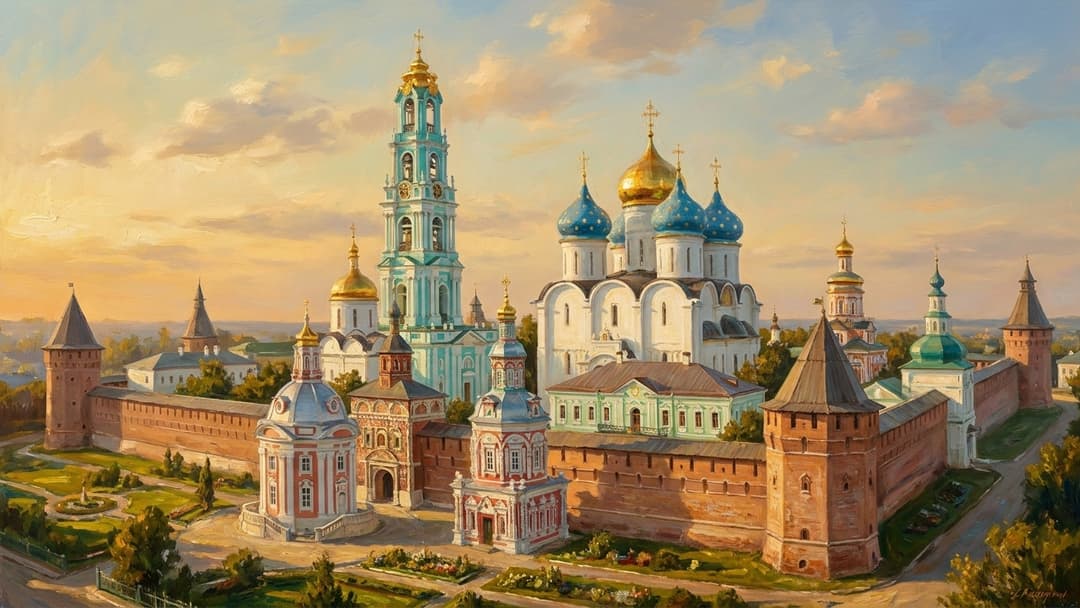
Visitors experience a living spiritual fortress where choral chant echoes beneath gold and azure domes. The vast courtyard provides peaceful contemplation alongside active theological studies and vibrant liturgical life.
Highlights
- Veneration of the incorrupt relics of St. Sergius of Radonezh within the white-stone Trinity Cathedral.
- The monumental azure domes of the Dormition Cathedral adorned with shimmering golden stars.
- The 88-meter Great Belfry housing the massive 72-ton Tsar Bell.
Things to Know
- Strict traditional Orthodox modesty is enforced, requiring head coverings and long skirts for women, and long trousers for men.
- Photography is prohibited inside sanctuaries during liturgical services.
- Arrive before morning liturgy to avoid heavy pilgrimage crowds.
Location
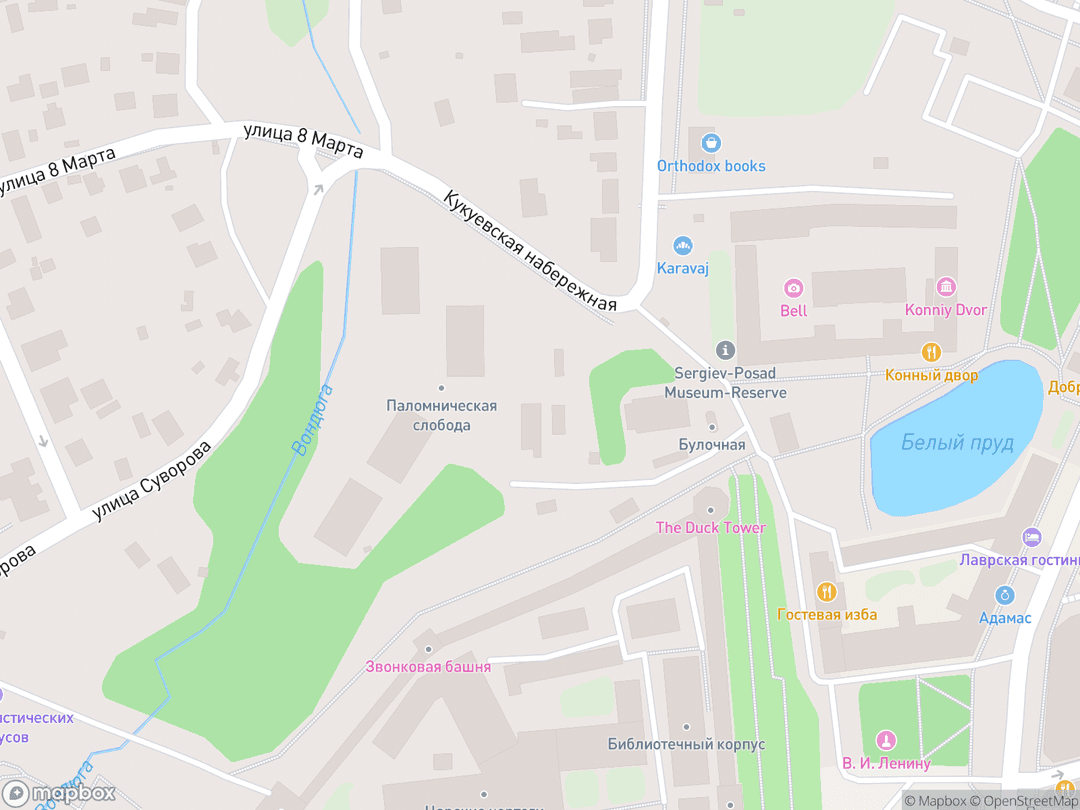
141300, Svyato-Troitskaya Sergieva Lavra, Sergiyev Posad, Moscow Oblast, Russian Federation
Hours: Daily 5:00 AM – 9:00 PM; open continuously during patronal feasts
Getting There: Take the commuter train or express Lastochka from Moscow Yaroslavsky Station to Sergiyev Posad, followed by a 10-minute walk.
Get DirectionsTips for Your Visit
Dress Code Compliance
Wrap-around skirts and headscarves are provided at the entrance gates if needed.
Choral Liturgy
Attend early morning service to hear the renowned monastic choir without daytime crowds.
Local Monastic Bread
Sample traditional kovriga spiced honey bread baked fresh by the monastery refectory.
About
The Trinity Lavra of St. Sergius stands as the supreme spiritual center of Russian Orthodoxy, founded in 1337 by the ascetic monk Sergius of Radonezh amid dense wilderness. Over centuries of national transformation, the woodland hermitage expanded into an impregnable fortified monastic city holding the preeminent ecclesiastical rank of Lavra.
The complex features an unparalleled ensemble of Russian ecclesiastical architecture, ranging from the 15th-century white-stone Trinity Cathedral to the towering 18th-century Baroque belfry. Its sacred spaces enshrine foundational masterpieces of Christian iconography, including Andrei Rublev's world-renowned Old Testament Trinity.
Surviving epic military sieges, imperial upheaval, and Soviet-era closures, the monastery continues as an active brotherhood and seat of the Moscow Theological Academy. Today, millions of pilgrims journey to Makovets Hill to venerate the relics of St. Sergius and seek communion within its historic sanctuaries.
Gallery
Symbolic Elements
The temple's exterior features intricate carvings, each rich with spiritual meaning:
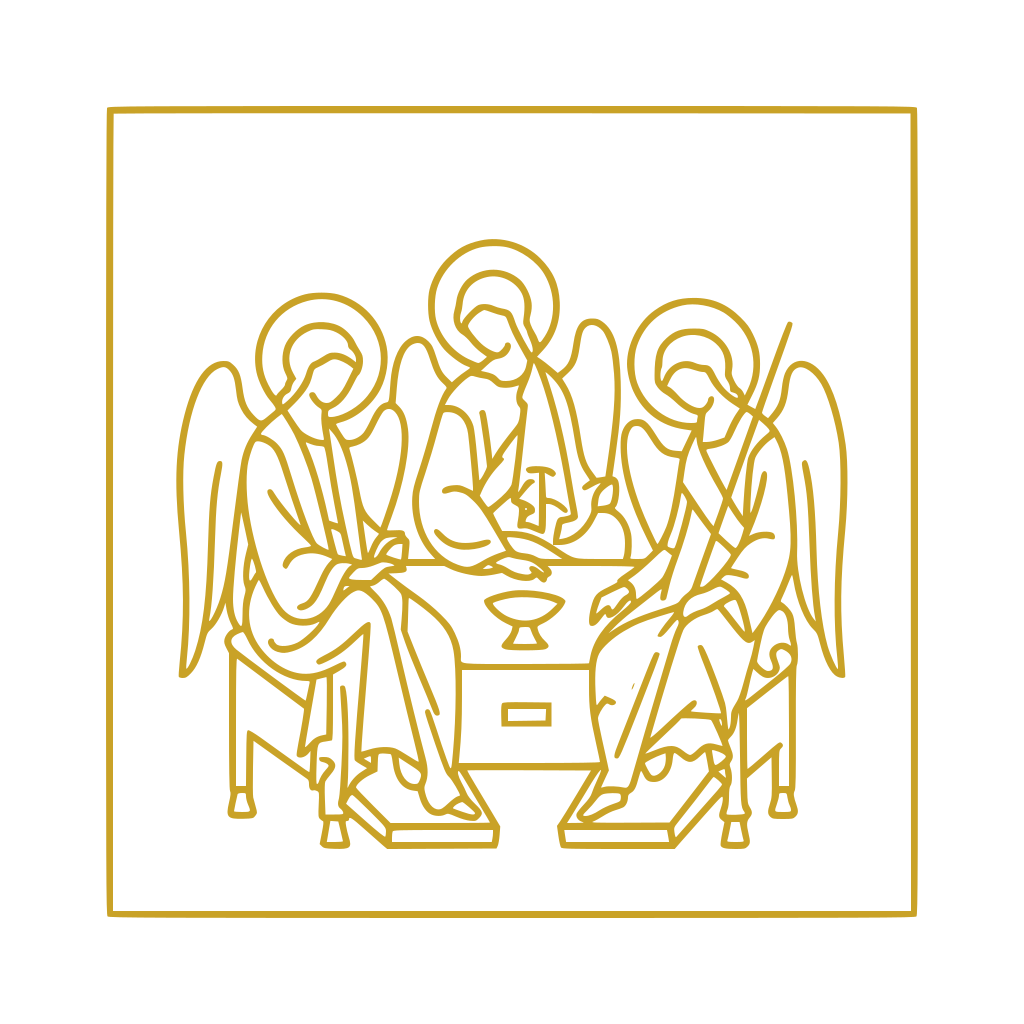
Old Testament Trinity Icon
Three winged angelic messengers seated in harmony symbolize divine love overcoming worldly strife.
Star-Studded Azure Domes
Four deep-blue cupolas with gold stars represent the purity and celestial protection of the Mother of God.

Gilded Helmet Dome
The shining central dome represents Jesus Christ reigning in glory as the Sun of Righteousness.

Silver Shrine of St. Sergius
The repoussé silver sarcophagus embodies the spiritual victory and incorruptibility of the holy founder.

Diamond-Rusticated Façade
Faceted geometric paintwork reflects the heavenly banquet and radiant splendor of God's kingdom.

Church Under the Bells
The open arcade under the dome symbolizes the descent of the Holy Spirit directly upon believers.
Fortress Ramparts and Towers
Formidable masonry walls signify the church militant standing firm against external turmoil.
Interesting Facts
Tsar Peter the Great twice sought shelter behind the monastery fortress ramparts during armed rebellions (Tier A).
Defenders discovered an artesian spring during a 16-month siege that still flows inside the Dormition Well Chapel (Tier B).
Andrei Rublev painted his world-famous Holy Trinity icon specifically for the Trinity Cathedral iconostasis (Tier A).
The Great Belfry houses a 72-ton bell that ranks as the largest operating church bell in the Christian world (Tier B).
The foundational ramparts rest upon colossal glacial boulders hauled from regional riverbeds to withstand artillery (Tier B).
Tsar Boris Godunov and his imperial family are buried in a stone vault outside the Dormition Cathedral (Tier A).
Philosopher Pavel Florensky secretly hid the skull of St. Sergius during Soviet seizures to prevent its destruction (Tier B).
The surrounding artisan posad originated the very first nested Russian Matryoshka doll in the 1890s (Tier C).
Common Questions
Who founded the Trinity Lavra of St. Sergius?
It was founded in 1337 by St. Sergius of Radonezh as a modest wilderness hermitage.
Why is the monastery called a Lavra?
Lavra is the highest honorary title in Eastern Orthodoxy, reserved for major monastic cities.
Is Andrei Rublev's Trinity icon still at the monastery?
Yes, the historic masterpiece was returned from state museum conservation to the Trinity Cathedral in 2024.
Are tourists allowed inside during liturgical services?
Respectful visitors are welcome to observe quietly, provided they follow Orthodox dress standards.
Featured Stories
The Sanctuary of the Boy Tsar
1689
When the violent Streltsy uprising threatened his life, seventeen-year-old Peter the Great fled under cover of darkness to the impenetrable walls of the Lavra. Sheltered by the monks and shielded behind massive granite battlements, the young ruler gathered his loyal regiments to secure the imperial crown. This safe refuge shaped his governance and led to royal gifts that transformed the monastery into a center of architectural magnificence.
Source: Kremlin State Historical Records
The Miraculous Artesian Well
1610
Surrounded by thirty thousand Polish-Lithuanian troops during a grueling sixteen-month siege, the monastic garrison ran out of fresh drinking water and faced certain surrender. Led by prayer and spiritual visions, defenders dug deep into the dry earth beside the cathedral until a freshwater spring surged upward through the sand. The miraculous well sustained the fighters, breaking the encirclement and turning the course of the Time of Troubles.
Source: Monastic Chronicle of Sergiyev Posad
Florensky and the Hidden Relics
1920
When Soviet commissions arrived to seize and expose the relics of St. Sergius, polymath priest Pavel Florensky executed an audacious plan of cultural preservation. He secretly substituted another skull inside the reliquary to prevent the founder's sacred remains from being desecrated or incinerated. The true relic remained concealed in secret vaults for decades until its joyful restoration to the Trinity Cathedral in 1946.
Source: Moscow Theological Academy Archives
Timeline
Wilderness Settlement
St. Sergius builds a wooden hermitage cell and chapel dedicated to the Trinity on Makovets Hill.
MilestoneBlessing for Kulikovo
St. Sergius blesses Prince Dmitry Donskoy before victory at the historic Battle of Kulikovo.
EventRepose of St. Sergius
The founding abbot reposes and is laid to rest within the original timber chapel grounds.
MilestoneDiscovery of Incorrupt Relics
The holy relics of St. Sergius are discovered intact during church excavations.
MilestoneTrinity Cathedral Consecration
Abbot Nikon completes the white-stone cathedral adorned with frescoes by Andrei Rublev.
DedicationChurch of the Holy Spirit
Pskovian craftsmen construct the unique church-under-the-bells structure.
MilestoneDormition Cathedral Completion
Imperial stonemasons finish the colossal five-domed cathedral modeled on the Moscow Kremlin.
DedicationRelief of the Great Siege
Monastery defenders break a sixteen-month Polish-Lithuanian military siege.
EventRefectory Church of St. Sergius
Peter the Great finances the completion of the sprawling columnless Baroque refectory.
MilestoneElevation to Lavra
Empress Elizabeth Petrovna formally grants the monastery the supreme title of Lavra.
MilestoneCompletion of the Great Belfry
Ivan Michurin and Dmitry Ukhtomsky complete the soaring five-tier Baroque bell tower.
DedicationSoviet Secularization
The Bolshevik government closes the cloister and converts the complex into a state museum.
RenovationMonastic Resumption
Liturgical services resume at the Trinity Cathedral and the relics of St. Sergius return.
MilestoneUNESCO World Heritage Inscription
The Lavra architectural ensemble receives inscription as a UNESCO World Heritage Site.
MilestoneHistory by Decade
1330s–1380s — The Wilderness Hermitage
Contemplation of the Holy Trinity should conquer the hateful discord of this world.
Bartholomew retreated to Makovets Hill in 1337, taking the tonsure as Sergius and constructing a humble wooden cell dedicated to the Trinity. His ascetic holiness drew followers, inspiring a cenobitic community that renewed Russian spiritual identity.
1420s–1470s — Stone Sanctuaries and Masterpieces
Following the rediscovery of the founder's incorrupt body in 1422, Abbot Nikon directed construction of the white-stone Trinity Cathedral. Master iconographer Andrei Rublev painted the seminal Old Testament Trinity for its newly raised icon screen.
1550s–1580s — Imperial Fortress Expansion
Tsar Ivan IV fulfilled royal vows by replacing timber stockades with monumental brick walls and defensive towers. Imperial artisans erected the colossal five-domed Dormition Cathedral to emulate the principal sanctuary of the Moscow Kremlin.
1600s–1690s — Siege Survival and Petrine Baroque
The monastery resisted a fierce sixteen-month siege during the Time of Troubles, inspiring national liberation. Peter the Great later took refuge here, patronizing the vast columnless Refectory Church decorated in vibrant Naryshkin Baroque style.
1740s–1810s — The Imperial Lavra and Theological Academy
Empress Elizabeth elevated the cloister to Lavra rank in 1744 while commissioning the grand eighty-eight-meter Baroque belfry. The prestigious Moscow Theological Academy transferred within its walls in 1814, establishing an enduring center for ecclesiastical scholarship.
1920s–Present — Suppression, Restoration, and UNESCO Recognition
Bolshevik officials nationalized the monastery in 1920, but scholars protected its sacred treasures by establishing a museum. Liturgical services resumed in 1946, culminating in UNESCO World Heritage designation in 1993 and the repatriation of Rublev's original icon in 2024.
Architecture & Facilities
The architectural ensemble embodies five centuries of Russian master building, seamlessly uniting early 15th-century Muscovite white-stone cubism, Pskovian dome belfries, grand 16th-century Byzantine-Muscovite cathedral design, and exuberant 18th-century Elizabethan Baroque. The fortified acropolis plan is anchored organically by sacred shrines enclosed inside towering medieval ramparts.
Building Materials
Podolsk White Limestone
Locally quarried white limestone forms the load-bearing ashlar masonry of the original Trinity Cathedral.
Glacial Boulder Foundations
Massive riverbed boulders underpin the outer ramparts to resist heavy artillery bombardment.
Kilned Red Brick
Durable historic brick laid with egg-and-lime mortar composes the monumental fortress enclosures.
Gilded and Azure Sheet Copper
Polished leaf-gilded copper and star-stenciled azure mineral coatings sheath the cathedral onion domes.
Interior Features
Trinity Cathedral Nave
An intimate, candlelit four-pillar sanctuary covered in 15th-century frescoes housing the silver shrine of St. Sergius.
Dormition Cathedral Vaults
A monumental six-pillar hall enveloped by expansive 17th-century biblical wall paintings executed by Yaroslavl masters.
St. Sergius Refectory Hall
A colossal columnless hall spanning over five hundred square meters crowned with ornate gilded stucco relief.
Church of the Holy Spirit Drum
A soaring vertical space terminating in an integrated open belfry suspended directly above worshippers.
Temple Grounds
The twenty-two-hectare fortified grounds feature stone-paved piazzas, landscaped gardens, ceremonial fountains, and monastic orchards surrounded by 1.5 kilometers of defensive ramparts.
Additional Facilities
The complex incorporates the Moscow Theological Academy, the Church Archaeological Museum, the historic Monastic Sacristy, and pilgrim guesthouses.
Religious Significance
The Trinity Lavra of St. Sergius serves as the spiritual fountainhead of Russian monasticism, embodying the mystical hesychast tradition of continuous inner prayer.
The monastery is dedicated to the Life-Giving Trinity as a divine model of unity, reconciliation, and selfless love.
Sacred Ordinances
Divine Liturgy
The daily Eucharistic sacrifice celebrated with historic monastic chant across multiple consecrated altars.
Veneration of Relics
Pilgrims pray before the incorrupt relics of St. Sergius, seeking his spiritual protection and intercession.
Akathist Hymns
Continuous solemn chanting of devotional hymns honoring the Holy Trinity and the Mother of God.
The Theology of Hesychasm
St. Sergius introduced the contemplative prayer of the heart, teaching that inner communion with God allows believers to radiate uncreated divine light.
The Iconostasis as a Cosmic Threshold
The multi-tiered icon screens visually unite earth and heaven, guiding worshippers through salvation history toward the heavenly altar.
Sources & Research
Every fact on Temples.org is backed by verified Sources & Research. Each piece of information is rated by source tier and confidence level.
View All Sources (10)
| Field | Source | Tier | Retrieved |
|---|---|---|---|
| Historical Foundation and Monastic Life | President of Russia Official Portal (opens in a new tab) | A | 2026-03-31 |
| World Heritage Architectural Dossier | UNESCO World Heritage Centre (opens in a new tab) | B | 2026-03-31 |
| Monastic Ensemble and History | Rusmania Cultural Heritage Guide (opens in a new tab) | B | 2026-03-31 |
| Regional Pilgrimage and Architecture | Russia E-Guide (opens in a new tab) | C | 2026-03-31 |
| Architectural Survey and Geography | Dokumen Academic Repository (opens in a new tab) | B | 2026-03-31 |
| Visitor Protocols and Logistics | Trip.com Travel Guide (opens in a new tab) | D | 2026-03-31 |
| Sanctuary Highlights and Travel Overview | Wanderlustingk Cultural Travel (opens in a new tab) | C | 2026-03-31 |
| Dormition Frescoes and Art History | Inspired By Maps (opens in a new tab) | C | 2026-03-31 |
| Sergiyev Posad Heritage Documentation | OneVasco Travel Services (opens in a new tab) | D | 2026-03-31 |
| Regional Monastic Registry | Kupi Regional Directory (opens in a new tab) | C | 2026-03-31 |