Visitor Insights
Visiting Mosque-Cathedral of Córdoba
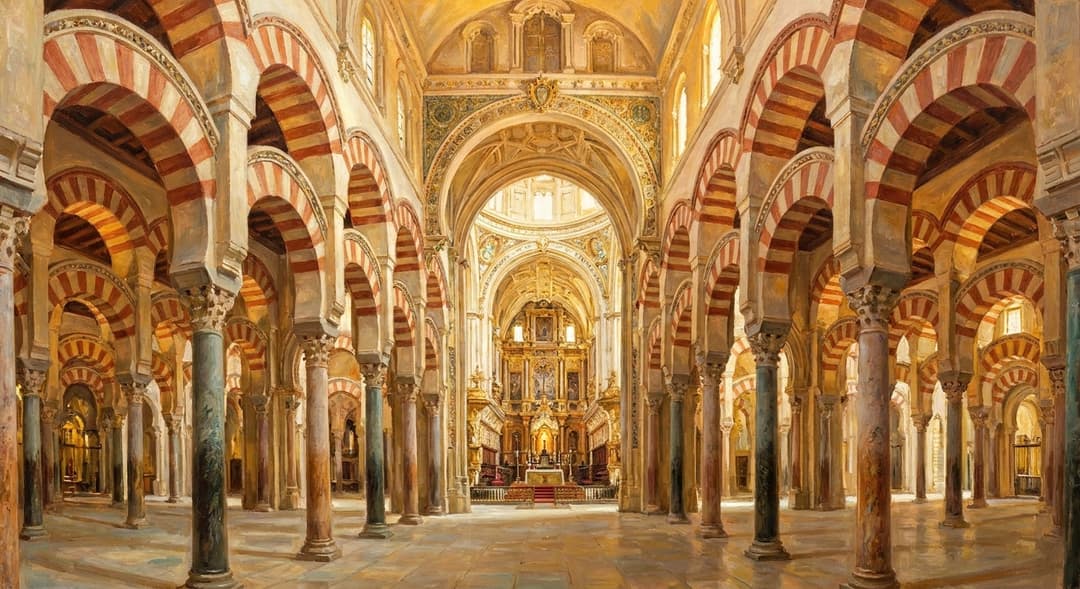
Visiting the Mosque-Cathedral offers an encounter with one of humanity's greatest architectural wonders. The vast hypostyle hall inspires contemplative awe through its rhythmic red-and-white double arches. Visitors can explore both Islamic caliphal halls and Christian chapels within a single sacred perimeter.
Highlights
- The two-tiered hypostyle forest of 856 jasper, onyx, and marble columns
- The jewel-like walk-in Mihrab with Byzantine gold mosaics
- The serene Patio de los Naranjos filled with orange trees and fountains
- The Renaissance cathedral choir rising at the center of the Islamic prayer hall
Things to Know
- Individual visitors can enter free of charge from Monday to Saturday between 8:30 and 9:30 AM
- Modest attire covering shoulders and knees is strictly enforced by cathedral authorities
- Active Catholic masses take place daily; access may be temporarily restricted during liturgies
- Ritual Islamic prayers and prostrations are prohibited by Spanish diocesan regulations
Location
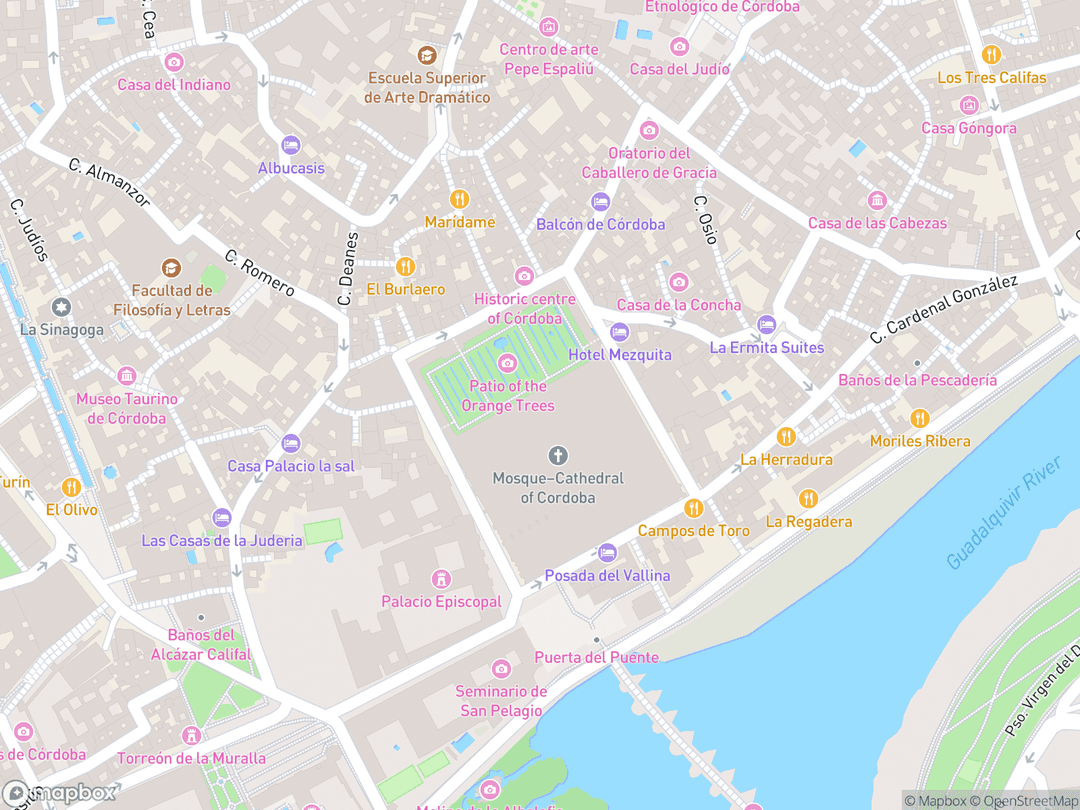
Calle Cardenal Herrero, 1, 14003 Córdoba, Andalusia, Spain
Hours: Monday to Saturday 10:00-18:00 (extended to 19:00 in summer); Sundays 8:30-11:30 and 15:00-18:00
Getting There: Located in the historic Judería, a 15-minute walk from Córdoba-Central station or via Aucorsa buses 3 and 12 to Puerta del Puente.
Get DirectionsTips for Your Visit
Arrive for Early Quiet Hours
Visit during the free 8:30 to 9:30 AM window for peaceful reflection before tour groups arrive.
Climb the Belfry Tower
Reserve a separate ticket to climb the Renaissance tower and see the ancient minaret encased inside.
Observe Column Signatures
Examine lower column blocks to spot historical stonemason trademarks carved during construction.
About
The Mosque-Cathedral of Córdoba stands as one of the most sublime expressions of sacred architecture in the Mediterranean world, embodying centuries of Abrahamic spiritual history. Conceived under the Umayyad Emirate of al-Andalus, it served as the prime congregational mosque of Western Islam.
Reflecting the core Islamic principle of Tawḥīd, the vast hypostyle hall creates a non-hierarchical space where worshippers stand in communal equality before the Divine. Rather than figurative art, geometric harmony and Arabic epigraphy evoke divine infinity.
Following the Christian reconquest of Córdoba in 1236, the structure was consecrated as a Catholic cathedral. The later insertion of a Renaissance choir and transept transformed the complex into a singular palimpsest where Islamic and Christian sacred heritages coexist.
Gallery
Symbolic Elements
The temple's exterior features intricate carvings, each rich with spiritual meaning:

The Walk-in Mihrab
The octagonal chamber acts as the sacred focal point indicating the direction of prayer toward Mecca.
Bicolor Horseshoe Arches
Alternating red brick and white stone voussoirs symbolize celestial harmony while absorbing seismic vibrations.
Gilded Conch Shell Ceiling
Carved from a single marble block above the Mihrab, the shell represents divine light and acoustically amplifies the prayer leader's voice.

Quranic Calligraphic Bands
Gilded inscriptions of the Quran remind worshippers of divine revelation and the transcendence of God.

Interlocking Multifoil Arches
Intricate multi-lobed stone screens frame the royal Maqsurah, translating mathematical geometry into lace-like architecture.

Patio de los Naranjos
The citrus courtyard mirrors the internal column grid, representing the lush gardens of Paradise and hosting ritual ablutions.

Ribbed Caliphal Domes
Intersecting stone ribs create octagonal star patterns that serve as early structural precursors to European Gothic vaulting.
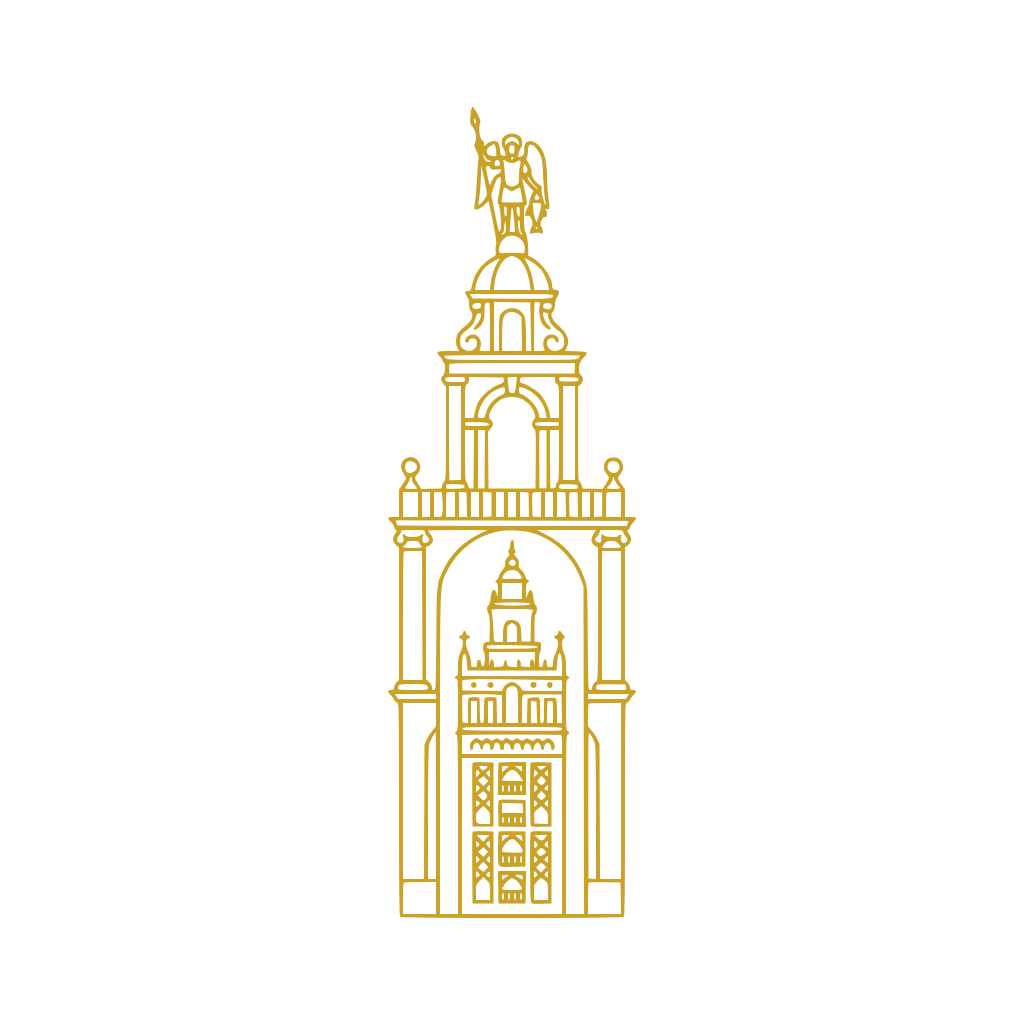
Renaissance Bell Tower
Crowned by Archangel Raphael, the sixteenth-century belfry completely encloses the original Islamic minaret of Abd al-Rahman III.
Interesting Facts
Holy Roman Emperor Charles V famously lamented that building the cathedral choir had destroyed something unique in the world (Tier A).
The Renaissance bell tower encases the original tenth-century caliphal minaret within its masonry walls (Tier A).
Byzantine Emperor Nikephoros II Phokas sent sixteen tons of gold tesserae to decorate the mihrab (Tier B).
The mosque's qibla wall faces south-southeast toward 150 degrees rather than directly east toward Mecca (Tier B).
Hundreds of masonry blocks bear individual stonemason marks used to calculate daily piecework wages (Tier B).
A milestone from the Roman Via Augusta dating to 43 BCE stands among the hypostyle prayer hall columns (Tier B).
Bronze bells taken from Santiago de Compostela in 997 CE were melted down to illuminate the mosque (Tier B).
The mihrab is positioned off-center along the southern wall due to the massive eastern expansion of 987 CE (Tier B).
The caliph accessed the mosque via an elevated private bridge called the Sabat spanning the street (Tier B).
Common Questions
Is the Mosque-Cathedral of Córdoba an active church?
Yes, it is a fully functioning Roman Catholic cathedral celebrating daily masses and Eucharistic liturgies.
Can visitors perform Islamic prayer inside?
No, Spanish diocesan authorities and civil courts prohibit non-Catholic ritual prayer on the premises.
Why does the prayer hall face south instead of east toward Mecca?
The alignment reflects traditional Syrian Umayyad orientation practices and adheres to the Roman street grid.
How many columns survive inside the hypostyle hall today?
There are 856 monolithic columns standing today out of more than one thousand originally erected.
Can you climb the bell tower?
Yes, timed-entry tickets allow visitors to climb the 54-meter tower and view the encapsulated minaret.
Featured Stories
The Byzantine Mosaic Exchange
965 CE
Despite deep political and religious divisions across the medieval Mediterranean, Byzantine Emperor Nikephoros II Phokas dispatched a master mosaicist to Córdoba. Together with sixteen metric tons of glass tesserae and pure gold leaf, this diplomatic gift allowed al-Hakam II to create the radiant, shimmering mihrab. The resulting artwork stands as a testament to cross-cultural artistic reverence across Abrahamic empires.
Source: ArchEyes Architectural Review
The Journey of the Santiago Bells
997 CE
During a military incursion into northern Iberia, vizier al-Mansur captured the bronze cathedral bells of Santiago de Compostela and forced captives to carry them south to Córdoba. The bells were inverted and hung within the prayer hall to serve as oil lamps illuminating Friday prayers. Nearly 250 years later, following the 1236 reconquest, Christian troops carried them back north to be recast for cathedral worship.
Source: City University of New York Medieval Studies
Emperor Charles V's Poignant Regret
1526
When Holy Roman Emperor Charles V visited Córdoba to inspect the newly inserted Renaissance choir in 1526, he felt an immediate pang of sorrow at the altered spatial harmony. He famously rebuked the cathedral chapter for compromising the boundless forest of Islamic columns in favor of conventional church architecture. His lament crystallized the unique artistic stature of the hypostyle hall in the European imagination.
Source: Cabildo Catedral de Córdoba Historical Annals
Timeline
Initial Construction
Emir Abd al-Rahman I begins construction of the original 11-aisle hypostyle mosque on the site of a Visigothic basilica.
component.timeline.groundbreakingFirst Minaret and Courtyard
Hisham I completes the ablution courtyard and erects the first minaret tower for the call to prayer.
MilestoneSouthern Expansion
Emir Abd al-Rahman II extends the prayer hall southward by eight bays toward the Guadalquivir River.
RenovationMonumental Portals
Muhammad I completes the Puerta de San Esteban, showcasing the earliest dated Andalusian decorative horseshoe arches.
MilestoneCaliphal Minaret
Caliph Abd al-Rahman III erects a monumental 47-meter minaret that establishes the archetype for western Islamic towers.
RenovationGolden Caliphal Mihrab
Caliph al-Hakam II completes the lavish Maqsurah and walk-in mihrab encrusted with Byzantine gold glass mosaics.
MilestoneEastern Extension
Vizier al-Mansur adds eight entire naves along the eastern flank, doubling the interior prayer capacity.
RenovationCathedral Consecration
King Ferdinand III captures Córdoba and consecrates the mosque as a Catholic cathedral dedicated to the Virgin Mary.
DedicationRoyal Chapel Construction
King Enrique II completes the Mudéjar-style Royal Chapel featuring Islamic stalactite stucco and polylobed arches.
MilestoneCathedral Choir Insertion
Bishop Alonso Manrique initiates the construction of a Renaissance choir and transept inside the hypostyle hall.
RenovationBelfry Tower Encasement
Architect Hernán Ruiz II completes the stone bell tower encasing the surviving tenth-century minaret.
RenovationUNESCO World Heritage
The Mosque-Cathedral is inscribed as a UNESCO World Heritage Site for its universal artistic value.
MilestoneHistory by Decade
780s–790s — Foundation of the Umayyad Great Mosque
Emir Abd al-Rahman I established the initial 11-aisle hypostyle mosque on the site of the Visigothic Basilica of San Vicente. The design introduced revolutionary two-tiered arches utilizing salvaged Roman and Visigothic columns. Hisham I completed the courtyard and first minaret for the call to prayer.
830s–850s — Early Caliphal Expansions
Emir Abd al-Rahman II expanded the prayer hall southward by eight bays toward the Guadalquivir River to accommodate Córdoba's surging population. Muhammad I later completed the monumental exterior gates, including the Puerta de San Esteban featuring the earliest dated Andalusian horseshoe arches.
950s–960s — Caliphal Grandeur and the Golden Mihrab
The radiant mihrab and soaring arches reflect the divine beauty and mathematical order of the cosmos.
Caliph Abd al-Rahman III erected a monumental 47-meter square minaret and enlarged the courtyard. His successor al-Hakam II executed the most lavish expansion, adding the Maqsurah, ribbed stone domes, and a walk-in mihrab encrusted with Byzantine gold mosaics.
980s–1000s — The Eastern Expansion of al-Mansur
Vizier al-Mansur doubled the mosque's width by constructing eight additional aisles along the entire eastern flank. This massive enlargement accommodated over 20,000 worshippers, although it displaced the mihrab from the central axis of the prayer hall.
1230s–1370s — Consecration and Royal Chapels
King Ferdinand III conquered Córdoba in 1236, consecrating the mosque as a Roman Catholic cathedral dedicated to the Virgin Mary. In 1371, King Enrique II constructed the Mudéjar-style Royal Chapel within the prayer hall, utilizing Islamic stucco and polylobed vaulting.
1520s–1600s — Insertion of the Renaissance Cathedral
You have built here what you or anyone might have built anywhere else, but you have destroyed something that was unique in the world.
Bishop Alonso Manrique oversaw the insertion of a massive Renaissance choir and transept directly into the center of the hypostyle hall. Architects Hernán Ruiz I and II directed the construction while also encasing the historic 10th-century minaret inside a stone belfry tower.
1880s–Present — Monument Conservation and Heritage Debates
Declared a National Monument in 1882, the site underwent careful restoration by architects Ricardo Velázquez Bosco and Félix Hernández Giménez. Inscribed on the UNESCO World Heritage list in 1984, the complex remains an active cathedral while hosting ongoing interfaith dialogue.
Architecture & Facilities
The monument represents the supreme achievement of Hispano-Umayyad caliphal architecture, seamlessly fused with Gothic, Plateresque, Renaissance, and Baroque insertions. Its structural genius lies in horizontal multiplicity, geometric harmony, and the synthesis of Roman structural engineering with Islamic spatial infinity.
Building Materials
Jasper, Onyx, and Porphyry Columns
Over 850 monolithic shafts were salvaged from regional Roman temples, Mérida ruins, and Visigothic structures.
Bicolor Calcarenite and Brick Voussoirs
Alternating courses of fired red brick and cream sandstone provide both seismic flexibility and rhythmic color.
Byzantine Gilded Glass Smalti
Sixteen tons of gold and colored glass cubes were gifted by Constantinople to illuminate the mihrab.
Carved Artesonado Timber Ceilings
Intricately carved cedar and Scots pine timber frames originally supported the vast horizontal roofing system.
Interior Features
The Caliphal Mihrab
A heptagonal walk-in prayer chamber adorned with Byzantine mosaics and crowned by a solid marble conch shell.
The Caliphal Maqsurah
The royal prayer enclosure features intricate interlaced multifoil arches supporting four octagonal ribbed vaults.
The Renaissance Crucero and Choir
A soaring Latin-cross church inserted into the prayer hall, featuring Gothic rib vaults and Baroque mahogany stalls.
The Mudéjar Royal Chapel
A fourteenth-century funerary chamber exhibiting Islamic-style plaster muqarnas and polylobed ribbing.
Temple Grounds
The Patio de los Naranjos spans the northern perimeter, featuring gridded rows of fragrant orange trees, cypress groves, and stone fountains that mirror the internal hypostyle layout.
Additional Facilities
The complex includes the encased belfry tower with visitor ascent platforms, a diocesan museum of liturgical silver, and archaeological crypts revealing Visigothic mosaic pavements.
Religious Significance
In the Islamic tradition, sacred architecture reflects the absolute oneness and transcendence of God (Tawḥīd). As the prime congregational mosque of the Western Caliphate, the Mezquita was designed as an earthly reflection of heavenly order, welcoming worshippers into an egalitarian assembly before their Creator.
To serve as the spiritual and civic center of al-Andalus, uniting the Muslim community in daily ritual prayer, Quranic recitation, and Friday congregational worship.
Sacred Ordinances
Salat (Ritual Prayer)
Five daily prayers performed in disciplined, unified rows facing the southern qibla wall.
Jumu'ah (Friday Congregation)
Weekly communal gathering centered on the sermon delivered from the caliphal minbar beside the mihrab.
Wudu (Ritual Purification)
Ablution performed at the courtyard fountains before entering the sacred prayer hall.
I'tikaf (Spiritual Retreat)
Periods of secluded devotion and contemplation among the columned aisles during holy seasons.
The Mihrab as Spiritual Gateway
Unlike statues or icons, the empty prayer niche focuses devotion purely toward Mecca and the divine presence without anthropomorphic intermediaries.
Shared Abrahamic Sacred Space
Having hosted Visigothic Christian liturgy, Islamic caliphal worship, and Catholic Eucharistic rites across nearly two millennia, the site embodies shared Abrahamic devotion to the God of Abraham.
Sources & Research
Every fact on Temples.org is backed by verified Sources & Research. Each piece of information is rated by source tier and confidence level.
View All Sources (8)
| Field | Source | Tier | Retrieved |
|---|---|---|---|
| About & Historical Background | Cabildo Catedral de Córdoba (opens in a new tab) | A | 2026-03-31 |
| Architecture & Structural Evolution | Consorcio de Turismo de Córdoba (opens in a new tab) | A | 2026-03-31 |
| Religious Significance & Liturgy | Patronato Provincial de Turismo de Córdoba (opens in a new tab) | A | 2026-03-31 |
| Timeline & Caliphal Expansions | City University of New York (opens in a new tab) | B | 2026-03-31 |
| Architecture & Ribbed Vaulting | ResearchGate Academic Repository (opens in a new tab) | B | 2026-03-31 |
| Historical Records & Inscriptions | Stanford University Research Archives (opens in a new tab) | B | 2026-03-31 |
| Artistic Features & Mosaic Provenance | ArchEyes Architectural Review (opens in a new tab) | C | 2026-03-31 |
| Visitor Experience & Access Guidelines | Tickets Córdoba Cultural Tourism (opens in a new tab) | D | 2026-03-31 |