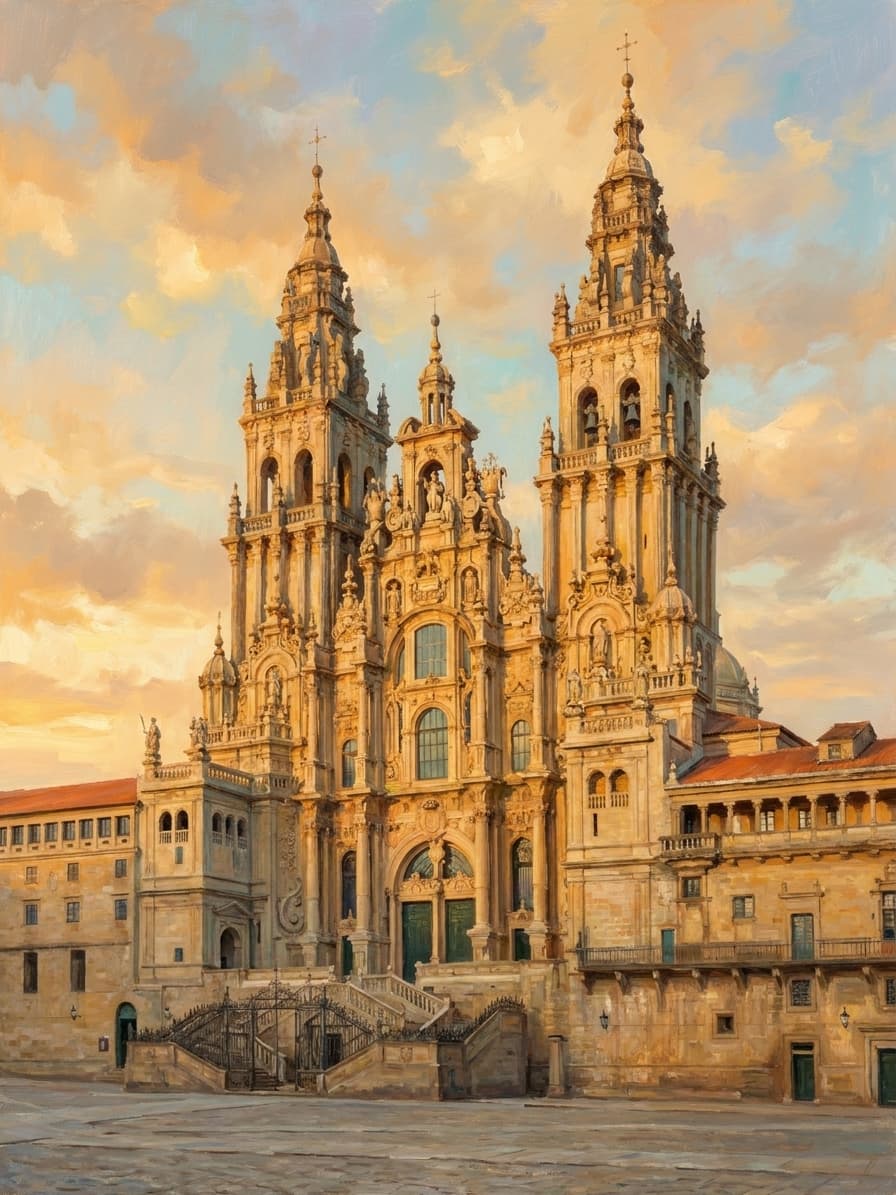
Visitor Insights
Visiting Santiago de Compostela Cathedral
Visiting the cathedral provides an immersive encounter with nine centuries of sacred European art and pilgrimage traditions. Pilgrims and tourists experience daily liturgical celebrations alongside historic veneration customs within the sanctuary.
Highlights
- Marvel at the restored 12th-century stone polychromy on Master Mateo's Pórtico de la Gloria.
- Venerate the silver reliquary containing the apostolic bones inside the subterranean Romanesque crypt.
- Witness the soaring trajectory of the giant Botafumeiro thurible during major liturgical feasts.
- Ascend behind the high altar to perform the traditional ritual embrace of the Saint James statue.
Things to Know
- Access to the Pórtico de la Gloria requires a timed reservation ticket to regulate conservation humidity.
- Arrive at least 45 minutes prior to the 12:00 PM Pilgrim Mass to secure seating during peak pilgrimage months.
- Touching or tapping heads against Master Mateo's stone self-portrait is strictly forbidden to preserve the sculpture.
Location
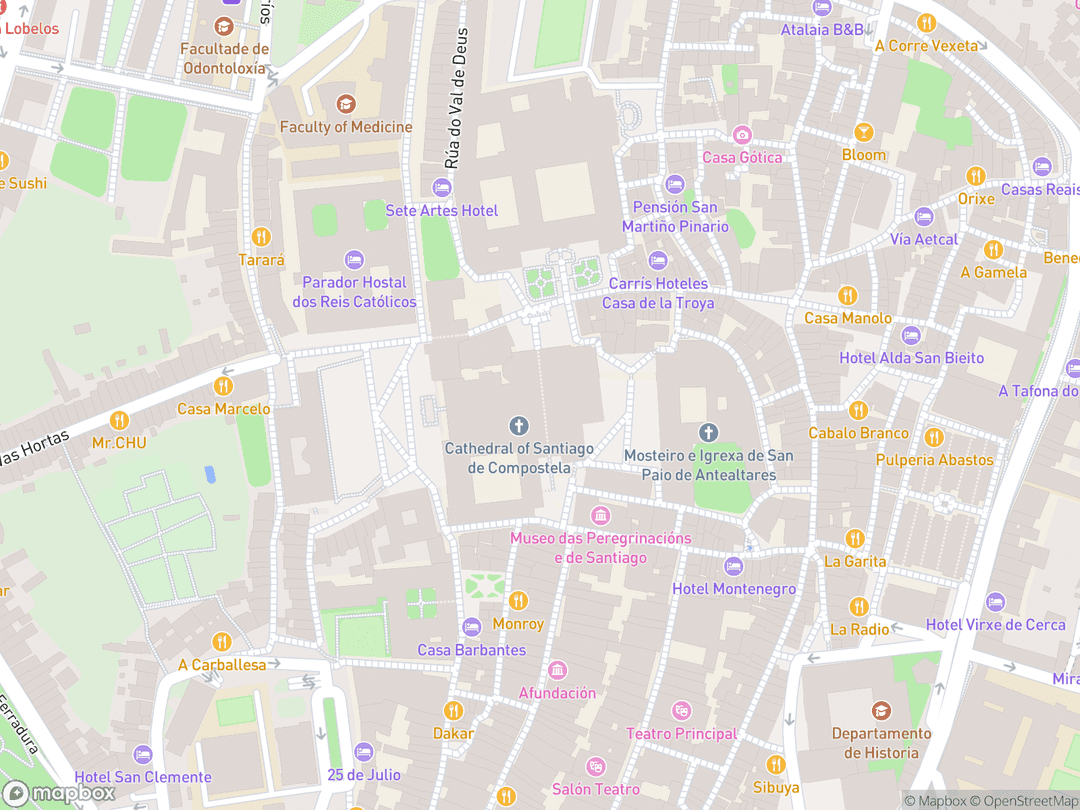
Praza do Obradoiro, s/n, 15704 Santiago de Compostela, A Coruña, Galicia, Spain
Hours: Cathedral open daily from 7:00 AM to 9:00 PM; Museum and Pórtico open daily from 9:00 AM to 8:00 PM.
Getting There: Located in Praza do Obradoiro, terminating all Camino walking routes, with transit connections to Santiago Airport and the central train station.
Get DirectionsTips for Your Visit
Pilgrim Mass Registration
Register at the Pilgrim Office early if you wish to have your departure starting point and nationality acknowledged during the midday liturgy.
Botafumeiro Schedule
The giant censer swings primarily on major liturgical solemnities and specific pre-arranged pilgrim masses rather than standard daily services.
Rooftop Tour Perspective
Book an official cathedral roof tour for panoramic perspectives across the historic plazas and sweeping views of the granite Obradoiro spires.
About
The Metropolitan Archcathedral Basilica of Santiago de Compostela stands as one of the most revered pilgrimage destinations in Christendom. Built over the venerated tomb of Saint James the Greater, the cathedral represents the physical and spiritual culmination of the historic Camino de Santiago pilgrimage network.
Initiated in 1075 during the reign of King Alfonso VI, the cathedral preserves a pristine medieval Romanesque core engineered to accommodate vast crowds of worshippers. Later centuries enclosed this medieval core within theatrical Galician Baroque facades, Gothic cloisters, and Renaissance administrative structures.
Beyond its architectural splendor, the cathedral remains a vital epicenter of Roman Catholic liturgy. Millions of pilgrims converge upon its sacred threshold each year to participate in ancient rituals of embrace, penitence, and celebration under its soaring vaults.
Gallery
Symbolic Elements
The temple's exterior features intricate carvings, each rich with spiritual meaning:

Scallop Shell
The grooved ridges converging to a single point symbolize the myriad pilgrim pathways uniting at the apostolic tomb.

Cross of Saint James
A crimson cruciform sword whose red blade honors the apostolic martyrdom while the fleur-de-lis represents spiritual purity.

Pilgrim Staff and Gourd
Represents physical and spiritual perseverance along life's pilgrimage, sustained by divine grace along the journey.

Tree of Jesse
Carved upon the central mullion, this relief illustrates the genealogical lineage of Christ fulfilling Old Testament prophecy.
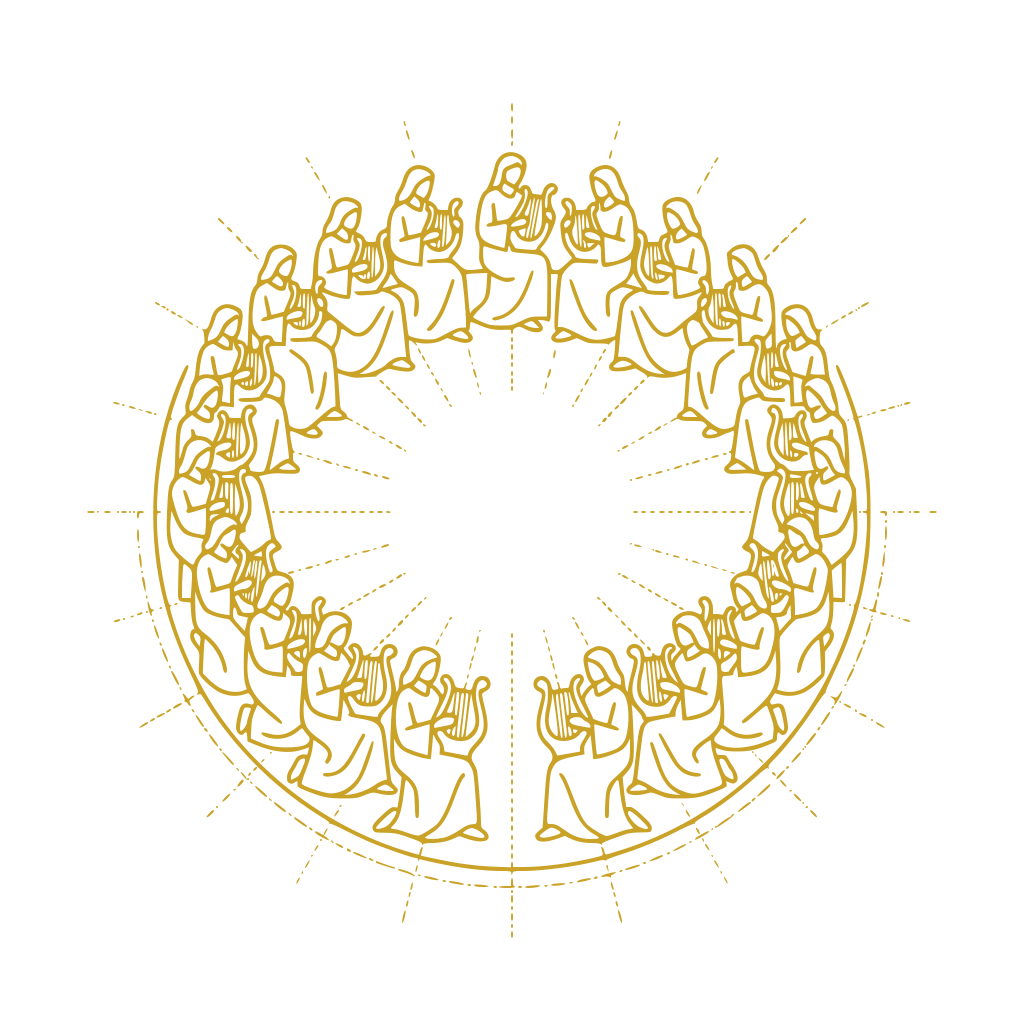
Twenty-Four Elders of the Apocalypse
These stone figures carved along the western archivolt hold stringed instruments in perpetual adoration before the throne of God.

Santo dos Croques
Master Mateo's humble self-portrait depicts the architect kneeling in penitence while facing the high altar of the Lord.

The Botafumeiro
The swinging censer dispenses incense aloft to signify the ascent of Christian prayers toward heaven.

The Holy Door
Opened exclusively during Jacobean Holy Years, crossing this bronze portal signifies spiritual renewal and reconciliation.
Interesting Facts
The eight Tiraboleiros operating the Botafumeiro rely solely on physical momentum and resonance to swing the heavy censer. (Tier A)
Medieval texts indicate the giant censer was originally expanded to deodorize the church when hundreds of pilgrims lodged overnight in the galleries. (Tier B)
In 1499, the swinging Botafumeiro snapped its ropes and crashed through the south window into the square in front of Catherine of Aragon. (Tier A)
Master Mateo built an entire vaulted lower church to elevate the Pórtico de la Gloria to the level of the central nave. (Tier B)
Modern luthiers have reconstructed playable medieval instruments based entirely on the stone carvings of the twenty-four apocalyptic elders. (Tier B)
The cathedral sounded a massive wooden ratchet wheel called the Carraca during Holy Week when bronze bells were traditionally silenced. (Tier A)
Fernando de Casas Novoa constructed the Baroque Obradoiro facade like a protective stone case around the delicate twelfth-century portico. (Tier B)
The cathedral is one of only three extant Christian basilicas built directly over the documented tomb of an original Apostle. (Tier A)
Common Questions
Why is the cathedral the terminus of the Camino de Santiago?
Tradition holds that the remains of Saint James the Greater were discovered here in the ninth century, establishing the site as an apostolic destination.
Does the Botafumeiro swing during every mass?
No, the colossal censer is operated primarily during major church feasts and specially sponsored pilgrim liturgies.
How do visitors access the Pórtico de la Gloria?
Visitors must reserve an advance ticket through the cathedral museum to maintain controlled humidity levels inside the narthex.
What is a Jacobean Holy Year?
A jubilee year celebrated whenever the Feast of Saint James falls on a Sunday, during which the Holy Door is unsealed.
Featured Stories
The Celestial Discovery at Libredón
813
In the early ninth century, the hermit Pelagius was guided by miraculous starlight shining over an ancient forested Roman necropolis in Galicia. Bishop Theodemar of Iria Flavia investigated the luminous phenomenon and authenticated the sepulcher of Saint James the Greater. King Alfonso II immediately traveled to the site, establishing the initial stone sanctuary and becoming the very first pilgrim of the Camino.
Source: Archdiocese of Santiago de Compostela
The Dramatic Flight of the Botafumeiro
July 25, 1499
During the feast day liturgy attended by Princess Catherine of Aragon before her voyage to England, the giant swinging censer experienced a catastrophic mechanical failure. Propelled by powerful momentum, the ropes snapped and the silvered vessel flew through the high window of the Platerías portal into the plaza below. Miraculously, despite the heavy crowd assembled outside, nobody was injured in the incident.
Source: Cathedral Chapter Historical Archives
Three Centuries of Hidden Relics
1589
When the English privateer Sir Francis Drake raided the Galician coast in 1589, Archbishop Juan de Sanclemente secretly concealed the relics of Saint James behind cathedral masonry. The precise location was lost for nearly three centuries following the deaths of the prelate and his canons. An archaeological excavation led by Antonio López Ferreiro broke through the choir floor in 1879, joyfully recovering the lost apostolic tomb.
Source: Metropolitan Chapter Records
Timeline
Discovery of the Apostolic Tomb
The hermit Pelagius discovers the Roman sepulcher of Saint James beneath celestial lights at Libredón.
MilestoneConsecration of Alfonso III's Basilica
King Alfonso III dedicates an expanded pre-Romanesque three-aisled ashlar basilica over the apostolic shrine.
DedicationDestruction by Almanzor
Umayyad forces raze the early basilica while sparing the apostolic tomb, looting the bronze bells for Córdoba.
EventGroundbreaking of Romanesque Cathedral
Bishop Diego Peláez and King Alfonso VI inaugurate construction of the present monumental stone cathedral.
component.timeline.groundbreakingErection of the Platerías Portal
Master Esteban completes the sculptural Romanesque south facade depicting the Passion and Temptation of Christ.
MilestoneInstallation of Pórtico Lintel
Master Mateo places the inscribed stone lintels completing the structural framing of the Pórtico de la Gloria.
MilestoneSolemn Consecration
Archbishop Pedro Muñiz solemnly consecrates the completed Romanesque basilica alongside King Alfonso IX of León.
DedicationSecret Concealment of Relics
Archbishop Sanclemente hides the apostolic relics inside cathedral subflooring to protect them from English privateers.
EventCompletion of the Obradoiro Facade
Architect Fernando de Casas Novoa finalizes the soaring twin-towered Baroque facade over Praza do Obradoiro.
RenovationRediscovery of the Apostolic Tomb
Archaeological excavations underneath the high altar successfully locate the long-hidden silver relic casket.
MilestoneUNESCO World Heritage Inscription
The cathedral and the surrounding historic old town receive designation as a UNESCO World Heritage Site.
MilestoneHistory by Decade
810s–890s — Apostolic Discovery and Early Basilicas
The Star Field revealed to our eyes the resting place of the Apostle who brought Christ's light to Iberia.
Following the revelation of the apostolic sepulcher to the hermit Pelagius, King Alfonso II established the initial stone shrine at Compostela. Recognizing its potential as a unifying spiritual center, King Alfonso III consecrated an expanded pre-Romanesque ashlar church in 899.
990s–1070s — Devastation and Monumental Rebirth
In 997, the warlord Almanzor burned Compostela, though he ordered his cavalry to respect the apostolic sepulcher itself. Recovering from this destruction, Bishop Diego Peláez laid the cornerstones of a grand Romanesque cathedral in 1075 to welcome Europe's surging pilgrim waves.
1100s–1210s — The Golden Age of Mateo and Gelmírez
Archbishop Diego Gelmírez transformed Santiago into an international ecclesiastical metropolis, commissioning the Platerías portal and expanding the transepts. Master Mateo completed the revolutionary Pórtico de la Gloria in 1188, leading to the basilica's solemn consecration in 1211.
1580s–1680s — Drake's Threat and Baroque Innovations
Fearing raids by Sir Francis Drake in 1589, church officials concealed Saint James's relics within the masonry, where they remained hidden for three centuries. During this era, architect Domingo Antonio de Andrade crowned the southern clock tower with its distinctive Baroque lantern.
1730s–1780s — The Triumph of Galician Baroque
Fernando de Casas Novoa constructed the theatrical Fachada del Obradoiro between 1738 and 1747, sheltering Master Mateo's aging portico behind monumental glass and granite. Neoclassical architects later rebuilt the northern entrance facing Acibecharía Plaza following a devastating fire.
1870s–1980s — Papal Authentication and Global Renewal
Excavations directed by Antonio López Ferreiro rediscovered the apostolic relics in 1879, which were officially authenticated by Pope Leo XIII in 1884. The declaration of the cathedral as a UNESCO World Heritage Site in 1985 helped ignite a global renaissance of the Camino pilgrimage.
2010s–2020s — Polychrome Restoration and Modern Jubilees
A landmark multi-million euro conservation project concluded in 2018 meticulously revealed Master Mateo's original twelfth-century paint layers. The cathedral subsequently celebrated the extended 2021–2022 Jacobean Holy Year, welcoming millions of pilgrims back to its pristine nave.
Architecture & Facilities
Santiago de Compostela represents the pinnacle of the medieval Romanesque pilgrimage plan, featuring a three-aisled cruciform design with a continuous ambulatory and five radiating chapels, enveloped within magnificent Galician Baroque and Neoclassical facades.
Building Materials
Galician Granite
Coarse-grained regional stone providing durable resistance against humid Atlantic rains across exterior facades and towers.
Sculptural Alabaster and Marble
Polished interior shafts and carved reliefs utilized extensively throughout the western narthex and the Pórtico de la Gloria.
Mineral Pigments
Lapis lazuli, cinnabar, and gold leaf applied to decorate the expressive biblical figures of Master Mateo's stone choir.
Silver and Cast Bronze
Repoussé metals forming the monumental high altar baldachin, reliquary chest, and liturgical ceremonial censers.
Interior Features
Pórtico de la Gloria
Master Mateo's late Romanesque masterpiece featuring Christ in Majesty surrounded by evangelists and the twenty-four apocalyptic elders.
Main Presbytery and Baldachin
A theatrical Baroque sanctuary centered upon a gilded medieval statue of Saint James embraced by visiting pilgrims.
Apostolic Relic Crypt
An intimate subterranean chamber housing the nineteenth-century silver chest containing the venerated bones of Saint James.
Ambulatory and Radiating Chapels
A continuous semicircular corridor permitting uninterrupted pilgrim processions around the high altar during daily divine liturgy.
Temple Grounds
The cathedral anchors four monumental civic plazas: the grand Praza do Obradoiro to the west, the historic Platerías square to the south, the granite Quintana amphitheater to the east, and the elegant Acibecharía entrance to the north.
Additional Facilities
An extensive multi-level museum complex housing the Gothic cloister, historical library, tapestry galleries, and archaeological crypts.
Religious Significance
As the traditional burial site of Saint James the Greater, Santiago de Compostela stands alongside Jerusalem and Rome as one of Christianity's three great historic pilgrimage sanctuaries.
To serve as the apostolic mother church of the Archdiocese of Santiago, fostering Christian repentance, sacramental renewal, and veneration of the Apostle James.
Sacred Ordinances
Pilgrim Mass
Daily celebrations of the Holy Eucharist during which newly arrived pilgrims from around the world are welcomed by name.
The Embrace of the Apostle
A traditional devotion wherein pilgrims climb behind the high altar to embrace the gilded stone effigy of Saint James.
Veneration in the Crypt
Silent prayer and reflection offered before the silver reliquary housing the apostolic remains.
Breach of the Holy Door
A solemn sacramental procession through the Puerta Santa during Jacobean Holy Years granting plenary indulgences.
The Jacobean Holy Year
When the Feast of Saint James on July 25 falls on a Sunday, the cathedral celebrates a Xacobeo Holy Year, opening the Puerta Santa for pilgrims seeking reconciliation.
The Theology of Pilgrimage
Catholic doctrine views the physical journey along the Camino as an incarnational metaphor for the Christian life, culminating in spiritual metanoia at the apostolic tomb.
Sources & Research
Every fact on Temples.org is backed by verified Sources & Research. Each piece of information is rated by source tier and confidence level.
View All Sources (7)
| Field | Source | Tier | Retrieved |
|---|---|---|---|
| About & Historical Background | Cabildo de la Catedral de Santiago de Compostela (opens in a new tab) | A | 2026-04-02 |
| Architecture & Master Mateo | Fundación Barrié & Real Academia Galega de Belas Artes (opens in a new tab) | B | 2026-04-02 |
| Timeline & Structural Evolution | Universidad de Navarra (opens in a new tab) | B | 2026-04-02 |
| Pórtico Conservation & Materials | Advanced Structural Analysis of Monuments and Historical Constructions (opens in a new tab) | B | 2026-04-02 |
| Apostolic Pilgrimage Heritage | Touchstone Journal (opens in a new tab) | B | 2026-04-02 |
| Architectural Survey & Facades | Architect Magazine (opens in a new tab) | B | 2026-04-02 |
| Granite Masonry & Preservation | Texas Tech University College of Architecture (opens in a new tab) | B | 2026-04-02 |