Visitor Insights
Visiting Seville Cathedral
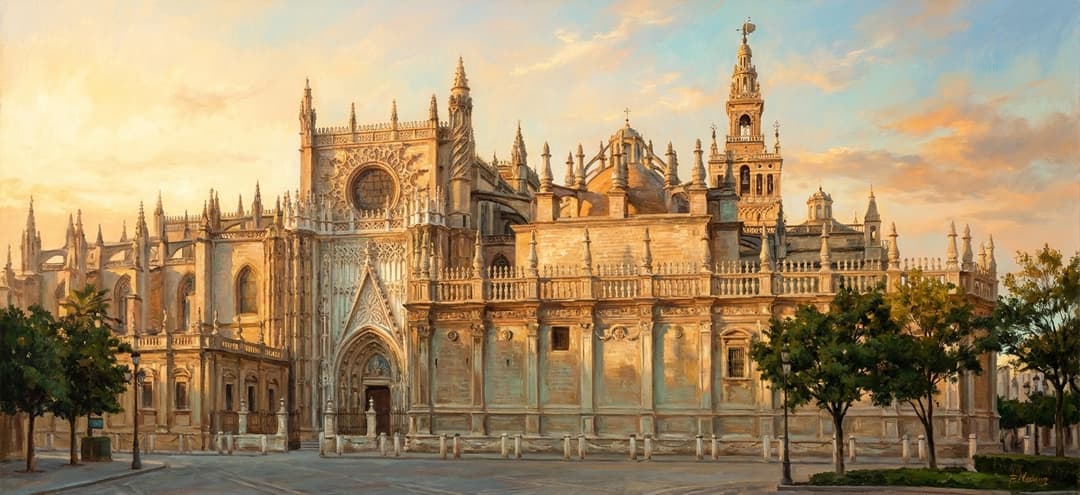
Seville Cathedral offers an awe-inspiring encounter with monumental Gothic scale, sacred art, and centuries of layered Andalusian history. Visitors explore five cavernous naves, ascend the gently sloping equestrian ramps of the Giralda, and reflect in the peaceful orange grove courtyard.
Highlights
- Ascending the 35 interior ramps of the Giralda for panoramic vistas across Seville.
- Admiring the colossal gilded Retablo Mayor featuring 44 masterfully carved wooden relief panels.
- Walking beneath the fragrant orange trees in the historic Patio de los Naranjos.
- Viewing the 1899 Columbus catafalque borne by four heraldic allegories of historic Spanish kingdoms.
Things to Know
- Active consecrated sanctuary requiring covered shoulders and knees at all security entrances.
- The Giralda ascent consists of continuous inclined ramps rather than stairs, requiring comfortable flat footwear.
- Free admission for worship is available during morning liturgical hours through designated chapel doors.
Location
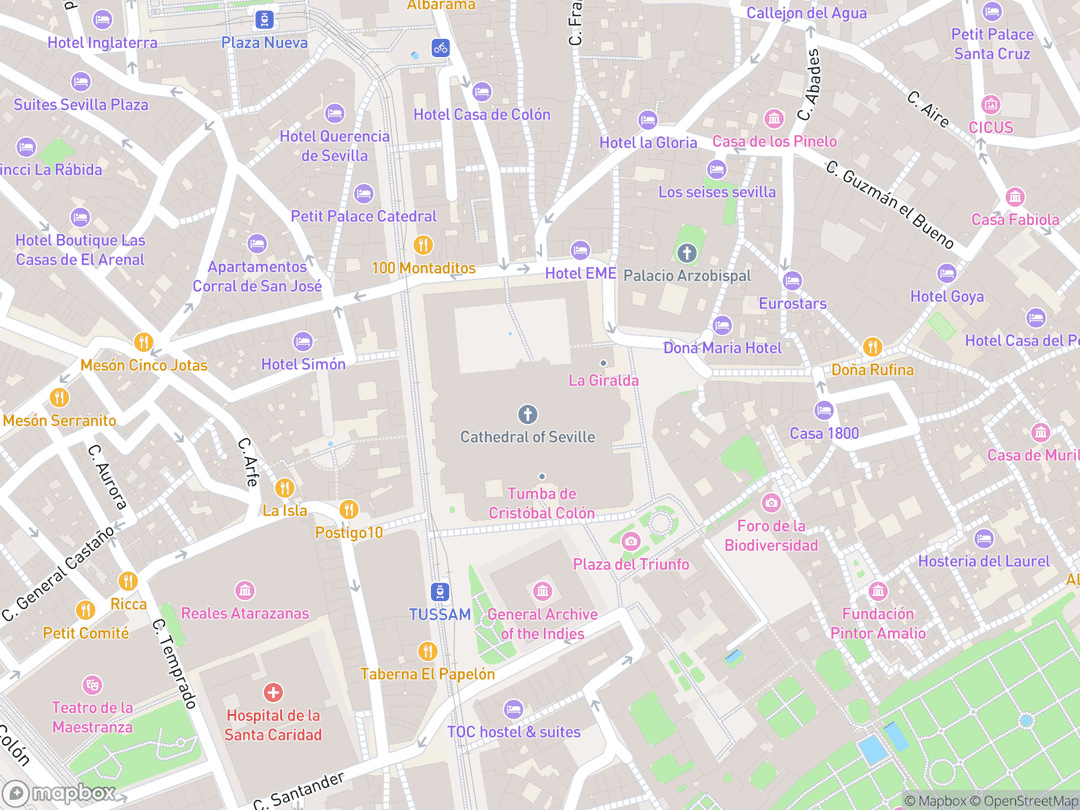
Avenida de la Constitución s/n, 41004 Seville, Andalusia, Spain
Hours: Monday to Saturday 10:45 AM - 7:30 PM, Sunday 2:30 PM - 7:30 PM
Getting There: Metro Line 1 to Puerta de Jerez or MetroCentro Tram T1 directly to Archivo de Indias stop.
Get DirectionsTips for Your Visit
Arrive Early for Stained-Glass Light
Morning light provides optimal illumination through the soaring upper clerestory windows.
Wear Supportive Footwear for the Tower
Ascending the 35 brick ramps of the Giralda involves a sustained walk up smooth inclines.
Reserve Time for the Sacristy Treasury
The Plateresque Main Sacristy houses priceless liturgical silverworks and paintings by Zurbarán and Goya.
About
Rooted in the shared Abrahamic tradition of sacred sanctuaries as earthly portals to the transcendent divine, Seville Cathedral stands as a monumental house of prayer, gathering the faithful to encounter the holy through consecrated space, liturgical memory, and upward-reaching stone.
As the metropolitan seat of the Archdiocese of Seville, the cathedral embodies Catholic incarnational theology as the Mystical Body of Christ. Its soaring ribbed vaults elevate matter to spirit through divine light, centering upon the high altar where the Eucharistic sacrifice is continually celebrated.
Commenced in 1401 over the foundations of the 12th-century Almohad Great Mosque, the cathedral arose from the bold resolve to construct a church of unprecedented grandeur. Consecrated in 1507, the complex ingeniously integrated the Almohad minaret as the Giralda bell tower and preserved the historic Orange Tree Courtyard.
Today, Seville Cathedral remains an active center of pontifical liturgy and a UNESCO World Heritage Site. Housing the tomb of Christopher Columbus, the royal chapel of King Saint Ferdinand III, and Christendom's largest carved altarpiece, it continues to welcome pilgrims and visitors from across the globe.
Gallery
Symbolic Elements
The temple's exterior features intricate carvings, each rich with spiritual meaning:

El Giraldillo
A monumental bronze statue crowning the tower that symbolizes the steadfast triumph of the Christian faith over time.
Cruciform Hall Plan
A Latin cross layout superimposed on a rectangular grid to direct the believer's journey from darkness toward the light of the altar.

The Pelican in Her Piety
An ancient Eucharistic motif carved in the choir representing Christ's sacrificial atonement in nourishing the faithful.

Sebka Brick Tracery
Interconnected diamond brick patterns on the tower preserved as an architectural emblem of harmonious geometric order.
Saints Justa and Rufina
Patron saint sisters of Seville traditionally revered for spiritually shielding the Giralda from historical earthquake destruction.
Patio de los Naranjos
An ancient courtyard garden of fragrant orange trees symbolizing inner purification and divine peace.
The Retablo Mayor
A towering wall of gilded biblical reliefs illustrating the divine plan of redemption centered on Christ.

The Historic City Keys
Surrendered ceremonial keys displaying Arabic and Hebrew blessings that commemorate the city's multifaceted spiritual history.
Interesting Facts
The cathedral chapter famously resolved in 1401 to construct a church so grandiose that posterity would think them mad. (Tier A)
The Giralda contains 35 gently sloping brick ramps instead of stairs so the muezzin and guards could ascend on horseback. (Tier A)
DNA testing conducted in 2006 confirmed that the remains interred in the cathedral catafalque match Christopher Columbus. (Tier A)
In 1874 an art thief cut out Murillo's painting of Saint Anthony, which was recovered in New York and restored to the cathedral. (Tier B)
The Gothic layout directly follows the rectangular foundation footprint of the 12th-century Almohad Great Mosque. (Tier A)
The Retablo Mayor is coated in over three tons of gold leaf traditionally believed to include the first gold brought from the Americas. (Tier B)
King Saint Ferdinand III lies inside a silver reliquary that is opened for public veneration four times each year. (Tier A)
Two monumental 18th-century organ cases face each other across the central choir, controlling thousands of pipes. (Tier B)
The treasury holds the historical 1248 keys of Seville bearing Arabic and Hebrew inscriptions surrendered to the Christian king. (Tier A)
Common Questions
Is Seville Cathedral the largest cathedral in the world?
Yes, by interior volume and floor footprint it is the largest Gothic church and the third-largest Christian cathedral worldwide.
Are Christopher Columbus's true remains inside the cathedral?
DNA testing by the University of Granada in 2006 confirmed the authenticity of the bones interred in the cathedral catafalque.
Can visitors climb to the top of the Giralda tower?
Yes, visitors can walk up the 35 continuous inclined ramps to enjoy panoramic views from the open bell chamber.
Is there a dress code for entering Seville Cathedral?
Visitors must observe respectful modest attire by ensuring that both shoulders and knees remain covered during the visit.
Featured Stories
The Chapter's Audacious Vow
1401
In July 1401, the cathedral chapter gathered in Seville and resolved to build a church so magnificent that future generations would consider them mad. Refusing conventional limits, the canons pledged their own clerical stipends to finance the unprecedented five-naved Gothic monument. Their daring ambition transformed the ancient Almohad footprint into the largest Gothic interior in Christendom.
Source: Cathedral Chapter Historical Minutes
The Collapse and Resurrection of the Crossing
December 28, 1511
Just four years after the cathedral's grand consecration, the immense crossing lantern vault gave way under structural strain and crashed to the marble pavement. Master architect Juan Gil de Hontañón was summoned to reimagine the central crossing, lowering the elevation and engineering a sophisticated ribbed stellar vault. His ingenious design restored the cathedral's structural equilibrium while enhancing its acoustic and artistic majesty.
Source: Archival Records of the Master Builders
The Transatlantic Odyssey of Columbus
1899
Following the Spanish-American War in 1898, the purported remains of Christopher Columbus were repatriated to Spain after centuries of voyages across the Atlantic. Sculptor Arturo Mélida fashioned a dramatic bronze and marble catafalque featuring four heraldic figures representing Castile, León, Aragon, and Navarre bearing the admiral's coffin. Modern genetic analysis in 2006 confirmed the authenticity of the lineage enshrined within the southern transept.
Source: University of Granada Forensic Report
Timeline
Almohad Mosque Groundbreaking
Caliph Abu Yaqub Yusuf commissions the Great Almohad Mosque of Seville.
MilestoneMinaret Construction Commences
Architect Ahmad Ben Baso begins construction of the massive brick minaret shaft.
MilestoneChristian Consecration
King Ferdinand III captures Seville and consecrates the mosque as a Catholic cathedral.
DedicationIberian Earthquake Damage
A major southwestern Iberian earthquake damages the prayer hall and topples the minaret bronze spheres.
EventDecree to Rebuild
The cathedral chapter formally resolves to build a monumental Gothic church across the mosque footprint.
component.timeline.groundbreakingHigh Altar Commission
Flemish woodcarver Pedro Dancart begins crafting the monumental wooden reliefs of the Retablo Mayor.
MilestoneGothic Vault Closure
Master masons secure the final keystone of the main Gothic dome.
MilestoneSolemn Consecration
The cathedral is consecrated for Pontifical liturgy and full sacramental worship.
DedicationCrossing Lantern Collapse
The original high crossing lantern collapses, prompting a structural redesign by Juan Gil de Hontañón.
EventEl Giraldillo Hoisted
The colossal bronze Giraldillo statue is hoisted atop the newly completed Renaissance belfry.
MilestoneAndalusian Earthquake
An earthquake shakes Andalusia, causing the crossing vault to collapse before being rebuilt by 1893.
RenovationUNESCO World Heritage Inscription
UNESCO inscribes Seville Cathedral on the World Heritage List under cultural criteria.
MilestoneHistory by Decade
1170s — Construction of the Great Almohad Mosque
Caliph Abu Yaqub Yusuf established the Great Mosque of Seville to serve as the chief congregational prayer hall of the Almohad Empire. Architect Ahmad Ben Baso began the monumental brick minaret in 1184, which was crowned with gilded bronze spheres in 1198.
1240s — The Reconquista and Christian Consecration
King Ferdinand III of Castile captured Seville on November 23, 1248, immediately ordering the purification and consecration of the great mosque as a Catholic cathedral. For more than a century, Christian liturgy was celebrated within the adapted hypostyle Islamic hall beneath its original timber roof.
1400s — Demolition and Gothic Foundations
Following severe earthquake damage in 1356, the cathedral chapter decreed the demolition of the aged prayer hall in 1401 to erect a colossal Gothic temple. Master masons laid new stone foundations across the mosque perimeter while intentionally preserving the minaret and the ablutions courtyard.
1500s — Gothic Dedication and Renaissance Additions
The central Gothic vaulting was completed in October 1506, culminating in solemn consecration on October 6, 1507. Following the crossing collapse of 1511, Juan Gil de Hontañón rebuilt the dome, while Hernán Ruiz II added the iconic Renaissance belfry atop the Giralda.
1570s–1650s — Royal Chapel and Golden Age Splendor
The Italianate Capilla Real was completed in 1579 to enshrine the relics of King Saint Ferdinand III and royal monarchs. During Seville's golden age, master artists including Bartolomé Esteban Murillo, Francisco de Zurbarán, and Juan de Arfe enriched the cathedral chapels with celebrated paintings and silversmithing.
1880s–1890s — Earthquake Reconstruction and Columbus Interment
An earthquake in August 1888 caused the central crossing lantern vault to collapse once again, prompting a faithful five-year reconstruction led by architect Adolfo Fernández Casanova. In 1899, the monumental catafalque housing Christopher Columbus was installed in the south transept after returning from Cuba.
1980s–Present — UNESCO Recognition and Modern Restoration
UNESCO designated Seville Cathedral as a World Heritage Site in 1987 alongside the Real Alcázar and Archivo de Indias. Continuous structural conservation and state-of-the-art cleanings have preserved its intricate stone facades, fragile stained glass, and historic organ complex for global pilgrims.
Architecture & Facilities
Seville Cathedral represents the pinnacle of Late Flamboyant Gothic architecture adapted to the colossal rectangular footprint of a 12th-century Almohad congregational mosque, enriched with subsequent Renaissance and Plateresque additions.
Building Materials
Piedra de San Cristóbal
Calcareous biocalcarenite ashlar quarried from the Sierra de San Cristóbal in El Puerto de Santa María.
Almohad Clay Brick
High-fired kilned mud bricks forming the structural core and decorative sebka lozenge panels of the lower Giralda.
Polychromed Hardwoods
A combination of native walnut, chestnut, and imported woods carved and heavily gilded for the monumental high altar.
Cast Bronze
High-relief bronze alloy utilized for the monumental Giraldillo weathervane and the Renaissance Tenebrario candelabrum.
Interior Features
Capilla Mayor and Retablo Mayor
The liturgical sanctuary featuring the largest wooden altarpiece in Christendom with 44 carved biblical scenes.
The Coro
A central enclosed choir containing 117 masterfully carved walnut and boxwood stalls crafted by Nufro Sánchez and Pieter Dancart.
Capilla Real
A domed Renaissance royal pantheon housing the silver reliquary of King Saint Ferdinand III and royal tombs.
Columbus Catafalque
A monumental 1899 bronze and marble sepulcher carried by four allegorical statues representing Castile, León, Aragon, and Navarre.
Sala Capitular
An elliptical Renaissance council room crowned by an elliptical dome featuring an Immaculate Conception canvas by Murillo.
Temple Grounds
The cathedral grounds preserve the rectangular 80-by-43-meter Patio de los Naranjos, irrigated by traditional brick channels and entered via the Mudéjar Puerta del Perdón.
Additional Facilities
The complex includes the Plateresque Main Sacristy housing the diocesan treasury, the neoclassical Church of the Sagrario, and the historic Colombina Library containing Columbus manuscripts.
Religious Significance
Rooted in the monotheistic Abrahamic heritage of holy ground, Seville Cathedral serves as the sacred heart of the Roman Catholic Archdiocese of Seville, elevating the soul through liturgy, sacraments, and sublime architecture.
As the episcopal seat of the Archbishop, the cathedral provides a sanctuary for communal Eucharistic adoration, apostolic teaching, and the celebration of Catholic holy sacraments.
Sacred Ordinances
The Holy Eucharist
Daily celebration of the Mass at the high altar, transubstantiating bread and wine into the Body and Blood of Christ.
Liturgy of the Hours
Choral chanting of canonical Psalms and prayers by the Cathedral Chapter within the central walnut choir stalls.
Veneration of Relics
Pilgrim veneration of the incorrupt body of King Saint Ferdinand III inside the silver reliquary of the Capilla Real.
The Mother Church and the Bishop's Cathedra
In Catholic ecclesiology, the cathedral houses the cathedra, the official seat representing the bishop's teaching authority and direct communion in apostolic succession dating back to Saint Peter.
The High Altar as Sacramental Core
Surrounded by wrought-iron grilles and towering vaults, the Capilla Mayor stands as the physical and spiritual focal point where the sacrifice of Calvary is reenacted during the Catholic Mass.
Sources & Research
Every fact on Temples.org is backed by verified Sources & Research. Each piece of information is rated by source tier and confidence level.
View All Sources (9)
| Field | Source | Tier | Retrieved |
|---|---|---|---|
| About & Historical Background | The Courtauld Institute of Art (opens in a new tab) | A | 2026-02-18 |
| Architecture & Structural History | Sevilla Heritage Documentation (opens in a new tab) | A | 2026-02-18 |
| Religious Significance & Liturgy | Seville Cathedral Historical Authority (opens in a new tab) | A | 2026-02-18 |
| Artistic Heritage & Retablo Mayor | Our World Cultural Heritage Studies (opens in a new tab) | A | 2026-02-18 |
| Patio de los Naranjos & Grounds | Wikimedia Commons Heritage Documentation (opens in a new tab) | B | 2026-02-18 |
| Capilla Real & Relics | Kiddle Historical Reference (opens in a new tab) | C | 2026-02-18 |
| Visitor Insights & Access | Barceló Cultural Guides (opens in a new tab) | D | 2026-02-18 |
| Historical Timeline & Construction | Totally Spain Heritage Guide (opens in a new tab) | D | 2026-02-18 |
| Giralda Tower Ascent & Hours | Visit Tickets Monument Guide (opens in a new tab) | D | 2026-02-18 |