Visitor Insights
Visiting Süleymaniye Mosque
Visitors experience one of the most serene and acoustically pure sanctuaries in the Islamic world. The expansive prayer hall and surrounding terrace gardens offer breathtaking panoramic vistas across the Golden Horn and Bosphorus.
Highlights
- Marvel at the soaring central dome illuminated by natural light and Surah An-Nur calligraphy.
- Inspect the vibrant early-period Iznik ceramic tiles revetting the sacred Qibla wall.
- Visit the historic landscaped cemetery containing the mausoleums of Süleyman I and Hürrem Sultan.
- Explore the terraced outer courtyards of the historic imperial civic foundation.
Things to Know
- Tourists must remove shoes and dress modestly before stepping onto the prayer hall carpets.
- Women are required to wear a headscarf, available free of charge at the visitor entrance.
- Access to the main prayer floor is paused during the five daily Islamic prayer services.
- Reverent silence should be maintained, and flash photography is strictly prohibited.
Location
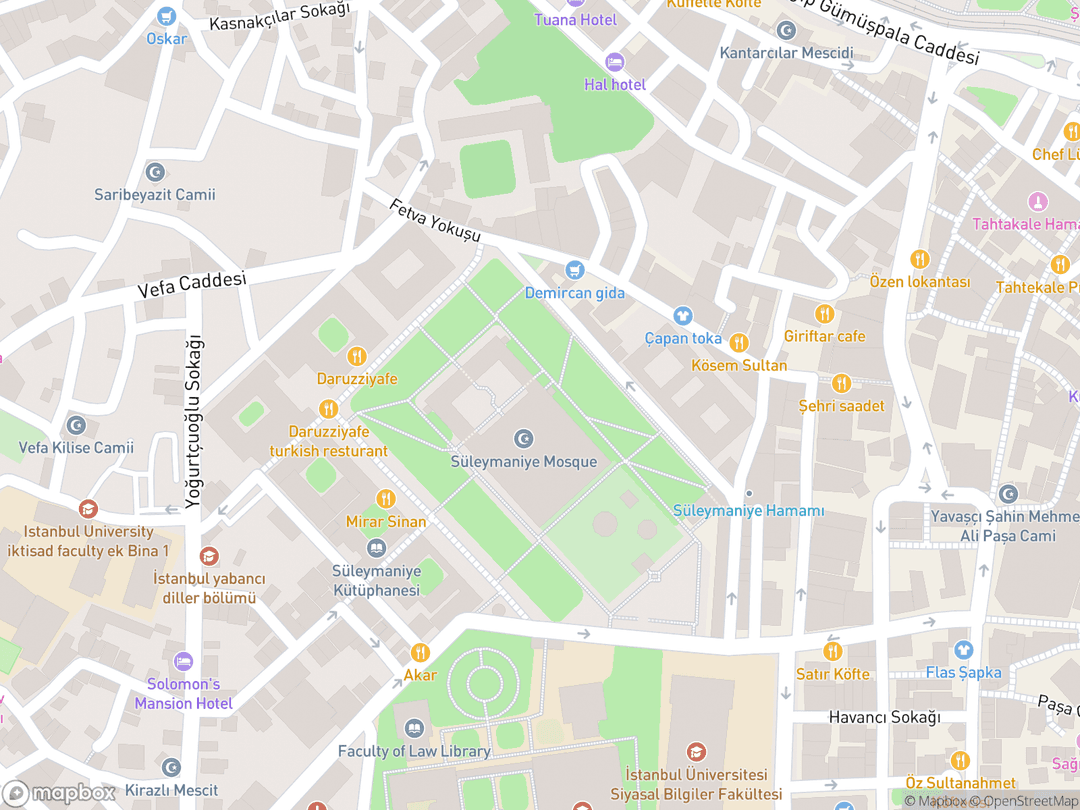
Süleymaniye Mah., Prof. Sıddık Sami Onar Cd. No:1, 34116 Fatih, Istanbul, Turkey
Hours: Daily 08:30–18:00 (closes at 17:00 October to April; paused during daily prayers)
Getting There: Take the T1 tram to Beyazıt-Kapalıçarşı or Laleli, then walk 10 minutes northward through the university quarter.
Get DirectionsTips for Your Visit
Arrive Early for Serenity
Visit at 08:30 on weekdays to experience the morning sunlight through the stained-glass windows before tour groups arrive.
Find the Architect's Tomb
Walk to the northern boundary wall outside the precinct to view Mimar Sinan's humble, open white-marble tomb.
Friday Prayer Schedule
Plan around Friday midday congregational prayers, when the interior is closed to tourists for approximately two hours.
About
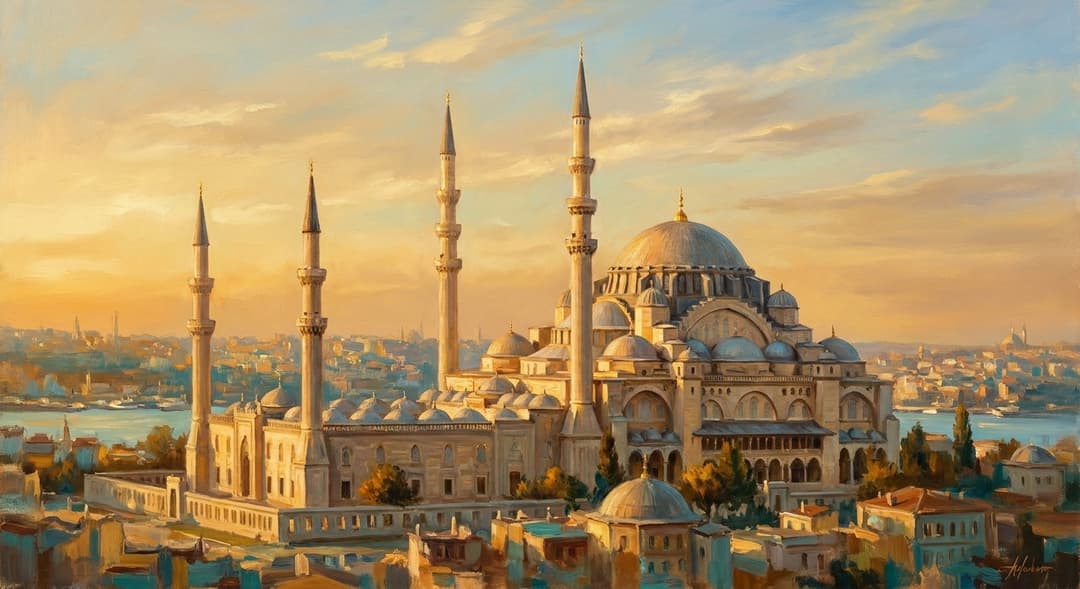
The Süleymaniye Mosque crowns Istanbul's Third Hill as a magnificent testament to imperial devotion and architectural brilliance. Commissioned by Sultan Süleyman I and completed by master architect Mimar Sinan in 1557, the monument exemplifies the absolute peak of the Classical Ottoman style.
Rooted firmly in the Abrahamic monotheistic lineage, the complex consciously evokes the Solomonic ideal of righteous kingship and divine order. Its sacred geometry and orientation toward Mecca organize worshippers into egalitarian rows, expressing the core Islamic doctrine of Tawḥīd, the indivisible oneness of God.
Beyond its role as a sanctuary, the mosque anchors a monumental külliye that integrated religious study with public welfare. Through soup kitchens, hospitals, and colleges, the foundation translated theological convictions into enduring civic charity that sustained urban life for centuries.
Gallery
Symbolic Elements
The temple's exterior features intricate carvings, each rich with spiritual meaning:

Four Minarets
Signifies that Sultan Süleyman was the fourth Ottoman ruler to govern Istanbul since the 1453 conquest.

Ten Minaret Balconies
Represents Süleyman as the tenth sovereign of the Ottoman imperial dynasty from Osman I.

Surah An-Nur Calligraphy
Inscribes the Verse of Light onto the dome apex to represent the divine illumination of heaven and earth.
Four Elephant-Foot Piers
Symbolizes the four Rightly Guided Caliphs whose names anchor the spiritual foundation of the community.
Suspended Ostrich Eggs
Acts as a historic natural sulfur repellent preserving the lamps and vaults from insect cobwebs.

Stained-Glass Windows
Channels natural sunlight toward the Qibla wall to symbolize the descent of divine tranquility upon worshippers.
Ablution Fountain
Reflects the spiritual and physical purification necessary before standing in prayer, echoing the waters of Paradise.
Interesting Facts
Sinan blended egg-white protein and powdered brick into the mortar to give the massive piers seismic elasticity during earthquakes. (Tier B)
Legend says Persian jewels sent by Shah Tahmasp were pulverized by Sinan and mixed into the mortar of the Gem Minaret. (Tier C)
Sinan tested dome acoustics by bubbling water in a tobacco-free waterpipe to gauge sound resonance to the ceiling. (Tier B)
Blown ostrich eggs were placed in chandeliers because their natural sulfur fumes repelled spiders and web construction. (Tier B)
Sinan famously designated this magnificent imperial project as his 'journeyman work' prior to building Edirne's Selimiye. (Tier A)
Soot from thousands of burning oil lamps was collected in a specialized chamber and turned into indelible calligraphic ink. (Tier B)
The northern college buildings are arranged on terraced subterranean vaults stepping downward toward the Golden Horn. (Tier B)
Mimar Sinan chose an unadorned open marble tomb near his public water fountain rather than a grand royal mausoleum. (Tier A)
Common Questions
Is there an admission fee to enter Süleymaniye Mosque?
Entry is entirely free for all visitors, though donations for site preservation are welcomed.
Can non-Muslims enter the mosque?
Yes, non-Muslim visitors are welcome outside of the scheduled congregational prayer times.
Why are ostrich eggs hanging from the chandeliers?
The drying eggshells emit natural sulfur compounds that deter spiders and insects without chemicals.
What is an imperial külliye?
It is an expansive socio-religious complex combining a mosque with schools, a hospital, and a public kitchen.
Featured Stories
The Handing of the Golden Key
October 15, 1557
At the grand opening ceremony, Sultan Süleyman I handed the golden master key to his aging architect, proclaiming that none was more worthy to open the doors. Sinan turned the lock and dedicated the monument to God, declaring it would stand steadfast until the Day of Judgment.
Source: General Directorate of Foundations Architectural Archives
The Imperial Ink Factory
1557
Sinan calculated interior convection currents to channel rising smoke from thousands of oil lamps directly into an isolated soot chamber over the main entrance. The collected carbon was harvested by imperial scribes, who mixed it with gum arabic to produce durable black ink for royal decrees.
Source: Archnet Architectural Studies
Acoustics of the Bubble Chamber
1554
When palace rivals whispered that Sinan was smoking tobacco inside the unfinished sanctuary, the Sultan arrived unannounced to inspect the violation. He found the master bubbling pure water through an empty pipe to test whether delicate sound frequencies carried uniformly to the highest reaches of the dome.
Source: Turkish Directorate of Religious Affairs Monograph
Timeline
Groundbreaking and Excavation
Excavation begins on Istanbul's Third Hill under chief imperial architect Mimar Sinan.
component.timeline.groundbreakingErection of Monolithic Pillars
Granite and porphyry columns reclaimed from antique Mediterranean sites are hoisted into position.
MilestoneOfficial Inauguration
Sultan Süleyman I receives the golden key and Mimar Sinan officially unlocks the grand portal.
DedicationMausoleum of Süleyman Completed
The imperial octagonal tomb for the Sultan is completed inside the landscaped garden cemetery.
MilestonePassing of Master Sinan
Chief architect Mimar Sinan dies at nearly a century of age and is interred in a modest tomb.
EventThe Great Fire of 1660
A major city conflagration damages the lead roof and prompts early Ottoman-Baroque interior updates.
RenovationThe Great Earthquake
A severe seismic event collapses dome plaster, leading to masonry stabilization under Mustafa III.
RenovationFossati Brothers Renovation
Swiss-Italian architects renovate the interior under Sultan Abdülmecid I, adding Baroque gilding.
RenovationWorld War I Munitions Fire
An accidental blast within the courtyard munitions depot ignites a fire damaging stone revetments.
EventScientific Masonry Restoration
The Directorate of Foundations meticulously reconstructs the scorched courtyard and lead roofs.
RenovationUNESCO World Heritage Inscription
The complex is inscribed on the UNESCO list as part of the Historic Areas of Istanbul.
MilestoneModern Structural Restoration
A three-year seismic overhaul concludes, restoring original calligraphic works and acoustic jars.
RenovationHistory by Decade
1550s — Conception and Imperial Dedication
O Sultan, I have built for thee a mosque that will endure until the day of judgment.
Commissioned by Sultan Süleyman I, Mimar Sinan drafted an ambitious master plan on Istanbul's Third Hill to surpass the scale of Hagia Sophia. Monolithic stone shafts were shipped from across the Mediterranean to erect the colossal sanctuary. The mosque was consecrated on October 15, 1557, with the Sultan bestowing the golden key directly onto his chief architect.
1560s–1580s — Funerary Garden and Sinan's Passing
Following the Sultan's death in 1566, Sinan completed an imperial octagonal mausoleum in the landscaped garden cemetery. In 1588, Sinan passed away at nearly one hundred years of age. He was interred in a modest, open-air marble tomb just outside the perimeter walls.
1660s–1760s — Fires and Seismic Rebuilding
A catastrophic urban fire swept through Istanbul in 1660, ravaging the mosque's lead sheeting and introducing initial Baroque embellishments. A century later, the severe 1766 earthquake collapsed portions of the central plaster dome. Sultan Mustafa III funded structural repairs that reinforced the masonry buttresses and vaults.
1840s–1910s — Foreign Overhauls and Wartime Blast
Sultan Abdülmecid I hired the Swiss-Italian Fossati brothers in 1849 to execute extensive renovations, adding heavier nineteenth-century plaster gilding. During the First World War, the courtyard served as an imperial military ammunition depot. In 1917, an accidental munitions explosion triggered a fire that damaged the arcade colonnade.
1950s–1980s — Scientific Restoration and World Heritage
The General Directorate of Foundations initiated extensive scientific restorations to repair wartime fire scars and recast the lead roofs. Baroque overpainting was carefully scraped away to reveal original 16th-century calligraphic underlayers. In 1985, the monument gained global protection as a core element of the UNESCO World Heritage Site.
2000s–Present — Advanced Structural Preservation
Between 2007 and 2010, the Turkish government conducted the most comprehensive seismic retrofitting in the monument's modern history. Workers removed rigid cement mortars, cleaned historic Iznik tiles, and uncovered buried acoustic resonance jars. The sanctuary reopened in November 2010 with state-of-the-art structural resilience.
Architecture & Facilities
The Süleymaniye Mosque represents the definitive peak of Classical Ottoman architecture, harmonizing monumental engineering with unified sacred space. Sinan reimagined the spatial dialectic of Hagia Sophia by transferring the main dome's weight outward onto four integrated perimeter piers, yielding an extraordinarily luminous and column-free prayer sanctuary.
Building Materials
Küfeki Limestone
Quarried locally in Thrace to construct the primary load-bearing masonry walls and exterior ashlar revetments.
Antique Monoliths
Granite, porphyry, and green serpentine shafts reclaimed from antique sites across Egypt and Anatolia.
Iznik Ceramic Tiles
Underglaze cobalt, turquoise, and bole red ceramic panels manufactured in Iznik to revet the Qibla wall.
Interlocking Cast Lead
Thick lead sheeting cast on site to protect the expansive array of central domes, half-domes, and minaret spires.
Interior Features
Central Prayer Hall
An expansive column-free square space sheltered by a 53-meter dome designed to accommodate 5,000 worshippers.
Mihrab and Minbar
Finely carved white Proconnesian marble prayer niche and pulpit framed by stained-glass windows and Iznik tilework.
Müezzin Mahfili
A raised wooden platform with intricate mother-of-pearl and ivory inlay used by chanters to lead responses.
Central Soot Room
A specialized chamber designed above the entrance portal to trap rising lamp-smoke for ink manufacturing.
Temple Grounds
The mosque sits within a terraced precinct featuring manicured gardens, an outer peristyle courtyard, a walled funerary garden, and stepped public educational facilities.
Additional Facilities
The historic külliye comprises four traditional colleges, a medical school, a public bathhouse, an imaret soup kitchen, and Mimar Sinan's tomb.
Religious Significance
In Islamic theology, the congregational mosque represents a physical manifestation of Tawḥīd, the absolute oneness and unicity of God. Within the broader Abrahamic family, Süleymaniye mirrors the Solomonic ideal of building a sacred sanctuary dedicated to divine glory and communal gathering.
To serve as a house of divine remembrance, communal prayer, and holistic civic service that dissolves worldly divisions before the Creator.
Sacred Ordinances
Salat (Congregational Prayer)
The performance of the five daily ritual prayers facing Mecca, unifying worshippers in horizontal, egalitarian ranks.
Salat al-Jum'ah (Friday Prayer)
The weekly congregational service incorporating a sermon delivered from the marble minbar.
Taharah (Ritual Purification)
Ablution performed at the central courtyard fountain to attain physical and spiritual cleanliness before prayer.
Külliye Service (Sadaqah & Waqf)
Endowed charitable hospitality, medical treatment, and daily food distribution provided to the community.
Aniconism and Geometric Light
Rejecting figurative imagery to prevent idolatry, the mosque conveys divine transcendence through sacred mathematics, radiant daylight, and Qur'anic calligraphy.
Sources & Research
Every fact on Temples.org is backed by verified Sources & Research. Each piece of information is rated by source tier and confidence level.
View All Sources (8)
| Field | Source | Tier | Retrieved |
|---|---|---|---|
| About & Historical Background | Presidency of Religious Affairs (Diyanet İşleri Başkanlığı) (opens in a new tab) | A | 2026-02-18 |
| Architecture & Structural Facilities | General Directorate of Foundations (Vakıflar Genel Müdürlüğü) (opens in a new tab) | A | 2026-02-18 |
| UNESCO World Heritage Nomination | UNESCO World Heritage Centre (opens in a new tab) | B | 2026-02-18 |
| Architectural Documentation & Drawings | Archnet Digital Library (opens in a new tab) | B | 2026-02-18 |
| Timeline & Restoration Records | Ministry of Culture and Tourism of the Republic of Turkey (opens in a new tab) | A | 2026-02-18 |
| Historical Epigraphy & Inscriptions | TDV Islamic Studies Centre (İSAM) (opens in a new tab) | B | 2026-02-18 |
| Urban Geography & Municipal History | Istanbul Metropolitan Municipality (opens in a new tab) | A | 2026-02-18 |
| Visitor Insights & Practical Etiquette | Türkiye Tourism Promotion and Development Agency (opens in a new tab) | B | 2026-02-18 |