Visitor Insights
Visiting Sultan Ahmed Mosque
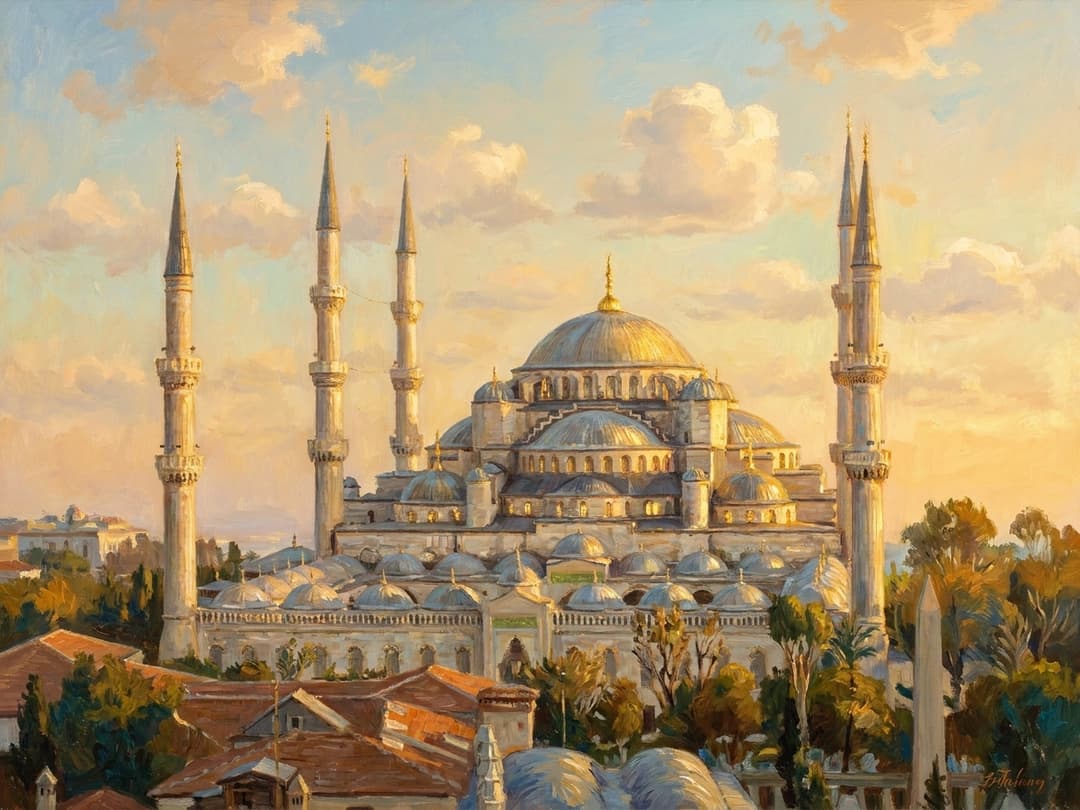
The Sultan Ahmed Mosque is a fully functioning imperial sanctuary welcoming both worshippers and travelers throughout the year. Visitors experience an awe-inspiring volume of light and sacred calligraphy, with free admission offered outside five daily prayer closures. Modest attire is strictly enforced, and women are provided traditional head coverings upon arrival.
Highlights
- Marvel at over 20,000 handmade 17th-century İznik ceramic tiles adorning the interior galleries.
- Observe the colossal 'elephant feet' marble piers engineered to withstand seismic tremors.
- Gaze upward into the 43-meter central dome inscribed with verses from Surah Fatir.
- Stroll through the grand peristyle marble forecourt matching the interior floor footprint.
Things to Know
- Sanctuary doors close to non-worshippers five times daily for 45 to 60 minutes during prayers.
- The mosque closes to tourists for approximately two hours during Friday midday prayers.
- Shoes must be removed and placed in provided bags prior to stepping onto the prayer carpets.
- Shoulders and knees must remain covered, and women must wear a headscarf.
Location
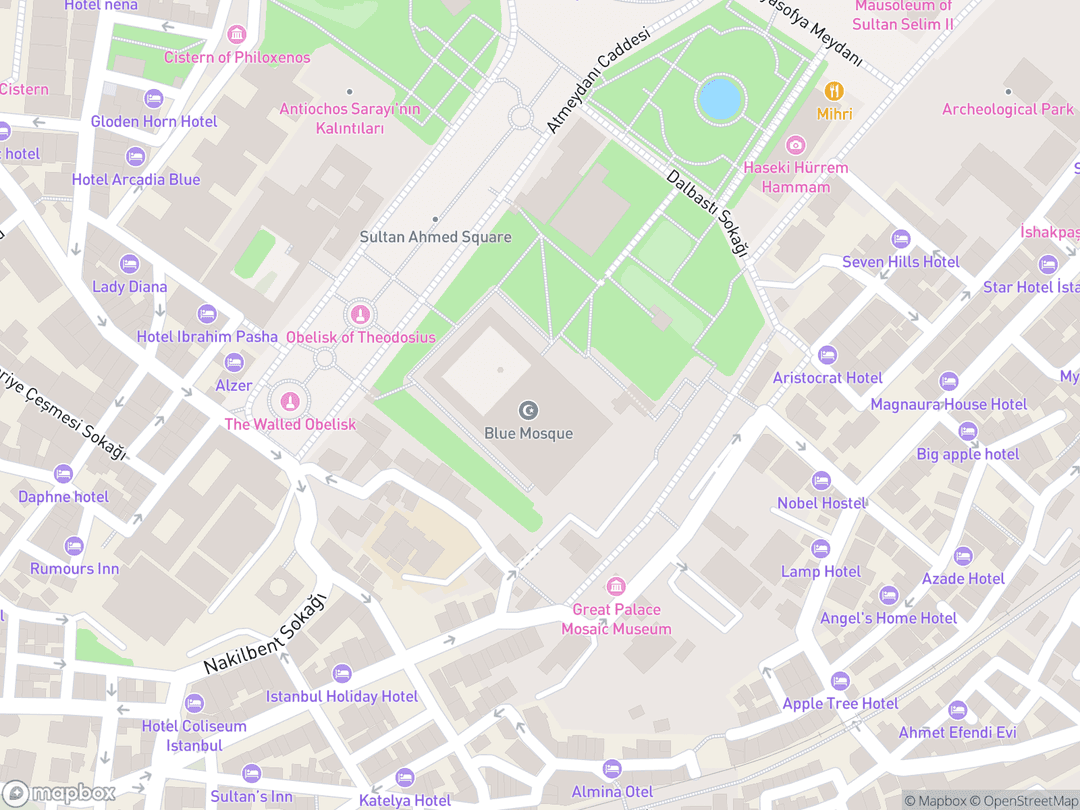
Sultan Ahmet Mahallesi, Atmeydanı Caddesi No: 7, 34122 Fatih/İstanbul, Turkey
Hours: Daily from 08:30 to 18:00 (closed during prayer services)
Getting There: Take the T1 Kabataş-Bağcılar Tramway Line to Sultanahmet Station and walk three minutes across Sultanahmet Square.
Get DirectionsTips for Your Visit
Time Your Visit Around Congregational Prayers
Arrive between 08:30 and 09:30 or during the mid-afternoon gap between Dhuhr and Asr prayers to avoid closures.
Dress Modestly Before Arrival
Wear long trousers or maxi skirts and shirts covering shoulders to bypass queue delays at the modesty kiosk.
Carry Slip-On Shoes
Footwear must be taken off at the portal entrance; slip-on shoes make entry and exit smooth and effortless.
About
Commissioned by Sultan Ahmed I and constructed between 1609 and 1617, the Sultan Ahmed Mosque stands as the absolute zenith of Classical Ottoman architecture. Designed by chief imperial architect Sedefkâr Mehmed Ağa, the complex was strategically positioned across from Hagia Sophia on the historical grounds of the Byzantine Hippodrome to assert imperial prestige and spiritual renewal following protracted foreign conflicts.
Celebrated globally as the 'Blue Mosque' due to the luminous cobalt and turquoise tiles revetting its soaring upper galleries, the sanctuary synthesizes monumental Byzantine domical engineering with refined Ottoman spatial rationality. Its soaring central dome cascades across four spherical pendentives and semi-domes, terminating in an expansive, harmonious prayer sanctuary illuminated by hundreds of arched windows.
Within the broader Abrahamic tradition of sacred precincts, the mosque operates as a dedicated monotheistic sanctuary exalting divine transcendence through pure non-figurative geometry and sacred calligraphy. It remains a vibrant, uninterrupted center of Islamic communal prayer, welcoming thousands of daily worshippers alongside global visitors within the UNESCO-inscribed Historic Areas of Istanbul.
Gallery
Symbolic Elements
The temple's exterior features intricate carvings, each rich with spiritual meaning:

The Celestial Qubba
The sweeping central dome symbolizes the cosmic vault of the heavens held by Divine decree.

The Sacred Tulip
The stylized tulip motif reflects the gematric spelling of Allah, signifying absolute Divine Uniqueness.

The Marble Mihrab
Carved from Proconnesian marble, the prayer niche establishes the sacred Qibla orientation pointing toward Mecca.
The Ascending Minbar
The towering marble pulpit represents prophetic succession and the spiritual elevation of the Friday sermon.
The Iron Humility Chain
Suspended across the western gate, this heavy chain compelled the entering Sultan on horseback to physically bow.
The Hexagonal Şadırvan
The courtyard ablution fountain symbolizes spiritual purity and cleansing before passing across the sacred threshold.

The Six Fluted Minarets
The unprecedented six minarets broadcast the call to prayer across Istanbul and proclaim imperial devotion.

Natural Light Illuminations
Over two hundred stained-glass windows diffuse soft daylight recalling the Quranic verse of Divine Radiance.
Interesting Facts
European travelers coined the name 'Blue Mosque' due to the brilliant cobalt and green İznik tiles cladding the upper galleries (Tier B).
Sultan Ahmed I resolved the controversy of having six minarets by commissioning a seventh minaret for the Holy Sanctuary in Mecca (Tier A).
The four primary interior load-bearing piers are each five meters thick, earning the historic architectural nickname 'elephant feet' (Tier B).
Hollowed-out ostrich eggs remain suspended across the iron chandeliers to serve as natural deterrents against spiders and webs (Tier B).
The Ottoman Turkish word for tulip uses the exact same Arabic letters and numerical gematric value as the supreme name Allah (Tier B).
A heavy iron chain hung across the western gate compelled the Sultan on horseback to physically bow his head upon entering (Tier B).
The mosque's foundations rest directly upon subterranean brick vaults and terraces of the ancient Byzantine Great Palace (Tier B).
Because Ahmed I achieved no major foreign conquests, construction was funded directly from the state treasury rather than war spoils (Tier B).
Common Questions
Why is the building called the Blue Mosque?
European visitors named it after the thousands of radiant blue and turquoise tiles illuminating the gallery walls.
Is there an admission fee to enter the mosque?
Entrance is completely free, though voluntary donations for site conservation are gratefully received.
Can non-Muslim visitors tour the mosque during prayer times?
No, tourist entry halts for forty-five minutes during the five daily prayer services and two hours on Friday midday.
What dress code is required for visitors?
All visitors must have shoulders and knees covered, and women are required to wear a headscarf inside the prayer hall.
Featured Stories
The Royal Pickaxe and Imperial Groundbreaking
1609
Determined to renew civic morale following military setbacks, nineteen-year-old Sultan Ahmed I initiated the foundation trenches himself with an ivory-handled pickaxe. Royal chroniclers noted that the young sovereign carried dirt away in his own skirts to demonstrate humble piety before God. His personal involvement established the complex as an enduring monument to spiritual renewal.
Source: General Directorate of Foundations & Archnet Archives
The Seventh Minaret of Mecca
1616
When the mosque was completed with six towering minarets, religious authorities voiced sharp dissent because the holy sanctuary in Mecca was the only shrine with six minarets. Rather than dismantle any of his newly erected spires in Istanbul, Sultan Ahmed I funded the immediate construction of a seventh minaret at the Kaaba. This respectful architectural gesture preserved the sanctity of Mecca while resolving civic controversy.
Source: Ottoman Imperial Chronicle Records
A Historical Moment of Inter-Faith Contemplation
November 30, 2006
In a historic moment of Christian-Muslim dialogue, Pope Benedict XVI entered the Sultan Ahmed Mosque alongside Istanbul Grand Mufti Mustafa Çağrıcı. Pausing before the illuminated marble mihrab, the pontiff bowed his head in several minutes of silent, respectful meditation facing Mecca. This landmark gesture established a tradition of peace later renewed by Pope Francis during his visit in 2014.
Source: Presidency of Religious Affairs
Timeline
Imperial Commission Decided
Sultan Ahmed I resolves to build an imperial mosque complex and appoints Sedefkâr Mehmed Ağa as Chief Imperial Architect.
MilestoneGroundbreaking Ceremony
Sultan Ahmed I initiates structural excavation using an ivory-handled pickaxe on the historic Hippodrome plateau.
component.timeline.groundbreakingSubstructure Foundations Laid
Porous limestone foundations and vaulted substructures rise over demolished Byzantine terraces.
MilestoneTile Revetment Commission
Over twenty thousand bespoke ceramic tiles arrive from imperial workshops in İznik and Kütahya.
MilestoneSuperstructure Assembly Concluded
The primary cascading domes and all six fluted minarets reach structural completion.
MilestoneInaugural Opening & Dedication
Formal dedication rites and inaugural Friday congregational prayers occur before Sultan Ahmed I passes away.
DedicationComplex Annexes Finalized
Ancillary külliye institutions including the madrasa, hospital, and public kitchen reach completion.
MilestoneThe Auspicious Incident
Sultan Mahmud II displays the Sacred Banner of the Prophet inside the mosque to summon citizens against the Janissaries.
EventImperial Lodge Renovation
Architects Gaspare and Giuseppe Fossati carry out targeted renovations within the elevated royal prayer pavilion.
RenovationUNESCO World Heritage Inscription
The complex is formally inscribed as part of the UNESCO World Heritage Site Historic Areas of Istanbul.
MilestoneCentennial Restoration Commenced
The Turkish General Directorate of Foundations begins a multi-year comprehensive restoration of the sanctuary.
RenovationGrand Reopening
Scaffolding is cleared and the sanctuary reopens fully following seismic stabilization and delicate tile conservation.
MilestoneHistory by Decade
1600s — Foundations and Groundbreaking
Following the Peace of Zsitvatorok, Sultan Ahmed I resolved to erect a premier imperial mosque to restore civic morale. He appointed Sedefkâr Mehmed Ağa, the celebrated pupil of Mimar Sinan, to construct the sanctuary on the former grounds of the Byzantine Hippodrome. Foundation trenches were inaugurated by the young Sultan in 1609.
1610s — Construction and Dedication
Thousands of artisans laid 20,000 İznik tiles and cast lead sheets across the domical canopy over six grueling years. Inaugural Friday prayers were celebrated in June 1617 shortly before Sultan Ahmed I passed away at age twenty-seven. The adjoining royal mausoleum was subsequently erected to inter his remains.
1620s–1700s — Center of Imperial Ceremonial Life
The mosque swiftly replaced Hagia Sophia as the principal venue for Friday imperial processions and civic festivals. Ottoman sovereigns held departure parades within the outer courtyards before launching military expeditions. Guilds and civic institutions congregated within the surrounding charitable complex for community banquets.
1820s — The Auspicious Incident
During the military crisis of 1826, Sultan Mahmud II raised the Sacred Banner of the Prophet within the mosque sanctuary. Loyal soldiers and Istanbul citizens assembled inside the courtyard to extinguish the rebellious Janissary Corps. This pivotal event reshaped the modern administrative and military landscape of the Ottoman state.
1930s–1980s — Republican Transition and World Heritage
While adjacent Hagia Sophia was converted into a secular museum in 1935, the Sultan Ahmed Mosque remained an active, unbroken house of prayer. In 1985, UNESCO recognized the structure as an irreplaceable monument within the Historic Areas of Istanbul. International preservation initiatives supported periodic restoration of the precinct walls.
2010s–2020s — Centennial Structural Restoration
In 2017, Turkish heritage authorities embarked on the most comprehensive restoration in the building's four-hundred-year history. Restorers fortified the minarets against seismic shifts, replaced oxidized exterior lead roofs, and cleaned centuries of accumulated soot from the delicate tiles. The mosque reopened fully in April 2023.
Architecture & Facilities
The Sultan Ahmed Mosque embodies the absolute zenith of Classical Ottoman architecture, blending monumental domical spatial mastery with balanced symmetry. Designed by Sedefkâr Mehmed Ağa, it adapts Sinan's structural achievements into a unified space where four cardinal semi-domes effortlessly shoulder a massive 43-meter central dome above four colossal fluted pillars.
Building Materials
Bakırköy Küfeki Limestone
Dense, resilient fossiliferous marine limestone forms the primary load-bearing ashlar masonry across the exterior walls.
Proconnesian White Marble
Fine crystalline white marble quarried from Marmara Island is utilized for interior galleries, capitals, and the ornate mihrab.
İznik and Kütahya Quartz Frit
Vitreous hand-painted underglaze ceramic tiles line the walls with vibrant cobalt, turquoise, and emerald botanical motifs.
Melted Lead Cladding
Interlocking lead sheets protect all exterior domes, semi-domes, and pointed minaret spires from regional moisture.
Interior Features
The Main Prayer Sanctuary (Harim)
A vast square hall under cascading domed vaults that accommodates thousands of worshippers on crimson carpets.
The Imperial Loge (Hünkâr Mahfili)
An elevated private royal prayer chamber shielded behind gilded latticework in the sanctuary's southeast corner.
The Elevated Marble Minbar
A steeply pitched marble pulpit carved with delicate geometric openwork used exclusively for the Friday sermon.
The Four Elephant Feet (Fil Payeleri)
Colossal fluted stone columns measuring five meters across that distribute the vertical deadweight of the dome.
Temple Grounds
The mosque sanctuary is framed by an expansive walled precinct featuring landscaped gardens, stone gates, and an equal-sized peristyle marble ablution courtyard.
Additional Facilities
The historic külliye complex encompasses a royal mausoleum, Quranic school, public hospital, soup kitchen, and the traditional Arasta covered bazaar.
Religious Significance
Within the broader Abrahamic tradition of sacred spaces, the Sultan Ahmed Mosque serves as a monotheistic sanctuary honoring the absolute transcendence of the Creator.
To provide an egalitarian gathering precinct where believers align shoulder-to-shoulder in submission to the One God during congregational prayer.
Sacred Ordinances
Salah (Daily Prayers)
Five prescribed daily prayers aligning worshippers in parallel rows behind the imam facing the sacred Qibla toward Mecca.
Jumu'ah (Friday Assembly)
The mandatory weekly congregational midday prayer accompanied by an instructive sermon delivered from the marble minbar.
Taharah (Purification)
The ritual ablution performed at perimeter marble fountains to achieve spiritual and bodily readiness for prayer.
Tawhid Expressed Through Sacred Architecture
Rejecting all figurative and anthropomorphic depictions, the mosque channels the Islamic doctrine of Tawhid through infinite geometric arabesques, rhythmic floral revetments, and sweeping calligraphic verses honoring the transcendent attributes of God.
Sources & Research
Every fact on Temples.org is backed by verified Sources & Research. Each piece of information is rated by source tier and confidence level.
View All Sources (9)
| Field | Source | Tier | Retrieved |
|---|---|---|---|
| Historical Timeline & Groundbreaking Record | Aga Khan Documentation Center at MIT (opens in a new tab) | B | 2026-02-18 |
| Restoration Operations & Foundation Oversight | Anadolu Agency (General Directorate of Foundations) (opens in a new tab) | A | 2026-02-18 |
| UNESCO Historic Areas of Istanbul Record | UNESCO World Heritage Centre (opens in a new tab) | B | 2026-02-18 |
| Interior Tilework & Monumental Dimensions | Inside Inside Architectural Database (opens in a new tab) | B | 2026-02-18 |
| Structural Mechanics & Pier Engineering | Budowle Architectural Survey (opens in a new tab) | B | 2026-02-18 |
| Courtyard Proportions & Six Minarets History | Visiting Istanbul Cultural Guide (opens in a new tab) | B | 2026-02-18 |
| Visitor Protocols & Public Access Guidelines | Istanbul Tourism & City Resource Portal (opens in a new tab) | C | 2026-02-18 |
| Transit Logistics & Modesty Regulations | Turkey Travel Service (opens in a new tab) | D | 2026-02-18 |
| Comparative Architectural Metrics | Safaraq Tourism Resources (opens in a new tab) | D | 2026-02-18 |