Visitor Insights
Visiting Kyiv Pechersk Lavra
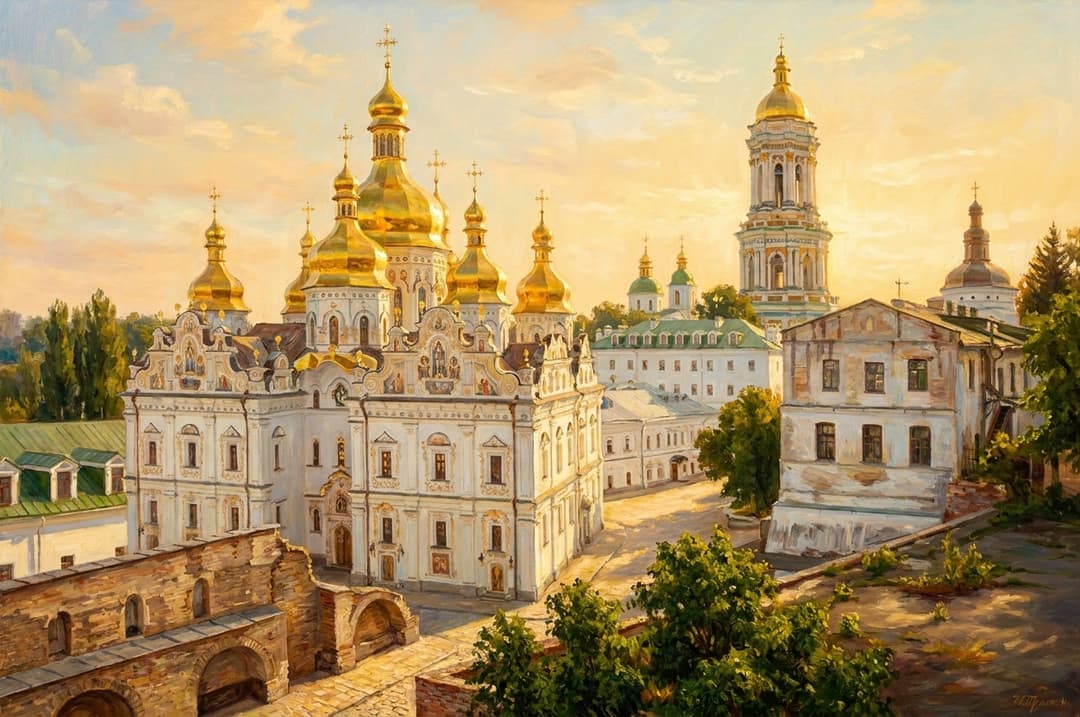
Perched majestically above the Dnieper River, Kyiv Pechersk Lavra provides a deeply evocative journey through Ukrainian monastic history and underground sacred sanctuaries. Visitors traverse cobblestone slopes between the monumental Upper Lavra museum reserve and the active devotional precincts of the Lower Lavra. Navigating the dimly lit catacombs by handheld beeswax candlelight offers a rare, unforgettable glimpse into medieval Christian ascetic life.
Highlights
- Venerating the ancient subterranean sanctuaries and incorrupt relics within the Near and Far Caves.
- Ascending the monumental 96.52-meter Great Lavra Bell Tower for sweeping panoramas across Kyiv and the Dnieper.
- Marveling at the rebuilt golden-domed Dormition Cathedral and surviving 12th-century Trinity Gate Church.
- Examining ancient manuscripts, historic printing presses, and liturgical gold treasures in the Upper Lavra museums.
Things to Know
- Strict dress codes require women to cover their heads and wear modest skirts, while men must wear long trousers.
- Cobblestone walkways and steep terraces between the Upper and Lower grounds require sturdy footwear.
- Underground galleries are narrow and illuminated only by candlelight, requiring care for claustrophobic visitors.
Location
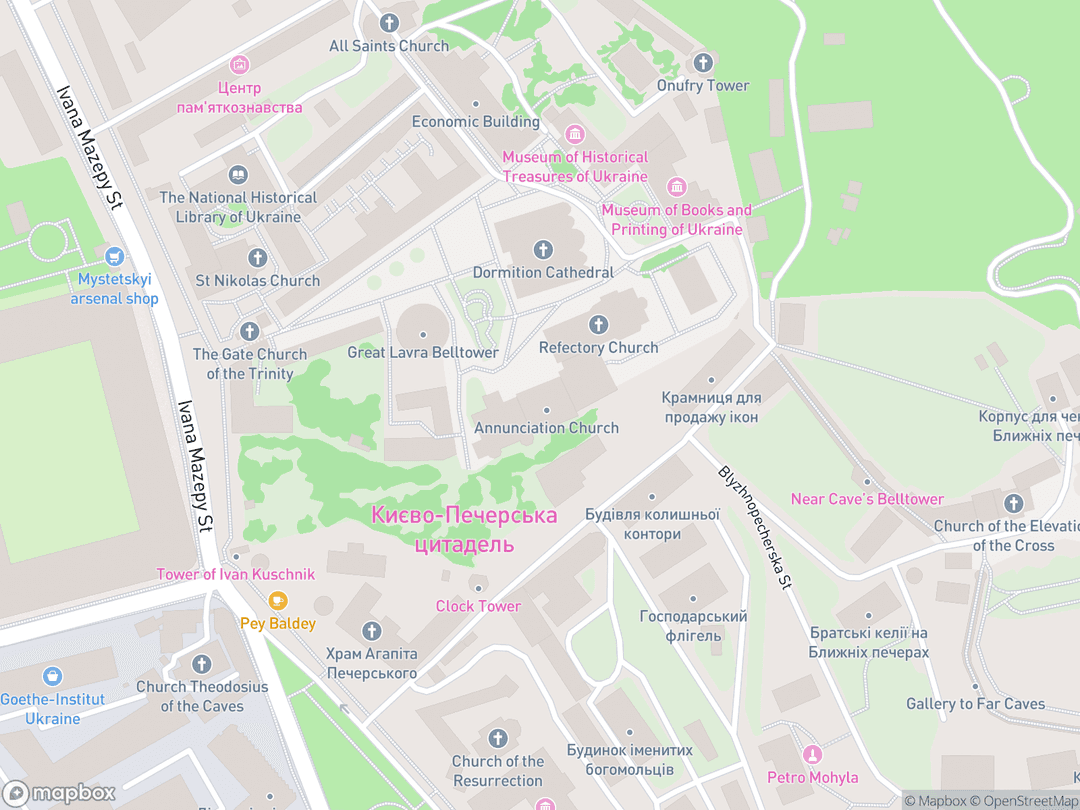
Lavrska St, 15, Kyiv, Ukraine, 01015
Hours: Upper Reserve: 09:00 to 18:00 daily; Underground Caves: 09:00 to 16:30 daily.
Getting There: Take Kyiv Metro Line 1 to Arsenalna Station, then walk south 15 minutes along Lavrska Street or take bus 24.
Get DirectionsTips for Your Visit
Candles for Catacombs
Purchase a slender beeswax candle at the cave entrance to navigate the unlit subterranean corridors reverently.
Pace Your Walking
The monastery is spread over 28 hectares of steep bluffs; allocate at least three to four hours for a comprehensive visit.
Check Service Schedules
Underground passages may close briefly during active liturgical molebens and formal monastic processions.
About
Founded in 1051 AD by Saint Anthony of the Caves, Kyiv Pechersk Lavra stands as the premier spiritual sanctuary of Eastern Slavic Christianity. Originating as a cluster of secluded subterranean prayer grottoes along the forested hills of the Dnieper River, it swiftly evolved into a monumental bastion of learning, monastic ascetism, and architectural splendor.
The complex features an exceptional harmony of 11th-century medieval Byzantine foundations and exuberant Ukrainian Cossack Baroque transformations, crowned by the soaring Great Lavra Bell Tower. Below ground, extensive catacomb networks wind through dry loess strata, sheltering over a hundred incorrupt relics of venerated ascetics, chroniclers, and early physicians.
Having survived the 1240 Mongol sack, catastrophic fires, Soviet-era closures, and the devastating demolition of its Dormition Cathedral during World War II, the Lavra has repeatedly risen from ruin. Today, as an active monastery and UNESCO World Heritage Site, it remains a radiant monument of spiritual fortitude and Ukrainian cultural identity.
Gallery
Symbolic Elements
The temple's exterior features intricate carvings, each rich with spiritual meaning:
Ukrainian Pear-Shaped Cupolas
Multi-tiered gilded pear domes symbolize the fiery tongues of the Holy Spirit descending at Pentecost.

The Holy Gate
The fortified entrance portal embodies the straight and narrow pathway leading from the world into salvation.

Reliquary Glass Caskets
Crystal-topped bronze caskets display preserved relics as physical testaments of bodily transfiguration.

Myrrh-Streaming Skulls
Silver chalices holding fragrant exuding skulls represent divine grace transcending physical death.

Nestor's Scriptorium Quill
The monastic quill signifies the preservation of literacy, history, and theology during medieval turmoil.

Ilya Muromets Hand
The warrior-monk's hand positioned in prayer marks the surrender of martial power to heavenly devotion.

Cossack Baroque Crests
Stucco relief emblems of Hetman Ivan Mazepa highlight the alliance between the Cossack state and Orthodoxy.
Interesting Facts
The name Pechersk is derived directly from pechera, the Old East Slavic word for cave. (Tier A)
The subterranean catacombs extend across more than 500 meters of hand-carved galleries reaching depths up to 15 meters. (Tier B)
Forensic medical analysis confirmed the saintly relic of epic bogatyr Ilya Muromets belonged to an exceptionally tall 12th-century warrior. (Tier B)
Kyiv's Arsenalna Metro Station was dug 105.5 meters deep specifically to pass safely underneath the monastery catacombs. (Tier C)
Saint Agapitus of the Caves operated the first documented free medical infirmary in medieval Kyivan Rus'. (Tier A)
The 12th-century Trinity Gate Church survived both the 1240 Mongol invasion and World War II explosions completely intact. (Tier B)
The Great Lavra Bell Tower rests on a seven-meter-thick stone platform anchored by thousands of driven oak piles. (Tier B)
Ancient tradition asserts the Dormition Cathedral dimensions were measured using a golden belt gifted by a Norse Varangian nobleman. (Tier C)
The printing house operated for over three centuries, publishing the primary history textbook of Eastern Europe in 1674. (Tier B)
Common Questions
Why is the monastery named Kyiv Pechersk Lavra?
The title derives from the Old East Slavic word for cave, commemorating the subterranean hermitage cells where it began.
Why are the relics in the catacombs preserved?
A combination of dry microclimates, stable temperatures, and theological reverence has preserved the remains naturally for centuries.
Who was Ilya Muromets buried in the caves?
He was the legendary 12th-century warrior-hero of East Slavic epic poetry who took monastic vows late in life.
Can tourists enter the underground caves?
Yes, visitors may enter during public hours provided they dress modestly, maintain silence, and carry a lit candle.
Featured Stories
Saint Anthony's Underground Solitude
1051
Returning inspired from Mount Athos, Saint Anthony settled into a deserted cliffside grotto above the Dnieper to practice perpetual prayer. As disciples gathered around his holy seclusion, they laboriously hollowed out subterranean corridors, establishing an enduring hearth of Eastern Slavic monasticism.
Source: Kyiv Pechersk Patericon
The Master Craftsmen of Constantinople
1073
Ancient chronicles record that Byzantine master masons arrived unexpectedly in Kyiv, guided across the Black Sea by visions of the Mother of God. Bearing sacred relics and structural blueprints, they laid the foundation stones of the Dormition Cathedral alongside Saint Theodosius and Grand Prince Sviatoslav II.
Source: Tale of Bygone Years
Rebirth of the Dormition Cathedral
August 24, 2000
Reduced to a desolate heap of rubble during the wartime devastation of 1941, the Great Dormition Church remained an open wound for nearly sixty years. Through meticulous historical research and national dedication, Ukrainian artisans resurrected the Ukrainian Baroque marvel in time for independent Ukraine's ninth anniversary.
Source: National Kyiv-Pechersk Historical and Cultural Reserve
Timeline
Monastery Foundation
Saint Anthony of the Caves establishes a solitary ascetic hermitage inside a cliffside cavern along the Dnieper River.
MilestoneDormition Cathedral Groundbreaking
Saint Theodosius and Grand Prince Sviatoslav II initiate construction of the first monumental stone cathedral.
component.timeline.groundbreakingCathedral Consecration
The Dormition Cathedral is consecrated following decorative completion by master mosaicists from Constantinople.
DedicationTrinity Gate Church Erected
Prince Sviatoslav funds the completion of the fortified stone church over the Holy Gate entrance.
MilestoneNestor the Chronicler Compiles Primary Chronicle
Monk Nestor finishes the Tale of Bygone Years within the monastery scriptorium.
MilestoneMongol Sack of Kyiv
Forces of Batu Khan pillage the surface monastery, forcing monks to seek refuge in the deep catacombs.
EventFounding of the Lavra Press
Archimandrite Yelisey Pletenetsky establishes a major printing press, catalyzing an intellectual renaissance.
MilestoneCossack Baroque Expansion
Hetman Ivan Mazepa finances new stone perimeter fortifications and the Church of All Saints.
RenovationGreat Bell Tower Completed
Architect Johann Gottfried Schädel finishes the 96.52-meter classical campanile after fourteen years of construction.
MilestoneCathedral Explosion
The 850-year-old Dormition Cathedral is demolished by high-grade explosives during the wartime occupation.
EventUNESCO World Heritage Inscription
The Lavra complex is formally inscribed alongside Saint Sophia Cathedral as a World Heritage Site.
MilestoneReconstructed Cathedral Consecrated
The painstakingly rebuilt Dormition Cathedral is formally consecrated on Ukrainian Independence Day.
DedicationHistory by Decade
1050s–1240s — Monastic Foundation & Golden Age
Saint Anthony and Saint Theodosius established the monastic brotherhood, merging subterranean hesychastic prayer with communal Studite life. The Dormition Cathedral and Trinity Gate Church were constructed in brick and mortar by Byzantine master craftsmen. The monastery flourished as the intellectual and theological capital of Kyivan Rus' until the catastrophic Mongol sack of Kyiv in 1240.
1240s–1590s — Subterranean Haven & Tatar Raids
With the surface complex pillaged by Batu Khan's armies, monastic life retreated deep into the catacombs. Despite subsequent raids by Crimean Tatar forces in 1482, local Lithuanian and Rus' princes sponsored phased restorations. The monastery became a revered bastion of traditional Eastern Orthodoxy, resisting Catholic expansion after the 1596 Union of Brest.
1610s–1680s — The Intellectual and Publishing Renaissance
Archimandrite Peter Mohyla transformed the monastery into a premier intellectual academy and European publishing center. The Lavra printing press produced foundational liturgical manuals, catechisms, and historical chronicles distributed across the Christian world. Catacomb networks were methodically mapped, excavated, and fortified with stone masonry during this transformative era.
1690s–1790s — The Cossack Baroque Flourishing
Lavishly patronized by Hetman Ivan Mazepa, the monastery underwent an exuberant architectural remodeling in the Ukrainian Baroque idiom. Following a severe fire in 1718, German architect Johann Gottfried Schädel was commissioned to build the towering 96.52-meter Great Bell Tower. Ornate gilded pediments, multi-tiered cupolas, and perimeter defensive stone walls defined the monastery's enduring visual profile.
1890s–1930s — Imperial Twilight and Bolshevik Martyrdom
Vladimir Nikolayev completed the expansive Neo-Byzantine Refectory Church of Saints Anthony and Theodosius in 1895. Following the 1917 Bolshevik Revolution, Metropolitan Vladimir was murdered outside the monastery walls, initiating widespread religious persecution. By 1926, Soviet authorities abolished the monastery, transforming the holy site into an atheistic state museum preserve.
1940s–1980s — World War II Blast and Late Soviet Revival
On November 3, 1941, the historic 11th-century Dormition Cathedral was destroyed by catastrophic internal explosions during the German occupation. Khrushchev-era persecution closed the monastic community once again in the 1960s, returning the complex entirely to museum status. In 1988, amid the Millennium of the Baptism of Kyivan Rus', the Far Caves were restored to the Church.
1990s–Present — Independence, Reconstruction, and War
Inscribed as a UNESCO World Heritage Site in 1990, the monastery celebrated the complete reconstruction of the Dormition Cathedral in 2000. In 2023, the Ukrainian state returned key cathedrals to national custody, hosting historic Ukrainian-language Christmas liturgies. Amid heightened threats from modern warfare, international conservation teams actively preserve its ancient treasures on the World Heritage in Danger list.
Architecture & Facilities
The architectural ensemble represents the pinnacle of the Ukrainian (Cossack) Baroque style, harmoniously integrating the underlying 11th-century Rus'-Byzantine masonry foundations with multi-tiered pear-shaped cupolas, stepped pediments, and exuberant relief facades across two steep riverside bluffs.
Building Materials
Byzantine Plinthite
Medieval thin flat bricks joined with crushed-brick lime mortar form the original 11th-century core walls.
Ukrainian Kiln Brick
Durable 17th-century masonry used to construct the defensive ramparts and opulent baroque pediments.
Amalgam Gold Leaf
Heavy fire-gilded copper sheet cladding crowns the monumental multi-tiered pear-shaped cupolas.
Loess Sandstone Strata
Dry dense subterranean clay and sandstone naturally encase the unreinforced catacomb corridors.
Interior Features
Dormition Cathedral Nave
A monumental cross-in-square space featuring six massive piers and soaring gilded fresco revetments.
Trinity Gate Church Sanctuary
Preserves intact 18th-century woodcarvings, narrative biblical murals, and a magnificent gilded iconostasis.
Refectory Church Central Hall
An expansive 20-meter column-free dome adorned with late-19th-century Neo-Byzantine oil paintings.
Subterranean Church of the Nativity
A rock-cut stone sanctuary deep underground holding miraculous myrrh-streaming relics.
Temple Grounds
Encompassing 28 hectares, the grounds feature terraced cobblestone pathways, apple orchards, fortified stone walls, and scenic riverside viewpoints.
Additional Facilities
Houses the National Historical and Cultural Reserve museums, library archives, theological classrooms, and conservation workshops.
Religious Significance
Kyiv Pechersk Lavra stands as the spiritual cradle and primary mother monastery of East Slavic Christianity, uniting medieval monasticism with unceasing liturgical worship.
To foster perpetual prayer, ascetic contemplation, theological education, and the reverent veneration of sanctified earthen relics.
Sacred Ordinances
Divine Liturgy
Daily Eucharistic celebrations accompanied by multi-part Orthodox liturgical choral chanting.
Moleben in the Caves
Subterranean intercessory prayer services held before the preserved glass caskets of the holy fathers.
Veneration of Relics
Pilgrims light beeswax tapers and bow before the incorrupt remains of over 120 recognized saints.
Theology of Incorruptibility
Orthodox belief holds that human bodies are sanctified temples of the Holy Spirit, viewing the naturally preserved saints as visible earthly tokens of the coming Resurrection.
Sources & Research
Every fact on Temples.org is backed by verified Sources & Research. Each piece of information is rated by source tier and confidence level.
View All Sources (7)
| Field | Source | Tier | Retrieved |
|---|---|---|---|
| About & Historical Background | UNESCO World Heritage Centre (opens in a new tab) | B | 2026-02-18 |
| Historical Timeline & Inscription | UNESCO State of Conservation (opens in a new tab) | B | 2026-02-18 |
| Visitor Insights & Operating Hours | National Kyiv-Pechersk Historical and Cultural Reserve (opens in a new tab) | A | 2026-02-18 |
| Subterranean Caves & Relics | National Kyiv-Pechersk Historical and Cultural Reserve (opens in a new tab) | A | 2026-02-18 |
| Liturgical Practices & Monastery Life | Orthodox Church of Ukraine (opens in a new tab) | A | 2026-02-18 |
| Patericon Monastic Chronicles | Internet Encyclopedia of Ukraine (opens in a new tab) | B | 2026-02-18 |
| Bell Tower Engineering Survey | Internet Encyclopedia of Ukraine (opens in a new tab) | B | 2026-02-18 |