Visitor Insights
Visiting Saint Sophia Cathedral
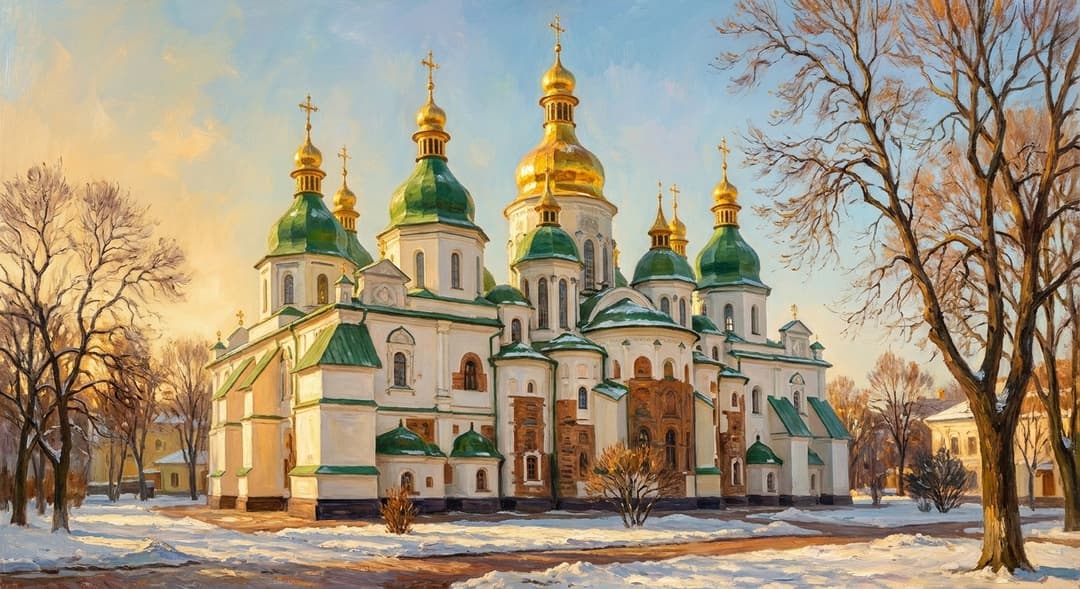
Visiting Saint Sophia offers an encounter with intact 11th-century sacred art beneath towering Baroque cupolas. The peaceful museum grounds house historic monastic buildings, manicured orchards, and panoramic city vistas from the bell tower.
Highlights
- Marvel at the monumental six-meter mosaic of the Virgin Orans in the central apse.
- Climb the 76-meter Baroque bell tower for sweeping views over Sofiyska Square.
- Examine secular medieval frescoes depicting Constantinople acrobats and royal hunts.
- Inspect over 7,000 ancient graffiti inscriptions scratched by medieval pilgrims.
Things to Know
- Flash photography and tripods are strictly prohibited inside the cathedral interior.
- Grounds close 45 minutes after the ticket office closes each evening.
- Expect security screenings and air raid protocol adjustments at the site.
- Staircase access inside the historic bell tower is steep and requires sturdy footwear.
Location
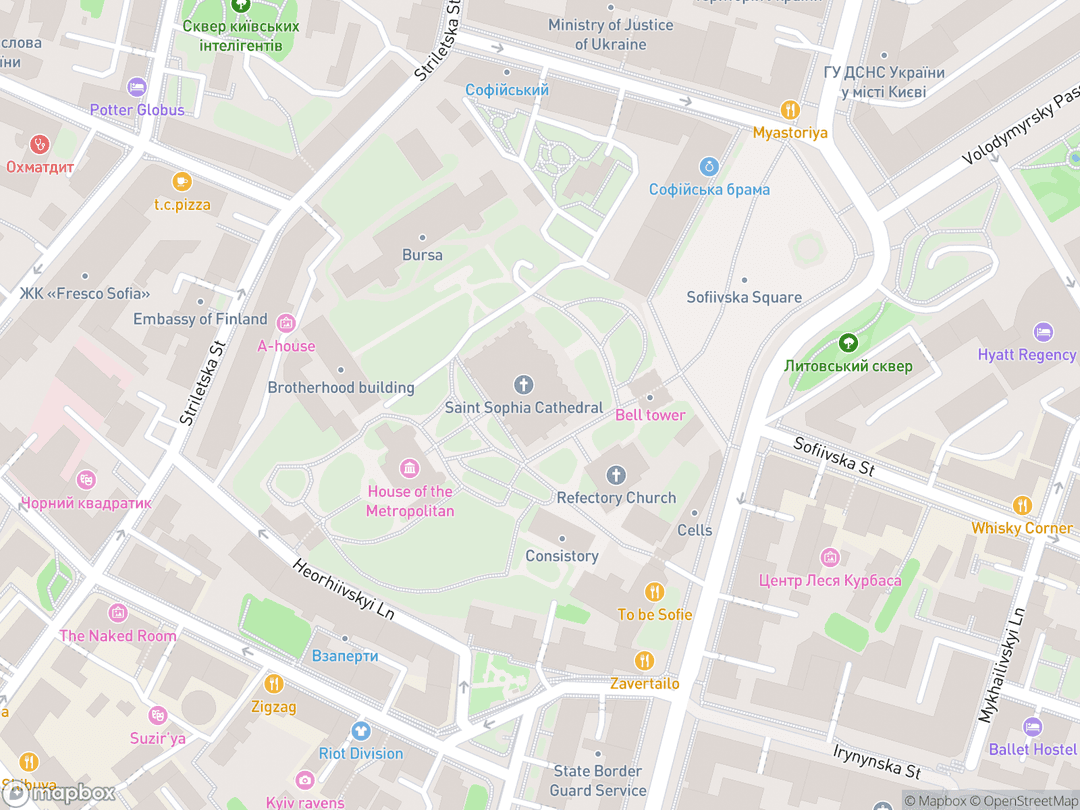
24 Volodymyrska Street, Shevchenkivskyi District, Kyiv, 01001, Ukraine
Hours: Daily 10:00 AM – 6:00 PM; ticket desk closes at 5:15 PM
Getting There: Take Kyiv Metro to Zoloti Vorota or Maidan Nezalezhnosti, then walk seven minutes along Volodymyrska Street.
Get DirectionsTips for Your Visit
Optimal Lighting
Visit in the late morning when southern light illuminates the gold mosaic tesserae of the main dome.
Audio Guide
Rent the official sanctuary audio guide to decode complex theological themes across the nave frescoes.
Grounds Ticket
Purchase the full complex pass to access the refectory, Metropolitan chambers, and bell tower tiers.
About
Saint Sophia Cathedral stands as the architectural and spiritual heart of Kyiv, founded in the early 11th century during the golden age of Kyivan Rus'. Conceived by Grand Prince Vladimir the Great and brought to completion by Yaroslav the Wise, the cathedral was designed to rival the imperial majesty of Constantinople.
Originally configured as a Byzantine cross-in-square church with thirteen symbolic domes, the sanctuary underwent an extensive Ukrainian Baroque reconstruction in the late 17th and 18th centuries under Cossack Hetman Ivan Mazepa. This synthesis created a distinct aesthetic blending ancient medieval brickwork with Baroque stucco.
Today, preserved as a national historic sanctuary and recognized as a UNESCO World Heritage site, Saint Sophia shelters the world's most extensive surviving ensemble of 11th-century mosaics and frescoes. It remains a living monument to Ukrainian statehood, cultural resilience, and Christian heritage.
Gallery
Symbolic Elements
The temple's exterior features intricate carvings, each rich with spiritual meaning:
Virgin Orans (Indestructible Wall)
The colossal six-meter apse mosaic symbolizes divine protection over the city of Kyiv.

Thirteen Cupolas
The original tiered domes represent Jesus Christ encircled by His Twelve Apostles.
Christ Pantocrator
The supreme dome mosaic depicts Christ the Ruler of All sustaining cosmic order.

Communion of the Apostles
The double-sided liturgical apse fresco represents the eternal sacrifice of the Holy Eucharist.

Carved Ovruch Slate Parapets
Ornamental red stone railings represent the harmony of Eden within the terrestrial church.

Vernacular Pilgrim Graffiti
Thousands of medieval inscriptions bear witness to the living prayers of ordinary Christians.

Imperial Staircase Murals
Secular court frescoes along private royal towers sanctify civic governance beneath divine authority.
Interesting Facts
The cathedral is dedicated directly to Divine Wisdom (Christ as Logos) rather than a historical saint named Sophia (Tier A).
The Virgin Orans mosaic in the central apse has remained entirely intact through centuries of foreign sackings (Tier B).
Among 7,000 ancient graffiti is an inscription attributed to Anna Yaroslavna, later Queen of France (Tier B).
The six-ton Roman marble sarcophagus of Yaroslav the Wise was found empty when opened for research in 2009 (Tier A).
Ukrainian scholars halted Stalinist demolition plans in the 1930s, preserving the cathedral as a museum reserve (Tier B).
Frescoes in the spiral stair towers depict secular Byzantine circus life and Constantinople chariot races (Tier A).
Byzantine mosaicists employed over 177 distinct color nuances of smalt glass, including 25 hues of gold (Tier B).
Renowned Symbolist painter Mikhail Vrubel restored three missing archangels in the central dome using oil in 1884 (Tier B).
Common Questions
Is Saint Sophia Cathedral dedicated to an early Christian martyr?
No, the cathedral is dedicated to Holy Wisdom (Hagia Sophia), representing Christ Himself as the Divine Word.
Are regular Sunday services held inside the cathedral?
Regular services are omitted to prevent candle soot damage, though special state ecumenical prayers occur.
Why does the exterior look Baroque while the interior is Byzantine?
Hetman Ivan Mazepa commissioned an 18th-century Ukrainian Baroque exterior shell over the medieval 11th-century masonry.
What is the significance of the Virgin Orans mosaic?
Known as the 'Indestructible Wall', tradition holds Kyiv will endure as long as the Orans keeps her hands raised.
Featured Stories
The Miracle of the Indestructible Wall
1240
When the Mongol army breached Kyiv's defensive gates in 1240, devastating the surrounding wooden city, citizens fled into the cathedral vaults for sanctuary. While surrounding porticos collapsed, the towering six-meter mosaic of the Virgin Orans remained unmarred amidst the ashes. For a millennium, Ukrainians have revered this enduring image as a sacred promise that Kyiv will never fall into ultimate oblivion.
Source: National Sanctuary Sophia of Kyiv
The Scholar Who Defied the Demolition Order
1934
In the early 1930s, Soviet officials drew blueprints to level Saint Sophia Cathedral to construct a gargantuan Communist parade plaza. Archeologist Mykola Makarenko courageously refused to sign the demolition clearance, mobilizing international art historians and French diplomats to intercede. Though Makarenko was subsequently arrested and executed for his defiance, his unyielding stand spared the ancient cathedral from destruction.
Source: UNESCO World Heritage Centre
The Queen of France's Childhood Inscription
1045
Centuries before modern archeology emerged, young princess Anna Yaroslavna climbed the private northern stair tower to attend liturgy on the royal mezzanine. Modern epigraphers discovered faint graffiti scratched into the plaster bearing her signature, carved just years before she journeyed across Europe to marry King Henry I of France. This preserved childhood script links the Kyivan court directly to the dynasties of medieval Europe.
Source: Institute of Ukrainian Archeology
Timeline
Foundation of the Cathedral
Grand Prince Vladimir the Great initiates construction to establish a primary cathedral for Kyivan Rus'.
component.timeline.groundbreakingAltar Consecration
The primary high altar is consecrated according to contemporary chronicle records.
DedicationYaroslav Completion Campaign
Grand Prince Yaroslav the Wise finishes the central vaulting and commissions imperial Byzantine mosaics.
MilestoneEntombment of Yaroslav
Yaroslav the Wise is entombed within an ornate Proconnesian white marble sarcophagus in the cathedral.
MilestoneSack of Kyiv
Prince Andrey Bogolyubsky storms the city and plunders liturgical treasures from the sanctuary.
EventMongol Invasion
Batu Khan captures Kyiv and destroys outer timber roofs, though core masonry and mosaics survive intact.
EventRestoration by Petro Mohyla
Metropolitan Petro Mohyla reclaims the complex and hires Italian architect Octaviano Mancini to stabilize vaults.
RenovationCossack Baroque Reconstruction
Hetman Ivan Mazepa finances the exterior redesign, encasing the walls in Baroque stucco and pear cupolas.
RenovationBell Tower Completion
Architect Johann Gottfried Schädel completes the soaring 76-meter bell tower and ornate Zaborovsky Gate.
MilestoneEstablishment of State Sanctuary
Ukrainian scholars successfully halt planned Soviet demolition, establishing a secular museum reserve.
MilestoneUNESCO World Heritage Inscription
Saint Sophia is inscribed on the UNESCO World Heritage List as Ukraine's inaugural cultural site.
MilestoneHistorical Unification Council
Ukrainian Orthodox hierarchs assemble inside the cathedral to establish the autocephalous Orthodox Church of Ukraine.
EventHistory by Decade
1010s–1030s — Princely Foundation
Grand Prince Vladimir the Great initiated construction of a monumental stone metropolitan cathedral following the Christianization of Rus'. Grand Prince Yaroslav the Wise expanded the structural footprint into a five-aisled basilica, importing master mosaicists from Constantinople to decorate the cupolas.
1240s–1250s — The Mongol Devastation
Batu Khan's forces captured Kyiv in 1240, heavily damaging the cathedral's outer galleries, lead roof, and secondary chapels. Despite widespread devastation across the Dnieper valley, the inner nave, high vaults, and central apse mosaics endured intact through the dark age of conquest.
1630s–1640s — Petro Mohyla's Renaissance
Metropolitan Petro Mohyla reclaimed the decaying cathedral from decades of neglect in 1633. He hired Italian architect Octaviano Mancini to stabilize cracking medieval vaults, install stone buttresses, and establish an adjacent monastic seminary complex.
1690s–1740s — Cossack Baroque Splendor
Cossack Hetman Ivan Mazepa funded a transformative exterior rebuilding campaign, converting medieval brick facades into ornate Ukrainian Baroque plaster compositions. Architect Johann Gottfried Schädel subsequently erected the monumental multi-tiered bell tower and sculptured Zaborovsky Gate.
1930s–1940s — Preservation Through Peril
Soviet antireligious campaigns planned the dynamite demolition of the cathedral complex in 1934. Ukrainian intellectuals mounted an international preservation campaign that persuaded authorities to convert the sanctuary into a state architectural museum reserve, saving it from Soviet destruction and wartime looting.
1990s–2020s — National Rebirth and Global Safeguarding
Following Ukrainian independence in 1991, Saint Sophia became the supreme cultural symbol of national heritage, hosting the historic 2018 Unification Council. In 2023, UNESCO inscribed the cathedral complex on the List of World Heritage in Danger to mobilize international emergency preservation resources during wartime.
Architecture & Facilities
Saint Sophia represents an extraordinary synthesis of 11th-century Middle Byzantine cross-in-square spatial design and 18th-century Ukrainian Cossack Baroque decorative remodeling. Its interior retains an original five-aisled Byzantine floor plan with tiered galleries and soaring central pendentives, while the exterior displays white-rendered facades with ornate volutes, pediments, and gilded pear-shaped cupolas.
Building Materials
Opus Mixtum Masonry
Alternating courses of natural quartzite stones and thin Roman-style clay plinthite bricks form the structural walls.
Hydraulic Pink Mortar
Thick lime mortar blended with pulverized red brick dust provides moisture resilience and structural elasticity.
Ovruch Pink Slate
Local pyrophyllite shale was carved into delicate parapet screens and choir balustrades along the royal mezzanine.
Imported Smalt Glass
Opaque glass cubes colored with mineral oxides and gold leaf create shimmering, light-refracting mosaic surfaces.
Interior Features
Central Crossing & Cupola
The 29.5-meter central dome frames the colossal mosaic bust of Christ Pantocrator encircled by archangels.
Main Apse Sanctuary
The six-meter Virgin Orans towers above the Communion of the Apostles mosaic in the high liturgical altar.
Royal Mezzanine Gallery
Elevated second-tier choir galleries once hosted the grand prince and royal court during liturgical celebrations.
Spiral Stair Towers
Twin cylindrical stairwells display rare secular medieval frescoes depicting Constantinople chariot races and musicians.
Temple Grounds
The walled sanctuary grounds encompass tranquil orchards, the Metropolitan's baroque palace, an 18th-century refectory, and the majestic 76-meter bell tower guarding Sofiyska Square.
Additional Facilities
The sanctuary complex includes historical museum exhibition halls, an epigraphic study center, scientific restoration workshops, and visitor reception amenities.
Religious Significance
Saint Sophia was consecrated as the spiritual mother church of Eastern Slavic Christianity, translating Byzantine cosmological theology into the architectural heart of Kyivan Rus'.
To serve as an earthly reflection of the heavenly cosmos and the metropolitan seat for the Christianization and divine ordering of the realm.
Sacred Ordinances
Divine Liturgy
The historic Eucharistic celebration linking heaven and earth beneath the gaze of Christ Pantocrator.
Holy Baptism
The foundational initiation sacrament administered to medieval converts and princely dynastic heirs.
Ecumenical State Prayer
Contemporary ceremonial prayers uniting diverse Christian traditions during moments of solemn national significance.
The Theology of Holy Wisdom
Saint Sophia is dedicated not to an earthly martyr, but to Hagia Sophia—the Divine Wisdom of God manifested in the Incarnate Christ.
Microcosm of the Cosmos
The cathedral's vertical architectural axis mirrors Byzantine cosmology, rising from terrestrial choir galleries to the heavenly vault of the Pantocrator.
Sources & Research
Every fact on Temples.org is backed by verified Sources & Research. Each piece of information is rated by source tier and confidence level.
View All Sources (6)
| Field | Source | Tier | Retrieved |
|---|---|---|---|
| About & Historical Background | National Sanctuary Complex Sophia of Kyiv (opens in a new tab) | A | 2026-02-18 |
| Architectural & UNESCO Heritage | UNESCO World Heritage Centre (opens in a new tab) | B | 2026-02-18 |
| Archaeological Chronology & Epigraphy | National Sanctuary Complex Sophia of Kyiv (opens in a new tab) | A | 2026-02-18 |
| Visitor Insights & Sanctuary Guidelines | National Sanctuary Complex Sophia of Kyiv (opens in a new tab) | A | 2026-02-18 |
| Timeline & Restoration Campaigns | UNESCO World Heritage Centre (opens in a new tab) | B | 2026-02-18 |
| Monumental Mosaics & Frescoes | National Sanctuary Complex Sophia of Kyiv (opens in a new tab) | A | 2026-02-18 |