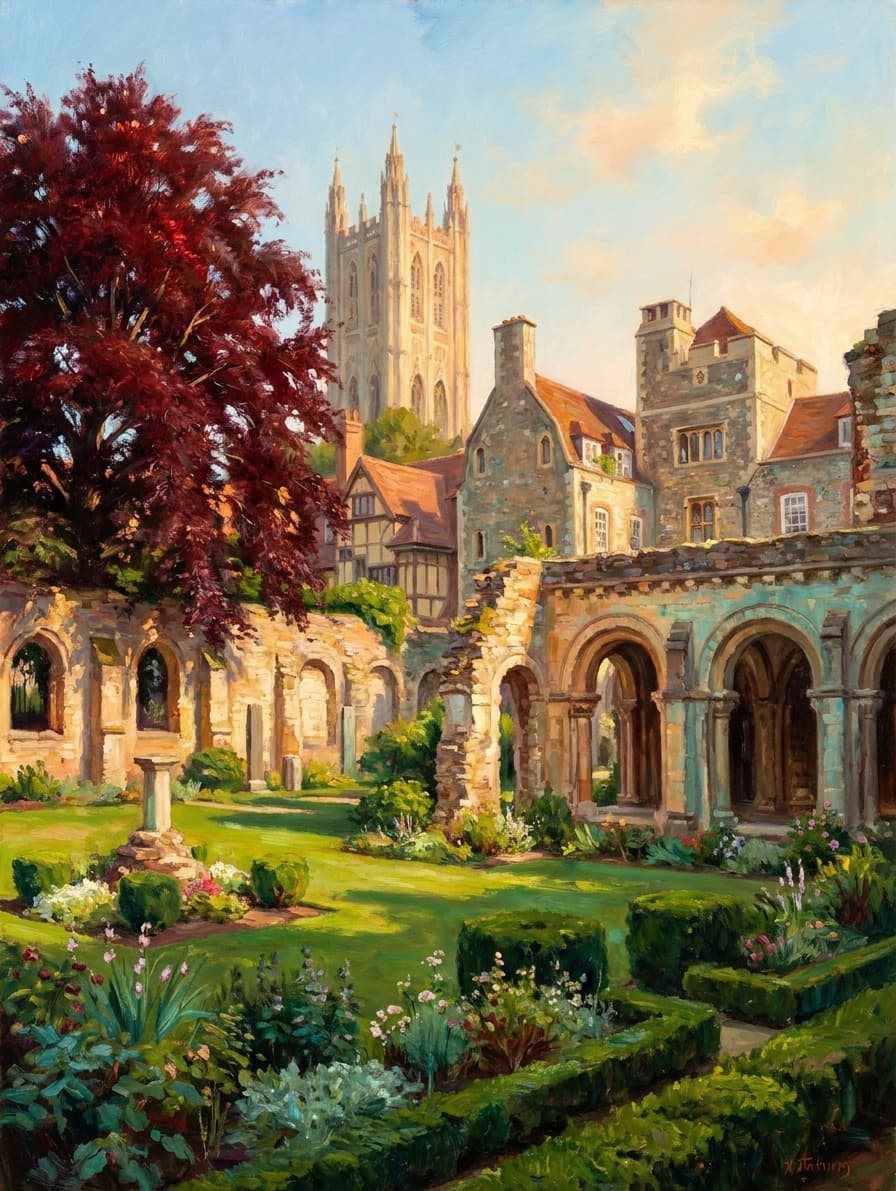
Visitor Insights
Visiting Canterbury Cathedral
Canterbury Cathedral offers a transcendent encounter with sacred art, historic architecture, and living Anglican choral worship. Sightseeing tickets convert automatically into a 365-day pass permitting unlimited return visits throughout the year. Visitors are warmly encouraged to plan their itineraries around Choral Evensong to hear the renowned cathedral choir within the medieval quire.
Highlights
- The Martyrdom transept marking the site of Thomas Becket's sacrifice in 1170
- The Romanesque Western Crypt with intricately carved 12th-century capitals
- The soaring Perpendicular Gothic nave designed by master mason Henry Yevele
- The Great Cloister showcasing 825 polychrome medieval heraldic stone bosses
- The 12th-century Ancestors of Christ stained glass in the Great South Window
Things to Know
- Entry is always free for private personal prayer and public worship services
- University graduations and diocesan synods can periodically restrict access to the nave
- The historic stone pavements can be uneven throughout the chapels and ambulatory
- Photography is welcomed during visiting hours but strictly prohibited during divine services
Location
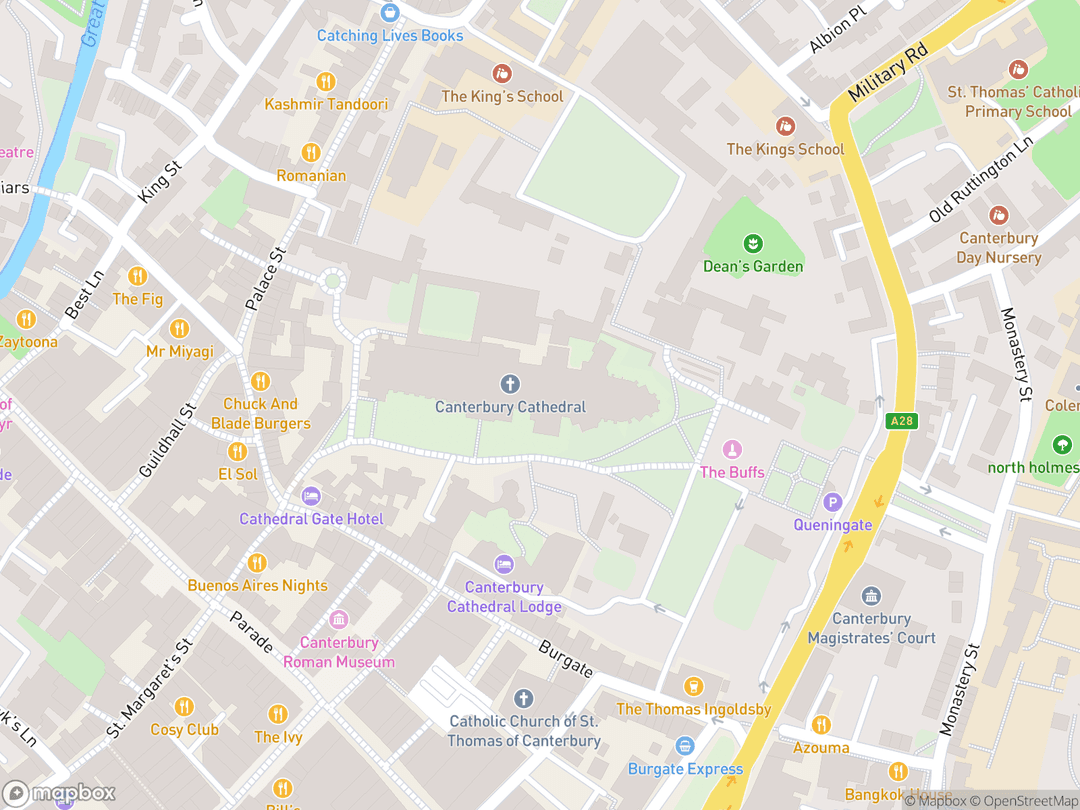
Cathedral House, 11 The Precincts, Canterbury, Kent, CT1 2EH, United Kingdom
Hours: Monday–Saturday: 10:00–17:00 (Last entry 16:00); Sunday: 12:30–17:00
Getting There: Located a 10-minute flat walk from both Canterbury West and Canterbury East rail stations with fast high-speed trains departing London St Pancras.
Get DirectionsTips for Your Visit
Attend Choral Evensong
Experience the cathedral choir singing evening liturgy at 17:30 on weekdays or 15:15 on weekends.
Morning Lighting
Visit the choir and Trinity Chapel between 10:00 and 11:30 for brilliant light through the medieval glass.
Book Cloister Passages
Walk through the Great Cloister into the Chapter House to view its 1405 Irish oak barrel ceiling.
Use Park and Ride
Canterbury city center is heavily pedestrianized; park at Wincheap or New Dover Road shuttles.
About
Canterbury Cathedral stands as the spiritual heart of England and the Mother Church of the global Anglican Communion. Founded in 597 AD by Saint Augustine of Canterbury under the commission of Pope Gregory the Great, this sacred sanctuary has anchored Christian worship, monastic devotion, and episcopal ministry across fifteen continuous centuries.
The cathedral gained international prominence as one of Western Christendom's greatest pilgrimage destinations following the 1170 martyrdom of Archbishop Thomas Becket. Pilgrims from across medieval Europe journeyed along ancient tracks to seek healing and spiritual renewal at Becket's golden shrine within the Trinity Chapel, an enduring tradition immortalized in Geoffrey Chaucer's Canterbury Tales.
Architecturally, the complex illustrates the progression from massive Anglo-Norman Romanesque masonry to early French-inspired Gothic and monumental Perpendicular vaulting. Today, Canterbury Cathedral continues as an active house of prayer, welcoming millions of worshippers, pilgrims, and global travelers to experience its living sacred choral and sacramental legacy.
Gallery
Symbolic Elements
The temple's exterior features intricate carvings, each rich with spiritual meaning:

Altar of the Sword's Point
Stylized hanging swords and a red cross mark the spot in the Northwest Transept where Becket died for spiritual integrity.

The Solitary Candle
A continuous flame burns upon the bare pavement where Becket's shrine stood, symbolizing resurrection and enduring faith.

The Chair of Saint Augustine
Carved from Petworth marble, this ancient cathedra embodies apostolic succession and global Anglican communion.

Miracle Windows
Thirteenth-century stained-glass medallions portray Becket's posthumous healings of peasants, lepers, and knights.

Ancestors of Christ Windows
Twelfth-century clerestory glass depicts Christ's biblical lineage according to the genealogy recorded in Saint Luke.

Compass Rose Pavement
A brass and marble inlay set into the nave floor represents the global reach of the Anglican Communion.

Black Prince Battle Achievements
Replicas of Edward the Black Prince's surcoat, helm, shield, and gauntlets reflect Christian chivalry and earthly mortality.

Bell Harry Fan Vaulting
Gilded Tudor roses and prioral heraldry within the high crossing vault express providential order and national reconciliation.
Interesting Facts
During the 1942 Blitz, volunteer fire watchers heroically kicked incendiary bombs off the wooden roof leads to save the medieval fabric. (Tier A)
Archaeological spectroscopy revealed the panel of Methuselah in the South Window is among the oldest intact stained glass in Britain. (Tier A)
The overwhelming influx of medieval pilgrims visiting Becket's tomb funded the cathedral's Early English Gothic reconstruction. (Tier B)
Master Mason William of Sens fell fifty feet from choir scaffolding in 1179 and directed building works from his sickbed. (Tier B)
King Henry IV is the only English monarch buried inside Canterbury Cathedral, placed directly facing Becket's former shrine. (Tier A)
The cathedral operations require over £20,000 per day to maintain and receive no ongoing direct funding from the Crown or State. (Tier A)
The Black Prince's original 14th-century tournament armor and heraldic achievements survived the English Civil War completely intact. (Tier B)
The cathedral precinct maintains its own private historic constabulary sworn to preserve peace across the historic close. (Tier A)
Common Questions
Is Canterbury Cathedral an active church or a historical museum?
It is an active cathedral offering multiple daily Eucharistic and choral services to all people.
Why is Thomas Becket's martyrdom central to the cathedral's history?
His 1170 assassination transformed Canterbury into one of Europe's greatest medieval pilgrimage shrines.
Do visitors need to pay an admission fee to worship?
Admission is always completely free for worship services, prayer, and quiet spiritual reflection.
Where is Thomas Becket's golden shrine located today?
The shrine was destroyed in 1538, and its historic site is marked by a perpetual solitary candle.
Why is Canterbury Cathedral called the Mother Church of Anglicans?
It contains the historic Cathedra of Saint Augustine, the spiritual seat of the Archbishop of Canterbury.
Featured Stories
The Martyrdom That Reshaped Western Christendom
December 29, 1170
On a cold winter twilight, four Anglo-Norman knights entered the northwest transept and confronted Archbishop Thomas Becket over royal encroachment on church autonomy. Becket refused to yield his pastoral duty or flee, commending his spirit to God before being struck down upon the stone pavement. His immediate martyrdom shocked medieval Europe, turning Canterbury into an epicenter of pilgrimage and sparking architectural renewal that defined English Gothic design.
Source: Canterbury Cathedral Archives
The Architect's Fall and Unfinished Masterpiece
1179
Master Mason William of Sens introduced revolutionary French pointed arches and rib vaults while rebuilding the choir after the great fire of 1174. As vaulting stones were hoisted across the high clerestory in 1179, scaffolding collapsed and pitched him fifty feet down to the stone floor. Though crippled by the fall, Sens valiantly oversaw the work from his bed until relinquishing direction to William the Englishman.
Source: Chronicles of Gervase of Canterbury
The Midnight Defense of the Cathedral Leads
June 1, 1942
During the devastating Baedeker Blitz raids of World War II, dozens of German incendiary bombs rained across the cathedral precinct and lodged into the roof. A courageous band of volunteer fire watchers mounted the catwalks, physically kicking live burning incendiaries off the lead sheeting and down into the lawns below. Their daring vigilance preserved the medieval timber roofs and stained glass from total destruction while surrounding buildings burnt.
Source: Friends of Canterbury Cathedral War Annals
Timeline
Augustinian Mission and Founding
Saint Augustine arrives from Rome and establishes the Cathedral of Christ the Savior on Roman foundations.
MilestoneNorman Romanesque Cathedral Consecration
Archbishop Lanfranc completes the comprehensive Norman rebuilding modeled upon Saint-Etienne in Caen.
DedicationDedication of Conrad's Glorious Choir
Prior Conrad dedicates the magnificent extended Romanesque eastern arm before King Henry I.
MilestoneMartyrdom of Thomas Becket
Four royal knights assassinate Archbishop Thomas Becket in the Northwest Transept.
EventChoir Fire and Gothic Renewal
A catastrophic fire destroys Conrad's Choir, prompting the introduction of early French Gothic design.
RenovationTranslation of Becket's Relics
Becket's remains are transferred from the crypt to a lavish gold shrine in the Trinity Chapel.
MilestoneBurial of the Black Prince
Edward of Woodstock is entombed in the Trinity Chapel beneath his heraldic achievements.
EventCompletion of the Perpendicular Nave
Master Mason Henry Yevele completes the soaring Perpendicular Gothic nave and aisles.
MilestoneRaising of Bell Harry Tower
Master Mason John Wastell finishes the 236-foot crossing tower and its intricate fan vaulting.
MilestoneDestruction of Becket's Shrine
Royal commissioners under King Henry VIII dismantle the shrine and confiscate its jewels and gold.
EventHeroic Blitz Defense
Volunteer Cathedral Fire Watchers shovel incendiary bombs off the roof leads during German air raids.
EventUNESCO World Heritage Inscription
Canterbury Cathedral is inscribed as a World Heritage Site alongside St Martin's and St Augustine's Abbey.
MilestoneHistory by Decade
590s–750s — Anglo-Saxon Basilica Foundations
Saint Augustine arrived in Kent in 597 and consecrated an existing Roman church as Christ Church Cathedral. Archbishop Cuthbert subsequently erected an adjacent eastern baptistery and burial chapel dedicated to Saint John the Baptist. This Saxon basilica remained the spiritual epicenter of Anglo-Saxon England for four centuries.
980s–1070s — Viking Raids and the Norman Conquest
Danish raiders besieged Canterbury in 1011, burning the sanctuary and martyring Archbishop Aelfheah. A catastrophic fire in 1067 gutted the surviving Saxon structure shortly after the Norman Conquest. In 1070, Archbishop Lanfranc cleared the ruins to erect a grand Romanesque cathedral modeled on Saint-Etienne in Caen.
1090s–1170s — Conrad's Choir and Becket's Martyrdom
Prior Ernulf and Prior Conrad doubled the size of the eastern arm, creating Conrad's Glorious Choir over a massive new crypt. On December 29, 1170, Archbishop Thomas Becket was assassinated in the transept by knights of King Henry II. Becket's canonization triggered unprecedented waves of pilgrims from across Western Europe.
1170s–1220s — Gothic Rebirth and the Golden Reliquary
Following the 1174 choir fire, William of Sens and William the Englishman erected the first Early English Gothic choir, Trinity Chapel, and Corona. In 1220, young King Henry III attended the translation of Becket's remains into a jewel-studded golden shrine. Pilgrim offerings transformed Canterbury into one of Europe's wealthiest ecclesiastical foundations.
1370s–1410s — Yevele's Perpendicular Nave and Royal Tombs
Master Mason Henry Yevele replaced the decaying Norman nave with an ethereal Perpendicular Gothic masterpiece featuring slender clustered piers and lierne vaults. Edward the Black Prince was buried in the Trinity Chapel in 1376, followed by King Henry IV in 1413. During this golden age, Geoffrey Chaucer composed his celebrated Canterbury Tales.
1490s–1540s — Bell Harry Tower and the Henrician Dissolution
Master Mason John Wastell completed the 236-foot Bell Harry crossing tower in 1504, crowning the interior with breathtaking heraldic fan vaulting. In 1538, King Henry VIII ordered the complete demolition of Becket's shrine and confiscated cartloads of gold and gemstones. Monastic life ceased in 1539 as Christ Church Priory surrendered to become a secular dean and chapter.
1640s–1840s — Puritan Iconoclasm and Victorian Symmetry
Puritan forces ransacked the cathedral in 1642, shattering medieval stained-glass windows and destroying historic statues. Restoration under Charles II in 1660 repaired the woodwork and installed exquisite Grinling Gibbons choir stalls. In 1832, architect George Austin took down the surviving Norman northwest tower to build a matching Perpendicular Gothic twin.
1940s–2020s — Blitz Survival, World Heritage, and Renewal
Cathedral fire watchers saved the sanctuary from incendiary bombs during the Canterbury Blitz of June 1942. Pope John Paul II and Archbishop Robert Runcie prayed together here in 1982, signaling historic Anglican-Catholic reconciliation. Between 2014 and 2022, the comprehensive Canterbury Journey project restored the lead roofs and opened a state-of-the-art Welcome Centre.
Architecture & Facilities
Canterbury Cathedral illustrates the stylistic evolution of English medieval ecclesiastical architecture over four centuries. It unites massive Anglo-Norman Romanesque load-bearing crypt construction, early French Gothic pointed arches and sexpartite vaulting, and luminous late-medieval Perpendicular Gothic verticality.
Building Materials
Caen Stone
Fine-grained, pale cream limestone quarried in Normandy and shipped across the English Channel for exterior and interior ashlar.
Purbeck Marble
Dense fossiliferous limestone quarried from Dorset and polished to a dark luster for colonnettes and floor pavements.
Kentish Ragstone
Hard sandy limestone extracted from Maidstone in Kent used extensively for subterranean foundations and structural rubble cores.
Cast Lead Sheeting
Over three thousand cast-lead tiles protecting the vast timber roof frameworks of the nave, choir, and transepts.
Interior Features
The Great Nave
Henry Yevele's 14th-century Perpendicular Gothic hall rising eighty feet to intricate lierne vaults framed by continuous clerestory windows.
The Quire and Presbytery
England's first major Gothic choir designed by William of Sens with pointed arches, sexpartite vaults, and tiered stone staircases.
The Trinity Chapel and Corona
The elevated eastern reliquary apse designed by William the Englishman to enshrine Saint Thomas Becket's sacred remains.
The Western Crypt
The largest surviving Norman Romanesque crypt in England with intact groin vaulting and relief-carved animal capitals.
Temple Grounds
The cathedral precinct spans extensive walled grounds featuring the historic Christ Church Gateway, the Deanery gardens, the ruins of the medieval monastic infirmary, and landscaped cloister garths that insulate the sacred sanctuary from modern commercial Canterbury.
Additional Facilities
The precinct includes the state-of-the-art Cathedral Welcome Centre with exhibition galleries, retail spaces, educational workshops, and the Canterbury Cathedral Lodge hotel and conference facilities.
Religious Significance
Canterbury Cathedral holds a singular spiritual standing as the apostolic mother church of the Anglican Communion and the historic metropolitical seat of the Archbishop of Canterbury. Built upon Roman foundations, it represents unbroken Christian witness across fifteen centuries.
To serve as a living house of prayer, a sanctuary of reconciliation, and a focal point of unity for global Anglicanism.
Sacred Ordinances
The Holy Eucharist
Daily celebration of Christ's sacrifice through the bread and wine of Holy Communion offered for the life of the world.
Choral Evensong
The daily sung evening prayer tradition featuring psalms, canticles, and anthems rendered by the Canterbury Cathedral Choir.
Pilgrimage and Intercession
Continuous prayer offered at the sites of historic martyrdom for global peace, Christian unity, and personal healing.
Episcopal Consecration and Enthronement
The liturgical investiture of archbishops and bishops seated upon the ancient Chair of Saint Augustine.
The Anglican Via Media
Canterbury embodies the Anglican Middle Way, maintaining Catholic historic episcopacy and sacramental life alongside Reformed scriptural primacy.
Ecumenical Reconciliation
The cathedral remains a center for global dialogue, exemplified by the historic joint prayer of Pope John Paul II and Archbishop Robert Runcie in 1982.
Sources & Research
Every fact on Temples.org is backed by verified Sources & Research. Each piece of information is rated by source tier and confidence level.
View All Sources (8)
| Field | Source | Tier | Retrieved |
|---|---|---|---|
| About & Foundation History | Canterbury Cathedral Chapter (opens in a new tab) | A | 2026-03-31 |
| Liturgical Life & Sacraments | The Church of England (opens in a new tab) | A | 2026-03-31 |
| Historic Shrine & Tombs | Medievalists.net (opens in a new tab) | B | 2026-03-31 |
| Gothic Masonry & Engineering | Encyclopedia.com (opens in a new tab) | B | 2026-03-31 |
| Cloister Heraldry & Sculpture | Bluffton University Digital Archives (opens in a new tab) | B | 2026-03-31 |
| Pilgrimage Traditions & Heritage | Sacred Destinations (opens in a new tab) | B | 2026-03-31 |
| Civic Context & Transport | Visit Canterbury (opens in a new tab) | C | 2026-03-31 |
| Visitor Facilities & Guided Tours | Viator (opens in a new tab) | D | 2026-03-31 |