Visitor Insights
Visiting Salisbury Cathedral
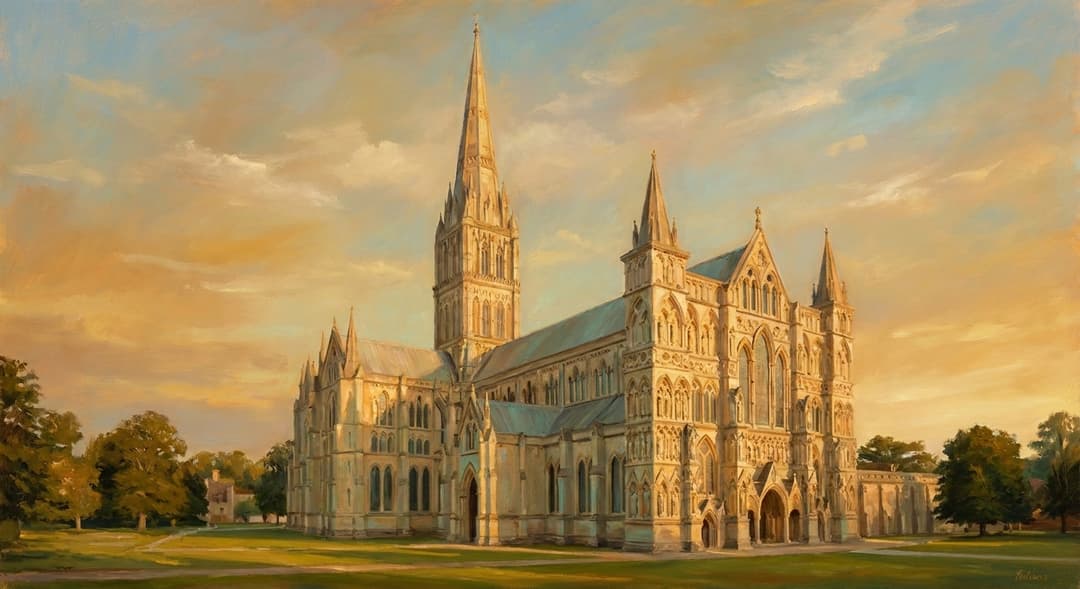
Salisbury Cathedral offers visitors an encounter with medieval engineering, soaring Gothic vistas, and active sacred worship. Visitors can wander through the vast cloister garth, inspect the original 1215 Magna Carta, and attend daily choral evensong.
Highlights
- Ascend the 332 steps of the crossing tower on a guided spire tour.
- View the best-preserved original exemplar of the 1215 Magna Carta in the Chapter House.
- Witness the 1386 mechanical clock, celebrated as the world's oldest working clock.
- Experience the meditative reflection of the 2008 William Pye living water font.
Things to Know
- Tower tours require advance booking and physical mobility to navigate steep spiral stairs.
- Access to certain chapels may be temporarily restricted during scheduled services and rehearsals.
- Photography is welcomed throughout the nave but prohibited during active divine worship.
Location
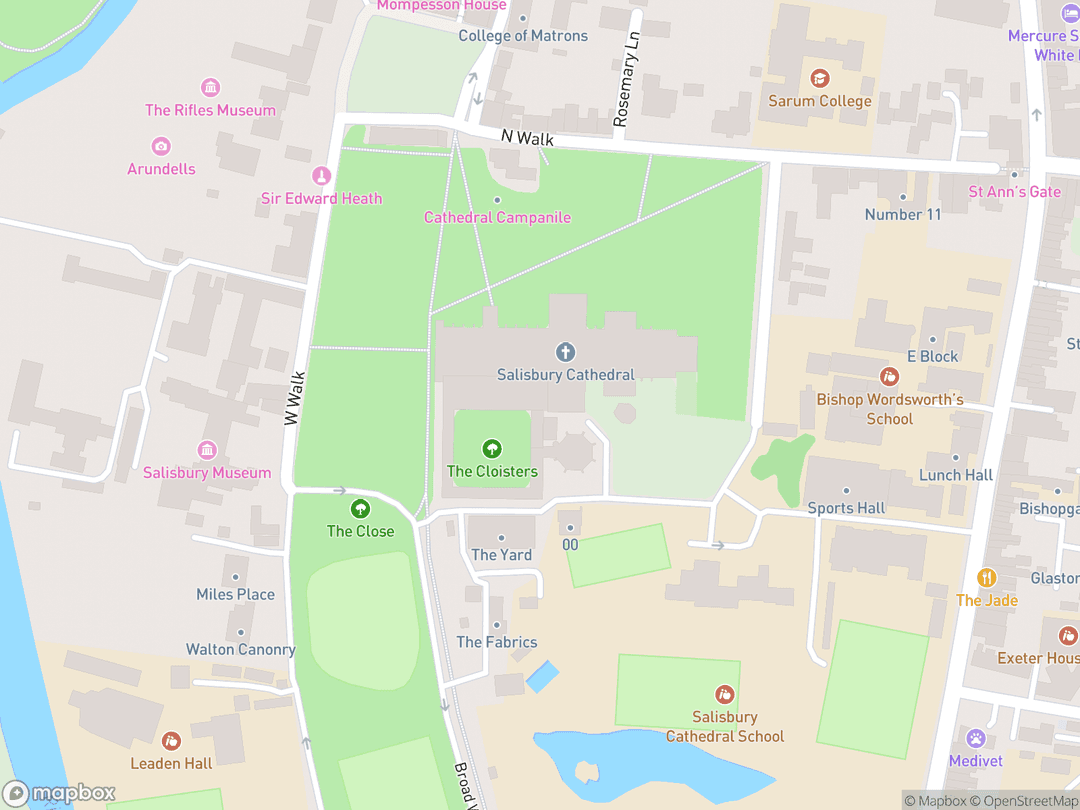
33 The Close, Salisbury, Wiltshire, SP1 2EJ, England, United Kingdom
Hours: Monday to Saturday from 09:30 to 17:00; Sunday from 12:30 to 16:00, with services beginning at 07:45.
Getting There: Direct South Western Railway trains connect London Waterloo to Salisbury Station in 90 minutes, followed by a 10-minute walk through the High Street Gate.
Get DirectionsTips for Your Visit
Choral Evensong
Attend evening prayer at 17:30 on weekdays to experience the cathedral choir's exceptional acoustic resonance.
Spire Tours
Book tower tours well ahead during summer to explore the medieval timber roof framework and high views.
Chapter House Morning Light
Visit the Chapter House before midday when sunlight illuminates the thirteenth-century stone frieze carvings.
Cathedral Close Walks
Allow extra time to explore the eighty-acre walled close, home to historic canonical houses and riverside paths.
About
Salisbury Cathedral, formally known as the Cathedral Church of the Blessed Virgin Mary, stands as the preeminent monument of Early English Gothic architecture. Conceived within the shared Abrahamic tradition of consecrated sanctuaries, the cathedral functions as an earthly reflection of divine holiness and sacred order.
Founded in 1220 following the relocation of the bishopric from the arid fortress of Old Sarum, the primary structure was raised in just thirty-eight years. This swift execution granted the cathedral an architectural and theological harmony rarely matched across medieval Christendom.
Dominated by its dramatic 404-foot spire added in the fourteenth century, the cathedral houses England's largest cloister and the world's best-preserved 1215 Magna Carta. Today, it remains an active mother church of the Anglican Communion, welcoming pilgrims into timeless prayer and liturgy.
Gallery
Symbolic Elements
The temple's exterior features intricate carvings, each rich with spiritual meaning:

Octagonal Spire
Rising 404 feet into the heavens, the eight-sided spire symbolizes resurrection and the eternal Eighth Day of Creation.

Purbeck Marble Contrast
Polished dark fossiliferous stone set against light Chilmark limestone embodies the interplay of earthly mortality and celestial light.

Cruciform Plan
The double-transept Latin cross plan mirrors the cross of Christ while providing dedicated procession paths for the Sarum liturgy.

William Pye Living Water Font
Mirror-smooth water overflowing a bronze cross symbolizes renewal and spiritual rebirth through the sacrament of baptism.

Chapter House Frieze
Sixty carved Old Testament reliefs wrap the chamber to ground human governance and justice in divine law.

Faceless 1386 Clock
The chiming iron gearwork sanctifies daily time and calls the faithful to continual prayer without dial or hands.
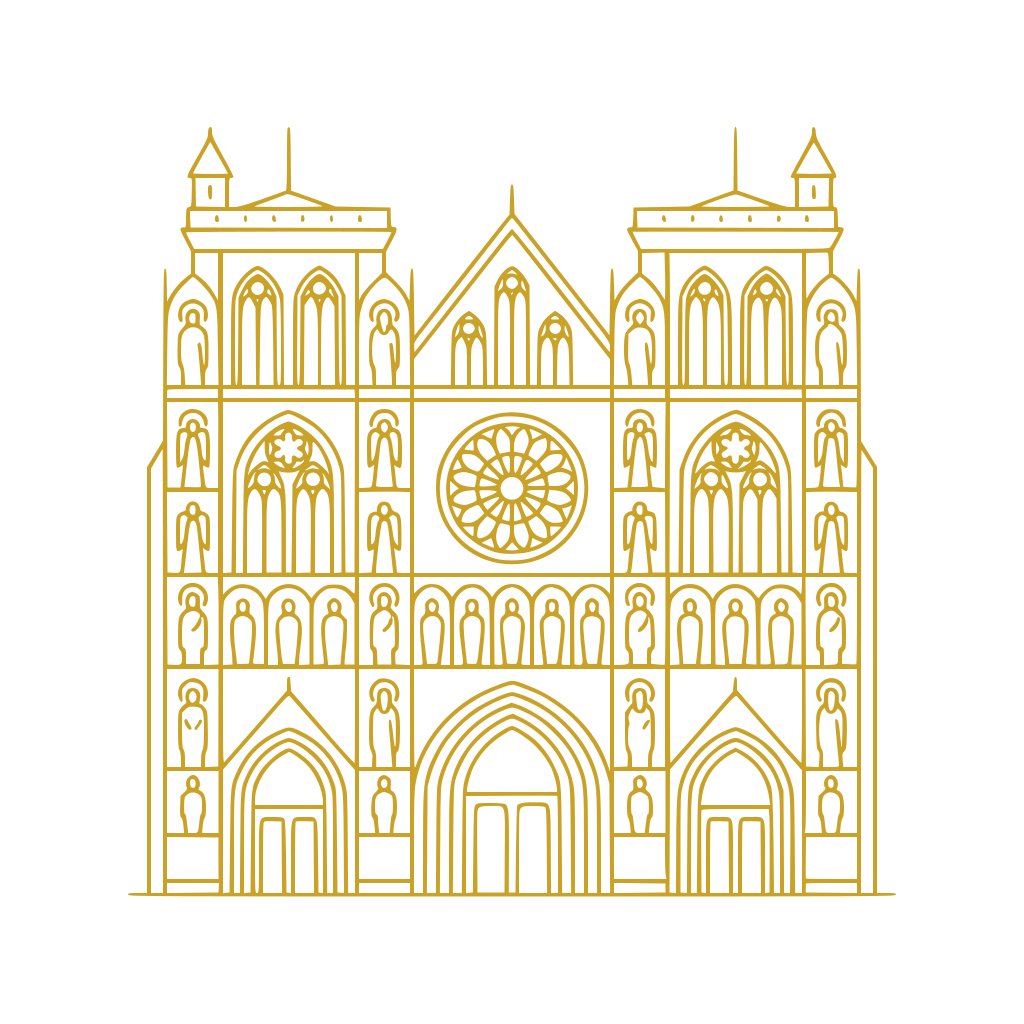
Screen-Style West Front
Over one hundred sculpted saints and angels present a physical vision of the Heavenly Jerusalem greeting pilgrims on earth.
Interesting Facts
At 123.1 meters (404 feet), Salisbury Cathedral boasts the tallest surviving church spire in the United Kingdom. (Tier A)
The cathedral houses the world's oldest working mechanical clock, hand-wrought from iron around 1386 without a face or hands. (Tier A)
The Chapter House displays the best-preserved of the four surviving original exemplars of the 1215 Magna Carta. (Tier A)
Unlike most medieval cathedrals built over centuries, Salisbury's main structure was completed in an astonishing 38 years. (Tier A)
The central crossing spire weighs roughly 6,400 tons and visibly bent the interior Purbeck stone support pillars. (Tier B)
Salisbury's Cathedral Close spans 80 acres, making it the largest enclosed cathedral precinct in the United Kingdom. (Tier A)
The 2008 William Pye bronze font holds 1,600 liters of continuously flowing, mirror-flat living water. (Tier B)
In 2021, the vast medieval nave was transformed into a mass COVID-19 vaccination hub accompanied by organ recitals. (Tier A)
The cathedral's dramatic spire construction inspired William Golding's celebrated 1964 allegorical novel The Spire. (Tier B)
Common Questions
Is Salisbury Cathedral open daily for visitors?
Yes, the cathedral is open daily for visitors and worship, with guided tours available throughout the year.
Where is the 1215 Magna Carta displayed?
The 1215 Magna Carta is displayed inside an interactive exhibition within the octagonal Chapter House.
Can visitors climb the cathedral spire?
Guided tower tours permit visitors to climb 332 steps into the wooden roof spaces and up to the base of the spire.
Is Salisbury Cathedral an active church?
It is the active mother church of the Anglican Diocese of Salisbury, offering daily communion and choral evensong.
Featured Stories
The Migration from Old Sarum
1219
Weary of water shortages and military harassment on the wind-swept heights of Old Sarum, Bishop Richard Poore petitioned Rome to relocate his see. After obtaining papal sanction from Pope Honorius III, the clergy processed down into the fertile water meadows of the River Avon. This bold relocation permitted the community to plan an unconstrained cathedral city and magnificent Gothic sanctuary from foundation to spire.
Source: Cathedral Chapter Historical Archives
The Daring Construction of the Spire
1320
A century after foundation, medieval master masons embarked on the perilous task of raising an immense stone tower and octagonal spire atop crossing piers never engineered for such weight. As 6,400 tons of Chilmark masonry were hauled into the sky, the central Purbeck columns visibly deflected inward under crushing pressure. Masonry squinches, internal timber scaffolds, and later iron tie-rods arrested catastrophe, bequeathing Britain its most iconic spire.
Source: Fabric Rolls of Salisbury Cathedral
Sanctuary and Healing in the Pandemic
2021
During the depths of the COVID-19 pandemic, the expansive medieval nave was transformed into a mass vaccination clinic serving thousands of Wiltshire citizens. Cathedral organists played classical works by Bach and Elgar throughout the clinics, providing solace to nervous attendees. This effort revived the ancient Christian vocation of cathedrals as hospitals and refuges for public physical and spiritual healing.
Source: Diocese of Salisbury Records
Timeline
Groundbreaking in the Meadow
Bishop Richard Poore lays the foundation stones in the water meadows following papal authorization to abandon Old Sarum.
component.timeline.groundbreakingConsecration of the Lady Chapel
The eastern Trinity Chapel is completed and consecrated to house the venerated relics of saintly bishops.
MilestoneDedication of the Cathedral
Archbishop Boniface of Savoy consecrates the completed nave and choir in the presence of King Henry III.
DedicationCloister Completion
Craftsmen complete Britain's largest cathedral cloister featuring fine geometric bar tracery openings.
MilestoneChapter House Vaulting
The vaulted octagonal Chapter House and its detailed Old Testament sculpted frieze are finished.
MilestoneErection of the Great Spire
Stonemasons complete the daring 404-foot tower and spire, making it the tallest church spire in Britain.
MilestoneInstallation of the Mechanical Clock
Craftsmen assemble the faceless iron clock mechanism to strike liturgical prayer hours for the cathedral Close.
MilestoneReformation Dismantling
Royal commissioners dismantle the shrine of Saint Osmund and whitewash medieval wall paintings during the English Reformation.
EventSir Christopher Wren's Survey
Architect Christopher Wren inspects the leaning spire and installs structural iron bracing to ensure its stability.
RenovationWyatt's Alterations
Architect James Wyatt demolishes the detached medieval campanile and reorganizes historical tombs into linear nave aisles.
RenovationScott's Victorian Restoration
Sir George Gilbert Scott restores the choir fittings and crossing arches to reverse centuries of structural decay.
RenovationDedication of the Living Water Font
The cathedral dedicates William Pye's cruciform bronze font to commemorate the 750th anniversary of its consecration.
MilestoneHistory by Decade
1210s — The Exodus from Old Sarum
Clergy at the hilltop fortress of Old Sarum faced military interference, gale-force winds, and severe water shortages. Bishop Richard Poore successfully petitioned Pope Honorius III for permission to transfer the episcopal see to the valley. The move cleared the way for a grand, unencumbered cathedral city planned around the River Avon.
1220s — Foundation in the Water Meadows
Foundation stones were consecrated on April 28, 1220, inaugurating a period of intense construction led by Elias of Dereham. By 1225, the eastern Trinity Chapel was completed and consecrated, allowing the translation of saintly episcopal remains. Noble benefactors like William Longespée provided essential funding to maintain construction momentum.
1250s — Consecration of the Early English Fabric
The ten-bay nave and the screen-type West Front reached completion with extraordinary rapidity. On September 29, 1258, Archbishop Boniface of Savoy consecrated the cathedral in the presence of King Henry III. This 38-year building campaign resulted in unprecedented stylistic unity throughout the entire main structure.
1310s — The Perilous Spire Addition
The cathedral chapter decided to crown the crossing tower with an ambitious two-storey tower and octagonal stone spire. Adding over 6,300 tons of masonry caused the central piers to buckle, requiring immediate structural stabilization. The resulting 404-foot landmark became the tallest church spire in the British Isles.
1530s — The English Reformation and the Sarum Rite
With the English Reformation, Salisbury transitioned into the Church of England, and the Latin Sarum Rite was replaced by the Book of Common Prayer. In 1538, royal injunctions led to the destruction of Saint Osmund's opulent shrine and the removal of religious images. Chantries were dissolved, shifting the cathedral's liturgical life toward reformed worship.
1660s — Restoration and Wren's Engineering Audit
Following royalist victories and the Restoration of the Monarchy, Bishop Seth Ward engaged Sir Christopher Wren to survey the leaning central tower. Wren identified that the spire leaned nearly thirty inches out of vertical alignment and devised iron reinforcement rods. His engineering interventions prevented the tower from collapsing under Atlantic wind loads.
1780s — Neo-Gothic Reorganization under Wyatt
Architect James Wyatt undertook extensive and controversial modifications to achieve spacious vistas within the nave. Wyatt demolished the freestanding thirteenth-century bell tower and removed two Perpendicular chantry chapels. Surviving medieval monuments and stained glass fragments were systematically rearranged along the nave benches.
1860s — Victorian Renewal by Sir George Gilbert Scott
Sir George Gilbert Scott directed a comprehensive structural and decorative restoration to stabilize deteriorating masonry. Scott strengthened the central crossing arches, designed an elaborate metalwork choir screen, and restored historic tile floors. His work preserved the medieval fabric while creating a dignified setting for Victorian liturgical revival.
Architecture & Facilities
Salisbury Cathedral represents the purest and most complete embodiment of Early English Gothic architecture, distinguished by lancet windows, quadripartite ribbed vaults, and restrained decorative articulation. Built rapidly across water meadows between 1220 and 1258, it maintains a unified architectural philosophy untouched by later stylistic shifts.
Building Materials
Chilmark Stone
Fine-grained limestone quarried twelve miles west forms the entire exterior ashlar, vault webs, and spire skin.
Purbeck Marble
Polished dark fossiliferous limestone from Dorset creates dramatic decorative contrast across interior piers and triforium arcades.
Hurdcott Stone
Local greensand sandstone was utilized primarily for solid subsurface footings and internal wall cores.
Oak Timber Framing
Medieval royal forest oaks form the preserved structural framing and windlasses inside the spire and high roofs.
Cast Lead Sheeting
Extensive sheets of cast lead protect the broad roof slopes and spire capping against damp Atlantic weather.
Interior Features
Ten-Bay Nave
Soaring 84 feet high, the nave emphasizes linear perspective drawn eastward by rhythmic Purbeck marble colonnettes.
Octagonal Chapter House
A single central Purbeck column supports branching palm-like vaults above sixty carved Old Testament frieze panels.
Trinity Chapel
The light-filled eastern chapel features delicate detached marble piers and early thirteenth-century lancet windows.
The Cloister Garth
Enclosed by Britain's largest medieval cloister, the garth centers around two grand nineteenth-century cedar of Lebanon trees.
Temple Grounds
The cathedral sits at the center of an eighty-acre walled close, featuring sweeping lawns, canonical houses, medieval gateways, and tranquil river meadows.
Additional Facilities
Visitor facilities include the Refectory restaurant beneath glass roofs, an educational exhibition space in the Chapter House, and the Bell Tower tearooms.
Religious Significance
Salisbury Cathedral embodies the ancient Christian understanding of the church as an earthly reflection of the Heavenly Jerusalem, carrying forward the Abrahamic theology of a consecrated dwelling place for God's glory among people.
As the seat (cathedra) of the Bishop of Salisbury, the cathedral serves as the mother church of the diocese and a sanctuary of daily Christian worship, intercession, and hospitality.
Sacred Ordinances
The Holy Eucharist
The central sacramental feast celebrated daily at the high altar, uniting worshippers in the sacrifice and presence of Christ.
Choral Evensong
The traditional Anglican evening office of psalms, canticles, and prayers chanted daily by the cathedral choir.
Holy Baptism
The rite of Christian initiation and spiritual rebirth administered in the flowing waters of the William Pye font.
Ordination and Confirmation
Episcopal rites wherein candidates are sealed with the Holy Spirit and commissioned for holy ministry in the Church.
The Legacy of the Sarum Rite
Salisbury was the birthplace of the Sarum Use, an elaborate liturgical order codifying processions, chants, and seasonal colors. This rite became the dominant pattern of worship across Britain and provided the foundational framework for Archbishop Thomas Cranmer's Book of Common Prayer.
Magna Carta and Covenant Justice
The cathedral's custody of the best-preserved 1215 Magna Carta reflects the historic Christian commitment to divine law, justice, and human dignity. Medieval canon lawyers recognized that rulers remain subject to God's moral order, establishing legal protections that continue to inspire global human rights.
Sources & Research
Every fact on Temples.org is backed by verified Sources & Research. Each piece of information is rated by source tier and confidence level.
View All Sources (8)
| Field | Source | Tier | Retrieved |
|---|---|---|---|
| About & Historical Background | Salisbury Cathedral Chapter (opens in a new tab) | A | 2026-03-31 |
| Timeline & Dedication Records | Historic England (opens in a new tab) | A | 2026-03-31 |
| Religious Significance & Liturgy | The Church of England (opens in a new tab) | A | 2026-03-31 |
| Diocesan History & Community Outreach | Diocese of Salisbury (opens in a new tab) | A | 2026-03-31 |
| Architecture & Structural Engineering | Sacred Destinations (opens in a new tab) | B | 2026-03-31 |
| Ecclesiastical History & Sarum Rite | Salem Web Network (opens in a new tab) | C | 2026-03-31 |
| Spire Timberwork & Structural Survey | Dokumen Pub Research Archive (opens in a new tab) | D | 2026-03-31 |
| Cathedral Archives & Clock Documentation | Scribd Document Library (opens in a new tab) | D | 2026-03-31 |