Visitor Insights
Visiting St. Patrick's Cathedral
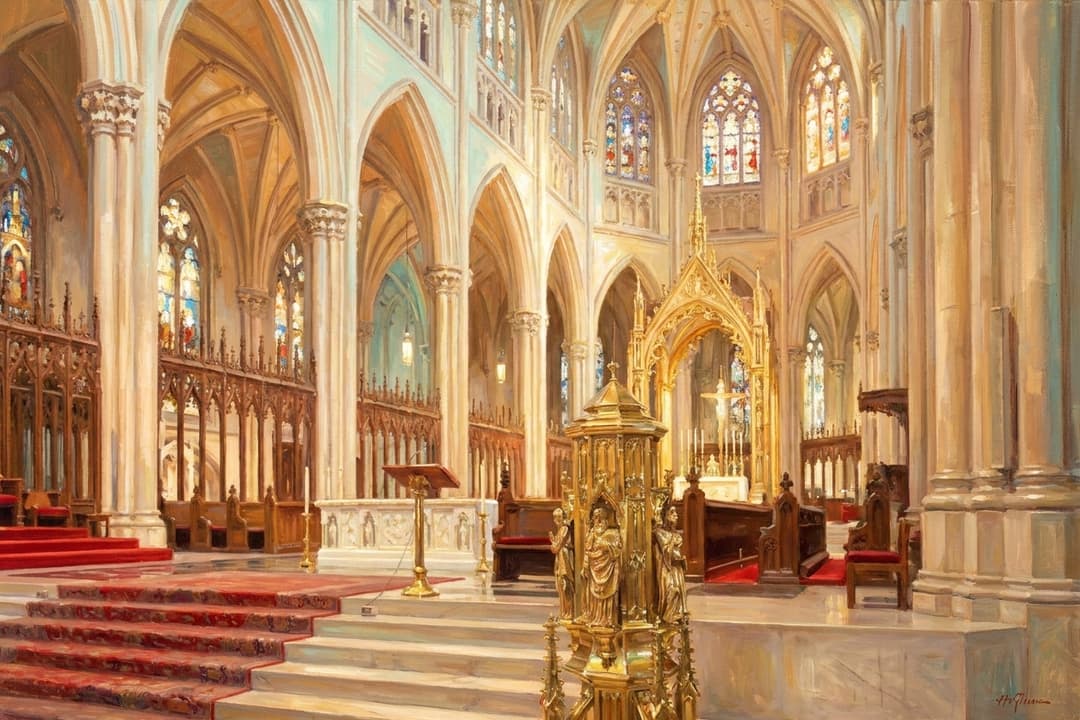
St. Patrick's Cathedral welcomes over five million visitors and pilgrims annually into its luminous sacred interior. Located directly opposite Rockefeller Center on Fifth Avenue, the sanctuary provides a peaceful haven from Manhattan's busy avenues.
Highlights
- Admire the 57-foot cast bronze baldachin canopy shielding the High Altar.
- Gaze upon the monumental 26-foot Great Rose Window above the gallery organ.
- Pray quietly before the larger-than-life Carrara marble Pietà sculpture.
Things to Know
- Modest attire is requested within this active Roman Catholic house of prayer.
- Sightseeing and photography are respectfully paused during sacred Masses.
Location
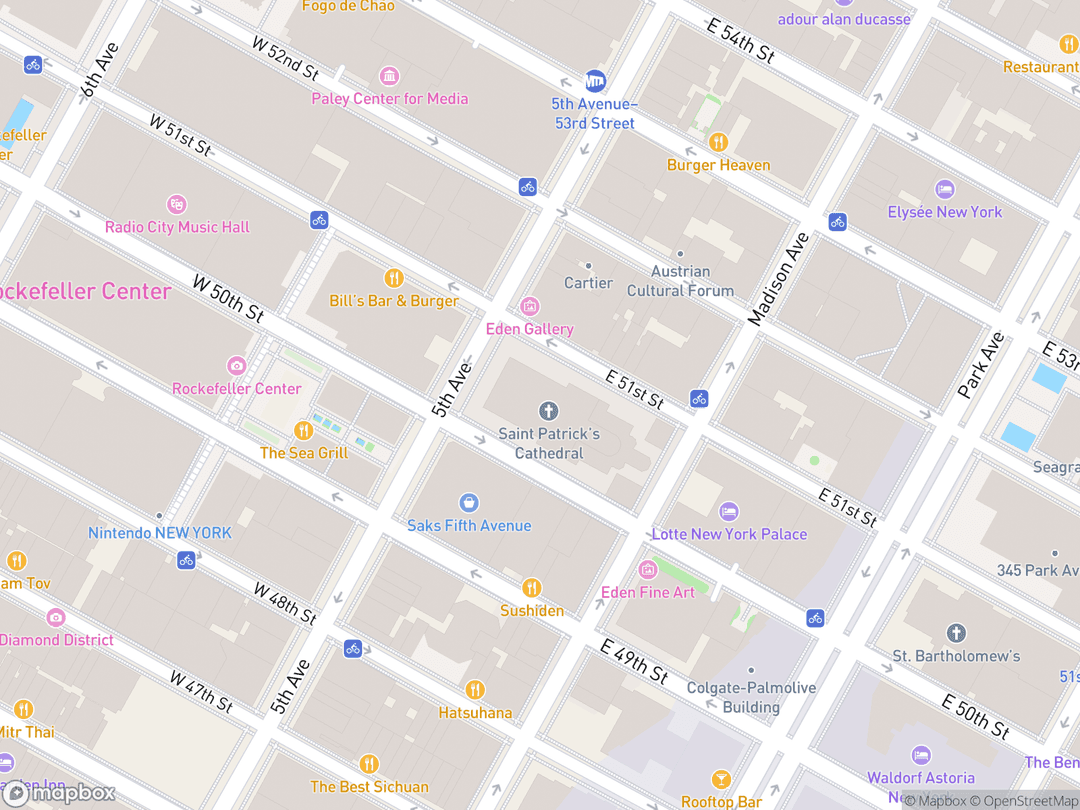
Fifth Avenue between 50th & 51st Streets, New York, NY 10022
Hours: Daily from 6:30 AM to 8:45 PM
Getting There: Take the B, D, F, or M subway trains to 47-50th Streets-Rockefeller Center station or the 6 train to 51st Street station.
Get DirectionsTips for Your Visit
Midday Sunlight
Visit in the mid-morning on weekdays to view sunlight illuminating the south clerestory stained glass.
Choral Mass
Attend the 10:15 AM Sunday Solemn Mass to hear the Cathedral Choir accompanied by the Great Kilgen Organs.
About
Rooted in the ancient Abrahamic sanctuary tradition, St. Patrick's Cathedral stands as a consecrated house of worship where heaven meets earth in the heart of midtown Manhattan. Conceived by Archbishop John Joseph Hughes, this sacred edifice reflects the biblical ideal of assembling the faithful to praise the One God while serving as an enduring spiritual monument.
As the metropolitan cathedral of the Roman Catholic Archdiocese of New York, it serves as the official seat of the archbishop. Its decorated Gothic architecture is oriented toward the High Altar and Eucharistic Tabernacle, embodying Catholic sacramental devotion, apostolic succession, and the vibrant heritage of immigrant laborers who financed its soaring towers.
Gallery
Symbolic Elements
The temple's exterior features intricate carvings, each rich with spiritual meaning:

Bronze Main Doors
Massive nine-ton portal doors sculpted by John Angel depicting key patron saints of New York and the Americas.

The High Altar Baldachin
A monumental 57-foot bronze canopy evoking the tabernacle tent of Exodus over the Eucharistic altar.

The Pietà
William Ordway Partridge's Carrara marble masterpiece illustrating Mary cradling Jesus in maternal sacrifice.

The Great Rose Window
A 26-foot stained-glass window by Charles Connick featuring the Lamb of God encircled by the Apostles.

Suspended Galeros
Traditional broad-brimmed red hats of deceased archbishops hanging above the choir as emblems of mortality.

Concealed Plaster Vaults
Ingenious lath-and-plaster ribbed vaults crafted to simulate stone without requiring outward flying buttresses.

Consecration Station Crosses
Twelve gilded Maltese crosses embedded into the nave piers marking where holy chrism oil was applied in 1910.
Interesting Facts
Archbishop Hughes funded the cathedral largely through small weekly contributions from impoverished Irish immigrant laborers (Tier A).
Cardinal John McCloskey, who dedicated the building in 1879, was the first Roman Catholic Cardinal in United States history (Tier A).
Venerable Pierre Toussaint, a formerly enslaved Haitian philanthropist, is the only layperson buried in the subterranean archbishop's crypt (Tier A).
The towering interior nave vaults are cleverly crafted from timber lath and plaster rather than heavy load-bearing stone (Tier B).
When its twin spires reached 330 feet in 1888, the cathedral stood as the tallest architectural structure in New York City (Tier B).
A subterranean geothermal network of ten deep wells was drilled into Manhattan bedrock to efficiently heat and cool the sanctuary (Tier B).
The Great Kilgen Organs comprise 7,855 pipes across 142 ranks and can be played simultaneously from a single master console (Tier A).
The master stained-glass clerestories were imported from legendary glass studios in Chartres, France, and Birmingham, England (Tier B).
Common Questions
Is St. Patrick's Cathedral open daily to tourists?
Yes, the cathedral is open daily from 6:30 AM to 8:45 PM for both prayer and quiet visiting.
Who was the architect of St. Patrick's Cathedral?
Renowned American architect James Renwick Jr. designed the cathedral in Decorated Gothic Revival style.
Why is the cathedral located so far uptown on Fifth Avenue?
Archbishop Hughes correctly anticipated that Manhattan's population would expand northward along the Fifth Avenue corridor.
Where is the Old St. Patrick's Cathedral located?
The original Basilica of Saint Patrick's Old Cathedral still stands in Lower Manhattan at Prince and Mott Streets.
Are guided tours available inside the cathedral?
Self-guided official audio tours and scheduled docent-led tours are available through the parish visitor center.
Featured Stories
Hughes' Folly and the Immigrant Faith
August 15, 1858
When Archbishop John Hughes unveiled plans for a grand cathedral in midtown Manhattan, skeptics mocked the venture as Hughes' Folly because the chosen parcel sat far north of the populated city. Undaunted, Hughes rallied thousands of impoverished Irish domestic servants and laborers, whose small weekly savings accounted for the vast majority of the cathedral's construction funds. Their sacrificial gifts turned remote countryside into America's most recognizable Catholic landmark.
Source: Archdiocese of New York Archives
The Venerable Pierre Toussaint
December 18, 1990
In a historic act of devotion, Cardinal John O'Connor arranged for the exhumation and reinterment of Pierre Toussaint into the archbishop's crypt beneath the High Altar. Born into slavery in Haiti, Toussaint became a celebrated New York hairdresser and generous benefactor to widows, orphans, and church projects across the city. He remains the only layperson buried alongside New York's cardinals and archbishops, recognized as Venerable by the Catholic Church.
Source: Archdiocese of New York Records
The Silent Spires of Fifth Avenue
October 1, 1888
When the cathedral's soaring twin spires were completed in October 1888, they rose 330 feet to become the tallest architectural structures across the entire New York skyline. Visible to ships navigating the Hudson River, the spires served as a towering beacon of welcome for waves of arriving immigrants. Although today dwarfed by modern commercial skyscrapers like Rockefeller Plaza, the spires continue to project spiritual elevation over the metropolis.
Source: Cathedral Archives
Timeline
Cathedral Project Announced
Archbishop John Hughes publicly announces plans to build a grand cathedral worthy of New York.
MilestoneCornerstone Laid
Archbishop Hughes lays the cathedral cornerstone before an assembled crowd of 100,000 citizens.
component.timeline.groundbreakingCivil War Halts Construction
Construction is suspended due to critical shortages of materials, funds, and labor during the Civil War.
EventConstruction Resumes
Archbishop John McCloskey directs the resumption of structural work on the marble walls.
MilestoneFormal Cathedral Dedication
Cardinal McCloskey presides over the grand dedication of the finished nave for regular divine worship.
DedicationTwin Spires Completed
The twin openwork spires along Fifth Avenue reach their full height of 330 feet.
MilestoneLady Chapel Opened
The French Gothic Lady Chapel designed by Charles Mathews opens behind the high altar ambulatory.
MilestoneSolemn Consecration
Archbishop John Farley consecrates the cathedral once all construction debts are completely liquidated.
DedicationSanctuary Baldachin Installed
The monumental 57-foot bronze baldachin designed by Maginnis & Walsh is installed over the High Altar.
RenovationNYC Landmark Designation
The New York City Landmarks Preservation Commission officially designates the complex an urban landmark.
MilestoneNational Historic Landmark
The cathedral is entered into the registry as a designated National Historic Landmark.
MilestonePapal Visit and Restoration Completion
Pope Francis leads evening prayer following the completion of a comprehensive $177 million restoration.
EventHistory by Decade
1850s — Vision and Cornerstone
We propose to erect a cathedral in the city of New York that may be worthy of our holy religion.
Archbishop John Hughes recognized that New York's growing Catholic community required a monumental house of worship. Architect James Renwick Jr. submitted Gothic Revival plans, and the cornerstone was laid on August 15, 1858, despite critics branding the uptown site Hughes' Folly.
1860s–1870s — Wartime Delay and Dedication
The Civil War halted construction from 1861 until 1865 under severe national strain. Under Archbishop John McCloskey, work resumed vigorously, culminating in the triumphant formal dedication of the nave on May 25, 1879.
1880s–1900s — Spires and the Lady Chapel
The cathedral took on its iconic silhouette with the completion of the 330-foot twin spires in October 1888. Architect Charles T. Mathews later designed the French Flamboyant Gothic Lady Chapel at the eastern apse, which opened in 1906.
1910s–1940s — Consecration and Modernization
With all construction mortgages paid in full, Archbishop John Farley solemnly consecrated the cathedral on October 5, 1910. The monumental Kilgen organs and the dramatic 57-foot bronze sanctuary baldachin were installed before mid-century.
1950s–1990s — Civic Milestones and Papal Visits
The cathedral became a global platform for historic papal visits by Pope Paul VI and Pope John Paul II. Sculptor John Angel's nine-ton bronze entrance doors were hung on Fifth Avenue, celebrating patron saints of America.
2000s–Present — Comprehensive Restoration
A three-year, $177 million conservation effort restored the Tuckahoe marble exterior, cleaned stained glass, and installed subterranean geothermal wells. Pope Francis celebrated evening prayer in 2015 inside the beautifully renewed landmark.
Architecture & Facilities
St. Patrick's Cathedral is the premier exemplar of Decorated Gothic Revival architecture in North America. Designed by James Renwick Jr., the edifice harmoniously blends French high-Gothic proportional symmetry inspired by Reims and Amiens with intricate English decorated tracery.
Building Materials
Tuckahoe Marble
Quarried in Westchester County, this crystalline dolomitic marble creates the cathedral's radiant white exterior walls.
Granite Footings
Subterranean foundational courses composed of native Maine and Blue Ridge granite anchor the plan into Manhattan schist.
Lath and Plaster Ribbed Vaults
Timber-framed lath and plaster ceiling vaults simulate carved Caen stone while eliminating horizontal thrust.
Cast Architectural Bronze
Heavy cast bronze composes the nine-ton Fifth Avenue entrance portals and the soaring sanctuary baldachin.
Interior Features
High Altar Sanctuary
Houses the white Italian marble sacrificial altar beneath a 57-foot bronze ciborium canopy.
The Lady Chapel
An intimate eastern apse chapel built in French Flamboyant Gothic style featuring stained glass by John Hardman.
Cathedral Crypt
A subterranean mortuary vault beneath the altar containing the tombs of New York archbishops and Pierre Toussaint.
Great Nave and Aisles
A soaring five-bay aisled hall rising 110 feet to the vault crown supported by clustered marble columns.
Temple Grounds
The cathedral occupies a full Manhattan city block bounded by Fifth and Madison Avenues between 50th and 51st Streets, featuring paved plazas and adjoining residential rectories.
Additional Facilities
Includes the historic Cardinal's Residence, Cathedral Rectory on Madison Avenue, a parish gift shop, and an innovative underground geothermal mechanical plant.
Religious Significance
Within Christian sacramental theology, St. Patrick's Cathedral serves as an earthly reflection of the New Jerusalem, dedicating sacred space entirely to the Holy Sacrifice of the Mass and the pastoral guidance of the faithful.
As the mother church of the Archdiocese of New York, the cathedral houses the cathedra of the archbishop, symbolizing continuous apostolic authority and pastoral unity.
Sacred Ordinances
The Holy Sacrifice of the Mass
The central Catholic liturgy celebrated daily where bread and wine become the Real Presence of Christ.
Sacrament of Reconciliation
Confession offered regularly for the forgiveness of sins and reconciliation with God and the Church.
Sacrament of Holy Orders
Solemn ordinations where bishops consecrate new priests and deacons to serve the archdiocese.
Solemn Evening Prayer (Vespers)
Liturgical evening prayer sung in community to mark sacred feasts and significant diocesan occasions.
The Cathedra and Apostolic Succession
The cathedra, or bishop's chair, represents the authentic teaching authority of the Archbishop of New York in communion with the Pope in Rome.
The Communion of Saints
Surrounding side chapels, saintly relics, and the subterranean crypt unite the prayers of the living faithful with holy souls throughout the ages.
Sources & Research
Every fact on Temples.org is backed by verified Sources & Research. Each piece of information is rated by source tier and confidence level.
View All Sources (10)
| Field | Source | Tier | Retrieved |
|---|---|---|---|
| About & Historical Background | St. Patrick's Cathedral (opens in a new tab) | A | 2026-03-31 |
| Diocesan History & Liturgical Schedule | Archdiocese of New York (opens in a new tab) | A | 2026-03-31 |
| Historical Development & Renwick Architecture | Seton Hall University (opens in a new tab) | B | 2026-03-31 |
| Landmark Designation & Architectural Analysis | NYC Landmarks Preservation Commission (opens in a new tab) | A | 2026-03-31 |
| Historical Records & Heritage Conservation | New York Landmarks Conservancy (opens in a new tab) | B | 2026-03-31 |
| Architectural Overview & Structural Milestones | Encyclopaedia Britannica (opens in a new tab) | B | 2026-03-31 |
| Construction History & Urban Context | History Hit (opens in a new tab) | C | 2026-03-31 |
| Cathedral Art, Crypt, & Architectural Features | Forbes (opens in a new tab) | C | 2026-03-31 |
| Visitor Details & Admissions | New York Tickets (opens in a new tab) | D | 2026-03-31 |
| Old Cathedral Historical Context | Basilica of St. Patrick's Old Cathedral (opens in a new tab) | A | 2026-03-31 |